
Public-source intelligence assessment | Published October 8, 2026 | Evidence reviewed through October 8, 2026
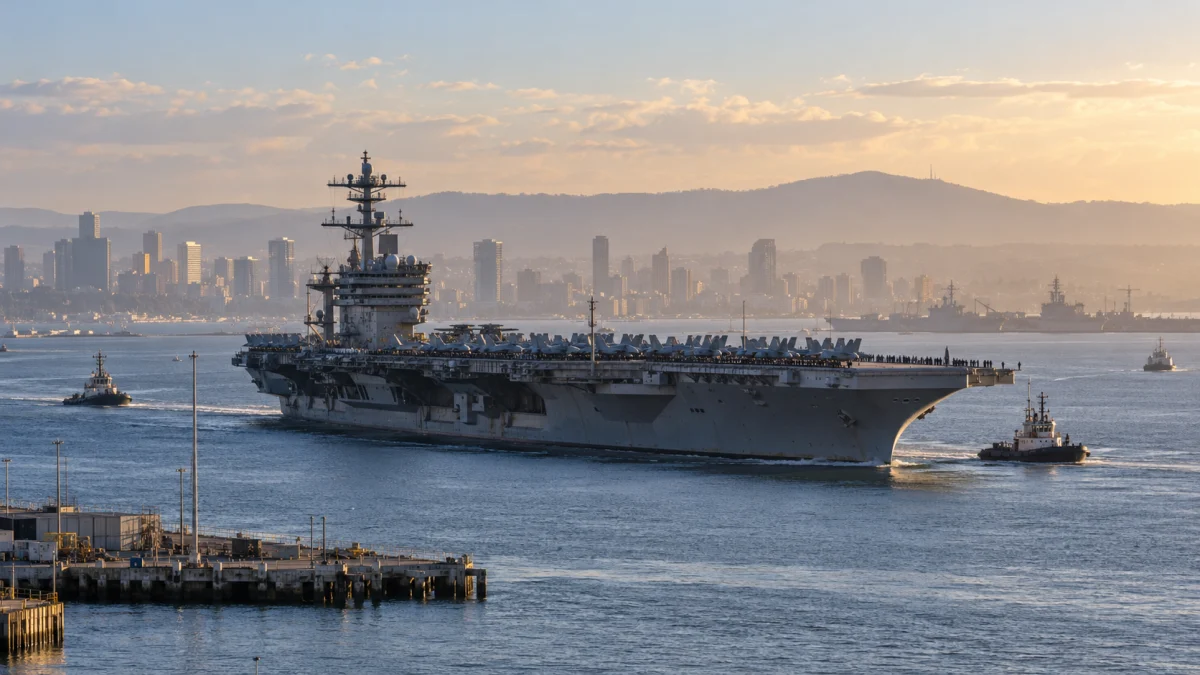
Bottom line: The nuclear-powered aircraft carrier USS Abraham Lincoln (CVN-72) returned to San Diego on October 8, 2026, after a 321-day deployment that began as an Indo-Pacific mission and was redirected to the Middle East. The carrier participated in U.S. combat operations against Iran, remained deployed through two extensions approved by Defense Secretary Pete Hegseth, and was relieved by USS George Washington in August. During the mission, the Navy acknowledged temporary resupply disruptions, reduced meal choices, piping failures and problems with desalination equipment. It separately disclosed eight suicide attempts across the carrier strike group, not necessarily aboard the carrier itself. The ship returned home with a Presidential Unit Citation, while significant questions about sailor welfare and the longer-term effects of the deployment remain unresolved. USNI News’s October 8 chronology, the Navy’s September 22 response to Congress, and Associated Press homecoming reporting establish the core record.
The deeper story is not simply that a ship spent an unusually long time at sea. It is that a combat-capable carrier strike group sustained major operations while depending on a supply network disrupted by war, managing substantial personnel movements and facing documented concerns from families and lawmakers. These facts should be assessed together, but they do not establish that the carrier lost combat readiness or that each reported hardship had the same cause.
Executive Assessment: Five Key Judgments
| Assessment | Confidence | Basis and limitation |
|---|---|---|
| Operational demands and two approved extensions explain the exceptional deployment length. | High | The ship’s documented reassignment, relief sequence and Hegseth’s acknowledgment of authorizing two extensions. Internal deliberations have not been made public. |
| Replenishment constraints and onboard engineering problems occurred. | High | Express admissions in the Navy’s September 22 letter, corroborated in part by logistics reporting and family accounts. The complete duration and severity of each disruption remain unknown. |
| The ship’s-company count fell by 294 between the Navy’s November and August reporting points. | High | The Navy supplied monthly onboard counts and cumulative gains/losses. This is a personnel count, not a measure of combat effectiveness or casualties. |
| Crew welfare concerns warrant independent evaluation, including the reported eight suicide attempts across the strike group. | High | The number comes directly from the Navy; lawmakers and journalists also collected reports of difficulties. Individual circumstances and a causal explanation are not public. |
| The deployment permanently damaged Lincoln’s combat capability or caused a quantifiable maintenance overrun. | Insufficient public evidence | The Navy says required readiness certifications were maintained. Ship-specific post-deployment maintenance and qualification records have not been publicly reconciled with the allegations. |
Scope: This is an assessment of public documents and attributed reporting, not a classified intelligence product, a medical review, or a claim to have independently interviewed Lincoln’s sailors. "High confidence" describes confidence that a reported event or documented statement occurred; it does not turn a military claim into an independently confirmed battlefield result.
The Deployment in Dates: How a Pacific Mission Became a 321-Day Assignment
Lincoln deployed from San Diego on November 21, 2025. Although it initially operated in the Indo-Pacific, the strike group moved into the Middle East in late January. The U.S.-Israeli campaign against Iran, known in U.S. military reporting as Operation Epic Fury, began on February 28. Lincoln remained in the region until its relief by USS George Washington (CVN-73) in August. Hegseth later confirmed that he had approved two extensions. USNI News reconstructed the movements and command decisions; the September Navy letter also confirms that George Washington relieved Lincoln.
| Date | Event | Public evidence |
|---|---|---|
| Nov. 21, 2025 | Lincoln departs San Diego for deployment. | USNI News, October 8 |
| Dec. 11, 2025 | The carrier makes a Guam port visit during its initial Indo-Pacific operations. | USNI News chronology |
| Late January 2026 | The strike group enters the U.S. Fifth Fleet/Central Command area after moving westward. | USNI News chronology |
| Feb. 28, 2026 | Operation Epic Fury begins. Lincoln’s strike group subsequently conducts combat operations. | Stars and Stripes, October 7 |
| August 2026 | Family complaints and journalism bring onboard conditions under scrutiny; lawmakers seek written explanations. | Congressional letter, August 15 |
| Aug. 22, 2026 | Lincoln leaves the Middle East after George Washington’s arrival and relief. | USNI News, August 22 |
| Sept. 2, 2026 | Lincoln visits Laem Chabang, Thailand, breaking its extraordinary interval without a port call. | Navy’s Thailand arrival release |
| Sept. 19, 2026 | The strike group makes a logistics stop in Guam. | USNI News chronology |
| Sept. 22, 2026 | Acting Navy Secretary Hung Cao signs his detailed response to Senator Kirsten Gillibrand. | Original four-page Navy letter |
| Sept. 27, 2026 | A bipartisan congressional delegation visits the ship. | Representative Sara Jacobs’s account |
| Oct. 7, 2026 | Hegseth announces the Presidential Unit Citation and publicly acknowledges authorizing two extensions. | Stars and Stripes; USNI News |
| Oct. 8, 2026 | Lincoln returns to Naval Air Station North Island in the San Diego area. | Associated Press |
Why do reports say 321 or 322 days deployed, 286 days at sea, and 264 or 265 days without a port call?
These figures describe different intervals and counting conventions, not necessarily contradictory voyages:
- 321 or 322 days deployed: Lincoln left San Diego on November 21, 2025, and returned on October 8, 2026. That is 321 elapsed days. USNI News uses 321; Stars and Stripes explicitly counts both the departure and arrival calendar days and therefore reports 322. This is a one-day convention difference.
- 286 days at sea before Thailand: A September 2 U.S. Navy port-arrival release says Lincoln’s deployment had included 286 days at sea by its first full port stop in Thailand. That wording refers to the longer deployment-to-date period; it should not automatically be read as 286 uninterrupted days without any port visit. The Navy separately documented a December 11, 2025, Guam port call.
- 264 or 265 consecutive days: This is the reported uninterrupted interval between the December Guam visit and the September Thailand visit. USNI News and the Associated Press use 265; The Guardian uses 264. Inclusive or exclusive counting may explain this one-day difference, but the public reports do not document a common counting methodology.
For consistency, this assessment uses 321 elapsed deployment days and describes the uninterrupted no-port interval as approximately 265 days. It preserves other source figures when evaluating what those sources actually claim.
The deployment was extraordinarily long by modern U.S. carrier standards. Lincoln’s previous deployment ended in December 2024 after approximately 162 days, according to USNI News’s fleet chronology. The 2026 deployment was almost twice that duration. USS Gerald R. Ford’s 326-day deployment, completed earlier in 2026, remained longer overall; Lincoln’s exceptionally long interval between port calls is a separate record. These comparisons concern deployment statistics, not an objective ranking of difficulty or combat intensity.
Why Did the USS Abraham Lincoln Stay Deployed So Long?
The strongest documented explanation is mission extension during wartime, followed by the time required to arrange relief and return the strike group home.
Lincoln was deployed to the Pacific but was redirected into Central Command’s area of operations before the February 28 launch of Operation Epic Fury. It then carried out strikes and other operations associated with the U.S. campaign against Iran. The strike group’s originally expected spring return did not happen; the Pentagon extended the assignment, ultimately dispatching George Washington to replace it. In an October 7 address aboard Lincoln, Hegseth acknowledged signing two extensions and said operational requirements drove the decision. This establishes the stated rationale and decision ownership, not the full internal planning process. USNI News’s reporting on Hegseth’s remarks and deployment sequence.
The Navy’s own response to Congress offers a narrower public explanation. It says decisions to extend deployments follow changing security requirements, while leaving specifics of the ship’s schedule classified. The response confirms relief had taken place, but it does not provide an itemized justification for every extra week at sea. Navy response, page 1.
A broader strategic question follows: What happens when a carrier expected to operate in the Indo-Pacific is reassigned to the Middle East for months? USNI News documented how diverting Lincoln, and later George Washington, affected the availability of carrier strike groups in the Indo-Pacific. That does not mean the U.S. Navy had no ships or aircraft in the region; a carrier strike group is a specific concentration of forces. The more defensible conclusion is that prolonged Middle East requirements placed competing demands on a limited number of deployable carriers. USNI News’s fleet review.
Assessment – high confidence: Wartime tasking and two approved extensions were central causes of the 321-day deployment. Open question: Whether different rotation, basing, or contingency choices could have shortened it cannot be established from the publicly available command decisions alone.
What Did the Lincoln Strike Group Actually Do in Combat?
A prolonged deployment is not proof that the Navy kept a carrier at sea without an operational purpose. In presenting the Presidential Unit Citation on October 7, Hegseth described extensive strike-group activity during Operation Epic Fury. The award covers February 28 through August 22, 2026, according to the publicly reported citation. Stars and Stripes’s account of the award and Associated Press’s award reporting.
| Measure | U.S. military-reported figure | What it does, and does not, establish |
|---|---|---|
| Combat sorties | 3,693 | Reported combat missions during the campaign; not the same measure as all aircraft flights during deployment. |
| Ordnance delivered | 1.37 million pounds | Claimed aggregate weapons weight; not an independently established measure of targets destroyed. |
| Tomahawk cruise missiles launched | 450 | A strike-group figure that includes actions by missile-equipped escort ships; not 450 launches from the carrier itself. |
| One-way attack drones shot down | 77 | U.S. military battle-result claim. |
| Anti-ship cruise missiles destroyed | 21 | U.S. military battle-result claim. |
| Iranian ships sunk | 64 | U.S. military battle-damage claim, not independently verified vessel-by-vessel in this assessment. |
Source and scope: These totals were presented during the October 7 Presidential Unit Citation announcement and reported by Associated Press, Stars and Stripes and USNI News. They should be described as military-reported totals unless individual records independently corroborate them.
The larger aviation total is also important. U.S. Navy figures relayed to KPBS describe more than 13,000 flights and approximately 28,500 flight hours by Carrier Air Wing Nine aircraft during the deployment. That is a broader category encompassing noncombat operations; it should not be conflated with the 3,693 combat sorties in the citation.
This distinction matters because raw totals are poor measures of readiness by themselves. The ability to conduct thousands of sorties indicates sustained aviation activity. It does not show how often particular aircraft were mission-capable, how exhausted individual personnel were, or how much maintenance was deferred. Those require different records.
Why Did a Nuclear-Powered Aircraft Carrier Experience Supply Problems?
The Lincoln’s nuclear reactors eliminate the need to refuel its propulsion plant frequently. They do not eliminate its reliance on fuel for aircraft, food for thousands of people, replacement parts, hygiene goods, medical items or ammunition. A carrier is a self-contained city in some respects, but it is not a self-sufficient supply chain.
A U.S. Navy explanation of replenishment operations aboard Lincoln distinguishes between connected replenishment, in which cargo or fuel passes between ships by equipment rigged across the gap, and vertical replenishment, in which helicopters move supplies. Both require coordination and functioning logistics ships. Loading cargo aboard the carrier is only the final step in obtaining, staging, transporting and scheduling those supplies.
The disrupted regional supply network
Independent military reporter Jeff Schogol found that Iranian attacks on logistics facilities in Bahrain and the United Arab Emirates complicated traditional supply routes supporting U.S. warships in the Gulf region. Naval logistics experts interviewed for Task & Purpose’s August 21 investigation explained that some supplies instead had to move from distant locations, including Diego Garcia and Singapore. That increased distances and complicated replenishment scheduling. Those experts’ analysis is a credible causal explanation; it is not a ship-by-ship accounting of every item that failed to arrive.
The same investigation explained why aircraft deliveries could not automatically make up the difference. A supply flight has finite payload capacity, and both aircraft range and the carrier’s distance from secure shore facilities limit how much can be moved quickly. The carrier also had to operate within a combat environment. Task & Purpose’s logistics reporting.
What does 72 replenishments at sea actually tell us?
According to Navy-provided figures reported by KPBS, Lincoln conducted 72 replenishments-at-sea during the deployment. That is substantial activity, but it does not mean that every scheduled delivery occurred on time or that every category of supplies was available in the quantities requested. A ship may receive aviation fuel and still be short of particular fresh foods, replacement parts or hygiene items.
The Navy’s September 22 letter adds a crucial admission: high operating tempo and sea conditions occasionally delayed scheduled replenishment events. It said the Navy prioritized hygiene items, fresh provisions and critical repair parts, and imposed a weekly distribution rotation once goods were restocked. Navy response, page 3.
Assessment – high confidence: The ship was being replenished, but some replenishments were delayed and some categories of goods were constrained. These propositions are compatible. What remains unknown is the full inventory history: planned deliveries, actual delivery dates, missed quantities and the number of days individual shortages lasted.
Food, Water, Plumbing and Medical Supplies: What Is Verified?
The best available primary document is Acting Navy Secretary Hung Cao’s September 22, 2026, letter to Senator Kirsten Gillibrand. It directly answers a set of questions raised in the August 15 congressional inquiry. It should be read as the Navy’s official account, not as an independent inspection report.
The Navy made several specific disclosures:
- Food: For a short period, regular meal hours offered one main entree instead of two. The Navy said four meal periods continued daily, with adequate calories and nutritionally balanced meals.
- Hygiene goods: Replenishment interruptions affected scheduling and distribution. The Navy said supplies of essential items were stable by the date of its response.
- Piping and water-making equipment: Earlier in the deployment, the carrier experienced localized piping failures and temporary problems with its reverse-osmosis desalination units. The Navy said repairs had been completed and potable water remained safe and tested daily.
- Medical supply inventory: The Navy reported no medical supply issues and said onboard medical personnel could meet routine and emergency needs.
All four positions appear in the Navy response, pages 2-3. The first three include acknowledgments of disruptions or mechanical faults; the fourth is an assurance not accompanied by a publicly released inventory audit.
These statements must be compared with reporting from other channels. Associated Press interviewed families who described worrying about the ship’s food, showers and hardships, including accounts relayed by sailors. Representative Sara Jacobs said that during a September 27 onboard visit she heard firsthand accounts of difficulty washing clothes, obtaining medicine and medical care, and getting enough food. Her observation is significant because she visited the ship, but her statement is still an attributed account rather than a released inventory or medical-treatment dataset. Associated Press homecoming reporting; Jacobs’s September 27 statement.
Claim-by-claim evidence ledger
| Question | Evidence currently available | Most defensible finding | Missing record |
|---|---|---|---|
| Were food options reduced? | Navy response, p. 3 | Confirmed by the Navy. One fewer entree for a period. | Dates, menus, inventories, galley inspection logs. |
| Did the ship stop providing meals? | Navy states four meal periods daily; individual and family accounts describe hardship. | Not established. Reduced choice is not proof that daily meal service stopped. | Daily meal service and consumption records. |
| Did replenishment operations face delays? | Navy response, p. 3; independent logistics reporting. | Confirmed by the Navy. | Scheduled versus completed replenishment records and cargo manifests. |
| Were there plumbing and water-making problems? | Navy response, p. 3. | Confirmed, described as localized/temporary by the Navy. | Detailed engineering fault and repair logs. |
| Was drinking water contaminated? | Reported concern; Navy says supply safe and tested daily. | Not independently established. Equipment faults alone do not prove unsafe drinking water. | Water-testing history and incident reports. |
| Were essential medicines unavailable? | Navy denies a supply failure; Jacobs says sailors described difficulty obtaining medicine and care. | Disputed or unresolved at the individual-service level. | Medical logistics and access-to-care records, privacy protected. |
| Was combat readiness lost because of these problems? | Navy says readiness certifications remained in effect. | Not established by the public record. | Readiness, maintenance, training and qualified-watchstander data. |
The important distinction is between an admission of a problem, an assurance that it was remedied, and independent verification. The September letter provides the first two for several issues but does not supply enough underlying records for the third.
The Crew Data: A 294-Person Net Reduction, Explained Correctly
A seldom-discussed part of the Navy’s congressional response is a ten-month ship’s-company personnel table. This is one area where the public document allows readers to reproduce a quantitative finding rather than rely on a headline.
The table below transcribes the figures on page 2 of the Navy’s September 22 letter:
| Reporting month | Sailors onboard (ship’s company) | Gains during month | Losses during month | Net monthly change |
|---|---|---|---|---|
| Nov. 2025 | 2,879 | — | — | — |
| Dec. 2025 | 2,889 | 61 | 51 | +10 |
| Jan. 2026 | 2,827 | 31 | 93 | -62 |
| Feb. 2026 | 2,779 | 27 | 75 | -48 |
| Mar. 2026 | 2,720 | 18 | 77 | -59 |
| Apr. 2026 | 2,687 | 5 | 38 | -33 |
| May 2026 | 2,687 | 0 | 0 | 0 |
| Jun. 2026 | 2,703 | 65 | 49 | +16 |
| Jul. 2026 | 2,624 | 29 | 108 | -79 |
| Aug. 2026 | 2,585 | 40 | 79 | -39 |
| Period total | -294 net | 276 | 570 | -294 |
Methodology: The last column is calculated as monthly gains minus monthly losses. Across December-August, 276 additions minus 570 departures = -294. The published onboard count also declines from 2,879 to 2,585, a 10.2% net reduction relative to November. The Navy separately describes gross departures as 19.8% and additions as 9.59% relative to the starting ship’s-company count. This arithmetic reconciles with the original table.
A number such as 570 departures can easily be sensationalized. That would be a mistake. It does not mean 570 people died, deserted, quit the Navy, or were evacuated because conditions became intolerable. Administrative departures may involve transfers, personnel rotations, medical movements and other ordinary or extraordinary reasons. The document does not separate the categories. Nor should the ship’s-company count be confused with the larger complement that includes its embarked air wing, Marines and other elements of the strike group.
July registered the largest net monthly drop in the table (79), but the data do not explain why. They also stop in August; they are not a verified October 8 staffing count.
Does a 10.2% headcount decline prove reduced readiness?
No. Readiness depends on the specialties, qualifications, billet requirements, shifts and replacement timing behind the headline count. Removing one qualified technician from a narrow specialty may matter more than numerous routine administrative rotations; conversely, a changing count can coexist with adequate staffing if qualified replacements and revised requirements maintain coverage.
Cao’s letter says Lincoln and Carrier Air Wing Nine (CVW-9) retained their deployment certifications and required levels of readiness. It does not publish the ship’s full required-versus-filled billet breakdown. Independent verification would require at least: authorized billets, actual assigned personnel, critical qualifications, temporary attachments, reasons for departures, and operational or maintenance consequences. Navy response, page 2.
There is a sound institutional reason to ask for that comparison. In an earlier Government Accountability Office investigation of Navy crewing, GAO found that comparing personnel against funded positions rather than operational requirements had historically understated fleet-wide shortfalls. That is background on how to measure readiness, not evidence that Lincoln suffered a comparable shortfall in 2026. It reinforces the need to know the denominator before interpreting the observed headcount decline.
Assessment – high confidence: The personnel total fell substantially and the arithmetic is reproducible. Assessment – insufficient evidence: That fall, by itself, demonstrates an unsafe manning level or a loss of combat capability.
Eight Suicide Attempts: What the Navy’s Statement Does and Does Not Say
The most serious personal-welfare disclosure in the Navy’s letter appears in its answer to Question 5. The department reported eight suicide attempts across the entire Abraham Lincoln carrier strike group since the deployment began. Its stated population included personnel aboard the carrier, the air wing, embarked staffs and accompanying destroyers. The Navy also reported no completed suicides aboard Lincoln during the deployment. Navy response, page 2; Gillibrand’s publication of the disclosure.
This is not a finding that eight sailors attempted suicide aboard the aircraft carrier itself. It is also not a reliable basis for calculating a comparative suicide-attempt rate without knowing the precise population, observation period, case definitions and appropriate comparison data.
The same letter describes two separate overboard-related events. In March, it says a sailor was stopped by shipmates while attempting to go overboard and received care before returning to homeport. In early August, it reports that an air-wing sailor went overboard, was promptly recovered, received medical care and was transferred off the ship. The letter does not specify that the August incident was a suicide attempt, and it would be wrong to categorize it as such from the overboard description alone. Navy response, page 4.
The Navy said Lincoln deployed with five chaplains, an embedded prevention counselor, a psychologist, a clinical social worker, three behavioral-health technicians and a facility dog. That describes resources assigned, not whether every service member obtained adequate, private and timely support. Navy response, page 2.
Deployment extensions, combat exposure, limited shore leave and disrupted family contact are relevant potential stressors. They should not be presented as a medically proven explanation for any individual’s crisis on the basis of aggregate counts. The people behind these incidents should not be reduced to a political talking point or a statistic detached from the circumstances that need investigation.
Independent oversight should establish, while protecting individual privacy, how incidents were classified, whether access to support was adequate, what recurring problems were reported by medical personnel, and what changes the Navy makes for future deployments.
Were the Navy’s Readiness Assurances Consistent With the Hardship Reports?
They can be, and neither proposition resolves the other. A warship may continue conducting combat operations despite serious quality-of-life problems. Equally, credible descriptions of fatigue and poor conditions do not establish that the flight deck, engineering plant or air wing stopped meeting operational requirements.
The Navy’s September letter asserted that the carrier and air wing maintained required readiness certifications. It also claimed that a review of mishap records through that period identified no Class A or Class B major mishaps and no elevated mishap rate relative to other carriers. Those are official representations; the underlying comparison and incident logs were not attached. Navy response, pages 2 and 4.
Meanwhile, Associated Press interviews with families and Representative Jacobs’s account of her onboard conversations describe hardship involving food, hygiene, family separation and access to services. These accounts do not directly measure aircraft readiness, but they raise separate questions about crew welfare and oversight.
That is the analytical distinction missing from some public debate: mission completion is evidence of operational performance, but not a comprehensive audit of the conditions under which the mission was completed. Likewise, mistreatment or under-resourcing should be established with documents and testimony rather than inferred simply from a long deployment.
How Does the 2026 Deployment Compare With Lincoln’s 2024 Mission?
There is a useful, if imperfect, historical baseline. An official U.S. Third Fleet account of Lincoln’s 2024 return documents more than 9,000 sorties, about 21,000 flight hours, 28 replenishments at sea and more than 78,000 nautical miles traveled during the preceding deployment. USNI News characterizes that deployment as lasting 162 days.
| Reported metric | 2024 deployment | 2025-26 deployment | Important caveat |
|---|---|---|---|
| Deployment duration | 162 days | 321 days | Different missions and operational environments. |
| Aviation sorties | More than 9,000 | More than 13,000 | The 2024 release describes strike-group activity; the 2026 figure is attributed to Carrier Air Wing Nine. Reporting scopes may differ. |
| Aviation flight hours | Approximately 21,000 | Approximately 28,500 | The reporting scope and mission mix may differ between the two releases. |
| Replenishments at sea | 28 | 72 | The 2024 release speaks about the strike group, while the 2026 tally is attributed to the carrier crew. These may not be identical accounting units. |
Sources: U.S. Third Fleet’s 2024 after-deployment release; USNI News’s October 2026 chronology; 2026 Navy figures reported by KPBS.
The 2026 mission lasted roughly twice as long. Both official reports also show high aviation and replenishment activity. But the 2024 source summarizes carrier-strike-group totals, while the 2026 report identifies Carrier Air Wing Nine flights and the carrier crew’s replenishments. In particular, the 28 and 72 replenishment counts should not be treated as a standardized ship-for-ship comparison or divided into rates without validating their accounting scope. Nor do the aviation figures prove that 2026 was twice as dangerous or that flight crews became less productive. Those conclusions require comparable definitions, combat-day denominators, aircraft availability, mission profiles and operating conditions not established here.
What can be said more firmly is that unusually extended deployments create a risk of pressuring the Navy’s broader maintenance and training cycle. A 2016 Government Accountability Office assessment of the Optimized Fleet Response Plan described how longer deployments and deferred maintenance had previously affected fleet condition, training availability and repair schedules. The report predates Lincoln’s deployment by a decade; it identifies a known systemic risk, not proof of a particular 2026 defect on Lincoln.
A second GAO assessment of Navy fatigue and crewing found substantial fleet-wide problems with sleep and staffing and documented evolving Navy policies. Its findings should likewise be used as institutional context, not treated as a survey of Lincoln’s crew.
Open question: What maintenance work, costs or delays, if any, did Lincoln accumulate because it remained deployed beyond the original schedule? Public information reviewed for this assessment does not support an independent dollar figure or a definitive ship-specific readiness finding.
Congress Asked 12 Questions. Which Answers Can the Public Test?
A group of senators sent 12 questions to Defense Secretary Pete Hegseth on August 15. Cao’s September 22 response addressed the subjects, but not every answer was accompanied by detailed supporting records.
| Congressional subject | Navy’s public response | What an independent investigation still needs |
|---|---|---|
| Why extended and when relieved? | Cites security demands and confirms relief by George Washington; keeps some schedule details classified. | Declassified decision chronology, if release is feasible, and force-availability context. |
| Personnel moved onto/off ship? | Provides month-by-month gains, losses and counts. | Departure reasons, occupational specialties and billet requirements. |
| Operational capability degraded? | Says certifications and required readiness maintained. | Appropriate readiness metrics and maintenance documentation. |
| Mental-health resources and attempts? | Lists resources and acknowledges eight strike-group suicide attempts. | Privacy-protected case accounting, trends and access-to-care measures. |
| Food, water, hygiene and plumbing? | Acknowledges specified short-term issues; states repairs and resupply adjustments worked. | Menus, inventories, delivery logs, water tests and fault reports. |
| Overboard incidents and other mishaps? | Describes March and August events and asserts no major mishaps in reviewed records. | Independent record review and clarified case classifications. |
| Communication with families? | Describes town halls, ombudsmen and family-readiness support. | Frequency and timeliness of notifications; independently collected family experience. |
| Congressional inspection? | Agreed to facilitate a bipartisan visit. | Follow-up findings and any written corrective-action commitments. |
The congressional record did not end with the letter. On September 27, Jacobs joined a bipartisan ship visit, then called for an inspector-general inquiry and further hearings. Senators Chris Coons and Patty Murray separately urged an independent strategic review of extended deployments and their readiness consequences. Gillibrand and Representative Brad Schneider sought hearings following the mental-health disclosure.
These are requests for oversight. They should not be described as completed inspector-general findings, substantiated misconduct determinations or an established official finding that military leadership caused particular injuries. The documentary question is whether investigators subsequently obtain records capable of confirming or rebutting the reported conditions.
Final Assessment: What the Lincoln Deployment Establishes
The USS Abraham Lincoln’s return on October 8 marks the end of an exceptional deployment. It also leaves a body of evidence that is neither a simple military triumph story nor a proven narrative of institutional collapse.
The verified operational chronology establishes that the carrier was reassigned from the Indo-Pacific, operated in the Iran campaign, was extended twice and received relief before coming home. The Navy’s own letter establishes that some logistical and engineering disruptions occurred and that the wider strike group recorded eight suicide attempts. Its personnel table establishes a net reduction of 294 in ship’s company between the November and August figures. These findings can be documented without exaggeration.
The U.S. military’s battle-result figures and readiness assurances are more properly described as official claims unless matched with underlying independent records. Family testimony and congressional eyewitness accounts are relevant evidence of hardship, but they do not automatically establish the condition of every compartment, every medical encounter or the carrier’s total combat capability.
The most consequential unresolved question is therefore not whether Lincoln completed its mission. It did. It is whether the Navy’s processes for staffing, resupply, maintenance and support can withstand similarly prolonged wartime requirements without avoidable harm to service members or future fleet availability. Answering that requires records that go beyond the award citation and beyond the most alarming personal accounts.
Indicators to monitor: Release of any formal inspector-general or independent review; additional congressional responses and hearings; verified post-deployment maintenance scope and schedule; anonymized specialty-level personnel and care-access data; and a documented lessons-learned account of wartime logistics disruptions.
Methodology and Evidence Standards
This assessment was prepared from public U.S. Navy statements, the Navy’s signed four-page September 22 response to Congress, lawmakers’ published correspondence, government oversight studies and attributed independent journalism available by October 8, 2026. It distinguishes:
- Documented fact: An event or figure directly supported by an identifiable record, such as the personnel counts printed in the Navy’s letter.
- Official claim: An assertion by a government or military official, including assessments of battle damage, safety, sufficiency or readiness, which may not be independently auditable from published data.
- Corroborated report: Credible independent reporting or testimony that adds evidence but may not settle every specific allegation.
- Analytical inference: A conclusion supported by the pattern of evidence but not directly established by a single record.
- Unknown: A matter for which publicly available evidence is insufficient.
Original calculation: The change in ship’s-company count is reproduced from the Navy’s monthly table using the straightforward equation ending onboard count = starting count + gains – losses. The resulting -294 and approximately -10.2% change refer to that documented ship’s-company dataset only; the numbers are not death counts, estimates of resignations or evidence of a failed readiness certification.
This report does not reproduce classified operational details, infer hidden routes from open-source ship tracking, or identify individuals connected with sensitive medical events. Publication of official or military-reported figures is not an endorsement of every inference drawn from them.
References and Further Reading
Primary Navy and Congressional Records
- Department of the Navy: Acting Secretary Hung Cao’s September 22, 2026, response to Senator Kirsten Gillibrand. Four-page primary record. Page 2 contains the ship’s-company personnel table and the eight-attempt strike-group disclosure; pages 3-4 address supplies, engineering faults, mishaps, overboard incidents and family outreach.
- U.S. senators’ August 15, 2026, letter to Defense Secretary Pete Hegseth. The original 12-question oversight request; identifies concerns that prompted the Navy response. The senators’ allegations and interpretations are not treated as adjudicated findings.
- Naval Air Force, U.S. Pacific Fleet: Abraham Lincoln Carrier Strike Group Arrives in Thailand. September 2, 2026, official port-arrival statement documenting the end of the lengthy uninterrupted at-sea interval.
- U.S. Third Fleet: Abraham Lincoln Carrier Strike Group Returns to San Diego After 3rd, 5th and 7th Fleet Deployment. December 2024 official deployment results, including aircraft and replenishment figures used in the historical comparison.
- U.S. Navy: Lincoln Supply Department Performs During Replenishments-at-Sea. Navy technical explanation of how connected and vertical replenishment supply a carrier. This is background on the mechanism, not direct evidence of the 2026 shortage timeline.
- Representative Sara Jacobs: In-Person Oversight of USS Abraham Lincoln. September 27, 2026, statement after the bipartisan ship visit, reporting sailor conversations and requested follow-up oversight.
- Senators Coons and Murray: Call for Independent Review of Extended Deployments. August 31, 2026, oversight proposal relating to Lincoln, Gerald R. Ford and fleet readiness.
- Senator Gillibrand and Representative Schneider: Call for Hearings After Navy Disclosure. September 25, 2026, confirmation of the Navy letter’s provenance and the resulting congressional demand.
Independent Reporting and Operational Context
- Heather Mongilio, USNI News: Abraham Lincoln Carrier Strike Group Returns to San Diego After Nearly 11 Months. October 8, 2026. Specialist reconstruction of deployment chronology, carrier relief, the record interval without port calls and the two extensions.
- Julie Watson and John Seewer, Associated Press: The Long-Deployed USS Lincoln Returns Home to San Diego Bay. October 8, 2026. Homecoming and independent family interviews, plus the Navy’s response and reported operational figures.
- Jeff Schogol, Task & Purpose: How a Navy Aircraft Carrier Ended Up Short on Food in a War Zone. August 21, 2026. Reporting on disrupted Gulf logistics infrastructure, the resulting supply distances and expert explanations of ship-to-ship and aircraft resupply limitations.
- Alison Bath, Stars and Stripes: Lincoln Carrier Strike Group Receives Presidential Unit Citation. October 7, 2026. Hegseth’s award presentation and attributed military combat totals.
- Alison Bath, Stars and Stripes: USS Abraham Lincoln Returns Home After 322-Day Deployment. October 8, 2026. Eyewitness homecoming account that explicitly includes the arrival calendar day in the deployment total; useful for reconciling 321 versus 322.
- Andrew Dyer, KPBS: USS Abraham Lincoln Carrier Will Return to San Diego Area Thursday. October 5, 2026. Navy-provided aviation, replenishment and meal figures used to distinguish broad operational activity from specific shortages.
- Sam LaGrone, USNI News: USS Abraham Lincoln Leaves the Middle East After Almost Seven Months. August 22, 2026. Independent confirmation of the strike group’s exit from the theater after relief.
Readiness and Personnel Research
- U.S. Government Accountability Office, GAO-16-466R: Military Readiness – Progress and Challenges in Implementing the Navy’s Optimized Fleet Response Plan. May 2016. Fleet-wide context on long deployments, maintenance capacity, predictability and training cycles. Not a Lincoln-specific 2026 inspection.
- U.S. Government Accountability Office, GAO-21-366: Navy Readiness – Additional Efforts Are Needed to Manage Fatigue, Reduce Crewing Shortfalls, and Implement Training. May 2021, with updated recommendation statuses. Explains why required billets and actual crew workload matter more than unqualified headcount comparisons.
Editorial currency note: This report is a snapshot of evidence available on October 8, 2026. Some military figures, crew records, congressional findings and maintenance plans may be revised or supplemented. Future updates should be dated, identify what changed, and retain the original source record.