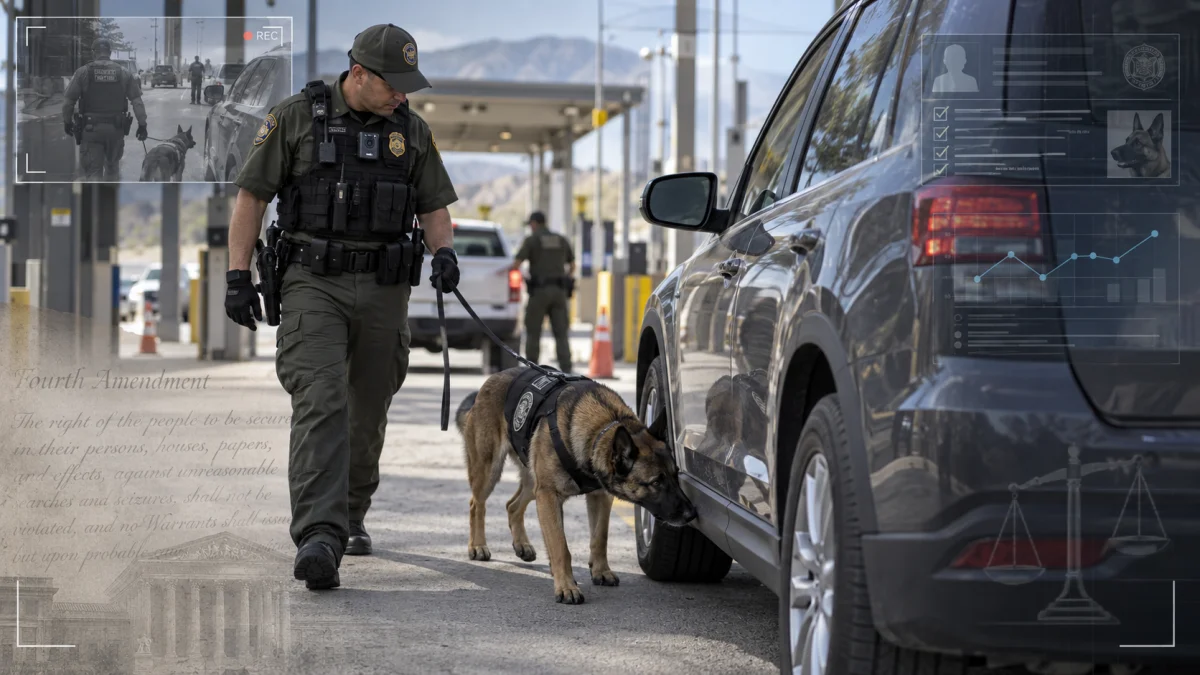
A trained narcotics dog can have extraordinary legal consequences.
During a lawful traffic stop, an exterior dog sniff may occur without separate suspicion so long as the sniff does not prolong the stop. If a sufficiently reliable dog alerts, that alert can help establish probable cause to search the vehicle without a warrant. The Supreme Court has also said that courts may rely heavily on controlled training and certification when deciding whether a dog is reliable. (Illinois v. Caballes; Florida v. Harris)
That combination creates an accountability problem that is easy to state:
If a government K-9 team’s alert is important enough to help authorize an intrusive search, the government should be able to show how that team actually performs and what happens when its alerts repeatedly fail to lead to the target odor it was trained to detect.
That does not mean every search that finds no drugs proves the dog made a mistake. The Supreme Court has specifically explained why that inference can be wrong: a dog may detect residual odor, a quantity too small to locate, or drugs that are concealed well enough to escape the subsequent search. (Florida v. Harris)
But the opposite conclusion does not follow either. An agency cannot logically say that a dog’s field record is too imperfect to prove an individual false alert and then use that uncertainty as a reason not to record the field record at all.
Those are different questions.
Probable cause is a legal judgment made before or during a search. Accountability is the systematic measurement of what happens afterward.
The Constitution sets the minimum rule for whether evidence may be searched for. It does not prevent agencies, legislatures, courts, or professional standards bodies from imposing stronger quality-control requirements on a tool that can materially affect Fourth Amendment rights.
And importantly, the detection-dog standards community has already recognized the value of recording unsuccessful field outcomes. Older federal SWGDOG narcotics guidance expressly called for deployment and seizure records to include non-productive responses, meaning alerts where no detectable or seizable amount of narcotics was found. (NIST-hosted SWGDOG substance detector guidance)
The hard question is not whether to keep records.
It is what to do with them.
The legal rule is narrower than many people think
The first mistake in this debate is treating every K-9 encounter as legally identical.
It is not.
A municipal police officer on an interstate, a Border Patrol agent at an interior immigration checkpoint, a customs officer at an international port of entry, and an officer bringing a dog to the front porch of a home are operating under different Fourth Amendment rules.
During an ordinary traffic stop
In Illinois v. Caballes, the Supreme Court held that using a properly trained narcotics dog to sniff the exterior of a vehicle during an otherwise lawful traffic stop generally does not itself violate the Fourth Amendment.
But that rule does not give police unlimited time to wait for a dog.
In Rodriguez v. United States, the Court held that officers may not extend a completed traffic stop merely to conduct a dog sniff unless they have independent reasonable suspicion justifying the continued detention. The critical question is whether the sniff adds time to the stop, not whether it happens before or after the officer physically hands over the ticket.
That distinction matters whenever a driver refuses consent and police decide to bring in a K-9.
A home is different
In Florida v. Jardines, officers brought a drug-detection dog onto the front porch of a home to investigate what was inside. The Supreme Court held that the canine investigation itself was a Fourth Amendment search.
The familiar rule allowing a dog to walk around a lawfully stopped vehicle therefore cannot simply be transplanted to the curtilage of a home.
Interior Border Patrol checkpoints are also different
At a fixed immigration checkpoint away from the actual border, the Supreme Court permits brief suspicionless stops for immigration-related questioning. That rule comes from United States v. Martinez-Fuerte.
But the Court separately held in United States v. Ortiz that Border Patrol officers at an interior checkpoint may not search a private vehicle without consent or probable cause merely because the vehicle is passing through the checkpoint.
Border Patrol has long used canine teams during checkpoint operations, and in congressional testimony the agency described an alert by a Border Patrol canine as a basis for probable cause to search. (2016 congressional hearing record)
That makes K-9 reliability especially consequential at inland checkpoints: the immigration stop itself may be lawful without individualized suspicion, while the dog alert can become the event that changes the encounter into a full vehicle search.
The "100-mile border zone" does not erase the Fourth Amendment
Federal regulation currently defines the immigration-law term reasonable distance as generally within 100 air miles of an external U.S. boundary. (8 C.F.R. § 287.1)
That does not mean every vehicle within 100 miles of a border can constitutionally be searched without cause.
The Supreme Court rejected that theory decades ago in Almeida-Sanchez v. United States. A statute or regulation defining immigration-enforcement authority does not override the Fourth Amendment.
That point is worth making explicitly because the phrase "100-mile border zone" is frequently misunderstood online as if it creates a Constitution-free strip around the country. It does not.
At the actual international border, the government has much broader search power
A port of entry or the functional equivalent of the border is a different legal environment.
In United States v. Flores-Montano, the Supreme Court held that customs officials did not need reasonable suspicion to remove and disassemble a vehicle’s fuel tank during a border search. The Court emphasized the government’s longstanding and unusually broad authority to conduct routine border searches without a warrant or probable cause.
So a K-9 alert at the actual international border does not play the same constitutional gatekeeping role it can play during an ordinary domestic traffic stop or at an inland immigration checkpoint.
That distinction is critical when discussing CBP, Border Patrol, customs inspections, and other federal operations. They cannot responsibly be collapsed into a single legal category.
Police also cannot create a general drug checkpoint just because dogs are available
There is another Supreme Court case that belongs in any serious discussion of K-9 search power.
In City of Indianapolis v. Edmond, Indianapolis established checkpoints whose primary purpose was narcotics interdiction. Officers stopped motorists without individualized suspicion and walked drug dogs around the vehicles.
The Supreme Court held the program unconstitutional because its primary purpose was ordinary crime control.
The Court distinguished those narcotics roadblocks from fixed immigration checkpoints and sobriety checkpoints, which serve narrower purposes the Court had previously recognized.
That ruling matters because it shows the constitutional line is not simply "a dog sniff is not a search, therefore anything involving a dog is allowed."
The legality of the encounter still depends on why the person was seized, how long the seizure lasted, where the sniff occurred, and what authority justified the encounter in the first place.
What does a drug-dog alert actually prove?
Not as much as the phrase sometimes suggests.
A dog does not tell police:
There are 300 grams of cocaine beneath the rear seat.
A trained detection dog reacts to an odor it has been conditioned to recognize. The handler then interprets the dog’s behavior and decides whether the team has produced an alert or final response sufficient to act upon.
That distinction is important because the relevant instrument is not merely the animal’s nose.
It is the dog-handler team.
The Supreme Court acknowledged this directly in Florida v. Harris. Even when a dog is generally reliable, the Court said circumstances surrounding a particular alert can undermine probable cause, including the possibility that a handler consciously or unconsciously cued the dog. (Florida v. Harris)
That is one reason an accountability system should preserve evidence of what the dog actually did, not merely the officer’s later statement that "the dog alerted."
Why "nothing found" is not automatically a false positive
This is the most important scientific correction to the bluntest version of the reform argument.
Suppose a dog alerts to a vehicle. Officers search it thoroughly and recover none of the substances the dog is trained to detect.
It is tempting to record that as a false positive.
But Florida v. Harris explains why that label is not always justified. The Court noted several possibilities:
- the dog detected residual odor from drugs that were previously present;
- the target substance was present in too small a quantity for officers to locate;
- the substance was concealed well enough to escape the search.
Field records have another limitation: false negatives are usually invisible. If a dog does not alert, police normally do not perform a full search simply to discover whether the dog missed something.
For that reason, the Court considered controlled testing a cleaner way to measure canine reliability than raw field "hit rates."
That does not make field outcomes worthless.
It means they answer a different question.
A scientifically careful accountability system should therefore use at least three categories:
- Productive field alert: the dog alerts and a trained target substance or other clearly relevant evidence is recovered.
- No-target-recovered alert: the dog alerts but officers do not recover a substance the dog was trained to detect. This is an important operational outcome but not automatically a proven canine error.
- Verified false response: in a controlled test where investigators know no target odor is present, the team nevertheless produces an alert.
Those categories prevent both sides of the argument from abusing the statistics.
Police should not be allowed to erase every unsuccessful search by invoking hypothetical residual odor.
Critics should not call every unsuccessful search a scientifically established false positive.
Record the event first. Determine what it means second.
The Supreme Court rejected mandatory field records as a constitutional prerequisite. That is not the same as saying agencies should not keep them.
This is where Florida v. Harris is frequently overread.
The Florida Supreme Court had required prosecutors to produce a fairly rigid package of evidence before a dog’s alert could establish probable cause, including comprehensive field-performance records.
The U.S. Supreme Court rejected that mandatory constitutional checklist. Probable cause, it held, requires a flexible totality-of-the-circumstances analysis. Strong controlled training or certification evidence can be enough to establish reliability even when field records are incomplete. (Florida v. Harris)
But Harris did not hold that field records are useless.
The Court expressly said a dog’s or handler’s field history may sometimes be relevant. It also said defendants must have an opportunity to challenge the adequacy of the certification program, training methods, team performance, and circumstances surrounding the particular alert.
And Harris did not forbid governments from adopting stricter administrative or statutory standards than the constitutional minimum.
That leaves a substantial policy gap:
The Constitution may permit a search based on a sufficiently reliable K-9 alert without requiring the government to maintain the kind of field-performance dataset that would let the public evaluate the K-9 program as a system.
Those are different institutional questions.
A courtroom asks whether probable cause existed in one case.
An oversight system asks whether hundreds or thousands of cases reveal a pattern.
Can handlers influence the result? The scientific answer is yes
The strongest scientific argument for independent testing does not depend on accusing officers of intentionally faking alerts.
Human expectation alone can affect the team.
A frequently cited 2011 study in Animal Cognition tested 18 certified drug- and explosive-detection dog-handler teams in areas containing no target scent. Researchers manipulated handler expectations by telling handlers that certain markers indicated likely scent locations. (Lit, Schweitzer & Oberbauer, 2011)
Across 144 search runs, handlers reported 225 alerts. Only 21 runs were completely alert-free; 123 runs contained at least one alert.
Those numbers are dramatic, but they must be interpreted correctly.
They are not an 85 percent real-world false-positive rate for police dogs.
The experiment was deliberately designed to test expectancy effects under artificial conditions where handlers had been led to believe target odor might be present. It did not estimate how often ordinary roadside K-9 deployments go wrong.
What it did demonstrate is highly relevant to accountability: handler beliefs changed the pattern of reported alerts even though no target odor was present.
The study could not determine in every instance whether the dog physically changed behavior because of subtle human cueing or whether the handler interpreted ambiguous dog behavior as an alert. From an oversight perspective, either mechanism matters.
If probable cause depends on the team, testing and auditing only the dog is incomplete.
A 2026 study makes the case for double-blind certification much stronger
A newer study provides unusually useful real-world certification data.
In 2026, researchers published an analysis of 667 first-attempt certification trials and 132 second-attempt trials involving 133 distinct professional narcotics dog-handler teams over six years. The underlying testing occurred from 2012 through 2017. (Quigley-McBride, Prada-Tiedemann & Helfers, 2026)
The difference between single-blind and double-blind testing was substantial:
| Search type | Single-blind pass rate | Double-blind pass rate |
|---|---|---|
| Vehicle searches | 94% | 72% |
| Luggage searches | 100% | 88% |
The researchers reported that teams were more than seven times as likely to pass single-blind trials as double-blind trials.
That does not establish that 28 percent of police vehicle sniffs in the field are wrong.
It shows that certification performance can change materially when neither the handler nor the evaluator present during the search knows the number or location of target odors.
Many teams that failed an initial double-blind trial passed a second attempt, which also matters. Failure did not necessarily mean the dog was permanently incapable. It often identified a deficiency that could be trained and retested.
That points toward a better accountability model than either extreme.
Do not assume every unsuccessful roadside search proves misconduct.
Do not assume a certificate proves a team can never become unreliable.
Continuously test the team under conditions designed to expose mistakes and cueing.
Professional canine standards already support documentation and independent assessment
The idea that rigorous recordkeeping somehow misunderstands canine work is difficult to reconcile with the professional standards themselves.
The NIST Organization of Scientific Area Committees registry currently includes ANSI/ASB Standard 088-20, General Guidelines for Training, Certification, and Documentation of Canine Detection Disciplines. The standard addresses handler and canine training, team assessment, certification, recordkeeping, and document management.
A second edition is presently listed by NIST as being in standards-development status. (NIST OSAC listing)
Older SWGDOG guidance, which helped form the basis for later standards work, went further in publicly available narcotics-specific recommendations. It called for standardized training, certification, proficiency, and deployment records and specifically listed non-productive responses among the events to be recorded. It also recognized blind and double-blind assessment as important tools. (SWGDOG narcotics guidance hosted by NIST; DOJ/OJP overview of SWGDOG)
SWGDOG was guidance, not binding federal law. That distinction should not be blurred.
But it demonstrates that documenting unsuccessful operational alerts is compatible with serious canine practice rather than hostile to it.
Federal watchdogs have documented real weaknesses in K-9 data and oversight
There is no reliable national dataset proving that police or Border Patrol handlers routinely fabricate K-9 alerts.
That claim would go beyond the evidence.
What the federal oversight record does show is that government canine data have not always been good enough to answer basic oversight questions.
In 2022, the Government Accountability Office examined Border Patrol’s interior checkpoint operations. GAO found that certain checkpoint data, including records of canine assists with drug seizures, were unreliable because sectors documented canine involvement inconsistently. (GAO-22-104568)
The discrepancy was enormous.
For fiscal years 2016 through 2020, Border Patrol records showed canine assists in only 2 percent of checkpoint drug-seizure events in some sectors but 77 or 88 percent in others. GAO did not conclude that those numbers represented actual performance differences; rather, officials themselves indicated that inconsistent documentation was a major problem. (GAO accessible report)
GAO also reported that during fiscal years 2016 through 2020 Border Patrol recorded about 17,970 drug-seizure events at checkpoints. Ninety-one percent involved only U.S. citizens, and among those events, 75 percent involved marijuana and no other drug. Those are historical figures for that five-year period, not current 2026 rates. (GAO-22-104568)
A separate 2021 Department of Homeland Security inspector-general audit found weaknesses in CBP’s canine program involving training aids, proficiency-training documentation, record-retention rules, and governance of the Canine Tracking System. (DHS OIG-21-19)
As of this article’s October 2026 review, the federal Oversight.gov record lists three of the audit’s four recommendations as open. (Oversight.gov report page)
Neither report establishes a national K-9 false-alert rate.
They establish something narrower but important:
the government’s own watchdogs have found meaningful weaknesses in canine-program documentation and oversight.
If the data are incomplete, the honest conclusion is not that abuse must be rampant.
It is that the public cannot reliably measure the system well enough.
One Border Patrol case shows why an audit trail can matter enormously
The Ninth Circuit’s 2021 decision in Nieves Martinez v. United States is a useful example precisely because the facts are complicated.
Armando Nieves Martinez and his family crossed into the United States and later encountered two Border Patrol checkpoints in Arizona. According to the record, a drug-detection dog at the first checkpoint did not alert. At the second checkpoint, another handler interpreted changes in his dog’s behavior as an alert, and the dog later alerted again during secondary inspection.
Agents searched the vehicle but initially found no drugs. They then examined the windshield-washer fluid. At least one presumptive field test indicated methamphetamine.
Nieves Martinez was arrested and remained in custody for 40 days.
A DEA laboratory later found no drugs in the fluid. Agents conducted another extensive search of the vehicle using a dog, scopes, and other tools and found no drugs. The government then moved to dismiss the criminal complaint.
The later civil case was not a simple ruling that the dog was right or wrong. It involved the Federal Tort Claims Act and its discretionary-function exception. The Ninth Circuit majority concluded that the agents had probable cause to arrest based on the combined information available at the time, including the canine alerts, the presumptive field test, and the agents’ knowledge that liquid drugs could be concealed in washer fluid.
The record also contained a dispute over what the dog had actually done. The family’s expert characterized the observed behavior as indicators rather than a completed alert, while the handler interpreted the behavior as an alert. The district court declined to credit portions of the expert opinion it found speculative.
That is exactly why this case belongs in an accountability article.
It does not prove that the handler fabricated the alert.
It demonstrates how consequential the interpretation of canine behavior can become once it is combined with other imperfect investigative tools.
A preserved video, contemporaneous alert declaration, complete deployment history, and independent review process would not necessarily have changed the result.
But they would make the event more objectively auditable.
Cannabis legalization has exposed a separate problem: a dog can smell accurately and still provide legally ambiguous information
Traditional drug-dog doctrine rests partly on the idea that a narcotics sniff reveals only contraband.
Cannabis legalization has made that assumption less clean in some jurisdictions.
In 2025, Florida’s Fifth District Court of Appeal decided Stephon Ford v. State. The police dog involved was trained to alert to marijuana, cocaine, heroin, and methamphetamine but could not communicate which odor caused the alert. Florida law permitted medical marijuana and legal hemp.
The court held that, under the circumstances and going forward in that Florida appellate district, the dog’s undifferentiated alert could not by itself provide probable cause because officers could not know whether the dog had detected illegal drugs or lawful cannabis-related odor. The conviction was nevertheless affirmed under the good-faith exception because officers had relied on then-existing precedent.
That decision is not a nationwide Supreme Court rule. Cannabis-search law varies by state and jurisdiction.
But it reveals an important conceptual point:
Reliability is not only about whether a dog’s nose accurately detects an odor. It is also about whether the information conveyed by that odor still predicts evidence of a crime strongly enough to justify the search that follows.
A perfectly functioning dog can therefore create a legally weaker inference when the target odor is no longer uniquely associated with contraband.
A better accountability framework should regulate the team, not punish the dog for every empty search
The intuitive reform is simple:
If the dog alerts and nothing is found, take the dog out of service. If it happens three times, retire the dog permanently.
That has an appealing deterrent logic, but it is scientifically too crude.
A no-target-recovered field alert is not automatically a proven canine error. Punishing a team after every such event would conflict with what Harris correctly recognized about residual odor and the limits of field data.
The stronger approach is to make every unexplained alert consequential without pretending every unexplained alert is conclusively false.
A defensible K-9 probable-cause accountability standard could look like this:
| Event or requirement | Accountability response |
|---|---|
| Every operational sniff | Log the deployment, legal basis for the encounter, team identifier, whether an alert was called, whether a search followed, and the search outcome. |
| Every probable-cause alert | Preserve available body-camera, dash-camera, checkpoint, or other video covering the sniff whenever technologically feasible. |
| Contemporaneous alert declaration | Before the search begins, the handler should verbally identify that an alert occurred or make another time-stamped declaration captured in the record. This reduces later reconstruction of ambiguous behavior. |
| Documented alert behavior | The team’s file should describe its trained final response and the behavioral changes the handler is trained to interpret as an alert. |
| Target substance recovered | Record the substance, location, approximate quantity, and whether identification was presumptive or laboratory-confirmed when that distinction matters. |
| No trained target recovered | Record a no-target-recovered alert. Do not automatically label it a false positive and do not allow it to disappear from the dataset. |
| Supervisor video review | Every no-target-recovered alert should receive documented supervisory review of available video and the handler’s report. |
| Alert unsupported by preserved evidence | If an independent reviewer concludes that the claimed alert is inconsistent with the team’s documented trained behavior, remove the team from deployments where its alert can independently generate probable cause until independent retesting is completed. |
| Pattern of no-target-recovered alerts | A defined statistical or numeric trigger should require a controlled double-blind proficiency examination rather than endless internal explanation. |
| First verified controlled-testing failure | Suspend probable-cause-generating deployment, retrain, and require independent recertification before return. |
| Second verified failure within a defined period | Impose a longer removal period and separately evaluate the dog and handler to determine where the failure occurs. |
| Third verified reliability failure within the certification window | Permanently decertify the team from probable-cause-generating narcotics work. The dog may be evaluated with another qualified handler rather than automatically retired. |
| Substantiated intentional misrepresentation by a handler | Treat it as an officer-integrity issue, not a canine-training issue. Immediate removal from K-9 probable-cause work pending the applicable disciplinary process is more rational than assigning the strike to the animal. |
| Independent certification | Certification should be conducted by qualified evaluators who are not simply validating their own daily training program, with regular blank searches and double-blind components. |
| Automatic case disclosure | When an alert is relied upon in a criminal case, provide the defense with the relevant certification, training, deployment, review, and video records subject to lawful redactions and protective orders. |
| Public reporting | Publish a continuously updated dashboard and downloadable dataset showing aggregate and team-level performance using stable identifiers and reasonable privacy safeguards. |
This preserves the deterrent insight behind a three-strikes proposal while fixing its biggest weakness.
The strike should be a verified reliability failure, not merely an unsuccessful search.
Why three strikes?
There is no peer-reviewed study establishing that exactly three verified failures is the scientifically perfect point at which a K-9 team must be permanently decertified.
Three is a governance rule, not a biological constant.
Its value is institutional.
Without a bright line, a system can repeatedly respond to documented failures with another round of training, another explanation, and another return to service without ever reaching a meaningful consequence.
A three-strike framework makes escalation predictable:
- one verified failure requires correction;
- a second establishes a pattern serious enough for deeper intervention;
- a third ends that particular dog-handler team’s authority to create probable cause through narcotics alerts.
The precise window could be debated. Twelve months, 18 months, a certification cycle, or another evidence-based period might ultimately be chosen.
The principle is more important than the exact number:
Repeated verified failures must eventually cost the team its search-generating authority.
And if the problem is the handler rather than the dog, the dog should not become the scapegoat.
The most important anti-abuse rule may be: show the alert
Consider the scenario that creates the greatest civil-liberties concern.
An officer wants to search a vehicle. The driver refuses consent. A K-9 circles the car. The handler then announces that the dog alerted.
If that statement can supply the missing probable cause, the accountability system should preserve the best available evidence of the event itself.
That does not mean every legitimate alert will look like a dramatic sit, scratch, or bark visible to an untrained observer. Detector dogs can show subtler learned changes of behavior before a formal final response, and handlers are trained to read those changes.
That is exactly why the team should have a documented alert profile and why the encounter should be recorded whenever feasible.
The later question should not be limited to:
Did the officer testify that the dog alerted?
It should also be possible to ask:
What behavior did the handler identify as the alert, when did the handler identify it, is that behavior consistent with this team’s training records, and what does the video show?
Video will not resolve every dispute. Camera angles fail. Dogs move quickly. Body cameras may not capture the animal continuously.
But independent evidence is still better than an event that exists only as an after-the-fact assertion.
Florida v. Harris itself recognizes that a particular alert can be undermined by conscious or unconscious handler cueing. Preserving the sniff creates evidence with which courts, supervisors, defense lawyers, trainers, and researchers can evaluate that possibility rather than merely debate it abstractly.
Public K-9 statistics should distinguish field outcomes from actual accuracy
A public dashboard would be easy to misuse if it published one simplistic percentage labeled "accuracy."
That should not be the model.
The dashboard should publish the underlying numbers and keep controlled-test performance separate from field outcomes.
| Public metric | What it tells us |
|---|---|
| Total operational sniffs | The denominator needed to interpret everything else |
| Total alerts called | How frequently the team generates alerts in actual deployments |
| Searches performed after alerts | How often an alert produces a physical search |
| Trained target recovered | How often the subsequent search finds a substance the dog is trained to detect |
| No trained target recovered | Operational alerts that remain unconfirmed or unexplained |
| Other evidence or contraband recovered | Prevents an empty target category from being mistaken for a completely fruitless search |
| Presumptive vs. laboratory-confirmed identification | Separates roadside tests from confirmed chemistry when applicable |
| Controlled blank-search trials | Direct evidence of how often the team alerts when evaluators know target odor is absent |
| Controlled target-present trials | Direct evidence of detection performance when target odor is known to be present |
| Single-blind and double-blind results | Shows whether performance changes when human knowledge of the hide is removed |
| Certification date and certifying organization | Shows whether the team’s credentials are current and who evaluated it |
| Retraining and recertification events | Shows whether identified deficiencies lead to corrective action |
| Temporary removals and permanent decertifications | Shows whether the accountability system has actual consequences |
| Reviewed handler-alert discrepancies | Identifies problems in human interpretation rather than odor detection itself |
The public version does not need names of motorists, investigative intelligence, home addresses, or details that compromise active operations.
A stable team identifier, agency, reporting period, and standardized outcome fields would be enough for meaningful outside analysis.
Nor does "live" need to mean second-by-second disclosure.
A rolling monthly dashboard with a short publication delay could provide current oversight without broadcasting active investigative information.
For researchers and journalists, the underlying data should also be available as a downloadable CSV or API rather than only as a polished agency graphic.
The denominator matters
Agencies should report every deployment, not only alerts that lead to arrests or seizures.
This sounds obvious, but it is crucial.
If an agency records only successful alerts, the dataset cannot measure how selective the team is.
If it records alerts but not non-alert sniffs, the public cannot calculate alert frequency.
If it records seizures but not no-target-recovered alerts, unsuccessful outcomes vanish.
And if it records field outcomes without controlled blank testing, observers cannot distinguish residual-odor possibilities from demonstrated false responses.
The correct system therefore needs both sides:
complete operational data plus controlled proficiency data.
That is also the best answer to the Supreme Court’s criticism of simplistic field statistics in Harris.
Do not pretend messy field data are a laboratory experiment.
Build the laboratory-quality testing alongside the field record.
This approach is not anti-K-9
A strong accountability regime would probably help the best K-9 teams.
A handler working with a genuinely reliable dog has an interest in proving that reliability through rigorous testing, complete records, preserved video, and independent certification.
Double-blind testing can identify training weaknesses before they affect a real person. Complete records can defend a legitimate alert when it is challenged. Video can show that a handler did not manufacture the event. Public performance data can distinguish a strong program from an agency that merely claims its dogs are excellent.
The 2026 double-blind study is useful here. Many teams that initially failed a double-blind trial passed after another attempt, suggesting that more rigorous assessment can expose correctable deficiencies rather than simply serving as a mechanism for punishment. (Quigley-McBride, Prada-Tiedemann & Helfers, 2026)
The objective should not be fewer dogs for its own sake.
The objective should be fewer unreviewable claims of canine authority.
What would this change in practice?
It would change the incentives.
Under a weak accountability system, the immediate consequence of declaring an alert is usually that officers gain additional search authority. If nothing is found, the event may produce little institutional consequence, particularly when complete field records are not systematically reviewed.
Under a strong system, every alert creates a durable record.
A handler who calls an alert knows that:
- the sniff may be preserved on video;
- the declaration is time-stamped;
- the outcome enters the team’s permanent performance history;
- repeated no-target-recovered events can trigger independent double-blind retesting;
- verified failures can remove the team from service;
- intentional misrepresentation becomes an integrity investigation rather than a dog-training excuse;
- aggregate results will eventually become public.
That structure does not assume misconduct.
It changes the cost of misconduct if it occurs and improves the detection of honest training problems when misconduct does not.
That is what a real control system is supposed to do.
Frequently asked questions
Can police search my car if a drug dog alerts?
Often, yes. Under Florida v. Harris, evidence that a dog performed reliably in bona fide controlled training or certification can support a finding that its alert established probable cause. But probable cause is evaluated under the totality of the circumstances, and a defendant can challenge the dog’s reliability, the training or certification program, the handler, or the circumstances of the particular alert.
State law can provide additional protections, and cannabis legalization has complicated the inference in some jurisdictions.
Is a dog sniff itself a Fourth Amendment search?
It depends on the context.
The Supreme Court has held that an exterior narcotics sniff during a lawful vehicle stop generally does not itself constitute a search, but bringing a drug dog onto the curtilage of a home to investigate its contents does. (Caballes; Jardines)
Can police make me wait for a K-9?
Not merely because they want to investigate drugs. Under Rodriguez v. United States, police generally may not prolong an otherwise completed traffic stop to conduct a dog sniff unless independent reasonable suspicion justifies the added detention.
If the dog alerts and police find nothing, was it a false alert?
Not necessarily. Residual odor, trace quantities, concealed drugs, or other limitations of the search may explain the outcome. The scientifically safer description is no-target-recovered alert unless the team alerts during a controlled blank test where investigators know target odor is absent.
Then why record unsuccessful alerts at all?
Because field outcomes still matter for oversight, pattern detection, litigation, training, and identifying teams that warrant controlled retesting. Harris rejected treating field records as the constitutional gold standard; it did not say agencies should destroy or ignore them.
Can a handler influence a K-9 alert?
Yes. The Supreme Court acknowledges handler cueing as a possible challenge to a particular alert, and controlled research has shown that handler expectations can affect reported detection outcomes. (Florida v. Harris; Lit et al., 2011)
What is double-blind K-9 testing?
In a double-blind assessment, the handler and the evaluator interacting with the team do not know the number or locations of target odors during the search. That reduces the opportunity for conscious or unconscious human knowledge to influence the outcome.
Can Border Patrol search every vehicle within 100 miles of the border?
No. The 100-air-mile regulation defines a geographic concept used in immigration law; it does not suspend the Fourth Amendment. At interior checkpoints, Ortiz requires consent or probable cause for a vehicle search. Roving-patrol searches are also constitutionally limited. (8 C.F.R. § 287.1; United States v. Ortiz; Almeida-Sanchez v. United States)
Are searches at the actual border different?
Yes. The border-search doctrine gives customs officers substantially broader authority to conduct routine vehicle and property searches without a warrant or probable cause. (United States v. Flores-Montano)
Are police allowed to set up a checkpoint just to run drug dogs around everyone’s car?
A checkpoint whose primary purpose is ordinary narcotics interdiction violates the Fourth Amendment under City of Indianapolis v. Edmond. That is different from a fixed immigration checkpoint, sobriety checkpoint, or an ordinary lawful traffic stop during which a dog sniff does not prolong the seizure.
The strongest rule is simple: search power should create an audit trail
The case for K-9 accountability does not require pretending every police dog is unreliable.
It does not require assuming every handler is dishonest.
And it does not require labeling every search that finds nothing a false positive.
The stronger argument is institutional.
A government tool that can materially contribute to probable cause should be measurable, reviewable, challengeable, and subject to consequences when verified failures repeat.
The Supreme Court was right in Florida v. Harris that raw field outcomes cannot, by themselves, tell us a dog’s true error rate.
The solution is not less data.
It is better data.
Record every deployment. Preserve the sniff when feasible. Make the handler identify the alert contemporaneously. Distinguish a no-target-recovered field alert from a verified false response. Require independent double-blind testing when patterns emerge. Separate dog failures from handler failures. Escalate consequences for repeated verified failures. Publish standardized performance data with privacy safeguards.
That framework preserves the legitimate usefulness of trained detection dogs while making the system substantially harder to manipulate and substantially easier to defend when it works correctly.
If an alert can help open a person’s vehicle without a warrant, the alert should not disappear into a black box the moment the search is over.
References and Further Reading
Supreme Court and Appellate Decisions
- Florida v. Harris, 568 U.S. 237 (2013) — The controlling Supreme Court decision on evaluating narcotics-dog reliability and probable cause. Particularly important for its discussion of controlled testing, field records, residual odor, and handler cueing.
- Illinois v. Caballes, 543 U.S. 405 (2005) — Holds that an exterior narcotics sniff conducted during an otherwise lawful traffic stop generally does not itself violate the Fourth Amendment.
- Rodriguez v. United States, 575 U.S. 348 (2015) — Holds that police generally may not prolong a completed traffic stop for a dog sniff without independent reasonable suspicion.
- Florida v. Jardines, 569 U.S. 1 (2013) — Holds that bringing a drug-detection dog onto the front porch of a home to investigate its contents constitutes a Fourth Amendment search.
- City of Indianapolis v. Edmond, 531 U.S. 32 (2000) — Invalidates suspicionless highway checkpoints whose primary purpose is ordinary narcotics interdiction.
- United States v. Martinez-Fuerte, 428 U.S. 543 (1976) — Permits brief suspicionless immigration questioning at fixed interior Border Patrol checkpoints.
- United States v. Ortiz, 422 U.S. 891 (1975) — Holds that interior Border Patrol checkpoints do not authorize full vehicle searches without consent or probable cause.
- Almeida-Sanchez v. United States, 413 U.S. 266 (1973) — Rejects a warrantless, suspicionless roving Border Patrol vehicle search and makes clear that statutory border authority does not override the Fourth Amendment.
- United States v. Flores-Montano, 541 U.S. 149 (2004) — Explains the much broader authority governing vehicle searches at the actual international border.
- Nieves Martinez v. United States, 997 F.3d 867 (9th Cir. 2021) — Detailed federal case involving Border Patrol canine alerts, presumptive drug testing, a later negative DEA laboratory result, additional negative searches, and a 40-day detention.
- Stephon Ford v. State of Florida, Fifth District Court of Appeal (2025) — Examines whether an undifferentiated alert by a dog trained on cannabis and other drugs can alone establish probable cause after hemp and medical marijuana legalization.
Federal Oversight, Regulations, and Standards
- GAO-22-104568: Border Patrol — Actions Needed to Improve Checkpoint Oversight and Data — Documents inconsistent recording of canine assists and other checkpoint data, showing why federal checkpoint performance cannot always be reconstructed cleanly from agency records.
- DHS OIG-21-19: CBP Needs to Improve the Oversight of Its Canine Program — Identifies weaknesses involving canine training aids, proficiency documentation, program policies, records retention, and the Canine Tracking System.
- Oversight.gov: OIG-21-19 recommendation status — Current federal oversight page showing the status of the inspector general’s recommendations.
- 8 C.F.R. § 287.1 — Current federal regulation defining "reasonable distance" for specified immigration-enforcement authority, generally as within 100 air miles of an external boundary.
- NIST OSAC: ANSI/ASB Standard 088-20 — Current OSAC Registry listing for the published general standard addressing training, certification, assessment, recordkeeping, and documentation of detection canine disciplines.
- NIST OSAC: ASB Standard 088 second edition in development — Shows that a second edition of the general canine training, certification, and documentation standard is under development.
- SWGDOG narcotics detector guidance hosted by NIST — Older, nonbinding best-practice guidance that specifically called for deployment records to include non-productive responses and detailed training, certification, and seizure documentation.
- DOJ Office of Justice Programs: Scientific Working Group on Dog and Orthogonal Detector Guidelines — Federal archive and overview of the SWGDOG project and its role in developing detector-dog best practices.
Scientific Research
- Quigley-McBride, Prada-Tiedemann & Helfers — Strengthening Operational Performance in Canine Detection Teams With Double-Blind Certification Testing (2026) — Analysis of 133 professional narcotics dog-handler teams showing substantially different certification pass rates under single-blind and double-blind conditions.
- Lit, Schweitzer & Oberbauer — Handler Beliefs Affect Scent Detection Dog Outcomes (2011) — Controlled study demonstrating that handler expectations can affect reported detection outcomes even when no target scent is present.
Editorial currency note: Fourth Amendment doctrine, state cannabis law, CBP and Border Patrol policy, canine certification standards, and federal oversight recommendations can change. This article was fully re-audited against available legal, scientific, regulatory, and federal oversight sources on October 5, 2026. State constitutional protections may also be stronger than the federal Fourth Amendment baseline.