
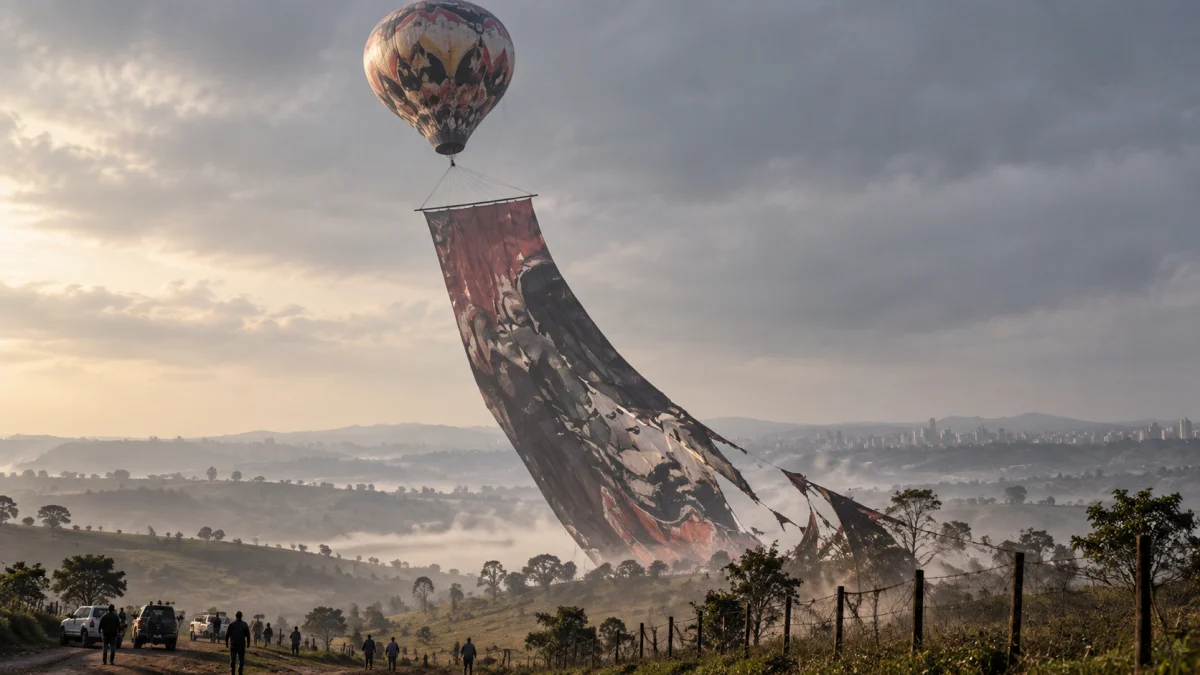
The enormous object in the viral Brazil balloon video is best explained as a giant banner suspended beneath an unmanned hot-air balloon, known in Brazil as a balão. The huge sheet-like material tearing across the landscape is not simply the balloon envelope coming apart.
That explanation sounds almost as strange as the video, but giant balloon-and-banner combinations are well documented in Brazil. In one 2025 case, São Paulo Military Police recovered an 18-meter balloon carrying a separate 25-meter banner. In an earlier incident near Jundiaí, UOL reported a roughly 50-meter balloon carrying a banner about 100 meters long and 50 meters wide.
What is much less certain is the dramatic metadata now traveling with this specific clip. Some news reports say the balloon was more than 50 meters tall, carried fireworks and exploded over São Paulo. Those details are being repeated widely, but they are not all independently established by the evidence currently available.
That distinction matters, because the video has become a good example of how a real and visually extraordinary event can pick up increasingly specific claims as it moves from social media into news coverage.
What are you actually looking at in the video?
The easiest way to understand the footage is to separate the flying system into two parts:
- The balloon: the lighter-than-air craft providing lift.
- The banner: the enormous decorative sheet or artwork hanging below it.
The viral footage is visually confusing because the banner is so large that it overwhelms the viewer’s sense of scale. As the material moves close to the ground, portions of it appear to catch on terrain, fencing or other obstacles and rip apart. The result looks less like a banner failure and more like a wall, sail or piece of the sky itself being shredded.
That confusion is visible in the reaction to the video. In a Reddit thread that drew tens of thousands of votes, users repeatedly asked what they were seeing, whether the clip was AI-generated, and how anything that large could be suspended from a balloon. A separate r/oddlyterrifying discussion shows the same pattern: viewers initially read the scene as CGI, science fiction or an enormous balloon tearing open before other commenters explained the banner arrangement.
The social-media comments are not proof by themselves. What makes the banner explanation strong is that it matches documented Brazilian balloon designs and documented incidents involving separate balloon-and-banner payloads.
Is the giant object the balloon itself?
Probably not. The strongest available explanation is that the huge object dominating the video is the hanging banner, while the balloon providing lift is a separate component above it.
There is unusually useful primary evidence for this distinction.
In March 2025, São Paulo Military Police said officers recovered a large unmanned balloon near Congonhas Airport. According to the official police account, the balloon measured 18 meters high and carried a 25-meter banner. Police described it as being propelled by a burning torch.
That is essentially the arrangement people are struggling to parse in the viral footage: a comparatively compact lifting balloon above an enormous suspended display.
The scale can become even more extreme. In 2013, a balloon fell near a public school in Jundiaí, São Paulo state. UOL reported that the balloon was about 50 meters tall and carried a banner roughly 100 meters long by 50 meters wide. The banner was large enough to cover the school after the balloon came down.
So the scale seen in the new viral video is bizarre, but it is not without precedent.
How can a balloon carry a banner that enormous?
Brazilian balões are not ordinary passenger hot-air balloons. They are unmanned craft built as display objects, and some have historically been designed to lift substantial decorative payloads.
A detailed history of Brazil’s baloeiro subculture by Felipe Fernandes Cruz describes balloons carrying long paper banners, illuminated panels and, in some cases, racks of fireworks. Cruz reported that by the 1980s some balloons reached about 216 feet in height and could lift hundreds of pounds of payload.
The banner is not necessarily launched fully extended. According to the same account, launch teams can hold the banner folded while the balloon is prepared. As the balloon gains lift, the payload rises and the banner progressively unfolds beneath it.
That process helps explain why a display capable of spanning an enormous area on the ground can still be launched beneath a balloon.
| Documented example | Balloon size | Banner or payload |
|---|---|---|
| São Paulo police recovery, 2025 | 18 meters | 25-meter banner |
| Jundiaí incident, 2013 | About 50 meters | About 100 × 50 meter banner |
| Historical giant balões | Some reached about 216 feet | Banners, light panels and other heavy display payloads |
The important point is not that the viral balloon must match any of those measurements. It is that balloons carrying banners far larger than the balloon itself are a documented real-world phenomenon in Brazil.
What is a Brazilian balão?
In this context, a balão is an unmanned hot-air balloon associated with a long Brazilian folk tradition, particularly in São Paulo and Rio de Janeiro. Historically, smaller paper balloons were connected to festas juninas, the June festivals associated with the celebrations of Saint Anthony, Saint John and Saint Peter.
Over time, some balloon-building groups developed the practice into a distinct subculture. Builders known as baloeiros created increasingly elaborate balloons, banners and illuminated displays. A University of São Paulo-hosted ethnographic study documented the social world surrounding one group of baloeiros in southern São Paulo, including the community relationships and conflicts around the practice.
The modern giant balloon tradition should not be confused with regulated recreational or commercial passenger ballooning. These unmanned craft are released without a pilot controlling where they travel or where they eventually descend.
Some have carried fireworks. Others have carried banners or illuminated displays. That distinction is important because the existence of fireworks on some Brazilian balões does not prove that the balloon in this particular viral video carried them.
Did the viral São Paulo balloon really explode?
That is not established as clearly as several headlines suggest.
Italian news agency ANSA published the clip on October 4 under a headline describing a gigantic balloon that “explodes and disintegrates” over São Paulo. La Repubblica went further, reporting that the balloon was more than 50 meters high and carrying fireworks that detonated.
But another outlet in the same viral news cycle took a much more cautious approach. Azteca Jalisco reported that the exact recording date, specific location and circumstances had not been independently corroborated, and specifically said it had not confirmed that the balloon carried fireworks. Its article linked the viral version of the claim back to a social-media post rather than to an identified authority or original incident report. See Azteca Jalisco’s account and caveats.
This is the key evidentiary problem: multiple articles repeating the same specific description do not necessarily represent multiple independent confirmations if they ultimately descend from the same social-media claim.
What is verified, likely, and still unconfirmed?
| Claim circulating with the video | Current assessment | Why |
|---|---|---|
| The footage involves a large unmanned Brazilian balloon system | Strongly supported | The video and reporting are consistent with a documented balão configuration |
| The gigantic sheet-like object is a hanging banner | Strongest explanation | It fits the visible geometry and documented balloon-banner systems |
| The banner tears apart | Visible in circulating footage | The large suspended material visibly fragments |
| The balloon itself exploded | Not firmly established | Some headlines say this, but the viral clip is dominated by the banner tearing and the original incident record is unclear |
| This specific balloon was more than 50 meters tall | Unverified | The number is widely repeated, but a primary measurement or authoritative incident report has not surfaced |
| This specific balloon carried fireworks | Unverified | Some outlets state it; other reporting explicitly says the claim has not been independently confirmed |
| Brazilian balões can carry fireworks | Verified generally | The practice is historically documented |
| The video was recorded on September 29, 2026 | Not firmly established | September 29 is clearly an early viral-circulation date, but that does not automatically make it the filming date |
| The precise location in São Paulo is known | Not firmly established | Current reporting does not provide a traceable authoritative location record |
| Injuries occurred | No confirmed evidence located | Lack of a confirmed report is not the same as proof that no injuries occurred |
Is the Brazil balloon video AI-generated?
There is no need to invoke AI to explain the physical phenomenon shown in the footage.
Giant unmanned Brazilian balloons carrying enormous banners are independently documented. The 2025 São Paulo police case, the 2013 Jundiaí incident and historical reporting on baloeiro construction all establish that balloon-and-banner combinations of surprising scale are real.
That does not mean every copy of the viral video has been forensically authenticated. sherafy.com has not obtained an original camera file with intact metadata, and we have not traced a complete chain of custody from the person who recorded the scene to every version circulating online.
The responsible conclusion is narrower: the scene does not require an AI-generated explanation, because the unusual mechanism it appears to show is a documented real-world practice.
That is different from claiming we have cryptographically authenticated every frame of the clip.
Where and when was the video actually recorded?
This is one of the weakest parts of the viral story.
Copies began spreading heavily on Reddit by September 29, 2026, including the large r/interestingasfuck thread. By September 30, social posts were circulating a more specific version of the story: a giant illegal balloon in São Paulo, allegedly loaded with fireworks, had started breaking apart in the air. That description was then repeated by several news outlets in early October.
But a viral-post date is not necessarily a recording date, and “São Paulo” can refer either to the city or the much larger state.
There is also an older lead worth separating from established fact. On August 18, local outlet Portal Aqui Vale reported that a Jack Sparrow-themed unmanned balloon had been filmed over Igaratá in São Paulo state. The outlet said the video did not establish where that balloon was launched, who launched it or the exact time of the recording. A local blog later posted a page titled “Vídeo de balão caindo em Igaratá (Agosto de 2026)”.
Some commenters under the September viral video identify the torn banner as Jack Sparrow imagery and connect it to Igaratá. That is an interesting provenance lead, but it is not enough to conclude that the August Jack Sparrow balloon and the late-September viral footage show the same incident.
Until the original uploader, recording date or location can be independently established, the safest description is that the footage is widely attributed to São Paulo, Brazil, and went viral by September 29, 2026.
Why do Brazilian balões carry giant banners?
For many baloeiros, the balloon is not merely a flying object. It is a display of design, construction skill and group identity.
Historical accounts describe teams spending months assembling large balloons from lightweight paper, creating elaborate patterns from individually cut pieces. Payloads evolved to include banners, light panels and sometimes pyrotechnic racks. The goal was spectacle and recognition within the balloon-building community.
That helps explain why the banner in the viral video can look absurdly oversized to someone expecting a normal advertising banner. In this subculture, gigantism itself became part of the achievement.
The USP-hosted ethnography of São Paulo baloeiros is useful here because it shows the practice as a social phenomenon with its own groups, relationships and conflicts, rather than simply a random one-off stunt.
Understanding that culture does not erase the safety problem. It explains why people build these objects despite the obvious risks.
Are these unmanned balloons illegal in Brazil?
Brazilian law is more precise than the shorthand “all balloons are illegal.”
Article 42 of Brazil’s Environmental Crimes Law, Law No. 9,605 of 1998, criminalizes manufacturing, selling, transporting or releasing balloons capable of causing fires in forests or other vegetation, urban areas or any type of human settlement. The stated penalty is detention for one to three years, a fine, or both.
That wording matters. The law is aimed at the fire risk associated with these uncontrolled balloons, not at the existence of every kind of ballooning activity.
In practice, Brazilian authorities routinely treat the large fire-heated unmanned balões at issue here as a serious public-safety and environmental problem. In the 2025 Congonhas-area case, São Paulo Military Police cited Article 42 when dealing with the recovered 18-meter balloon and its 25-meter banner.
Why aviation authorities are worried about them
The danger is not theoretical.
In June 2026, Brazil’s Ministry of Ports and Airports, together with aviation and airline organizations, launched a national campaign warning about the dangers of uncontrolled balloons. According to the ministry’s official figures, authorities recorded:
- 425 balloon sightings near airports or air routes in 2024;
- 728 sightings in 2025;
- 206 sightings in just the first five months of 2026.
The ministry warned that once released, these balloons cannot be steered away from homes, schools, hospitals, vegetation, electrical infrastructure or aircraft flight paths. Near airports, a balloon can cross departure and arrival routes, interrupt operations or force inspections after an encounter with an aircraft.
The same uncontrolled flight that makes a giant banner spectacular also makes its eventual path unpredictable.
So what happened in the viral Brazil balloon video?
The best-supported explanation is straightforward once the scale problem is removed:
A large unmanned Brazilian balão was carrying an enormous decorative banner. The banner passed dangerously close to the ground and was torn apart as it encountered obstacles. Because the hanging material was so large, the footage initially looked to many viewers like a balloon, building-sized object or even the sky itself was disintegrating.
What we should not do is turn the rest of the viral caption into fact simply because it has been repeated.
The available evidence does not yet firmly establish that this particular balloon was more than 50 meters high, that it carried fireworks, that the balloon itself exploded, or that September 29 was the date the event was recorded. Those claims may ultimately prove correct, but their current source trail is much weaker than the evidence for the balloon-and-banner explanation.
That is the useful distinction: the bizarre physical phenomenon is real; several of the most dramatic details attached to this particular clip remain unverified.
Frequently Asked Questions
What is the giant object in the Brazil balloon video?
It is best explained as a huge decorative banner suspended beneath an unmanned Brazilian hot-air balloon, or balão. The banner is the enormous sheet-like object seen tearing apart near the ground.
Is the giant object the balloon itself?
Probably not. Documented Brazilian balões can carry separate banners much larger than the balloon’s visible envelope. São Paulo police documented an 18-meter balloon with a 25-meter banner in 2025, while UOL reported a 2013 case involving a roughly 50-meter balloon and a 100-by-50-meter banner.
Is the viral Brazil balloon video AI?
The physical event shown does not require an AI explanation. Giant balloon-and-banner systems are well documented in Brazil. However, sherafy.com has not obtained the original camera file, so that should not be confused with a complete forensic authentication of every viral copy.
Did the São Paulo balloon contain fireworks?
That remains unconfirmed for this specific incident. Some outlets report fireworks as fact, but other coverage explicitly says the claim has not been independently verified. Brazilian balões have historically carried fireworks, banners and illuminated displays, but one practice does not prove what this particular balloon carried.
How big can Brazilian balloon banners get?
Very large. A 2013 incident reported by UOL involved a banner approximately 100 meters long and 50 meters wide. A 2025 São Paulo police case involved an 18-meter balloon with a separate 25-meter banner.
What does balão mean in this context?
Balão simply means “balloon” in Portuguese, but in this context it refers to the large unmanned hot-air balloons built and released by Brazilian baloeiros. Some carry decorative banners, illuminated panels or pyrotechnic displays.
Are these balloons illegal in Brazil?
Brazil’s Environmental Crimes Law criminalizes manufacturing, selling, transporting or releasing balloons capable of causing fires in forests, other vegetation, urban areas or human settlements. The penalty under Article 42 is detention for one to three years, a fine, or both.
Where was the viral balloon video filmed?
The video is widely attributed to São Paulo, Brazil, but the precise location and recording date have not been firmly established in the source trail currently available. It was circulating heavily online by September 29, 2026.
References and Further Reading
Primary and Government Sources
- Brazilian Environmental Crimes Law, Law No. 9,605/1998 — Article 42 — Brazil’s official legal text. Article 42 covers manufacturing, selling, transporting or releasing balloons capable of causing fires and states the applicable penalty.
- São Paulo Military Police: 18-meter balloon with a 25-meter banner recovered near Congonhas Airport — Primary-source documentation showing that a large balão and its banner can be separate structures of substantial size.
- Brazil Ministry of Ports and Airports: national campaign on balloon risks — Current official aviation-safety figures for balloon sightings near airports and air routes in 2024–2026.
Research and Cultural Background
- “Balão não tem destino”: an ethnography of São Paulo baloeiros — University of São Paulo-hosted ethnographic research on the social world surrounding a São Paulo balloon-building group.
- “An Art of Air and Fire: Brazil’s Renegade Balloonists” — The Appendix — Detailed historical reporting on construction, launch techniques, banners, fireworks, illuminated payloads and the development of giant Brazilian balões.
Documented Large Balloon and Banner Cases
- UOL: 50-meter balloon and 100-by-50-meter banner fall near a school in Jundiaí — A useful scale comparison showing that banners of extraordinary dimensions have been carried beneath Brazilian balloons.
- Portal Aqui Vale: Jack Sparrow-themed balloon seen over Igaratá in August 2026 — Local reporting relevant to a possible, but not established, provenance connection raised by social-media users.
- Espaço Aberto Igaratá: video page describing a balloon falling in Igaratá in August 2026 — Additional local provenance lead. It does not by itself establish that the August footage and the late-September viral clip are the same event.
Current Viral Coverage and Source-Chain Comparison
- Azteca Jalisco: viral São Paulo balloon video with explicit verification caveats — Notable because it explicitly says the date, exact location, fireworks claim and other details had not been independently confirmed.
- ANSA: “gigantic balloon explodes and disintegrates” over São Paulo — Example of the stronger “explosion” framing circulating in international coverage.
- La Repubblica: report describing a 50-plus-meter balloon carrying fireworks — Example of the more specific version of the viral narrative that currently lacks a clearly traceable primary incident source.
- Reddit: large r/interestingasfuck discussion of the footage — Useful evidence of reader confusion and the questions driving search demand; not used as authoritative proof of the incident details.
Editorial currency note: This article reflects evidence available as of October 4, 2026. The provenance of the viral video is still developing. If an original uploader, police report, exact location, recording date or authoritative identification of the balloon emerges, those details should be incorporated into this page rather than treated as established before verification.