
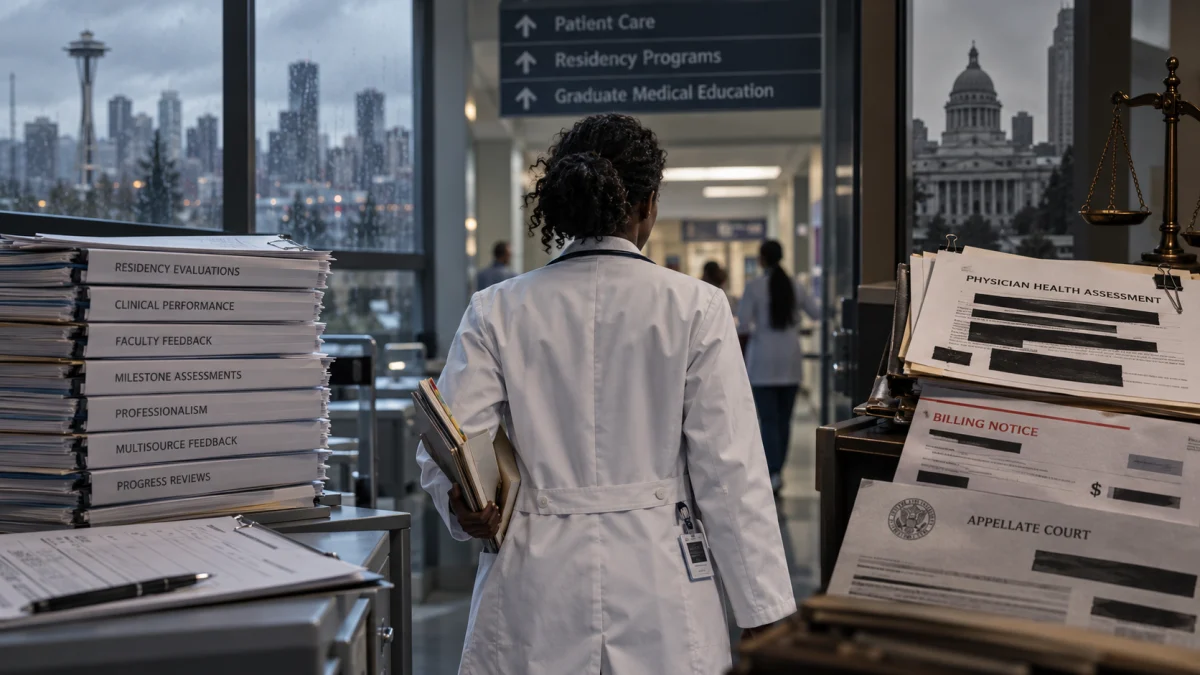
Dr. Dorender Gray was a University of Washington OB-GYN resident, a first-generation college graduate and a Ghanaian immigrant whose story UW itself once highlighted as an example of student success. By February 2025, she was no longer in the residency program.
What happened in between is now the subject of court filings, an appeal and a growing public controversy.
According to a proposed class-action complaint filed by Gray and former UW orthopedic resident Dr. Temi Ogunleye, Gray was referred to the Washington Physicians Health Program, or WPHP, after struggling during residency and seeking time away for her mental health. The complaint alleges that she later underwent neuropsychological testing that produced a report containing biographical details that were not hers, including a supposed suicide attempt by her brother that Gray says never happened. A second neuropsychologist concluded that serious errors had been made and recommended that Gray return to work.
The complaint then alleges something even harder to explain: after WPHP agreed there was no medical reason preventing Gray from returning and UW put her back on the schedule, WPHP withheld formal clearance because of an outstanding $350 bill. The complaint says WPHP subsequently acknowledged that part of the bill reflected an incorrect rate. When Gray returned before the issue was resolved, WPHP told UW she was not cleared, and UW suspended and then terminated her.
Those are allegations. They have not been tested at trial. But they also have not been disproved in court. The King County Superior Court case was dismissed because the judge held that WPHP was protected by statutory immunity, not because a trial determined that Gray’s factual account was false. Gray and Ogunleye have appealed.
There is another part of Gray’s story that deserves equal scrutiny.
A fundraising campaign naming Gray as its beneficiary says that before the WPHP referral, Gray had raised concerns about harsher scrutiny, inconsistent feedback and lack of guidance. It alleges that when she questioned why she had received no feedback before being told to repeat training, an attending told her she "no longer gives feedback to residents of color."
sherafy.com has not located that statement in the publicly available WPHP complaint or the current appellate brief, and no primary UW grievance record establishing the quote appears to be public. It should therefore be treated as a serious allegation, not a proven quotation from the court record.
But it cannot simply be waved away as incidental. UW’s own residency policies say feedback is a required part of medical training. And a 2026 peer-reviewed survey of 1,755 resident physicians found that Black respondents reported substantially higher rates of remediation and disciplinary action than White respondents.
The point is not that White residents are never disciplined. They are. The point is that the racial disparity Gray is asking people to examine also appears in broader residency data; it is not a question raised only by her individual case.
The short version: what is verified, alleged and still unresolved
| Claim | Current status | Strongest public evidence |
|---|---|---|
| Gray was a UW OB-GYN resident whom UW had previously profiled positively | Verified | UW Magazine profile |
| Gray was referred to WPHP during residency | Verified through court filings and independent reporting | Complaint; Seattle Times reporting syndicated by The Spokesman-Review |
| An attending told Gray she no longer gave feedback to residents of color | Alleged; not independently established in the public court record reviewed by sherafy.com | Gray fundraising campaign |
| Gray’s neuropsychological report included a supposed suicide attempt by her brother that she says never occurred | Alleged in the complaint and independently reported from Gray’s account | Complaint; Seattle Times/Spokesman-Review |
| A second neuropsychologist found serious errors and recommended a return to work | Alleged in the complaint and appellate filing | Complaint; appellants’ opening brief |
| WPHP withheld Gray’s final clearance while a $350 bill remained outstanding | Alleged in the complaint; also reported by The Seattle Times | Complaint; Seattle Times/Spokesman-Review |
| The lawsuit was dismissed because the judge found WPHP immune from the asserted civil claims | Verified | King County Superior Court dismissal order |
| The factual allegations were disproved at trial | No | There was no trial on the facts; the dismissal was based on immunity |
| The case is on appeal | Verified | Washington Court of Appeals briefs page |
UW once held Gray up as an example of success
The contrast is difficult to miss.
In a University of Washington Magazine profile, UW described Gray as a first-generation college student who earned a neurobiology degree, worked on malaria-vaccine development and later attended UW School of Medicine before entering the university’s OB-GYN residency program.
Gray also explained why representation mattered in her specialty. Black patients, she said, would sometimes react with visible relief because they had never had a Black OB-GYN before.
That background does not prove UW later discriminated against her. It establishes that Gray had already progressed through college, medical school and into one of the most demanding phases of physician training at the same institution that had publicly celebrated her path.
Then, during residency, the relationship changed.
Independent reporting by The Seattle Times says Gray was told during her second year that she needed to repeat a particularly demanding rotation. She requested a short break. Soon afterward, she entered WPHP.
The racial question enters the story before that referral, however, through the allegation about feedback.
If the feedback allegation is accurate, it conflicts directly with how UW says residency should work
Medical residency is not supposed to operate on the theory that trainees should somehow infer their deficiencies after a final decision has already been made.
UW’s Resident and Fellow Evaluation Policy says resident performance evaluations must include feedback and that faculty must directly observe, evaluate and frequently provide feedback during rotations and other educational assignments.
Its Remediation Policy and Grievance Procedure goes further. UW defines due process as adequate notice of performance deficiencies plus an opportunity to respond and potentially remediate. The policy says regular, consistent feedback and evaluations are the mechanisms by which residents are informed of deficiencies.
That makes Gray’s allegation about race more than a story about an offensive remark.
If a resident is later penalized for performance problems, feedback is part of the machinery that determines whether she was ever given a meaningful opportunity to understand and correct those problems in the first place.
A system can look formally neutral at the moment of discipline while unequal treatment has already occurred earlier, when concerns are noticed, interpreted, documented, communicated and escalated.
That distinction matters because the national data increasingly show that Black residents are not experiencing disciplinary systems at the same rate as White residents.
Black residents are more likely to report remediation and disciplinary action
A 2026 peer-reviewed study in Health Equity, "Discipline Is Not Neutral: Racial Disparities in Resident Physician Disciplinary Action", surveyed resident physicians affiliated with the Committee of Interns and Residents and analyzed 1,755 validated responses.
Compared with White respondents, Black residents had:
- 2.24 times the adjusted odds of reporting that they had been asked to meet with program leadership;
- 2.93 times the unadjusted odds of reporting that they had ever been placed on remediation; and
- 1.76 times the adjusted odds of reporting any combined disciplinary action.
Current remediation, probation or possible dismissal was also reported more often by Black respondents in the sample: 5.8% of Black respondents compared with 2.0% of White respondents, although the number of residents currently facing those actions was small.
The study does not prove that any particular UW decision involving Gray was caused by racism. It also has real limitations: only 9.2% of invited residents completed the survey, the sample came from residents affiliated with one large union, and self-selection could affect the results.
But the disparity is large enough that pretending race is irrelevant would be less objective, not more.
The result also fits a broader research pattern. A 2022 study in Academic Medicine analyzed 3,600 faculty evaluations of 703 internal-medicine residents across six programs. Residents from racial and ethnic groups underrepresented in medicine received lower adjusted scores across five clinical competency categories. The researchers cautioned that the differences could reflect multiple mechanisms, including assessment bias, structural inequities and differences in the learning environment.
Older unpublished ACGME data obtained by STAT in a 2022 investigation pointed in the same direction: Black residents were a small share of all trainees but a much larger share of residents dismissed in the dataset. ACGME cautioned that some subgroup numbers were small.
None of this means every Black resident facing remediation was treated unfairly. It means the burden cannot be placed entirely on each individual Black doctor to produce a confession of racial bias before racial disparity is considered relevant.
Gray asked for mental-health time. WPHP then became a career gatekeeper
The viral version of this story often describes WPHP as a program for physicians with substance-abuse problems. That description is incomplete today.
WPHP did originate with a strong focus on drug and alcohol addiction, according to the plaintiffs’ appellate filing, but the organization now explicitly says it works with mental-health disorders, cognitive concerns, depression, anxiety, suicidal thinking, burnout, trauma, stress and other conditions that may affect clinical performance.
UW’s own Physician Impairment Policy likewise treats depression, suicidality, sleep disorders, stress disorders, substance use and other physical or mental conditions as potential impairment concerns.
That means Gray’s referral itself is not proof of racial discrimination. Under UW policy, a serious concern about a resident’s ability to practice safely can trigger a WPHP referral even without definitive evidence of impairment.
The more consequential issue is what happens after that referral.
UW states that WPHP is an independent nonprofit, separate from the university. Yet the same UW policy gives WPHP extraordinary practical authority: for residents referred over impairment concerns, WPHP is solely authorized to determine fitness for duty and endorse a return to work. UW residents are required, as a condition of appointment, to comply when their program removes them from clinical duties and refers them to WPHP over suspected impairment.
That structure turns an outside health program into something much more powerful than an optional therapist.
Once a resident is inside the process, the question of whether WPHP will clear that person can determine whether years of medical training continue at all.
The complaint says Gray was first cleared, then subjected to more testing
According to the February 2026 complaint, Gray underwent drug and alcohol testing despite no allegation that she had a substance-use disorder. Her drug screen reflected amphetamine use, which the complaint says came from prescribed medication for an existing ADHD diagnosis.
She was then sent for additional psychological evaluation.
At one point, according to the complaint and later appellate brief, Gray was deemed safe to practice and returned to residency. The appellate filing says she received strong patient reviews and that supervisors raised no academic concerns after her return.
But WPHP required further neuropsychological testing focused on whether she had ADHD.
The complaint alleges that this next evaluation led to a diagnosis of an unspecified neurocognitive disorder and recommendations that Gray be removed from clinical work and undergo additional testing and therapy.
Then Gray obtained the written report.
The report allegedly contained a family history that was not hers
According to the complaint, the neuropsychological report connected Gray’s condition to lingering distress over her brother’s suicide attempt and other childhood trauma.
Gray says her brother had never attempted suicide.
She also said she did not recognize the childhood trauma described in the report.
The complaint alleges that when Gray challenged the apparent mismatch, the evaluator characterized it as a "copy/paste error" but WPHP continued to require the recommended treatment before clearing her.
That allegation is not a minor clerical dispute. A neuropsychological evaluation can affect whether a resident is judged medically capable of treating patients. If material history belonging to another person entered the reasoning behind a career-altering diagnosis, the accuracy of the process itself becomes the issue.
Gray eventually obtained a second opinion from Dr. Phyllis Sanchez, whom the complaint describes as an experienced neuropsychologist who had previously directed a neuropsychology clinic at Harborview.
According to the complaint, Sanchez found serious errors in the earlier evaluation and recommended a graduated return to work. The appellants’ September 2026 opening brief similarly says Sanchez reviewed the evaluations of both Gray and Ogunleye, reached different conclusions and recommended that both be allowed to return.
The complaint says WPHP then agreed there was no medical reason preventing Gray from returning to her program. UW put her back on the schedule.
Then came the $350 bill.
The $350 clearance dispute may be the most consequential allegation in the case
The complaint alleges that WPHP refused to send a final approval letter to UW because Gray had an outstanding $350 invoice.
It further alleges that when Gray asked about the amount, WPHP acknowledged that she had been charged a $75 monthly "professional" rate instead of the $50 "resident/fellow" rate.
According to the complaint, Gray returned to work before the billing issue was fully resolved. WPHP then told UW that she was not cleared to work. UW suspended her and ultimately terminated her from the residency program.
The Seattle Times independently reported Gray giving substantially the same account: she said WPHP required the $350 payment before sending the clearance letter, UW later told her the required letter had not arrived, and she was terminated in February 2025.
This remains an allegation rather than an adjudicated finding. WPHP has said the lawsuit’s claims are "without merit" and has said it cannot publicly discuss individual participant details.
But the allegation poses a precise question that deserves an equally precise answer:
If WPHP had concluded there was no medical reason preventing Gray’s return, why was a career-critical clearance allegedly withheld over a disputed bill?
Because UW policy gives WPHP sole authority to endorse a referred resident’s fitness to return, the difference between a medical restriction and an administrative billing dispute is not trivial. It can be the difference between working and being barred from clinical training.
Dr. Temi Ogunleye says his report had the wrong age, birth date and hand dominance
Gray is not the only former UW resident making allegations about errors in the WPHP process.
Dr. Temi Ogunleye, a Black physician from Nigeria who trained in orthopedic surgery at UW, is Gray’s co-plaintiff.
According to the complaint and independent reporting, Ogunleye was referred to WPHP after struggling with burnout, oversleeping and arriving late to work during residency.
The complaint alleges that a neurocognitive evaluation diagnosed him with a major neurocognitive disorder and early-onset dementia.
But the report allegedly listed the wrong date of birth, wrong age and wrong hand dominance, while omitting his existing ADHD diagnosis.
After Ogunleye raised the discrepancies, the complaint says he was directed to undergo an MRI. His insurer declined to cover it as medically unwarranted, according to the filing, so Ogunleye paid for it himself. The MRI showed no abnormality, the complaint says.
A later second opinion by Sanchez concluded that Ogunleye had ADHD but was otherwise functioning and able to complete residency, according to the complaint. He eventually returned to UW, later left the program and entered another orthopedic residency in California.
Two Black physicians encountering serious alleged errors in the same system does not, by itself, prove WPHP discriminated against them because of race. The WPHP lawsuit itself is not pleaded as a racial-discrimination case.
But the parallel experiences matter for a different reason: they make it harder to dismiss Gray’s problems as one inexplicable clerical mistake, while the national residency data provide a separate reason to examine how Black physicians move through evaluation and discipline systems in the first place.
Gray says UW’s own grievance reviewers sided with her
Gray told The Seattle Times that she challenged her termination through UW’s internal process and that a review committee unanimously concluded the dismissal was "arbitrary and capricious." She said the dean of the UW School of Medicine nevertheless upheld the termination.
That claim is significant, but it needs the same evidentiary discipline as the rest of the story.
sherafy.com has not located the underlying grievance committee decision in the public court record. Until that document is available, the safest formulation is that Gray says the committee reached that conclusion, and The Seattle Times reported her account.
UW’s published remediation and grievance rules are nevertheless relevant. They describe due process, notice, the opportunity to remediate and a secondary review process for certain adverse actions.
If the written grievance ruling becomes public, it may be one of the most important records in the entire case.
The lawsuit was dismissed, but not because a court found Gray’s allegations false
This distinction has already become muddled in online discussion.
Gray and Ogunleye filed their proposed class action against WPHP in King County Superior Court in February 2026. They asserted claims under Washington consumer-protection law and for tortious interference and outrage.
On May 26, Judge Haydee Vargas dismissed the complaint with prejudice, ruling that WPHP was entitled to absolute immunity from the claims under RCW 18.130.300. The order states that the matter was decided without oral argument.
That ruling was a major victory for WPHP, but it was not a trial verdict declaring that the disputed reports were accurate, that the $350 allegation was false or that Gray and Ogunleye had been treated properly.
The doctors appealed.
Their September 3 opening brief argues that WPHP does not qualify for the immunity applied by the trial court, that the conduct at issue was not protected "official" conduct under the statute and that applying the statute this broadly would raise constitutional problems.
Those are the plaintiffs’ legal arguments; the appellate court has not ruled on them.
As of September 30, 2026, the Washington Court of Appeals’ public briefs page for case 89865-5 lists the appellants’ opening brief and does not yet list a respondent’s brief or hearing date.
The case remains unresolved.
What WPHP says about its role
WPHP rejects the plaintiffs’ characterization of the program.
In a statement reported by The Seattle Times, WPHP called the lawsuit’s claims "without merit" and described itself as a national leader focused on clinician recovery and patient safety. The organization says it cannot discuss confidential details of individual participants.
WPHP’s own frequently asked questions describe it as an independent, physician-led nonprofit providing early intervention, assessment, treatment referral and post-treatment health support. It also has an internal reconsideration process for participants who dispute decisions.
WPHP reports strong aggregate satisfaction with its services. In a 2025 summary, the organization said 84% of surveyed participants described their experience as helpful and one in five said WPHP saved their life.
Those outcomes matter. Physician health programs can provide an important alternative to untreated illness, licensing discipline and patient-safety risks.
But aggregate satisfaction does not answer the allegations in Gray’s or Ogunleye’s cases. A program can help many people and still require scrutiny when a participant alleges that an inaccurate evaluation or administrative decision derailed a career.
The more power a program holds, the stronger the case for transparent safeguards when something goes wrong.
Three important corrections to the viral version
The social-media version of Gray’s story is powerful, but some details need tightening.
1. WPHP is not simply a substance-abuse program
WPHP began with a strong addiction-treatment mission, but today it explicitly handles mental health, cognitive issues, ADHD-related concerns, suicidal thinking, burnout, trauma and other health conditions. Calling it only a drug-rehab program leaves out how broad its modern role has become.
That correction does not weaken the accountability question. In some ways it makes the stakes clearer: a physician who seeks help for mental health can enter the same fitness-for-duty system even when substance use is not the issue.
2. The racial-feedback statement is an allegation, not yet a verified court-record fact
The public fundraiser says an attending told Gray she no longer gave feedback to residents of color. That is serious and directly relevant to UW’s own feedback requirements. But sherafy.com has not found the statement in the WPHP complaint, appellate brief or a publicly available UW grievance decision.
The correct treatment is neither to erase the allegation nor to present it as already adjudicated. It should be attributed until stronger documentation becomes public.
3. The claim that Gray still owes roughly $150,000 in student debt is now outdated
The fundraiser originally said Gray had more than $153,000 in student loans. The page has since been updated to say that she paid off the $153,000-plus balance. Viral retellings that say she currently still owes that amount are no longer accurate.
The larger question is not whether every adverse decision can be proven racist
There is a familiar trap in stories about racial disparity.
A Black professional describes differential treatment. The institution’s procedures appear neutral on paper. Unless someone produces an email explicitly saying "we are doing this because she is Black," the racial dimension is treated as speculative and removed from the analysis.
That is not how institutional disparity usually presents itself, and it is not what the residency research asks us to believe.
The more useful questions are earlier and more concrete:
Who gets coached before a problem becomes disciplinary? Who receives specific feedback? Who is regarded as struggling but salvageable? Whose mistakes are interpreted as ordinary features of training, and whose become evidence of a deeper deficiency? Who is given a clear path back to good standing? Who gets a second chance before a career-ending process begins?
Those are not rhetorical questions. They are exactly the points where subjective judgment can accumulate into different outcomes while every individual step remains capable of being described as routine.
Gray’s story sits directly inside that problem.
She says she was subjected to different scrutiny and denied feedback. UW’s policies say feedback is central to evaluation and remediation. She then entered a health and fitness system that UW gives sole authority to endorse a referred resident’s return. Court filings allege that the process produced an evaluation containing someone else’s family history, followed by a second opinion that sharply disagreed, followed by an alleged $350 clearance dispute immediately before her suspension and termination.
Meanwhile, the 2026 peer-reviewed resident survey finds Black respondents reporting materially higher rates of remediation and discipline than White respondents.
None of that proves that every decision in Gray’s case was racially motivated.
It does establish that race is part of the factual context, not an optional political interpretation pasted onto the story afterward.
What would answer the remaining questions
Several records could materially change or sharpen the public understanding of this case:
- the written UW grievance committee decision Gray says found her termination arbitrary and capricious;
- Gray’s evaluations and documented feedback from the disputed rotations;
- any contemporaneous record or witness evidence concerning the alleged statement about feedback to residents of color;
- the full disputed neuropsychological report and Sanchez’s second-opinion letter;
- WPHP correspondence showing why final clearance was withheld after Gray was medically considered able to return;
- billing records surrounding the $350 charge and acknowledged rate issue; and
- UW’s written reasoning for upholding Gray’s termination after the internal grievance process.
Those documents could strengthen Gray’s account, complicate it or resolve questions that the existing public record cannot.
That is what further reporting should pursue.
Why the Dorender Gray story matters beyond one residency
UW once promoted Dorender Gray as an example of what opportunity in medicine could produce: a first-generation student who became a physician, entered OB-GYN and wanted to serve patients who rarely saw doctors who looked like them.
Black physicians also remain a small share of the U.S. medical workforce. According to the Association of American Medical Colleges’ 2025 resident data, 8.0% of active residents in 2024-25 reported identifying as Black or African American, alone or in combination with another race or ethnicity. The AAMC’s 2025 physician-workforce findings put Black or African American physicians at 5.3% of the active physician workforce in 2024. Those measures are not perfectly interchangeable because the resident table allows multiple race/ethnicity selections and the workforce dataset has its own methodology, but they provide a more current picture than the older representation figures cited in some residency-disparity literature.
Against that background, the question raised by Gray’s case is not merely whether UW was legally permitted to terminate one resident or whether WPHP is legally immune from one civil lawsuit.
It is whether medical training systems give Black physicians the same practical opportunity to receive useful feedback, correct deficiencies, challenge inaccurate assessments and recover from setbacks before those setbacks become career-ending.
White residents are disciplined. Black residents can have genuine performance problems. Patient safety cannot be subordinated to demographic statistics.
But the evidence now shows that Black residents encounter remediation and discipline at disproportionate rates. When a Black resident says race explicitly entered the feedback process, and the subsequent record contains the kinds of disputed evaluations and administrative failures alleged here, the responsible response is not to assume discrimination and it is not to assume fairness.
It is to investigate the system closely enough to find out which assumption the evidence can actually support.
For Dorender Gray, that investigation is not academic. It concerns whether she gets to finish the medical career UW once celebrated her for beginning.
References and Further Reading
Primary court records and UW policies
-
Gray and Ogunleye v. Washington Physicians Health Program — Class Action Complaint, filed Feb. 12, 2026 — The plaintiffs’ original pleading. It contains the detailed allegations concerning both physicians’ WPHP evaluations, Gray’s second opinion and the $350 clearance dispute. Allegations in a complaint are not findings of fact.
-
King County Superior Court — Order Granting WPHP’s Motion to Dismiss — The May 26, 2026 order dismissing the complaint with prejudice because the court found WPHP entitled to absolute immunity under RCW 18.130.300. The order did not adjudicate the underlying factual allegations at trial.
-
Gray and Ogunleye v. WPHP — Plaintiffs-Appellants’ Opening Brief — The Sept. 3, 2026 appellate brief challenging the immunity ruling and summarizing the plaintiffs’ account of their WPHP experiences.
-
Washington Court of Appeals Division I — Public Briefs — Current public case-status page for Dorender Gray and Temi Ogunleye v. Washington Physicians Health Program, case 89865-5.
-
UW Resident and Fellow Evaluation Policy — Establishes UW requirements for direct observation, evaluation and frequent feedback during residency.
-
UW Remediation Policy and Grievance Procedure — Describes notice, feedback, opportunities to remediate and grievance procedures for adverse residency actions.
-
UW Physician Impairment Policy — Explains when residents may be referred to WPHP and states that WPHP is solely authorized to determine fitness for duty and endorse return to work for referred UW residents.
-
UW Physician Impairment and Referral Information — Clarifies that WPHP is an independent entity separate from UW and describes referral, oversight and reconsideration procedures.
Research on racial disparities in residency
-
Vanessa Grubbs, "Discipline Is Not Neutral: Racial Disparities in Resident Physician Disciplinary Action," Health Equity, 2026 — Peer-reviewed national survey finding substantially higher reported odds of leadership intervention, remediation and combined disciplinary action among Black residents than White residents. The study also details its 9.2% response rate and other limitations.
-
Association Between Resident Race and Ethnicity and Clinical Performance Assessment Scores in Graduate Medical Education, Academic Medicine, 2022 — Multisite analysis of 3,600 faculty evaluations finding lower adjusted competency scores for residents from racial and ethnic groups underrepresented in medicine.
-
STAT: Black doctors forced out of training programs at far higher rates than White residents — Independent reporting on older unpublished ACGME dismissal data and Black physicians’ experiences in residency programs. The underlying subgroup data were limited and should not be treated as a substitute for current national reporting.
-
AAMC 2025 Report on Residents — Race/Ethnicity by GME Specialty — Current AAMC data showing that 8.0% of active residents in 2024-25 reported Black or African American identity, alone or in combination.
-
AAMC 2025 U.S. Physician Workforce Data Dashboard — Key Findings — Current workforce data reporting that 5.3% of active physicians in 2024 identified as Black or African American.
Background and independent reporting
-
UW Magazine — Dorender Gray profile — UW’s own profile of Gray as a first-generation graduate, medical student and OB-GYN resident, including her comments about the importance of Black physician representation.
-
The Seattle Times via The Spokesman-Review — Physicians say mental health group for doctors harmed rather than helped — Independent reporting based on interviews with Gray and Ogunleye, WPHP’s response and the early trial-court proceedings.
-
Keller Rohrback — Washington Physicians Health Program case page — Plaintiffs’ counsel’s case page collecting the complaint, dismissal order, notice of appeal and appellate brief. It is an interested-party source and is most useful as a document repository.
WPHP’s own description and response context
-
Washington Physicians Health Program — Frequently Asked Questions — WPHP’s description of its mission, current scope of conditions served and internal reconsideration process.
-
WPHP Program Highlights — Describes the conditions and workplace situations WPHP says it addresses, including mental health, cognitive disorders, substance use and medical leaves.
-
WPHP — Participant and stakeholder outcomes — WPHP’s own reported satisfaction statistics. These figures provide institutional context but do not independently resolve the allegations in Gray’s or Ogunleye’s cases.
-
Fundraiser for Dorender Gray — Interested-party source for the allegation concerning feedback to residents of color and for the fundraiser’s updated statement that Gray’s $153,000-plus student-loan balance has been paid. Claims from the fundraiser are identified as such in the article rather than treated as independent verification.
Editorial currency note: Court status and publicly available filings were checked through September 30, 2026. The appeal is active, and later briefs, rulings or newly released UW records may materially change the factual or legal picture. sherafy.com should update this article when substantive new records become public.