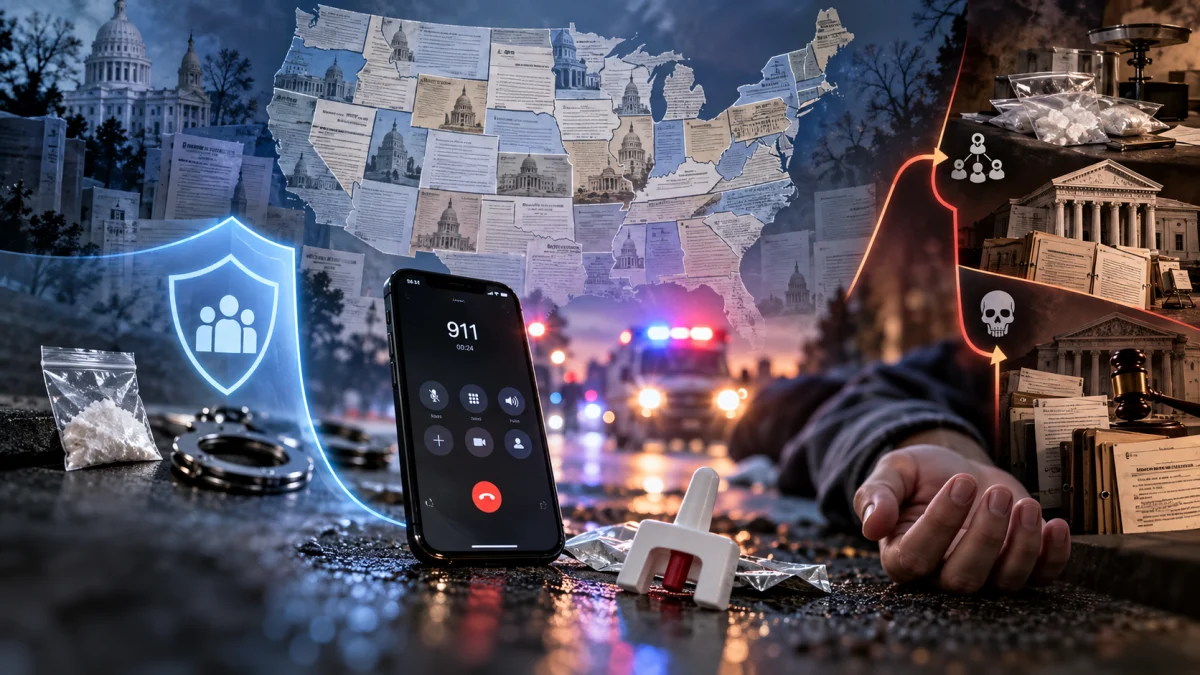
Yes, you can still potentially be arrested or prosecuted for some conduct after calling 911 for an overdose.
All 50 states and Washington, D.C., have enacted at least one overdose-specific Good Samaritan law, according to the Network for Public Health Law’s 50-state survey, which reflects state law through December 31, 2025.
But these laws provide limited protection, not blanket immunity.
Depending on the state, seeking emergency help may protect a caller, the person overdosing, or both from arrest, charges, or prosecution for certain low-level drug offenses. It may also protect against some paraphernalia charges, probation or parole consequences, or other specified violations.
It does not necessarily protect someone from an outstanding warrant, an unrelated crime, trafficking or distribution allegations, or a separate charge based on supplying drugs that cause a death.
That creates the legal distinction that matters most:
A 911 call can protect someone from a possession offense while leaving a completely different question open about whether that person supplied the drug.
If you think someone is overdosing, do not delay emergency care to sort out the law. The CDC recommends administering naloxone if available, calling 911, trying to keep the person breathing, placing them on their side, and staying until emergency help arrives.
This article explains the law generally. It is not legal advice for a specific case, and state statutes can change.
What Is an Overdose Good Samaritan Law?
Overdose Good Samaritan laws are designed to reduce one very specific reason people sometimes hesitate to call 911: fear that police will arrive with emergency medical services and arrest the caller or the person overdosing because drugs are present.
The Network for Public Health Law says every state and D.C. had enacted at least one such law by the end of 2025. The laws generally provide some form of limited legal protection when someone seeks emergency assistance during a suspected overdose.
They are different from the civil Good Samaritan laws people may know from CPR or first aid. Those laws generally address liability for trying to help someone medically. Overdose Good Samaritan laws focus on criminal exposure associated with seeking help during a drug emergency.
Can You Still Be Arrested After Calling 911 for an Overdose?
Yes, in some circumstances.
The problem is that the word “protected” can mean several different things.
| Type of protection | What it generally means |
|---|---|
| Protection from arrest | Police generally cannot arrest or take an eligible person into custody for the covered offense |
| Protection from charge | The covered offense cannot be formally charged |
| Protection from prosecution | Prosecutors cannot pursue the covered offense |
| Affirmative defense | A defendant may still enter the criminal process but can raise the emergency assistance as a legal defense |
| Sentencing mitigation | Seeking help may reduce punishment for an offense that is not immunized |
Those are not interchangeable.
The Legislative Analysis and Public Policy Association’s July 2025 national comparison found that only slightly more than half of the jurisdictions in its survey expressly protected eligible people against arrest or being taken into custody for covered possession offenses. Other jurisdictions used different mechanisms, including protection from prosecution, evidentiary restrictions, or affirmative defenses.
So the answer to “Can police arrest me?” may be different from the answer to “Can I ultimately be prosecuted for possession?”
That distinction is one of the most important things short Good Samaritan-law explanations leave out.
What Does Calling 911 Usually Protect You From?
The core protection is generally low-level drug possession connected to the overdose emergency.
Depending on the jurisdiction, the law may also cover drug paraphernalia, being under the influence, some probation or parole violations, or other specified offenses.
But eligibility can depend on details such as:
- whether the caller acted in good faith;
- whether the evidence was discovered because help was requested;
- the quantity and type of drug involved;
- whether the statute protects the caller, the overdose victim, or both;
- whether the person remained at the scene;
- whether the person cooperated with responders;
- whether another offense falls outside the statute.
The LAPPA national survey is useful precisely because it separates these conditions state by state instead of treating “Good Samaritan law” as a single national rule.
What Is Not Automatically Protected?
A Good Samaritan law does not usually create a temporary law-free zone around the overdose scene.
The Network for Public Health Law’s December 2025 survey found that most laws still provide relatively narrow carveouts from otherwise applicable criminal law. The survey specifically notes that most do not protect people from outstanding warrants and generally do not extend to more serious drug-related crimes.
Potentially unprotected issues can include:
- an outstanding warrant;
- an unrelated crime;
- trafficking or manufacturing;
- distribution or delivery;
- some probation, parole, or pretrial-release violations;
- evidence of offenses outside the statute;
- a drug-related death charge;
- federal criminal liability.
That means a caller might be protected from prosecution for the small amount of drugs found in a pocket while still facing legal consequences for something else discovered during the same emergency.
What If the Drugs Were Yours?
Consider the simplest scenario.
Two people are using drugs together. One becomes unresponsive. The other has a small amount of the same drug and calls 911.
That is close to the situation overdose Good Samaritan laws were designed to address.
But even then, the correct questions are:
- Does the state’s law protect the caller?
- Does it protect the person overdosing?
- Is the particular possession offense covered?
- Was the evidence obtained because emergency assistance was requested?
- Does the statute prevent arrest, prevent prosecution, or provide some other defense?
- Did the caller satisfy any requirements to remain, identify themselves, or cooperate?
The national answer is therefore not simply “you cannot get arrested.”
The stronger answer is:
A qualifying overdose call may protect you from specified low-level drug offenses, but the scope and legal mechanism depend on the state.
What If You Shared the Drugs With the Person Who Overdosed?
This is where the legal picture can change substantially.
Possessing a drug and supplying a drug are different legal questions.
A Good Samaritan statute may protect possession without protecting conduct classified as delivery, distribution, furnishing, or trafficking.
But the reverse oversimplification is also dangerous: saying that a person “shared the drugs” does not automatically establish that every jurisdiction will treat that person as a distributor, much less that a death-resulting crime has been proved.
The details matter.
What if you bought the drugs together?
A useful federal example is United States v. Semler, a 2021 Third Circuit case involving a fatal heroin overdose.
The court held that a jury could find that two people who jointly and simultaneously acquired a small amount of drugs solely for their shared personal use possessed the drugs jointly rather than one distributing the drugs to the other. The court vacated the defendant’s conviction and ordered a new trial because the jury had not been instructed on that legal theory.
But the limits are important.
The Third Circuit expressly marked the opinion not precedential. It also said that social sharing can still constitute distribution in other circumstances, particularly where one person acquires the drugs alone and later transfers some or all of them to someone else.
So “we bought it together” and “I bought it and gave some to my friend” may look similar socially while creating different legal arguments.
State law can also differ from federal law.
What If the Person Dies?
A fatal overdose can change the legal stakes dramatically.
A caller may qualify for Good Samaritan protection for possessing drugs while still facing a separate statute based on allegedly delivering or supplying the substance that caused the death.
These provisions are commonly described as drug-induced homicide or drug-delivery-resulting-in-death laws, although their names, elements, and penalties differ by jurisdiction.
The Center for Public Health Law Research at Temple University counted 31 states plus D.C. with laws authorizing prosecution of drug-related deaths as criminal killings in its dataset valid through May 1, 2024.
A later LAPPA survey, current through July 2025, classified 35 states plus D.C. as having an express drug-induced-homicide or drug-delivery-resulting-in-death law.
Those numbers should not be treated as proof that one source is simply wrong. They cover different dates, and experts do not classify every statute identically. LAPPA itself notes disagreement over some jurisdictions.
The more important point is that a large majority of states have some express legal mechanism that can expose a person who delivers drugs to much more serious liability when a death results.
Does Calling 911 Protect You From a Drug-Related Death Charge?
Sometimes it can matter, but there is no single national rule.
In its July 2025 review, LAPPA identified eight states whose drug-induced-homicide or delivery-resulting-in-death laws provided an affirmative defense based on a good-faith effort to promptly seek, provide, or obtain emergency assistance: Delaware, Illinois, Kentucky, Mississippi, North Dakota, Rhode Island, Vermont, and Virginia.
In Kentucky, Vermont, and Virginia, LAPPA found that the relevant Good Samaritan protection itself extended to the state’s death-resulting provision.
But an affirmative defense is not necessarily the same thing as immunity from investigation, arrest, or charge.
This is why the statement “Good Samaritan laws protect you if you call 911” is too broad without explaining what kind of protection the law actually provides.
Giving Someone Drugs Is Not the Same as Proving You Caused Their Death
Another simplification deserves correction.
Even when prosecutors can show that someone delivered or supplied a drug, that does not automatically establish every element of a death-resulting offense.
Depending on the jurisdiction, prosecutors may still need to prove questions such as:
- whether a legally relevant delivery occurred;
- whether the statute covers the substance involved;
- whether the victim actually used that substance;
- whether the required mental state was present;
- whether the substance legally caused the death.
Causation is especially important in deaths involving several substances.
The federal rule in Burrage v. United States
In Burrage v. United States, the U.S. Supreme Court considered the federal Controlled Substances Act’s enhanced penalty when death or serious bodily injury “results from” use of a distributed drug.
The Court held that, where the drug was not independently sufficient to cause the death or injury, the federal enhancement does not apply unless use of that drug was a but-for cause of the death or injury.
In other words, under the federal provision at issue, it was not enough to show merely that the heroin contributed to a mixed-drug death.
That does not mean every state uses the same causation standard. Burrage interprets federal law, and state death-resulting statutes must be analyzed separately.
Federal Law Is a Separate Layer
State Good Samaritan laws govern state legal exposure. They do not rewrite federal criminal law.
Under the current text of 21 U.S.C. § 841, knowingly or intentionally distributing certain controlled substances is a federal offense, and qualifying death- or serious-bodily-injury findings can sharply increase the penalty.
For violations governed by § 841(b)(1)(C), for example, a qualifying death or serious bodily injury can trigger a sentence of 20 years to life.
That does not mean federal prosecutors routinely charge every person present during an overdose, every friend who shared drugs, or every caller who sought help.
It means only that a state Good Samaritan statute should not be mistaken for universal immunity from every possible federal offense.
Some States Require More Than Simply Making the Call
Good Samaritan protections can come with conditions.
LAPPA’s July 2025 review found examples of states requiring some combination of:
- a good-faith request for help;
- being the first caller, or reasonably believing you are the first caller;
- providing your name;
- remaining at the scene;
- cooperating with medical or law-enforcement personnel;
- seeking help before police are already executing a warrant or arrest;
- satisfying limits on repeated use of the protection.
Indiana stood out in that survey because its statute required the person seeking assistance to administer naloxone to qualify for protection.
At the other end of the spectrum, Maine adopted an unusually broad approach. Under Maine Revised Statutes § 1111-B, a protected person at the overdose scene is immune from arrest or prosecution for violations discovered through the emergency response except for a specifically enumerated group of excluded crimes.
That contrast illustrates why the phrase “every state has a Good Samaritan law” is true but incomplete.
The laws are not interchangeable.
What If You Have an Outstanding Warrant?
Do not assume an overdose Good Samaritan law makes the warrant disappear.
The Network for Public Health Law’s 2025 survey says most state laws do not provide protection from outstanding warrants.
A person could therefore be protected from a covered possession charge and still be taken into custody on an unrelated warrant.
Those are separate legal issues.
Can Police Search You After You Call 911?
There is no nationwide overdose Good Samaritan rule that automatically prevents police from conducting an otherwise lawful search.
Good Samaritan laws primarily determine whether specified conduct or evidence can lead to particular criminal consequences. Search-and-seizure law is a separate constitutional issue.
LAPPA’s survey also found many states expressly allowing evidence of crimes outside the Good Samaritan protection to remain usable.
So Good Samaritan protection should not be confused with blanket search immunity.
Should You Still Call 911 If You Are Afraid of Getting Arrested?
Yes.
An overdose can become fatal within minutes, and the legal analysis can wait.
The CDC’s current overdose-response guidance says that if you think someone is overdosing:
- administer naloxone or another opioid-overdose reversal medication if available;
- call 911;
- try to keep the person awake and breathing;
- place the person on their side to reduce the risk of choking;
- stay with them until emergency help arrives.
Naloxone can restore breathing within roughly two to three minutes in an opioid overdose. If normal breathing does not return, the CDC advises giving another dose after about two to three minutes.
More than one dose may be needed with potent opioids.
Calling 911 remains important even if the person wakes up after naloxone because naloxone is temporary and emergency personnel can evaluate whether additional treatment is needed.
Frequently Asked Questions
Can you get arrested for calling 911 for an overdose?
Potentially, yes. Every state has an overdose Good Samaritan law, but the laws differ. Some expressly protect against arrest for covered offenses; others primarily protect against charges or prosecution or provide a defense that may be raised later.
Will you get charged if drugs are found when you call 911?
Not necessarily. Low-level possession is the central offense most overdose Good Samaritan laws are designed to protect. The answer depends on the state’s law, the offense, the quantity, how the evidence was discovered, and whether the statutory conditions were met.
Does the Good Samaritan law protect the person who overdosed too?
Often, but not always in exactly the same way. Many state laws protect both the help-seeker and the person experiencing the overdose, while others define eligibility more narrowly.
Do you have to stay after calling 911 for an overdose?
In some states, remaining at the scene is an explicit condition for legal protection. Independently of the law, the CDC recommends staying with the person until emergency help arrives.
What if you have an outstanding warrant?
Do not assume the Good Samaritan law protects you from it. Most state laws do not provide general immunity from unrelated outstanding warrants.
Can you be charged if you gave the person the drugs?
Potentially. Possession immunity does not automatically cover distribution, delivery, furnishing, trafficking, or a death-resulting offense. Whether a charge applies depends on the jurisdiction and the facts.
What if you both bought the drugs together?
That can matter. The nonprecedential Third Circuit decision in United States v. Semler recognized that jointly and simultaneously acquiring a small amount solely for shared personal use can present a different distribution question from one person buying drugs alone and later transferring them to another person. It is not a nationwide rule.
Can you be charged with homicide if someone overdoses?
Potentially, depending on the jurisdiction and facts. National surveys show that many states have express drug-induced-homicide or delivery-resulting-in-death provisions, but their elements and scope vary substantially.
Does calling 911 protect you from a drug-induced-homicide charge?
Sometimes seeking emergency help can provide an affirmative defense or broader protection, but that is not true uniformly across the country.
Does a state Good Samaritan law protect you from federal charges?
Not automatically. State immunity does not rewrite the federal Controlled Substances Act.
Can you get in trouble for giving someone Narcan?
Naloxone administration is broadly protected under state naloxone-access laws, although the exact legal framework varies. From a medical standpoint, the CDC recommends using naloxone when an opioid overdose is suspected; naloxone will not harm someone simply because the emergency turns out not to involve opioids.
The Bottom Line
Every state and Washington, D.C., now has an overdose Good Samaritan law.
But “there is a Good Samaritan law” does not mean “nothing can happen to you if you call 911.”
The useful way to understand the law is to separate the questions.
Did you merely possess the drugs? That is the conduct most commonly protected.
Can police arrest you for that possession? It depends on how the state structured its protection.
Did you share, furnish, deliver, or distribute the drugs? That can raise a separate legal issue.
Did the person die? A death-resulting statute may become relevant, but prosecutors still have to prove the elements required by that law.
Did you call for help? In some jurisdictions, that can provide protection or a defense even to more serious liability. In others, it does not.
The result can sound strange but is legally coherent:
The same 911 call can protect someone from prosecution for possessing a drug while leaving open a separate question about whether that person supplied it.
None of that changes the immediate medical answer.
If someone may be overdosing, give naloxone if available, call 911, and stay with them until help arrives.
References and Further Reading
National Good Samaritan Law Surveys
Legal Interventions to Reduce Overdose Mortality: Overdose Good Samaritan Laws — Network for Public Health Law
A 50-state survey reflecting the legal landscape through December 31, 2025. It distinguishes protection from arrest, charge, and prosecution and identifies important state-specific conditions and exclusions.
Good Samaritan Fatal Overdose Prevention and Drug-Induced Homicide: Summary of State Laws — LAPPA
Detailed national comparison current through July 2025 covering overdose Good Samaritan protections, qualifying conditions, drug-induced-homicide laws, emergency-assistance defenses, and state-by-state statutory citations.
Drug-Related Death Laws and Federal Cases
Drug Induced Homicide Laws — Center for Public Health Law Research, Temple University
Longitudinal dataset covering federal and state statutes authorizing prosecution of drug-related deaths as criminal killings, valid through May 1, 2024.
21 U.S.C. § 841 — U.S. House Office of the Law Revision Counsel
Current federal statutory text governing controlled-substance distribution and applicable death- or serious-bodily-injury penalty provisions.
Burrage v. United States — U.S. Supreme Court opinion via Cornell Legal Information Institute
Supreme Court decision explaining the but-for causation requirement for the federal death-resulting enhancement in the circumstances addressed by the case.
United States v. Semler — U.S. Court of Appeals for the Third Circuit
Nonprecedential appellate decision examining when joint acquisition for shared personal use may differ from distribution under federal law.
Primary State-Law Example
Maine Revised Statutes § 1111-B — Immunity Following a Suspected Drug-Related Overdose
Current Maine statutory text illustrating one of the country’s broader overdose Good Samaritan protections and its enumerated exclusions.
Emergency Overdose Response
5 Things to Know About Naloxone — CDC
Current federal public-health guidance on naloxone administration, repeat dosing, calling 911, positioning the person safely, and remaining until emergency help arrives.
Editorial currency note: This article was reviewed September 28, 2026. The newest comprehensive nationwide Good Samaritan survey located for this article reflects state law through December 31, 2025, while the detailed LAPPA Good Samaritan/drug-induced-homicide comparison is current through July 2025. State criminal statutes change frequently. Readers dealing with an actual case should verify the current statute in the relevant jurisdiction and consult qualified legal counsel.