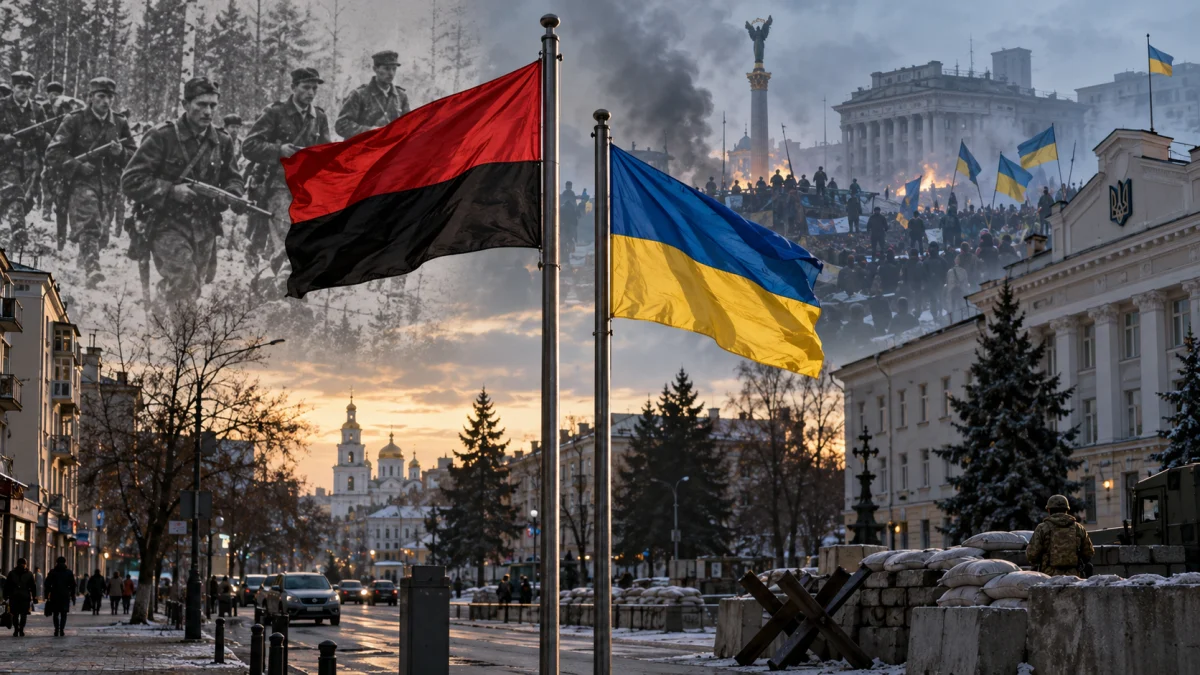
The red-over-black flag seen across Ukraine is not another Ukrainian national flag. Its specific political lineage traces to the Bandera faction of the Organization of Ukrainian Nationalists, or OUN-B, which adopted black and red as its organizational colors in 1941. The banner later became closely associated with the Ukrainian Insurgent Army, or UPA.
But that is only half the answer.
Today the flag can also represent Ukrainian armed resistance, national independence, remembrance of fallen fighters, or opposition to Russian domination. That broader meaning became increasingly visible during the 2013–2014 Euromaidan uprising and the war that followed, and intensified after Russia’s full-scale invasion in 2022. Academic research has documented people in central Ukraine explicitly using the red-and-black imagery simply as a symbol of the country’s contemporary "defenders." (Sage Journals)
That does not erase the flag’s difficult World War II history. OUN-B emerged from an authoritarian radical-nationalist movement with substantial fascist influences, initially cooperated with Nazi Germany, and its activists were implicated in anti-Jewish violence. OUN-B and UPA forces were also responsible for the ethnic cleansing and mass killing of Polish civilians during the war. (OpenURL Connection)
At the same time, describing every modern person who displays the flag as a Nazi is not supported by the evidence either.
The historically accurate answer requires keeping both facts in view.
First: It Is Not Ukraine’s Official Flag
Ukraine has one constitutional state flag: two equal horizontal bands of blue above yellow.
Article 20 of Ukraine’s Constitution explicitly defines the State Flag of Ukraine that way. The red-and-black banner has no equivalent status as a national state flag.
So when someone visiting Ukraine sees the red-and-black banner flying beside the blue-and-yellow flag, they are seeing two different kinds of symbols.
The blue-and-yellow flag represents the Ukrainian state.
The red-and-black flag represents a historical nationalist and armed-struggle tradition whose contemporary meaning varies considerably depending on who is displaying it and why.
And If You Are Seeing It in Sumy, There Is a Specific Reason
This is where the viral question becomes more interesting.
Someone walking around Sumy, in northeastern Ukraine, may understandably wonder why a symbol most strongly associated historically with western Ukrainian nationalism is appearing there.
It is not necessarily accidental.
In June 2018, the Sumy City Council adopted Resolution No. 3541-MR, titled On the Use of the Combat Red-and-Black Flag in the Territory of Sumy. The city said that on commemorative days, municipal buildings displaying the Ukrainian state flag would also display the red-and-black flag. (State Migration Service of Ukraine)
The council’s own explanation explicitly identified it as the flag of the revolutionary Organization of Ukrainian Nationalists and connected its modern use with the 1990 Ukrainian independence movement, the Revolution of Dignity and the defense of Ukraine in the ongoing war. (State Migration Service of Ukraine)
More importantly for the present day, the Sumy council’s current register of valid normative acts still lists Resolution No. 3541-MR concerning use of the red-and-black flag. (State Migration Service of Ukraine)
That makes Sumy an especially useful example of how far the symbol has traveled from its original geographic and ideological setting.
A visitor seeing it there in 2026 is not merely discovering an obscure surviving World War II emblem. Sumy’s local government formally incorporated the banner into certain commemorative practices years ago.
Where Did the Red-and-Black Flag Actually Come From?
The answer is more precise than simply calling it "the UPA flag."
The Organization of Ukrainian Nationalists, or OUN, was founded in 1929. It later fractured, most importantly into factions associated with Andriy Melnyk and Stepan Bandera.
Bandera’s faction became known as OUN-B.
At its Second Great Assembly in Kraków in April 1941, OUN-B approved a separate organizational flag using black and red. Contemporary organizational records initially left the precise arrangement and proportions to be settled later. Historical research based on Ukrainian archival material documents a subsequent directive specifying the now-familiar design:
red on top, black below. (Павло Гай-Нижник)
This distinction matters.
The banner originated as an OUN-B organizational flag before the dominant OUN-B-controlled Ukrainian Insurgent Army had taken shape.
That is why descriptions such as "UPA flag," "OUN flag," "OUN-B flag," "Bandera flag" and "Ukrainian nationalist flag" often overlap today, even though they are not perfectly interchangeable historically.
What Do the Red and Black Mean?
Within OUN-B’s own wartime symbolism, the explanation was straightforward.
A directive cited from Ukrainian archival records explained:
- red as blood
- black as earth
The image was one of Ukrainian soil watered by the blood of those fighting for the country. (Павло Гай-Нижник)
Historians including Grzegorz Rossoliński-Liebe and Per Anders Rudling have situated that symbolism within the broader "blood and soil" political culture of European radical nationalism and fascism in the period. (OpenURL Connection)
There is an important qualification.
Red and black as colors were not invented by OUN-B. Variations of the combination existed earlier in Ukrainian cultural traditions and other organizations. What is historically distinctive here is the specific horizontal red-over-black political banner formalized by OUN-B in 1941.
Pointing out that Ukrainians used the colors before World War II therefore does not erase the flag’s OUN-B provenance.
Conversely, the fact that OUN-B adopted them does not somehow turn every red-and-black object in Ukrainian culture into an OUN symbol.
Context matters.
Was This a Nazi Flag?
Not literally.
It was not a flag of Nazi Germany, the Nazi Party or the German armed forces.
But saying it therefore has "nothing to do with fascism" would go too far in the other direction.
OUN-B in 1941 was an authoritarian, revolutionary ultranationalist movement. Historian Grzegorz Rossoliński-Liebe has characterized its 1941 program and political practice as fascist, while other scholarship has used formulations such as radical nationalism with substantial fascist influences. (OpenURL Connection)
And the relationship with Nazi Germany was real.
Before and during Germany’s invasion of the Soviet Union, OUN-B hoped that German power could help create an independent Ukrainian state. The U.S. Holocaust Memorial Museum notes that OUN had provided German forces with military assistance and intelligence ahead of Operation Barbarossa. OUN-B activists entered Lviv in the environment created by the German invasion in June 1941. (Holocaust Encyclopedia)
OUN-B then proclaimed a Ukrainian state in Lviv on June 30, 1941, envisioning cooperation with Germany against the Soviet Union. (Encyclopedia of Ukraine)
What happened next is crucial because it complicates both political caricatures of the history.
Nazi Germany and OUN-B Did Not Remain Allies
Hitler’s government did not intend to permit an independent Ukrainian state.
German authorities rejected OUN-B’s declaration. After Bandera and Yaroslav Stetsko refused to rescind it, the Germans detained them and subsequently carried out a broader crackdown on OUN-B.
Bandera eventually spent much of the war imprisoned in the special prisoner section at Sachsenhausen concentration camp, remaining there until 1944. (bpb.de)
The nationalist underground’s relationship with Germany consequently became hostile, and armed nationalist forces later fought German troops.
But this chronology produces an important historical rule:
Later conflict with Nazi Germany does not undo earlier collaboration, just as earlier collaboration does not mean OUN-B or UPA remained simple German proxies throughout the entire war.
The relationship changed.
Any account that stops after either half is incomplete.
What Was the UPA, and How Does It Relate to This Flag?
The history of the Ukrainian Insurgent Army, or UPA, is slightly messier than the usual one-sentence description suggests.
Different Ukrainian forces used the UPA name in 1942 and 1943. Taras Borovets operated one insurgent formation, while OUN-B developed its own armed structures. By 1943, OUN-B’s forces had become dominant and absorbed or disarmed rivals. (Encyclopedia of Ukraine)
The resulting UPA became closely controlled politically by OUN-B.
That is how the red-and-black OUN-B banner became so firmly identified with the UPA that it is now usually called the UPA flag.
But historically the sequence is worth remembering:
OUN-B’s red-and-black flag came first. The dominant OUN-B-led UPA followed.
The Darker History Cannot Be Edited Out
This is the part that simplified patriotic accounts sometimes minimize.
OUN-B’s historical record includes genuine atrocities.
The U.S. Holocaust Memorial Museum’s reconstruction of the July 1941 Lviv pogrom documents German forces and OUN-B activists inciting anti-Jewish violence. Jews were seized, beaten, humiliated and murdered, with Ukrainian militia members and some civilians participating alongside German perpetrators. At least several hundred Jews, and possibly considerably more, were killed during the pogrom. (Holocaust Encyclopedia)
It would be inaccurate to extrapolate from that episode that every Ukrainian nationalist committed Holocaust crimes.
It would be equally inaccurate to pretend OUN-B’s involvement is simply a Soviet or Russian invention.
The documentary record is real.
The UPA’s Campaign Against Polish Civilians Is Also Well Documented
The UPA’s record against Polish civilians is another reason the red-and-black flag carries a radically different emotional meaning across Ukraine’s western border.
In Volhynia and Eastern Galicia in 1943–1944, OUN-B and UPA structures participated in a systematic campaign to remove the Polish population from contested territory. That campaign included massacres of entire civilian communities.
Historian Jared McBride, using Ukrainian security-service archives alongside testimony and other records, describes the events as a Ukrainian nationalist-led ethnic-cleansing campaign against Polish civilians. (Cambridge University Press)
Polish forces also killed Ukrainian civilians in retaliatory and intercommunal violence, but acknowledging those killings does not erase the organized UPA campaign against Polish communities.
This history explains why a flag that many Ukrainians now understand as a symbol of anti-Russian resistance can be perceived in Poland as a symbol associated with the murder of Polish civilians.
Those interpretations did not appear from nowhere.
So How Did the Meaning Become Broader?
The transformation accelerated during Euromaidan in 2013–2014.
Red-and-black flags appeared prominently during protests against President Viktor Yanukovych. Far-right organizations were among those using them, and the symbol unquestionably retained an explicitly nationalist constituency.
But it did not remain confined to that constituency.
Research into Ukrainian memory and symbolism finds that imagery associated with Bandera, OUN and UPA increasingly acquired a second contemporary meaning: resistance to a government perceived as aligned with Moscow, followed by armed resistance to Russia itself. (Sage Journals)
Anna Glew’s research into memorial culture in central Ukraine provides an unusually useful example.
At one Russia-Ukraine war memorial incorporating red-and-black colors, a local organizer explained the symbolism simply as representing "the defenders of Ukraine." Glew found that UPA symbolism, historically much more contentious in central Ukraine than in western Ukraine, had begun spreading there as the war created new narratives of national resistance. (Sage Journals)
By the full-scale invasion era, the banner could be found at military checkpoints, public demonstrations, commemorations and liberated towns alongside Ukraine’s national flag. (The Kyiv Independent)
This does not mean its older meaning disappeared.
It means a new layer was added.
Does Flying the Flag Today Mean Someone Is Far Right?
Not by itself.
That conclusion asks a flag to tell us more about an individual than it actually can.
The red-and-black banner remains used by nationalist and far-right organizations, so seeing it in that context can absolutely carry an explicitly ideological meaning.
But researchers have also documented its use by ordinary Ukrainians, local institutions and wartime commemorations in which its immediate meaning is resistance, military sacrifice or national independence rather than a complete endorsement of OUN-B’s 1941 ideology. (Sage Journals)
The context therefore matters enormously.
A red-and-black flag at an ideological OUN commemoration is not necessarily communicating precisely the same thing as one hanging at a contemporary military checkpoint.
And a red-and-black flag displayed by Sumy municipal institutions on commemorative days exists in yet another institutional context.
The flag’s history does not disappear in any of those settings.
But the setting helps tell us which part of that history the person displaying it is invoking.
Nor Does Modern Usage Make the Historical Problem Disappear
There is an opposite mistake worth avoiding.
Symbols can acquire new meanings, but societies do not get to retroactively rewrite the organizations that created them.
A Ukrainian in 2026 may genuinely intend the red-and-black flag to mean:
"We will fight for an independent Ukraine."
That tells us something important about its contemporary meaning.
It does not transform OUN-B’s 1941 politics into liberal democracy, erase its cooperation with Nazi Germany, remove OUN-B activists from the history of anti-Jewish violence, or undo UPA’s campaign against Polish civilians.
Both propositions can be true simultaneously:
The historical movement associated with the flag committed serious crimes and embraced an authoritarian radical-nationalist ideology.
Many people displaying the flag in modern Ukraine are using it for a broader meaning centered on Ukrainian resistance and independence rather than endorsing those crimes or that entire ideology.
That is not a contradiction.
It is how political symbols often evolve.
Ukraine Itself Has Helped Institutionalize the Newer Interpretation
The change was not entirely grassroots.
In 2015, Ukraine enacted a law concerning the status and commemoration of twentieth-century independence fighters. The legislation expressly includes both the Organization of Ukrainian Nationalists and the Ukrainian Insurgent Army among groups whose participants are legally recognized as fighters for Ukrainian independence. That law remains in force. (Zakon)
That does not make every historical action of those organizations lawful, admirable or historically uncontested.
It does help explain why OUN-UPA imagery has entered official commemorative culture in places such as Sumy.
The Sumy City Council expressly referenced that national legislation when adopting its own 2018 red-and-black flag policy. (State Migration Service of Ukraine)
Why Poland Still Sees the Flag Very Differently
The disagreement remains politically active in 2026.
Poland formally established July 11 as a national day commemorating Polish victims of killings by OUN and UPA in a law enacted in 2025. The Polish statute describes the campaign as genocide and says more than 100,000 Poles were murdered, a characterization reflecting Poland’s official legal position. (Sejm API)
Separately, Polish President Karol Nawrocki submitted legislation in September 2025 that would expand criminal provisions concerning promotion of OUN-B and UPA ideology. According to the Polish Sejm’s legislative record, the bill was referred to the Justice and Human Rights Committee in July 2026 and, as of its September 14, 2026 status update, had not become law.
So the controversy surrounding this flag is not merely a historical argument preserved in textbooks.
It remains part of a live dispute about memory between two countries that are otherwise closely aligned against Russia’s invasion.
Is It Fair to Call It the "Bandera Flag"?
That description is understandable but imprecise.
The flag belonged to Bandera’s faction of OUN, which is why the association exists.
But Bandera himself was in German custody for much of the period when the UPA carried out its major 1943–1944 operations. Calling every UPA act something Bandera personally ordered therefore requires evidence beyond the organization’s name.
At the same time, invoking Bandera is not some arbitrary foreign association.
OUN-B literally means the Bandera faction, and the movement’s political identity developed around his leadership.
The most accurate terminology for the flag is therefore:
the red-and-black OUN-B flag, later and popularly associated with the UPA.
Calling it simply the UPA flag is understandable shorthand.
Calling it Ukraine’s second national flag is wrong.
What Can You Actually Infer When You See One?
Not as much as either side of the argument sometimes claims.
| What you see | What the evidence supports |
|---|---|
| Red over black horizontal flag | Historically associated with OUN-B and later UPA |
| Displayed beside Ukraine’s national flag | Common in contemporary nationalist, military and commemorative settings |
| Displayed in Sumy | Sumy adopted a municipal policy in 2018 authorizing its use beside the state flag on commemorative days |
| Someone carries it today | They are invoking some form of Ukrainian nationalist, independence or resistance symbolism |
| Therefore they support OUN-B’s entire 1941 ideology | Cannot be assumed from the flag alone |
| The flag has no connection to fascism or wartime atrocities | Historically false |
| It is an official Ukrainian state flag | False |
| It is literally a Nazi German flag | False |
| Its modern meaning has expanded since 2014 | Well documented |
The Bottom Line
If you are standing in Ukraine and wondering why red-and-black flags are flying beside the familiar blue-and-yellow Ukrainian flag, the short answer is:
You are looking at a historical OUN-B nationalist flag that became associated with the UPA and has since evolved into a much broader Ukrainian symbol of struggle and resistance.
Its history is genuinely uncomfortable.
The flag emerged from the Bandera wing of a radical nationalist movement in 1941. OUN-B initially cooperated with Nazi Germany. Its activists were involved in anti-Jewish violence, and the later OUN-B-dominated UPA carried out ethnic cleansing against Polish civilians.
Those facts should not be sanitized.
But history did not stop in 1945.
During Euromaidan, the Russia-Ukraine war and especially the era following the full-scale Russian invasion, many Ukrainians began using the same banner more broadly to represent resistance, soldiers, national survival and independence.
That transformation is also real.
And in Sumy specifically, there is an unusually concrete answer to why a visitor might encounter so many of them: the city itself adopted a policy in 2018 allowing the red-and-black flag to be flown beside Ukraine’s state flag on commemorative days, and that decision remains listed in the city’s current register of normative acts. (State Migration Service of Ukraine)
So neither easy answer works.
It is not simply a harmless flag with no baggage.
It is not proof that everyone carrying it is a Nazi.
It is a political symbol with a documented radical-nationalist origin, an ugly and consequential wartime history, and a modern meaning that has expanded dramatically under the pressure of another war.
That is why you see it across Ukraine today.
References and Further Reading
Primary and Government Records
Ukraine Constitution, Article 20 The authoritative constitutional definition of Ukraine’s blue-and-yellow state flag and other state symbols. Constitution of Ukraine, Article 20
Sumy City Council, Resolution No. 3541-MR and 2018 explanation The city’s own account of its decision to display the red-and-black flag beside the Ukrainian state flag on commemorative days and its explanation for doing so. Sumy City Council: red-and-black flag decision
Sumy City Council, Current Register of Normative Acts The city’s current register lists Resolution No. 3541-MR, useful for confirming that the 2018 measure remains part of the city’s active regulatory record. Sumy register of current normative acts
Law of Ukraine on the Legal Status and Honoring the Memory of Fighters for Ukraine’s Independence in the Twentieth Century Ukraine’s 2015 legislation explicitly includes the OUN and UPA among twentieth-century independence organizations covered by the law. Verkhovna Rada legislation database
OUN-B, UPA and World War II
U.S. Holocaust Memorial Museum, The Lwów Pogrom of July 1, 1941 Documents the German occupation of Lviv, OUN-B’s relationship with German forces and the participation of OUN-B activists and Ukrainian militia in anti-Jewish violence. USHMM: The Lwów Pogrom of July 1, 1941
Grzegorz Rossoliński-Liebe, "The Ukrainian National Revolution of 1941: Discourse and Practice of a Fascist Movement" Peer-reviewed historical analysis of OUN-B ideology, its 1941 political project and its relationship with Nazi Germany. Kritika article record
"Eugenics and Racial Anthropology in the Ukrainian Radical Nationalist Tradition," Science in Context Academic research documenting OUN-B’s April 1941 assembly and adoption of red-and-black symbolism within its contemporary ideological setting. Cambridge Core article
Jared McBride, "Peasants into Perpetrators: The OUN-UPA and the Ethnic Cleansing of Volhynia, 1943–1944" Peer-reviewed Slavic Review research using archival and testimonial evidence to examine the ethnic-cleansing campaign against Polish civilians. Cambridge Core: Peasants into Perpetrators
Encyclopedia of Ukraine, Ukrainian Insurgent Army Useful for the complicated organizational history of the competing forces that used the UPA name and OUN-B’s eventual dominance. Encyclopedia of Ukraine: Ukrainian Insurgent Army
Modern Meaning and Memory
Anna Glew, "Narrating War Through Visual Language," Journal of European Studies Research into war memorials in central Ukraine showing how red-and-black UPA symbolism acquired additional contemporary meanings connected with Ukraine’s defenders and resistance to Russia. SAGE Journals: Narrating War Through Visual Language
Barbara Törnquist-Plewa and Yuliya Yurchuk, "Memory Politics in Contemporary Ukraine" Academic treatment of OUN-UPA symbolism, Euromaidan and the difficult interaction between Ukrainian national memory, collaboration, civilian killings and modern anti-imperial narratives. SAGE Journals: Memory Politics in Contemporary Ukraine
Kyiv Independent, "Everything You Didn’t Know About Ukraine’s Flag" Contemporary reporting on the visibility of the red-and-black flag at checkpoints, rallies and wartime locations following Russia’s invasion. Kyiv Independent flag explainer
Current Polish Legal Context
Polish Sejm, Bill No. 1760 Legislative Record Official legislative record for the Polish president’s proposal concerning OUN-B and UPA ideology. As of the September 2026 status shown by the Sejm, the bill had been referred to committee rather than enacted. Polish Sejm: Bill No. 1760
Editorial currency note: The core World War II history discussed above is historical, but laws, municipal display policies and contemporary political treatment of OUN-UPA symbolism can change. The current legal references were checked through September 2026.