
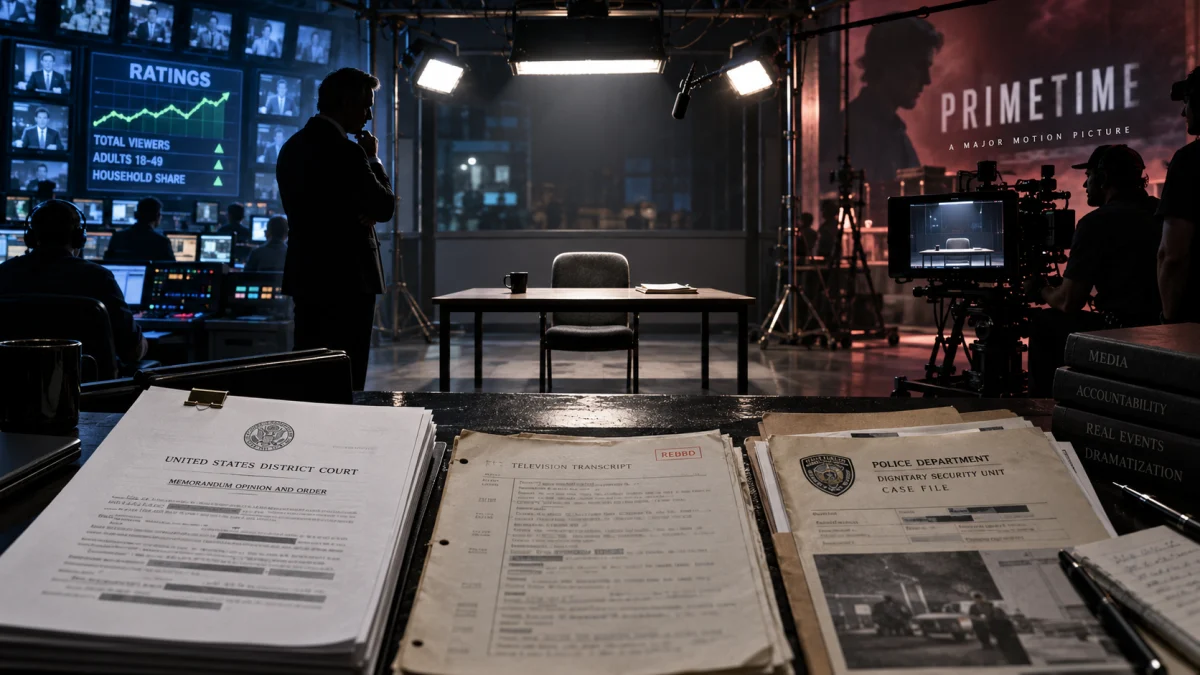
The short answer: Primetime is not trying to tell the familiar story of Chris Hansen as the journalist who exposed adults attempting to meet minors for sex. It deliberately turns the camera back on Hansen, portraying him as increasingly consumed by ratings, celebrity and the spectacle of public punishment. There is legitimate history behind that criticism. But the movie also makes some striking choices about whose conduct it foregrounds and whose it pushes into the background.
That distinction matters.
A24’s Primetime, directed by Lance Oppenheim and starring Robert Pattinson as Hansen, opens in U.S. theaters on September 25, 2026. A24’s official page describes the film simply: “In 2006, To Catch a Predator host Chris Hansen sets out to make television history.”
Oppenheim has been much more explicit about the movie’s thesis.
In his official Venice Film Festival statement, the director describes To Catch a Predator as pioneering a “spectacle of punishment,” where moral outrage became must-see television.
That is a legitimate subject for a movie.
The harder question is whether Primetime fairly examines that subject, or whether it becomes so interested in indicting Hansen that the people he was confronting sometimes become little more than instruments for making Hansen look worse.
Reviews from critics who have already seen the movie suggest that tension is real.
Primetime really does portray Hansen as something close to a villain
This is not simply an angry interpretation of the trailer.
The Los Angeles Times’ review of Primetime describes Pattinson’s Hansen as driven by professional jealousy, ratings and a desire for recognition, while arguing that the film spends relatively little time examining the men arriving at the sting houses.
The Daily Beast’s review is harsher. Critic Nick Schager argues that the movie depicts Hansen as an almost grotesque figure from the beginning while treating the people caught by To Catch a Predator largely as victims of the production.
Whether viewers agree with those reviews is subjective.
The underlying observation is not: the movie intentionally presents Hansen through a deeply hostile lens.
Hansen himself has objected to the portrayal.
In an August 2026 interview with the Los Angeles Times, he said the movie uses his name, image and real people from his life within what he considers a largely fictionalized story. A24 told the Times that Primetime is a dramatized film inspired by true events and that consultation with Hansen was not required.
The filmmakers are therefore not presenting Primetime as a documentary.
But dramatization does not make questions about what was emphasized, omitted or reframed disappear.
One scene is particularly revealing
One of the film’s credited characters is “Red BD / Rabbi,” played by Bob Ari, according to TV Guide’s published cast list.
That designation unmistakably points toward David Kaye, who used the screen name REDBD during the real To Catch a Predator investigation.
Kaye was a Washington-area rabbi who traveled to a Virginia sting house in August 2005 after sexually explicit online conversations with someone he believed was a 13-year-old boy.
His case did not end with a television confrontation.
It went to federal court.
According to contemporaneous Washington Post reporting on Kaye’s conviction, Kaye argued at trial that he believed the supposed 13-year-old was really an adult participating in sexual role-play.
U.S. District Judge James C. Cacheris rejected that defense.
Kaye was convicted of coercion and enticement and of traveling with intent to engage in illicit sexual conduct. The court considered sexually graphic chats, NBC outtakes and Kaye’s own conduct surrounding the meeting.
The Washington Post subsequently reported that Cacheris sentenced Kaye to 78 months in federal prison followed by 10 years of supervised release.
That history makes the corresponding scene in Primetime unusually important.
The film gives Kaye’s confrontation a very different dramatic function
The Los Angeles Times describes a scene in which the rabbi angrily challenges Hansen during the sting, demanding to know what gives Hansen the right to do what he is doing.
According to the review, it becomes one of the movie’s strongest moments of uncertainty about whether Hansen himself has become morally compromised.
There is nothing inherently illegitimate about dramatizing that challenge.
Hansen’s methods are fair game for criticism.
But the historical record changes how the scene looks.
In the actual federal case, Kaye’s reaction to Hansen was part of a much larger evidentiary record that included the sexually explicit chats, his travel to the house and testimony the judge ultimately rejected.
The Washington Post reported that Cacheris described the government’s evidence as overwhelming and specifically noted Kaye’s response after Hansen confronted him.
That creates a legitimate question for Primetime:
If a dramatization uses Kaye’s anger to make the audience question Hansen, how much does it tell viewers about what the subsequent federal prosecution actually established?
That is not an argument that Hansen’s conduct was beyond criticism.
It is an argument for applying scrutiny in both directions.
To Catch a Predator really did have serious ethical problems
Any honest examination of Primetime also has to acknowledge why the filmmakers had substantial material to work with.
The strongest example is not David Kaye.
It is Louis William Conradt Jr.
Conradt was a Texas assistant district attorney suspected of sexually explicit online communications with someone presented to him as a 13-year-old boy.
Unlike the typical To Catch a Predator target, Conradt did not arrive at the sting house.
Police instead went to his home.
An NBC crew was outside as officers attempted to execute warrants. Conradt died by suicide as police entered.
His sister later sued NBC.
In the federal case Conradt ex rel. Conradt v. NBC Universal, Inc., U.S. District Judge Denny Chin allowed significant portions of the lawsuit to proceed.
The procedural context is critical.
The court was ruling on a motion to dismiss. It was not making a final factual finding that NBC had committed the misconduct alleged by Conradt’s family.
But Chin concluded that, if the allegations were eventually proven, a jury could find that NBC had crossed the boundary between journalism and reckless participation in law enforcement and had helped push police toward unnecessary tactics in pursuit of dramatic television footage.
NBC disputed wrongdoing.
The litigation did not end with a trial verdict. NBC and Conradt’s family later reached an undisclosed settlement, according to contemporaneous Los Angeles Times reporting.
That same report contains another uncomfortable fact: the Collin County district attorney’s office declined to pursue more than 20 prosecutions arising from the Murphy, Texas operation because of problems with the evidence.
Those are not trivial criticisms.
They establish that To Catch a Predator was not simply conventional law enforcement with cameras present.
NBC, the civilian organization Perverted Justice and local police operated in an unusual relationship where journalism, entertainment and criminal investigation sometimes overlapped.
That deserves scrutiny.
But criticizing the machinery does not erase what some targets actually did
This is where the argument around Primetime can become strangely binary.
Two things can be true simultaneously.
NBC’s methods could cross ethical lines.
And some of the people Hansen confronted could still have knowingly attempted to arrange sexual encounters with minors.
David Kaye’s case demonstrates the second point unusually clearly because his conduct was subjected to an actual federal prosecution rather than merely a television confrontation.
His defense was heard.
The evidence was examined.
The judge rejected his explanation.
He was convicted.
If Primetime wants to explore the moral danger of public humiliation becoming entertainment, that is a legitimate artistic argument.
But turning a convicted offender’s outrage at being exposed into an indictment of the person confronting him can become misleading if viewers are not given enough information to understand what preceded and followed that confrontation.
The ethics of the camera and the culpability of the person in front of it are separate questions.
One does not cancel the other.
Why was Primetime already skeptical of Hansen?
There is also a straightforward explanation for the movie’s perspective that predates most of the current speculation surrounding it.
Primetime was written by Ajon Singh and draws from Luke Dittrich’s 2007 Esquire investigation, “Tonight on Dateline This Man Will Die.”
The screenplay’s critical orientation also existed before Oppenheim was selected as director.
Robert Pattinson told British GQ that he initially joined the project as a producer because he liked the first draft of the screenplay. Only afterward did the team consider Oppenheim as director.
That chronology matters.
It means the project’s fundamental interest in questioning Hansen was not something Oppenheim suddenly imposed after taking control of the movie.
Oppenheim and Singh continued developing the screenplay together, and later revisions pushed the film further toward the surreal and psychological style now visible in the finished product.
But the underlying critique was already there.
Primetime itself was publicly reported as an A24 project on October 22, 2024, when TheWrap reported that Oppenheim was attached to direct and Singh had written the screenplay.
That date becomes important when examining another claim now circulating around Hansen.
Did Chris Hansen catch Benjamin Netanyahu’s former security chief?
The man at the center of that claim is Matthew Mahl, a 23-year veteran of Washington, D.C.’s Metropolitan Police Department.
Mahl was arrested in Maryland in April 2026 after an undercover investigator posed as a 15-year-old boy.
According to court records summarized by WTOP after Mahl’s guilty plea, Mahl disclosed during the conversations that he was a D.C. police lieutenant involved in presidential escorts. Prosecutors said he exchanged sexually explicit material with the undercover investigator, acknowledged the supposed teenager’s age and arranged a meeting.
Several news organizations have reported that Matthew Mahl previously served as a security aide or security chief connected to Israeli Prime Minister Benjamin Netanyahu. sherafy.com could not independently verify that specific job title. What is independently established is that Mahl was a senior D.C. police officer whose duties included presidential and foreign-dignitary security, and that he appears to have worked security connected to at least one Netanyahu visit to Washington.
Hansen’s own Have a Seat episode about the case, “The Lieutenant,” describes Mahl as someone who ran presidential motorcades and escorted foreign heads of state
Jordan-based Roya News reported in May 2026 that Mahl was a “former security chief for Israeli Prime Minister Benjamin Netanyahu.” The same report later described his former position more broadly as “a security role linked to the office” of Netanyahu. Press TV and other regional outlets published similar accounts.
Those reports mean the Netanyahu connection should not be dismissed as something invented entirely on social media.
There is, however, an important unresolved sourcing problem.
None of the reports sherafy.com reviewed provides an Israeli government personnel record, Metropolitan Police Department employment record, statement from Netanyahu’s office, named official source or other primary documentation establishing that Mahl formally served as Netanyahu’s personal security chief.
The independently documented part of Mahl’s career is clearer.
Mahl was a 23-year veteran of Washington, D.C.’s Metropolitan Police Department and was assigned to its Special Operations Division when he was arrested. Court records cited by WTOP say Mahl described himself during the undercover conversations as a lieutenant involved in presidential escorts.
Chris Hansen has likewise described Mahl as someone who ran presidential motorcades and escorted foreign heads of state through Washington.
There is also a more specific Netanyahu connection. In accounts of Hansen’s confrontation with Mahl, Mahl is described as having told the undercover decoy that he had recently worked an escort involving President Donald Trump and Prime Minister Benjamin Netanyahu.
That would be entirely consistent with Mahl’s documented D.C. police duties.
But it leaves an important distinction unresolved.
A D.C. police lieutenant assigned to protect or escort Netanyahu during an official visit could accurately be described as having worked security for Netanyahu’s visit without having been employed by Netanyahu or having served as the head of his personal security detail.
At the same time, because multiple news organizations independently published the stronger “former security chief” description, sherafy.com is not treating that characterization as definitively disproven. We simply have not found the primary evidence necessary to verify it.
What is not disputed is the criminal case.
Mahl was arrested in April 2026 after an undercover Harford County investigator posed as a 15-year-old boy. Prosecutors said Mahl exchanged sexually explicit messages and images with the supposed teenager, discussed his age and arranged an in-person meeting.
The operation was conducted through the Harford County Sheriff’s Office’s partnership with Takedown with Chris Hansen.
Mahl pleaded guilty on August 7, 2026, to two felony counts of solicitation of a minor. He remained jailed without bond ahead of a sentencing scheduled for September 30.
And the timeline rules out one version of the theory entirely
This part is much easier to establish.
Mahl was arrested in April 2026.
Primetime was already publicly announced in October 2024.
The screenplay existed before that announcement, and Pattinson has said he had already read its first draft before Oppenheim was selected to direct.
So whatever explains Primetime’s hostile depiction of Hansen, the Matthew Mahl sting cannot explain why the movie was conceived or why its underlying argument against Hansen exists.
The basic creative direction predates Mahl’s arrest by well over a year.
That does not mean every broader concern surrounding the movie is invented.
It means chronology allows us to eliminate this particular causal theory.
There is a difference between a connection and an explanation
This is where discussion around Primetime can go wrong.
Several of the underlying connections are real.
David Kaye was genuinely confronted in a Hansen sting and later convicted in federal court.
Primetime appears to recreate his confrontation and explicitly credits a character as “Red BD / Rabbi.”
Matthew Mahl genuinely held a sensitive D.C. police position involving presidential and foreign-dignitary escorts.
Hansen genuinely participated in the operation that caught him.
Mahl genuinely pleaded guilty.
Those facts are worth reporting.
But none of them, separately or together, establishes why the creators of Primetime chose to portray Hansen as they did.
For that question, we have much more direct evidence.
The movie developed from reporting about the Conradt controversy.
Singh’s critical screenplay existed before Oppenheim joined as director.
Oppenheim has publicly described To Catch a Predator as a case study in televised punishment and spectacle.
And Primetime was already deep into development long before Mahl’s arrest.
Those facts create a documented chain explaining the film’s point of view.
A more elaborate retaliation theory does not currently have comparable evidence.
The strongest criticism of Primetime does not require a conspiracy
There is actually a sharper criticism available.
The movie appears willing to interrogate Hansen’s ambition, ego, journalistic methods and appetite for spectacle in extraordinary detail.
Good.
Those are legitimate subjects.
But the same evidentiary standard should apply to the people whose anger or humiliation the movie uses to challenge him.
If a real target subsequently went through a federal trial, had his defense rejected and received a lengthy prison sentence, that matters.
If a federal court criticized NBC’s conduct only while considering allegations at a preliminary stage of litigation, that procedural limitation matters too.
If a later Hansen sting catches a police lieutenant who actually pleads guilty, that matters.
And if an online story upgrades “D.C. officer who worked presidential and foreign-dignitary escorts” into “Netanyahu’s former chief of security,” that needs correcting regardless of whether the correction helps Hansen, hurts Hansen or makes the story less dramatic.
That is the distinction between investigation and narrative.
What Primetime gets right, and what viewers should keep separate
Primetime is on solid ground when it asks whether NBC transformed punishment into profitable entertainment.
The Conradt case alone makes that question unavoidable.
It is also reasonable to ask whether Hansen benefited personally and professionally from the enormous attention To Catch a Predator generated.
But neither question requires treating the underlying conduct of the show’s targets as morally incidental.
In Kaye’s case, a federal judge did not simply accept Hansen’s television narration.
The court independently evaluated the chats, testimony and surrounding evidence and convicted him.
Likewise, Mahl’s current case does not rest on Hansen pointing a camera at somebody and declaring him guilty.
Mahl pleaded guilty in court.
The useful questions therefore are not:
Was Chris Hansen a hero?
or:
Was Chris Hansen a villain?
Both are too simple.
The better questions are:
Did Hansen and NBC expose genuinely dangerous conduct?
In multiple documented cases, yes.
Did the television operation sometimes create serious journalistic, ethical and legal problems of its own?
Yes.
Can a filmmaker reasonably explore Hansen’s ambition, celebrity and the spectacle surrounding the program?
Certainly.
Does doing that require minimizing what some of the people he confronted actually did?
No.
That last distinction may be where Primetime deserves the most scrutiny.
Once the argument becomes a competition to decide which side must be entirely righteous and which must be entirely corrupt, the evidence starts disappearing.
Bottom line
Primetime makes Chris Hansen look disturbing because that is the movie’s thesis, not an accidental side effect of Robert Pattinson’s performance.
The filmmakers are examining how legitimate moral outrage can become entertainment, how journalism can blur into law enforcement and how television rewards escalation. The Conradt case gives them substantial historical grounds to ask those questions.
But the movie should be scrutinized just as aggressively as the television program it scrutinizes.
One of its most provocative confrontations appears to draw directly from David Kaye, whose anger at Hansen looks different when placed beside the subsequent federal case that convicted him and sent him to prison for more than six years.
Meanwhile, the newer claim that Hansen caught “Netanyahu’s former security chief” contains a real underlying connection but exaggerates it substantially. Matthew Mahl was a D.C. police lieutenant whose duties included presidential and foreign-dignitary escorts. He was caught in a Hansen-associated sting and later pleaded guilty. There is no evidence in the records reviewed by sherafy.com that he served as Netanyahu’s personal security chief.
And most decisively, Primetime was already being developed long before Mahl was arrested.
There is therefore plenty here worth questioning without inventing the missing links.
The strongest criticism of Primetime is not that some hidden interest must have ordered Hollywood to attack Chris Hansen. It is that a film condemning sensationalized moral storytelling has an obligation not to build its own moral argument by selectively simplifying the people and events it dramatizes.
That is a much more serious criticism because it can actually be tested against the record.
References and Further Reading
The Film and Its Development
Primetime — A24
A24’s official film page, including the September 25, 2026 U.S. release date, cast and synopsis.
Primetime — Venice Film Festival
Official festival listing containing Lance Oppenheim’s director statement and his description of To Catch a Predator as a spectacle of punishment.
Robert Pattinson on Primetime’s Development — British GQ
Pattinson explains that he liked the first draft of Ajon Singh’s screenplay before Oppenheim was considered as director.
Robert Pattinson to Produce Crime Drama Primetime for A24 — TheWrap
The October 22, 2024 announcement establishing that Primetime and its critical screenplay substantially predated the Matthew Mahl sting.
Tonight on Dateline This Man Will Die — Esquire
Luke Dittrich’s 2007 investigation into the Murphy, Texas operation and Bill Conradt case, which became source material for Primetime.
The Film’s Portrayal of Hansen
Primetime and Chris Hansen Deserve Each Other — Los Angeles Times
Review examining the movie’s treatment of Hansen, its fictionalization of the Conradt episode and the confrontation involving the “rabbi” character.
How Primetime Gets To Catch a Predator All Wrong — The Daily Beast
A sharply critical review arguing that the film overwhelmingly directs its moral condemnation toward Hansen while treating the people caught in the stings differently.
Why Chris Hansen Hasn’t Seen the New Film About To Catch a Predator — Los Angeles Times
Detailed reporting on Hansen’s objections, A24’s response, the film’s source material and the history of the original NBC series.
Primetime Cast and Crew — TV Guide
Published cast listing identifying Bob Ari’s character as “Red BD, Rabbi.”
David Kaye
Rabbi Guilty in Child Sex Case — The Washington Post
Contemporary report on Kaye’s federal conviction, the evidence considered by Judge James C. Cacheris and Kaye’s claim that he believed the supposed 13-year-old was an adult role-playing.
Rabbi Sentenced in Internet Sex Sting — The Washington Post
Reports Kaye’s 78-month federal sentence and 10 years of supervised release.
The Conradt Case and NBC
Conradt ex rel. Conradt v. NBC Universal, Inc. — U.S. District Court Opinion
The February 26, 2008 federal ruling allowing significant claims against NBC to proceed. Important for distinguishing allegations deemed legally sufficient from final findings of liability.
NBC Settles Suit Over Suicide — Los Angeles Times
Contemporary reporting on the undisclosed settlement and the Collin County district attorney’s decision not to prosecute more than 20 cases arising from the Murphy operation.
Matthew Mahl
D.C. Police Lieutenant Pleads Guilty in Child Sex Abuse Sting — WTOP
Confirms Matthew Mahl’s guilty plea to two felony solicitation counts and summarizes court records describing his D.C. police career and presidential-escort responsibilities.
The Lieutenant — Have a Seat with Chris Hansen
Hansen’s own program about the Mahl case, describing Mahl’s work running presidential motorcades and escorting foreign heads of state. Useful as a primary source for Hansen’s characterization of the case, but not independent proof of every assertion made by the program.
Editorial currency note: Matthew Mahl was scheduled for sentencing on September 30, 2026 at the time this article was prepared. That section should be updated after sentencing or if the court schedule changes.