
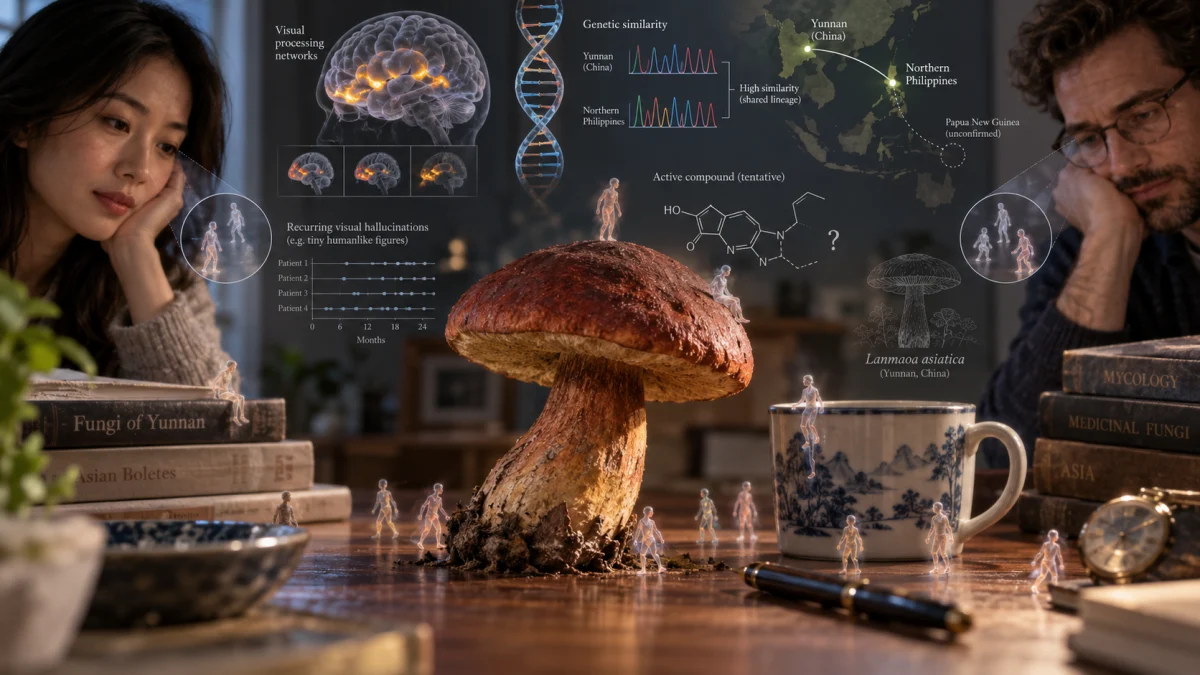
A mushroom associated with vivid hallucinations of miniature humanlike figures is real. The clinical reports are real. Researchers have genetically linked mushrooms associated with the phenomenon in southwestern China and the northern Philippines. And scientists still do not know which chemical in the mushroom is responsible.
But one extraordinary claim has quietly turned into an even more extraordinary one.
People exposed to Lanmaoa asiatica appear unusually prone to the same kind of hallucination: tiny people or humanlike figures that seem to occupy the ordinary physical environment.
Science has not shown that two people sitting beside each other look at the same lamp and independently see the same tiny man climbing it.
That distinction matters.
The evidence so far points toward a remarkable and poorly understood property of human perception, apparently triggered by an unidentified mushroom compound or combination of compounds. It does not establish shared visions, hidden gnomes or a glimpse through some otherwise invisible layer of reality.
And the verified version is already strange enough.
What is actually established?
Here is where the evidence stands as of September 2026.
| Claim | What the evidence actually shows |
|---|---|
| Lanmaoa asiatica is a real mushroom | Verified |
| It can cause vivid visual hallucinations | Well documented clinically |
| Tiny people are a characteristic reported hallucination | Yes. Clinically documented and repeatedly reported |
| Every poisoned person sees tiny people | No |
| More than 90% see tiny people | Not established. A large study found visual hallucinations in 90.7% of patients, not specifically tiny people in 90.7% |
| Chinese and northern Philippine mushrooms associated with the phenomenon are the same species | Supported by DNA sequencing |
| The Papua New Guinea mushroom is also L. asiatica | Not established |
| Psilocybin explains the effect | No evidence for the canonical psilocybin biosynthetic pathway |
| Scientists know which chemical causes the hallucinations | No |
| Two people have been shown to see the same individual tiny figure | No published demonstration located for this article |
| The phenomenon proves elves, fairies or gnomes exist | No |
That distinction between similar hallucinations and a shared hallucination is the part much of the viral coverage skips.
The mushroom really does send people to hospitals with bizarre visual hallucinations
The strongest evidence does not come from folklore. It comes from hospitals in Yunnan, China, where Lanmaoa asiatica is eaten as a wild food but can cause poisoning when improperly prepared.
A 2023 clinical study of 398 patients with Lanmaoa asiatica poisoning examined patients treated at the Affiliated Hospital of Yunnan University in 2020 and 2021.
The study reported visual hallucinations in 90.7% of patients, delirium in 35.2%, dizziness in 30.7% and mania in 9.1%. Most neuropsychiatric symptoms appeared after a delay of roughly 12 to 24 hours. No deaths were recorded in that series.
But the paper did not establish that 90.7% of patients specifically saw tiny people.
That distinction has been blurred in some popular retellings.
A separate 2024 Hong Kong Journal of Emergency Medicine case series examined 81 patients treated in Yunnan during 2023. Fifty-six patients, or 69.1%, had visual hallucinations. In the paper’s clinical table, those hallucinations are characterized as “seeing little people,” and the discussion notes that some patients reported “little people” or “elves” dancing.
The same study found that six patients, or 7.4%, required admission to a psychiatric unit because neuropsychiatric symptoms persisted.
So “this mushroom can make people see little people” is a defensible summary of a real recurring phenomenon.
“Everyone who eats it sees little people” is not.
There is another caveat worth preserving: the 81-patient study did not genetically sequence the mushroom consumed by every patient. Identification was based on patient recollection or photographs compared with a fungal atlas. That is reasonable clinical evidence, but it is not the same thing as DNA-confirming every meal.
These are not ordinary reports of psychedelic colors and shapes
One reason the phenomenon has attracted so much attention is that the reported figures often seem to occupy ordinary physical space.
Researcher Colin Domnauer, a University of Utah doctoral researcher working with the Natural History Museum of Utah, has collected accounts in which miniature figures appear to move around dishes, furniture and other real objects. His descriptions are field reports and interviews, not a controlled clinical census, so the colorful details should not be turned into precise population statistics.
The broader phenomenon has a clinical name: Lilliputian hallucinations, after the miniature inhabitants of Lilliput in Jonathan Swift’s Gulliver’s Travels.
And Lanmaoa asiatica is not the only circumstance in which the human brain produces them.
The biggest clue comes from people who never ate this mushroom
Psychiatrist Jan Dirk Blom conducted a systematic review of Lilliputian hallucinations that examined 145 published reports and case series containing 226 case descriptions.
The hallucinated entities could be miniature humans, animals or fantasy figures. Some experiences were purely visual, while others involved multiple senses.
One result is particularly relevant to the mushroom reports:
In 97% of the cases, the miniature figures were perceived as grounded in the person’s actual environment.
In other words, the brain was not merely producing abstract imagery. It was apparently integrating hallucinated entities into the perceived geometry of the real world.
The causes in the review were highly varied. Schizophrenia-spectrum disorders, alcohol-use disorders and loss of vision together accounted for half of the cases, while neurological disease accounted for another 36%. Blom discussed perceptual release and deafferentiation as leading possible mechanisms, although the underlying neuroscience is not settled.
That changes the most useful way to think about Lanmaoa asiatica.
The mushroom does not need to contain a chemical whose peculiar biological purpose is to manufacture elves.
A more plausible scientific possibility is that it triggers a perceptual state the human brain is already capable of entering through several very different routes.
That still leaves an extraordinary question:
Why does the human visual system have such a repeatable way of constructing miniature beings and placing them into real-looking space?
We do not yet know.
China and the northern Philippines provide the strongest cross-cultural evidence
The cross-cultural part of the story is also real, but it needs careful wording.
In Yunnan, Lanmaoa asiatica has long been eaten as food and is notorious for hallucinations when undercooked. In 2024, Domnauer traveled to a community in the northern Philippines where local knowledge associated a wild mushroom called “Sedesdem” with visions of little people.
He collected specimens in both regions.
According to the University of Utah’s report on the research and the Natural History Museum of Utah field account, DNA sequencing identified the Chinese and northern Philippine mushrooms as the same species: Lanmaoa asiatica.
That matters.
A theory in which one community simply learns to expect tiny people from its own folklore becomes less satisfying when a geographically distant community independently associates the same unusual type of experience with the same DNA-identified mushroom species.
It is strong evidence for a biological component.
It does not prove that culture plays no role in the exact appearance, clothing, behavior, personality or interpretation of the figures. Hallucinations can have biological triggers while their details are shaped by memory, expectation and culture.
The careful conclusion is that the evidence supports a repeatable biological trigger for a recurring class of hallucination, not culturally identical experiences down to the individual figure.
Papua New Guinea is much less settled than the viral story suggests
This is one of the biggest factual problems in simplified versions of the story.
Reports connecting wild mushrooms with unusual behavior in Papua New Guinea date back to the 1930s. Later anthropologists and mycologists investigated what became known as “mushroom madness,” but the responsible species and pharmacology remained disputed.
A 2024 review of the historical New Guinea literature argued that earlier conclusions may deserve re-examination in light of newer evidence involving psychoactive boletes elsewhere in Asia and Melanesia.
But this remains a historical and ethnomycological question, not a DNA-confirmed Lanmaoa asiatica case.
University of Utah researchers attempted to close that gap. Bryn Dentinger traveled to Papua New Guinea hoping to collect comparison specimens, but unusually dry conditions prevented the team from obtaining suitable mushrooms.
Therefore:
China and the northern Philippines are genetically linked to Lanmaoa asiatica. Papua New Guinea is not.
Papua New Guinea is an intriguing parallel that deserves additional fieldwork. It should not be presented as a third genetically confirmed population.
Scientists still do not know what chemical causes the hallucinations
This may be the strangest verified part of the entire story.
A 2026 Mycologia study by Colin Domnauer and Bryn Dentinger used whole-genome sequencing across 53 Lanmaoa specimens and reconstructed the evolutionary relationships of the genus.
When the researchers mined the L. asiatica genome, they did not detect the canonical biosynthetic genes associated with psilocybin or ibotenic acid production.
The authors said this suggests the presence of a novel psychoactive compound.
That wording is important.
It does not mean scientists searched the mushroom and discovered that it contains “no chemicals.”
Researchers have already isolated many chemical constituents from L. asiatica. A 2025 Fitoterapia study isolated four previously undescribed compounds along with 16 known compounds from the fruiting bodies. A 2026 Chemistry & Biodiversity study reported two previously undescribed pyrrole alkaloids, asiaticain A and asiaticain B.
Neither study established that those newly described compounds cause the characteristic hallucinations.
The Natural History Museum of Utah research team has also reported that its chemical analyses have not identified a known psychoactive compound that explains the effect.
So the scientifically responsible statement is simple:
The psychoactive agent remains unidentified.
It could prove to be a previously unknown molecule, an unexpected psychoactive effect of a known molecule, multiple compounds acting together, or chemistry arising from a pathway researchers have not yet recognized.
The genome results make novel chemistry especially interesting. They do not yet tell us what that chemistry is.
The metabolomics study did not discover the mushroom’s mystery drug
Another recent paper can easily be misunderstood.
A 2025 Food Science & Nutrition metabolomics study compared blood plasma from 20 patients with L. asiatica poisoning against 20 healthy controls.
Fifteen of the 20 poisoned patients experienced hallucinations. Researchers identified 914 differential metabolites between the patient and control groups and found evidence of disrupted metabolic pathways, including oxidative phosphorylation.
Those 914 metabolites were changes measured in the patients’ plasma.
They were not 914 compounds isolated from the mushroom, and the study did not identify the substance responsible for the tiny-person hallucinations.
The paper may help researchers understand how poisoning affects the body, but it did not solve the central chemical mystery.
As of September 2026, that remains open.
So are different people actually seeing “the same thing”?
This is where ordinary language gets ahead of the evidence.
When articles say people are “seeing the same hallucination,” readers can reasonably interpret that to mean multiple witnesses perceive an identical scene.
That has not been demonstrated.
The evidence supports something narrower:
Different people, sometimes in widely separated places, have independently reported a recurring category of hallucination involving miniature humanlike entities.
That is scientifically interesting.
But compare it with the much stronger claim:
Two people ingest the substance together. Without communicating, both independently report a 10-centimeter-tall man in a red coat standing on the same corner of the same table, doing the same thing at the same time.
A search of the published literature for this article found no controlled study demonstrating anything like that.
The 2024 81-patient series is particularly useful here because the authors explicitly wrote that no group poisoning incidents occurred in their study. That cohort therefore could not answer the viral question by comparing simultaneous observers.
The larger 398-patient study provides aggregate symptom data, not matched descriptions showing that different people perceived the same individual figure in the same location.
So we have evidence for recurrent phenomenology.
We do not have evidence for shared visual content.
Those are very different claims.
What would it mean if two people really did see the same tiny man?
It would be fascinating, but it still would not immediately prove that an external miniature being had become visible.
Researchers would first need to rule out ordinary explanations such as communication between observers, shared expectations, cultural priming, prior knowledge of the mushroom’s reputation, environmental cues, interviewer suggestion, memory contamination and coincidence.
A serious test would need independent reports collected before participants could compare notes, precise descriptions of location and behavior, predefined standards for what counts as a match, and controls against participants influencing one another.
There is a genuinely interesting scientific experiment hiding inside the viral question.
There is not yet a result.
And because the medical literature treats these episodes as mushroom poisoning, this is not an experiment people should try to reproduce themselves. The dose-response relationship and active substance remain unknown, and some patients experience prolonged neuropsychiatric effects.
Does any of this support the idea that gnomes or elves are real?
As a philosophical possibility, a person can propose almost anything.
As a scientific conclusion, the evidence currently provides no reason to say that Lanmaoa asiatica allows humans to perceive objectively existing elves, fairies, gnomes or miniature people.
The known evidence fits a neurological explanation much more directly.
The human brain is independently known to generate Lilliputian hallucinations under multiple medical and neurological circumstances. L. asiatica appears capable of triggering an unusually characteristic version of that perceptual phenomenon.
The cross-cultural evidence makes the mushroom more scientifically interesting, not more supernatural.
In fact, the broader Lilliputian-hallucination literature may provide the biggest clue. Human perception appears capable of generating small agent-like figures and embedding them convincingly into three-dimensional surroundings.
If scientists eventually isolate the mushroom’s active compound, it could provide a new research tool for studying how the brain determines whether an object is internally generated or externally perceived, how perceived size is constructed, and how hallucinatory imagery becomes anchored to real space.
Those possibilities remain hypotheses.
But they arise from a phenomenon that is very real and very much unsolved.
The strangest part of this story does not need exaggeration
Lanmaoa asiatica is real.
People poisoned after eating it have been hospitalized with striking visual hallucinations. Miniature humanlike figures are a characteristic recurring report. DNA work has linked mushrooms associated with those experiences in China and the northern Philippines. Genome mining did not find the canonical biosynthetic machinery expected for psilocybin or ibotenic acid, and scientists still have not identified the molecule responsible.
Meanwhile, medicine already knows that the human brain can manufacture miniature people under an assortment of completely different neurological and psychiatric circumstances.
What nobody has shown is the detail that would make this story substantially stranger:
two independent observers perceiving the same individual little person in the same place at the same time.
Until evidence for that exists, “everyone sees the same hallucination” goes one step too far.
The evidence supports something subtler and, scientifically, more useful:
There appears to be a mushroom with unidentified psychoactive chemistry that can repeatedly push human perception toward one of the strangest visual experiences our brains are capable of producing.
We still do not know why the brain has that setting.
References and Further Reading
Primary Research
Phylogenomic systematics of Lanmaoa (Boletaceae) reveals cryptic diversity, resolves global evolutionary relationships, and suggests a novel psychoactive lineage — Mycologia (2026)
Domnauer and Dentinger’s genome-level study of 53 Lanmaoa specimens. It found no canonical biosynthetic genes associated with psilocybin or ibotenic acid production in L. asiatica and concluded that an unidentified psychoactive compound may be involved.
Analysis of epidemiology and clinical characteristics of Lanmaoa asiatica poisoning — Journal of Clinical Emergency (2023)
A 398-patient Yunnan clinical series. Visual hallucinations were reported in 90.7% of patients. This is the source most useful for correcting the misleading claim that more than 90% specifically saw tiny people.
Neuropsychiatric symptoms following the consumption of Lanmaoa asiatica, a poisonous mushroom native to Yunnan — Hong Kong Journal of Emergency Medicine (2024)
An 81-patient case series in which visual hallucinations characterized as “seeing little people” occurred in 56 patients, or 69.1%. The study also reported no group poisoning incidents and six psychiatric admissions for persistent symptoms.
Untargeted Metabolomic Analysis Using UPLC-MS/MS Reveals Metabolic Changes Associated With Lanmaoa asiatica Poisoning — Food Science & Nutrition (2025)
Compared plasma from 20 poisoned patients with 20 controls and identified 914 differential metabolites. It describes the body’s metabolic response to poisoning rather than identifying the mushroom’s active hallucinogen.
Leroy’s elusive little people: A systematic review on Lilliputian hallucinations — Neuroscience & Biobehavioral Reviews (2021)
Systematic review of 226 case descriptions from many causes. Especially important because 97% of the miniature entities were perceived as grounded in the real environment.
Mushroom Chemistry
Chemical constituents from the fruiting bodies of Lanmaoa asiatica and their anti-inflammatory activity — Fitoterapia (2025)
Researchers isolated four previously undescribed compounds and 16 known compounds from the mushroom. The study did not identify the substance responsible for the hallucinations.
Two New Pyrrole Alkaloids From Lanmaoa asiatica — Chemistry & Biodiversity (2026)
Reports two newly described pyrrole alkaloids, asiaticain A and asiaticain B. Their discovery is another reason it is inaccurate to say scientists found “nothing” in the mushroom; what remains unknown is which compound or combination causes the psychoactive effect.
Field Research and Historical Context
Scientists identify mushroom behind ‘tiny people’ hallucinations — University of Utah (2026)
University account of the China and northern Philippines fieldwork, DNA identification and the unresolved Papua New Guinea comparison.
Experts Explore New Mushroom Which Causes Fairytale-Like Hallucinations — Natural History Museum of Utah
Colin Domnauer’s field account describing the northern Philippines collection, the identification of Sedesdem as L. asiatica, and the continuing search for the active compound.
A new interpretation of the “mushroom madness” of New Guinea — Antrocom Journal of Anthropology (2024)
A modern re-examination of the complicated Papua New Guinea ethnomycology literature. Useful context, but not evidence that the New Guinea mushroom has been genetically identified as L. asiatica.
Editorial currency note: Research on Lanmaoa asiatica is active. The compound responsible for its psychoactive effects had not been established in the literature reviewed for this article as of September 20, 2026. If that molecule is identified, or if researchers conduct a controlled comparison of simultaneous observers, the article should be updated.