The disappearance of Liu Huijun (劉慧君) and her four-year-old daughter is genuinely unresolved. But the version often repeated online makes one part of the mystery sound more impossible than the evidence supports.
They did not simply enter an elevator and vanish from a sealed building in which every possible exit was covered by cameras.
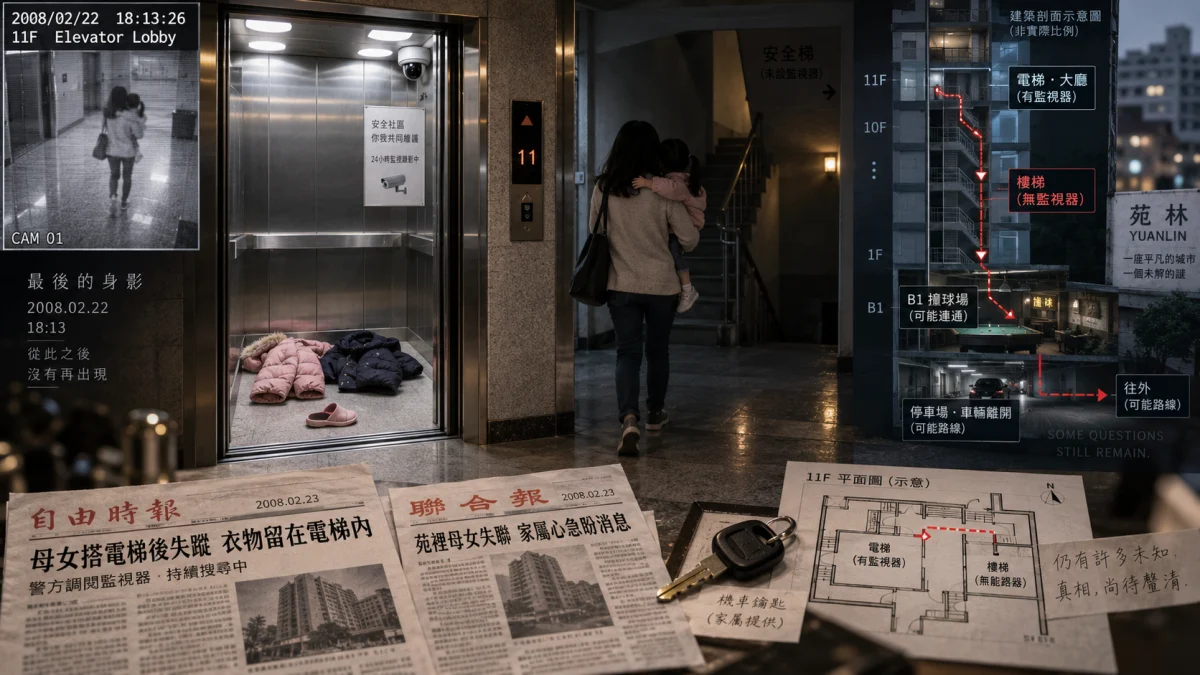
Contemporary Taiwanese reporting shows that the mother and daughter rode an elevator to the 11th floor, got out, and headed toward a stairwell that was not covered by the building’s surveillance system. Years later, police and residents also described blind spots around the basement, a billiards-hall connection, and a vehicle exit that could potentially have allowed someone to leave without appearing on the lobby cameras.
That does not solve the case.
It explains something narrower: how Liu and her daughter could conceivably have moved beyond the camera-covered areas without being recorded.
The harder question is what happened after that.
Police searched the building and surrounding areas, later checked medical, school, financial, insurance, and other records, and retained family DNA for comparison with unidentified remains. No confirmed later trace of either mother or daughter has been publicly established. Their bodies have never been found.
The strongest evidence therefore points to a mystery with two separate parts:
- How did they get beyond the building’s cameras?
- What happened to them afterward?
The first question may have an ordinary explanation.
The second remains unresolved.
What happened to Liu Huijun and her daughter?
On January 20, 2008, a 37-year-old woman from Shetou Township in Changhua County left home with her four-year-old daughter after serious marital conflict.
Later Taiwanese reporting identifies the woman as Liu Huijun. Contemporary coverage generally referred to her only by her surname.
The surviving reports differ somewhat on how they characterize the marital conflict. An archived 2008 United Daily News report said Liu left after alleged domestic violence, while the original TVBS report quoted family members discussing arguments and disputing at least some allegations of physical abuse. The safest conclusion is that the marriage was troubled and a serious dispute preceded Liu’s departure, while not every later description of the relationship can be independently reconstructed from the public record.
That evening, Liu and her daughter traveled to a building on Yuying Road in Yuanlin, commonly described in Taiwanese coverage as the Yuanlin Finance Building.
The archived United Daily News account reproducing its January 29, 2008 report gives unusually specific times.
According to the building manager’s description of the surveillance footage, Liu arrived by Yamaha scooter at approximately 8:40 p.m. The scooter was left outside with its key reportedly still in it.
At 8:47:30 p.m., Liu and her daughter entered the elevator.
They went to the 11th floor.
No one else entered the elevator during the ride.
Then Liu began removing items of clothing.
What exactly was left inside the elevator?
This is one of the details that has changed as the story has been retold.
The strongest contemporaneous written account, the archived 2008 United Daily News report, says Liu removed:
- her own pink outer coat;
- her daughter’s coat;
- the pair of slippers Liu herself was wearing.
She left two coats and one pair of slippers in a corner of the elevator.
That matters because some later retellings say that both mother and daughter removed their shoes.
The contemporary report is more specific.
| Item | What the 2008 United Daily News report says |
|---|---|
| Liu’s coat | Removed and left in the elevator |
| Daughter’s coat | Removed and left in the elevator |
| Liu’s slippers | Removed and left in the elevator |
| Daughter’s shoes | Not identified among the abandoned items |
The original January 28, 2008 TVBS report also described coats and slippers being removed, but the United Daily News account provides the clearest item-by-item description.
This is a small discrepancy, but it illustrates an important rule for this case: later retellings should not automatically outrank the reporting made while the disappearance was still unfolding.
They did not disappear inside the elevator
When the elevator reached the 11th floor, Liu and her daughter got out.
The 2008 TVBS report described them going toward the stairwell.
That stairwell is the critical point in the case.
TVBS interviewed the building manager at the time. When the reporter asked whether someone using the stairs would appear on camera, the manager said the stairwell itself could not be seen by the surveillance system.
So the last confirmed sequence is not:
elevator → inexplicable disappearance
It is:
elevator → 11th floor → stairwell → surveillance blind spot
That distinction substantially changes the "impossible disappearance" framing.
A timeline of the last confirmed movements
| Time / Date | What the available reporting supports |
|---|---|
| Jan. 20, 2008, about 8:40 p.m. | Liu and her daughter arrive at the Yuanlin building by scooter. The key is reportedly left in the scooter. |
| 8:47:30 p.m. | They enter the elevator. |
| During the ride | Liu removes her own coat, her daughter’s coat, and her slippers, leaving the items inside. |
| 11th floor | Mother and daughter exit the elevator and move toward the stairwell. |
| After entering the stairwell area | Their movements are no longer captured by the known surveillance footage. |
| Jan. 21 | According to the archived 2008 report, the building manager reviews surveillance while trying to identify who left the clothing and slippers. |
| By Jan. 28 | Police are searching the building and surrounding area and reviewing surveillance. |
| After the searches | No confirmed trace of Liu or her daughter is found. |
The 8:40 p.m. and 8:47:30 p.m. times come from the building manager’s account reproduced by United Daily News.
Was there really no way to leave without being seen?
This is probably the most important correction to the viral version of the case.
The building manager initially believed that someone leaving normally through the main entrance should have appeared on surveillance. The 2008 United Daily News account says the management station was beside what he described as the building’s only ordinary entrance.
But even that early account contained an exception: the manager said someone might have been able to leave in a vehicle.
More importantly, the stairwell itself was not covered.
Later police work identified additional surveillance weaknesses.
A 2024 CTS report on the renewed investigation quoted a building resident describing an unrecorded area in the basement that connected toward a billiards hall. A Yuanlin police investigator also described the possibility of leaving through the billiards-hall area or in a vehicle using the building’s ramp without usable surveillance footage showing the occupants.
Those statements are not proof that Liu used either route.
They do establish something important:
The claim that she could not possibly have left the building without being captured on camera is not supported by the full record.
There were meaningful surveillance blind spots.
The blind spot explains only the first half of the mystery
Assume, for the sake of analysis, that Liu entered the unmonitored stairwell, made her way down, and left through a basement or vehicle route.
That could explain why she did not appear walking through the lobby.
It does not explain what came afterward.
Years later, investigators tried to find the kinds of records a mother and young child would ordinarily generate.
The 2024 CTS report says investigators checked areas including:
- medical records;
- the child’s school enrollment;
- insurance information;
- drugstore and department-store membership or consumer records;
- relatives and acquaintances.
They reported finding no confirmed trace.
Taiwan’s Central News Agency reported in June 2024 that renewed police checks likewise found no medical-treatment or cash-withdrawal records attributable to the pair.
TVBS also reported that police collected or retained DNA information from Liu’s other children so it could be compared with unidentified remains if relevant evidence surfaced. A 2024 TVBS interview with investigators describes the use of family, financial, medical, care-facility, and DNA inquiries without a breakthrough.
That is why the surveillance correction does not make the case disappear.
It simply relocates the mystery.
What did police search inside and around the building?
The original search was not limited to the elevator.
The archived United Daily News report says police and building security searched the rooftop water tanks, electrical or machinery rooms, stairs, individual floors, and alleys around the building.
The 2008 TVBS report similarly shows investigators examining the rooftop, water tanks, ventilation or mechanical spaces, and other areas where a person might conceivably have hidden or died.
Nothing publicly reported from those searches established that Liu or her daughter remained in the building.
There was also no reported evidence of a fall from the building.
That matters because suicide was one of the possibilities considered early in the case. But the searches did not produce bodies or physical evidence proving an on-site death.
The responsible conclusion is not that suicide was impossible.
It is that the public evidence never established it.
Why did Liu take off the coats and her slippers?
Nobody knows.
It is possible the discarded items were intended to misdirect anyone trying to follow her.
It is possible the behavior reflected severe emotional distress.
It is possible the act had a practical purpose that is no longer recoverable from the evidence.
All of those remain hypotheses.
Some online retellings assign symbolic or cultural meaning to the removal of shoes and treat it as evidence of suicidal intent. The Taiwanese sources reviewed for this article do not establish that Liu was carrying out a recognized ritual, nor do the abandoned slippers prove what she intended to do.
The strongest answer is therefore the least dramatic one:
We do not know why she left the clothing and slippers behind.
Why did Liu choose that particular building?
That is another unresolved question.
The 2024 TVBS police follow-up says Liu told the building manager that she was going to the 11th floor to visit a friend.
Investigators later examined the residents and Liu’s known relationships but did not establish a clear connection between her and someone living there.
A later TVBS retrospective quotes a former police official explaining that investigators had compared the building’s residents with information from Liu’s family and still could not identify anyone there whom the family recognized.
That does not prove Liu lied to the manager.
She could have known someone her relatives did not know.
"Visiting a friend" could have been an explanation used simply to enter the building.
Or the building may have been selected for some entirely different reason.
The evidence available publicly does not distinguish among those possibilities.
Is Liu’s daughter’s name actually known?
Many authoritative Taiwanese reports do not publish the four-year-old girl’s given name.
The 2008 TVBS and United Daily News accounts identify her as Liu’s four-year-old daughter. Central News Agency’s 2024 report likewise does not publish a given name.
Some later internet retellings assign a name to the child, but we did not find a sufficiently authoritative source establishing that name.
For that reason, sherafy.com does not repeat an unverified given name as fact.
Did Liu’s husband have anything to do with the disappearance?
There is no publicly established evidence that he caused Liu and her daughter’s disappearance.
The troubled marriage is relevant because it appears to have been the immediate context for Liu leaving home.
It is not proof of what happened afterward.
In the 2024 TVBS report, a police official said investigators had made a preliminary exclusion of the husband as being involved based on the investigation then available.
Liu’s husband later died in 2023 after an accident involving a water tank at his home, according to Central News Agency. That later death has been incorporated into some mystery retellings, but there is no evidence that it explains what happened to Liu or her daughter in 2008.
It is a coincidence in the later history of the family, not proof in the disappearance.
What theories are actually consistent with the evidence?
Several possibilities remain physically or logically possible.
None has been proven.
1. Liu deliberately left through a surveillance blind spot
This has the strongest evidentiary support as an explanation for how she might have exited without appearing on the lobby cameras.
The stairwell was unmonitored, and later investigators and residents described possible basement and vehicle routes that were also poorly covered.
What this theory does not explain is the apparent lack of a later documented life for either Liu or her daughter.
2. Liu intentionally disappeared and tried to start a new life
The scooter key, abandoned clothing, and movement into an unmonitored area can be interpreted as possible signs of a planned disappearance.
But that interpretation is still inference.
A four-year-old child would eventually create practical needs involving education, health care, housing, identity, or other systems. Police later searched several such records and reported no confirmed match.
A deliberate disappearance therefore remains possible, but the available public evidence does not show how it was sustained.
3. Liu and her daughter died somewhere in or near the building
Investigators searched water tanks, machinery spaces, the roof, stairs, and other areas.
No bodies were found.
That weakens a simple "they died somewhere inside and were overlooked" explanation, although the public record cannot logically exclude every possible location or scenario.
4. Someone helped them leave
An accomplice with a vehicle could explain how the pair bypassed pedestrian surveillance.
Even the building manager’s 2008 account allowed for the possibility that someone left by vehicle, and later investigators discussed vehicle and basement routes.
But no publicly identified accomplice has been established.
There is a possible mechanism without evidence identifying the person who supposedly used it.
5. A third party harmed them
There is no publicly disclosed evidence proving homicide or abduction.
A blind spot creates an opportunity for events to occur outside camera view. It does not tell us what those events were.
Without additional evidence, homicide and abduction remain possibilities rather than conclusions.
What the evidence proves, and what it does not
| Claim | Evidence status |
|---|---|
| Liu Huijun and her four-year-old daughter entered the Yuanlin building | Supported |
| They rode the elevator to the 11th floor | Supported |
| Liu left two coats and one pair of her slippers in the elevator | Supported by the strongest contemporaneous written account |
| They left the elevator and moved toward the stairwell | Supported |
| The stairwell was not covered by CCTV | Supported |
| There was absolutely no way to leave the building without being recorded | Not supported |
| The building had potential basement or vehicle surveillance blind spots | Supported by later police and resident accounts |
| Liu removed her slippers as part of a suicide ritual | Unverified |
| The child’s given name is established by authoritative public reporting | Not established in the sources reviewed |
| Liu died by suicide | Unproven |
| Liu’s husband caused the disappearance | Unsupported by the public evidence reviewed |
| Mother and daughter were later found | No |
| Their bodies were recovered | No |
| They were legally declared dead | Yes |
| The legal declaration establishes when, where, or how they died | No |
Why were they legally declared dead if no bodies were found?
A legal declaration of death is not the same thing as a forensic determination of how someone died.
Central News Agency reported that Liu’s older children separately petitioned the Changhua District Court to have their mother and younger sister declared dead after the pair had been missing for well beyond Taiwan’s statutory period.
The court granted the petitions in late 2023.
That allows families and courts to resolve legal affairs involving people who have been missing for many years.
It does not mean investigators found their bodies.
It does not establish where they died.
And it does not establish what happened after they entered the stairwell in 2008.
So what is the strongest evidence-based conclusion?
The most defensible conclusion is narrower than the popular version of the story.
Liu Huijun and her daughter did not vanish from a perfectly sealed surveillance environment.
They were recorded riding an elevator to the 11th floor and then moving into an area the cameras did not cover.
Later police reporting identified additional surveillance weaknesses that could have allowed someone to leave through the basement or in a vehicle without producing useful footage.
That provides a plausible answer to one question:
How could they stop appearing on camera?
It does not answer the question that matters most:
Where did they go?
The case still contains several facts that are difficult to reconcile into a complete explanation.
Why that building?
Why leave the scooter key behind?
Why abandon two coats and a pair of slippers?
Was Liu deliberately creating a misleading trail?
Was another person involved in helping them leave?
And if mother and daughter did leave the building alive, why did later searches of ordinary-life records fail to produce a confirmed trace?
The cameras did not record two people disappearing into thin air.
They recorded two people moving from a monitored space into an unmonitored one.
What happened after that remains unknown.
References and Further Reading
Contemporary Reporting
TVBS, January 28, 2008 — "Mother Takes 4-Year-Old Daughter Into Elevator and Disappears"
Contemporary television reporting from eight days after the disappearance. It documents the mother and daughter leaving the elevator for the stairwell and includes the building manager’s statement that the stairwell itself was not visible on surveillance.
United Daily News archival reproduction of the January 29, 2008 report
The most detailed contemporaneous written account located for this article. It gives the approximately 8:40 p.m. arrival, 8:47:30 p.m. elevator entry, the description of two coats and one pair of slippers, and the original building searches.
Police Follow-Up and Legal Status
Central News Agency, June 6, 2024 — Changhua mother and daughter missing 16 years, court declares them dead
Authoritative reporting on the legal declaration of death and the later police review, including the absence of identified medical-treatment and cash-withdrawal records.
CTS, June 6, 2024 — Renewed investigation finds no trace
Important for understanding the building’s surveillance limitations. It includes police and resident descriptions of basement blind spots, the billiards-hall connection, possible vehicle departure, and the range of records investigators later checked.
TVBS, June 6, 2024 — Mother and daughter missing after entering elevator for 16 years
Includes investigator comments about Liu’s stated reason for entering the building, later family and record checks, DNA comparison efforts, and the preliminary exclusion of her husband from involvement.
TVBS, December 15, 2025 — Later case retrospective
A later reconstruction that publicly identifies Liu as Liu Huijun and includes retrospective comments from investigators about the unresolved question of why she selected that building. Where details conflict with the 2008 accounts, this article gives greater weight to contemporaneous reporting.
TVBS, December 10, 2020 — Police revisit the disappearance
Documents an earlier renewed effort to investigate the case and the absence of health-insurance and school records at that time.
Editorial Currency Note
This article distinguishes contemporary reporting from later reconstructions because several details have changed as the case has been retold. If investigators release new records, identify either missing person, or disclose new physical evidence, those developments could materially change the analysis.