Airport malaria is real, but the viral version of the Frankfurt story is more certain than the evidence.
As of September 18, 2026, authorities know of eight cases of Plasmodium falciparum malaria associated geographically with Frankfurt Airport, including three deaths. The first six patients worked at the airport and had not traveled to malaria-endemic countries. Five became ill in early July and another in mid-August. Two died. In September, two more people who live in nearby Schwanheim developed the same form of malaria despite neither working at the airport nor having traveled to a malaria-endemic region. One of those patients subsequently died. Frankfurt’s health department has confirmed the current case count and circumstances. (Frankfurt.de)
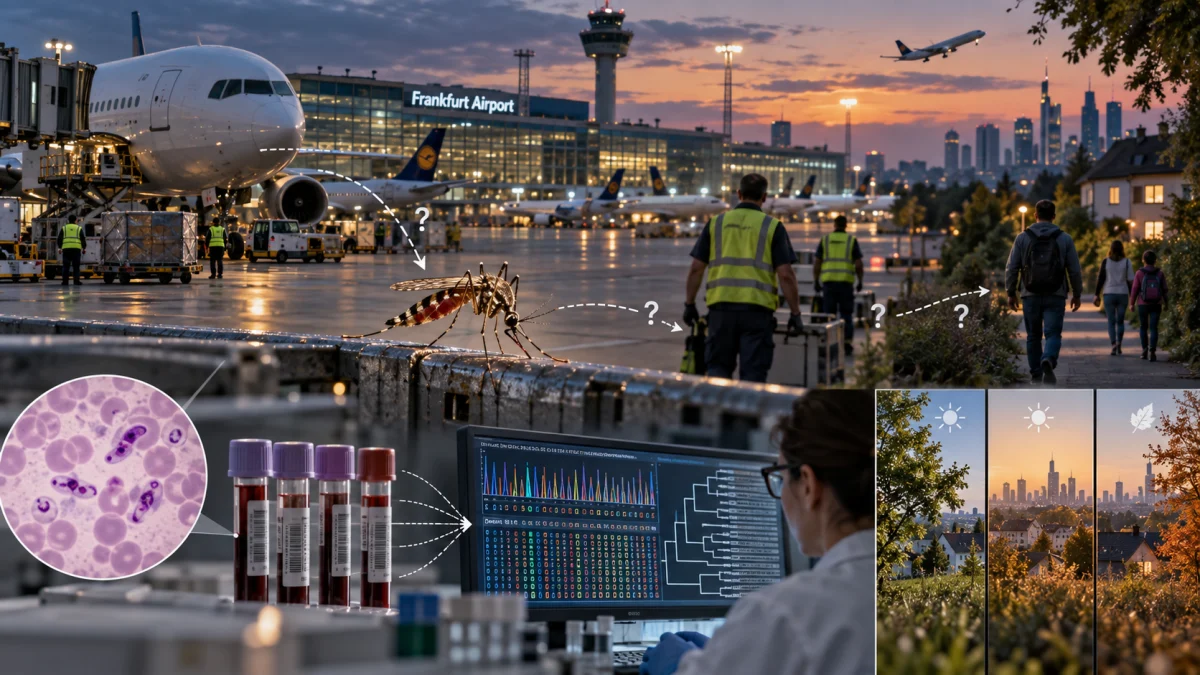
The leading explanation is that one or more malaria-infected Anopheles mosquitoes arrived in Germany through international aviation and subsequently bit people in or around Frankfurt. The European Centre for Disease Prevention and Control, or ECDC, considered that the likely explanation for the original six airport-worker cases. (ECDC)
But several crucial details remain unknown.
Investigators have not identified the aircraft, flight, airline, origin airport, baggage item or cargo shipment that carried the mosquito or mosquitoes. They have not established how many mosquitoes were involved. Frankfurt’s health department says it cannot yet determine whether the two September cases belong to the same transmission event as the July and August cases. And despite mosquito trapping around the airport and Schwanheim, authorities say no Anopheles mosquito has yet been detected in the monitoring program. Specialized parasite-genome testing is still underway. (Frankfurt.de)
So the evidence supports airport-associated mosquito transmission much more strongly than ordinary alternatives such as international travel, but it does not support the simplified claim that investigators found “the mosquito that got trapped on a plane” and traced eight infections back to it.
They have not.
What is actually known about the Frankfurt malaria cases?
The timeline matters because it immediately exposes one problem with the single-mosquito version of the story.
| Date | What is established |
|---|---|
| Early July 2026 | Five people who worked at Frankfurt Airport developed P. falciparum malaria despite no malaria-endemic travel. |
| Mid-August | A sixth airport-associated patient became ill. |
| By August 28 | ECDC reported six airport-worker cases, two deaths and four patients discharged from hospital. |
| September 15 | Frankfurt announced two additional P. falciparum cases in residents of Schwanheim. Neither worked at the airport or had traveled to a malaria-endemic country. |
| September 17 | Frankfurt announced that one of the two Schwanheim patients had died, bringing the total number of deaths to three. |
| September 18 | Eight known cases remain under investigation. Authorities have not established that all eight arose from one mosquito or one introduction. |
The Frankfurt Health Department’s September 15 notice says the first six patients had been present at Frankfurt Airport through their jobs. Five became ill in early July and one in mid-August. None had recently visited a malaria-endemic country or received a blood transfusion. (Frankfurt.de)
The September 17 official update confirmed the death of one of the two Schwanheim residents and said no additional cases had been reported since the two were identified earlier that week. (Frankfurt.de)
All eight known infections involve malaria tropica caused by Plasmodium falciparum, the malaria parasite responsible for most severe malaria deaths worldwide. (Frankfurt.de)
What is “airport malaria”?
Airport malaria occurs when an infected mosquito is unintentionally transported from a malaria-endemic area into a place where malaria is not normally circulating.
The passenger does not need to have malaria. In fact, a passenger does not need to be involved at all.
An already-infected female Anopheles mosquito can enter an aircraft cabin, cargo hold, baggage compartment, cargo shipment or other conveyance at the departure end, survive transportation and emerge after arrival. If it subsequently takes another blood meal, it can transmit malaria to someone who has never been anywhere near a malaria-endemic country.
A closely related phenomenon is luggage malaria, in which the mosquito is carried farther from the airport inside baggage or another transported item. Both are sometimes grouped under the term Odyssean malaria.
This is not a speculative disease category invented to explain Frankfurt. A 2024 systematic review published in Eurosurveillance identified 145 European airport or luggage-malaria cases dating from 1969 through the study period. Researchers classified 105 as airport malaria, 32 as luggage malaria and eight as one of the two without sufficient evidence to distinguish them. (PubMed Central (PMC))
Airport malaria is therefore real.
It is also extremely rare.
Has anyone actually found the mosquito from Frankfurt?
No.
That distinction matters because some headlines make the story sound as if a mosquito was physically discovered aboard an aircraft and investigators then connected it to the deaths.
Frankfurt says the precise introduction pathway is unknown. Authorities do not know whether the mosquito arrived in baggage, freight, an aircraft cabin or another part of an aircraft. They also cannot currently determine whether one mosquito or multiple mosquitoes were involved. (Frankfurt.de)
Mosquito traps have been installed at Frankfurt Airport and monitoring has expanded to Schwanheim, but the city’s current FAQ says no Anopheles mosquitoes have yet been found through that surveillance. (Frankfurt.de)
That may sound like a weakness in the airport-malaria hypothesis, but historically it is not unusual.
The 2024 European systematic review found that none of the reviewed airport or luggage-malaria case reports had actually identified the infectious mosquito in an airport or luggage. These investigations normally work backward from the patient’s parasite, travel history, geography, timing, airport exposure and exclusion of competing transmission routes. (PubMed Central (PMC))
Airport malaria is therefore often an epidemiological reconstruction, not a situation where investigators catch the culprit mosquito with the patient’s blood still inside it.
How strong is the evidence that Frankfurt’s infections came from aviation?
The evidence is strongest for the first six cases and less complete for the two September cases.
| Claim | Evidence status | What the evidence currently supports |
|---|---|---|
| Eight people have had P. falciparum malaria | Verified | Frankfurt health authorities report eight cases. |
| Three of the eight patients have died | Verified | Two airport-associated patients died, followed by one Schwanheim resident. |
| The first six did not acquire malaria during normal travel to endemic regions | Verified | All worked at Frankfurt Airport and reported no malaria-endemic travel. |
| Imported mosquitoes probably caused the original airport cluster | Strong inference | ECDC assesses one or more infected mosquitoes transported by aircraft as the likely explanation. |
| The two Schwanheim cases came from the same source | Unresolved | Genetic testing is underway. |
| One mosquito caused all eight cases | Not established | The chronology makes this increasingly difficult to reconcile with normal mosquito lifespan. |
| A specific airline or flight carried the mosquito | Unknown | No aircraft, airline, flight or route has been identified. |
| German mosquitoes are now sustaining malaria transmission | Possible in theory, unproven | Native Anopheles species exist, but authorities have not documented this transmission chain. |
| Frankfurt is experiencing broad endemic malaria transmission | Not supported | Authorities continue to assess the general population risk as very low. |
That last distinction is important. Eight extraordinary infections do not mean malaria is now circulating throughout Frankfurt in the way it circulates in endemic regions.
Could one mosquito really infect eight people?
An infected female Anopheles mosquito can potentially bite more than one person during its life, so multiple infections from one mosquito are biologically possible.
The chronology, however, makes a single mosquito an increasingly weak explanation for all eight Frankfurt cases.
Frankfurt says P. falciparum malaria typically produces symptoms about 7 to 15 days after infection. Five people became ill in early July, which points toward exposures around late June. Another developed illness in mid-August. The latest two cases were not announced until September. (Frankfurt.de)
The CDC notes that most adult malaria-vector mosquitoes are relatively short-lived. Some may survive as long as roughly three weeks in nature, although survival depends heavily on species and environmental conditions. (CDC)
A mosquito surviving from late June until well into September would therefore require an unusually long lifespan.
That does not weaken the broader mosquito-importation explanation. It weakens the one-mosquito-for-everything explanation.
Several possibilities remain consistent with the evidence: multiple infected mosquitoes could have arrived together; separate introductions could have occurred on different flights; mosquitoes could have been transported onward from the airport; or, more consequentially, an infected person or imported mosquito could theoretically have allowed a local mosquito to enter the transmission chain.
The laboratory work should help distinguish those possibilities.
An infected mosquito’s babies would not automatically have malaria
There is another misconception worth eliminating.
An infected female Anopheles mosquito does not normally transmit malaria parasites through her eggs so that a new generation of automatically infected mosquitoes emerges.
Frankfurt’s health department specifically notes that Plasmodium does not undergo the relevant form of transovarial transmission in malaria mosquitoes. (Frankfurt.de)
That means an imported infected mosquito cannot simply lay eggs and create an infected mosquito colony.
For a secondary local transmission chain to occur, something more complicated would have to happen.
A local mosquito would have to bite an infected human while transmissible parasite stages were circulating in that person’s blood. The parasite would then have to survive and develop inside that mosquito. The mosquito would need to survive long enough for those parasites to reach its salivary glands, and then bite another person.
According to the CDC’s description of the malaria life cycle, parasite development inside a mosquito generally takes about 9 to 18 days, strongly depending on temperature and other environmental conditions. (CDC)
That is possible.
It is also a much more demanding biological chain than simply saying “one mosquito arrived and malaria started spreading.”
Can German mosquitoes transmit malaria?
Potentially, yes.
Germany becoming malaria-free did not mean that every species of Anopheles mosquito disappeared.
Frankfurt’s health department says indigenous Anopheles species exist that could theoretically transmit malaria, while emphasizing that German climatic conditions remain unfavorable for sustained transmission. (Frankfurt.de)
That creates an important distinction between two scenarios.
In classic airport malaria, an already infectious imported mosquito arrives and directly infects someone.
In genuinely local or “introduced” transmission, an indigenous mosquito would first have to acquire the parasite from an infected person, support its development and then transmit it to another person.
There is currently no evidence demonstrating that the second scenario caused the 2026 Frankfurt cases.
Authorities have not captured an infected local Anopheles mosquito. They have not demonstrated an ongoing local mosquito-to-human-to-mosquito cycle. The Schwanheim cases make the question worth investigating, but they do not answer it.
How could someone several kilometers from the airport get “airport malaria”?
Because “airport malaria” does not require the patient to be standing beside an airplane.
The 2024 European systematic review found that among airport-malaria cases with usable distance data, people who lived or worked near an international airport were on average 4.3 kilometers from it. Reported distances varied considerably. Researchers also documented cases in which onward transport of mosquitoes by automobile was considered plausible. (PubMed Central (PMC))
Mosquitoes can move under their own power, be carried by wind or enter vehicles, baggage and other objects that continue beyond the airport.
The fact that the two newest patients lived in nearby Schwanheim therefore does not, by itself, contradict airport-associated transmission.
But it does make the investigation more important because the new patients did not have the occupational airport exposure shared by the first six.
Frankfurt has had airport malaria before
The 2026 event is not Frankfurt’s first unexplained cluster.
In 2019, two Frankfurt Airport maintenance workers developed severe P. falciparum malaria despite no plausible travel-related source. Both had worked the same night shift, and genetic testing found matching parasite patterns. One diagnosis took nine days from symptom onset and the other 12 days. Investigators considered transmission by an imported mosquito highly likely. Both patients eventually recovered. (PubMed Central (PMC))
Frankfurt experienced another cluster in 2022.
Three airport employees who had not traveled to malaria-endemic regions developed P. falciparum malaria. Two became severely ill. Investigators could not identify a particular transmission location and captured no competent mosquito that could establish the source.
Genomics provided the most interesting evidence.
Whole-genome sequencing of the 2022 parasite samples found the infections were highly genetically related and indicated that their ancestry most closely resembled parasites from Ghana. Researchers examined flights from African malaria-endemic countries and even a parcel originating in Ghana, but they still could not identify the precise mosquito or transportation event. (PubMed Central (PMC))
That previous investigation is a useful warning against oversimplification.
Genomics can make the case for a common source dramatically stronger without necessarily telling investigators which plane delivered the mosquito.
What are scientists testing in the 2026 cases?
Researchers are sequencing the parasite DNA in patients’ blood.
This is another detail that has been garbled in some coverage.
The Institute of Tropical Medicine in Antwerp, which is assisting with the investigation, said it had received blood samples from infected patients and was comparing P. falciparum genome sequences with existing databases. The institute specifically corrected reports suggesting it had received mosquito samples. (ITG)
Those results could answer several important questions.
If the parasites from different patients are nearly identical, that would strengthen the argument for a common source or connected transmission chain.
If the July, August and September parasites are genetically distinct, multiple introductions would become considerably more plausible.
Genomic comparisons can also help estimate the parasite’s likely geographical ancestry.
What they cannot normally do by themselves is tell investigators, for example, “this mosquito was aboard Flight X in seat row 31.”
Epidemiology, flight histories, parasite genetics and mosquito surveillance have to be combined.
Why have three of eight patients died?
Three deaths among eight known cases is an observed proportion of 37.5%, but interpreting that as the normal fatality rate of airport malaria would be badly misleading.
Eight patients are far too few to estimate a meaningful population fatality rate, and Frankfurt has not disclosed enough individual medical information to determine why the three patients died. Authorities specifically say they will not release details concerning underlying illnesses or whether particular patients experienced diagnostic delays. (Frankfurt.de)
There is nevertheless an established reason airport malaria can be especially dangerous.
Doctors normally use travel history as one of the strongest clues to malaria.
If someone in Germany arrives with fever, headache, gastrointestinal symptoms and general illness but has never visited a malaria-endemic country, malaria may initially seem implausible.
ECDC warns that this lack of travel history can lower clinical suspicion and contribute to delayed diagnosis, while P. falciparum can deteriorate rapidly if treatment is delayed. (ECDC)
The European systematic review found a mean diagnostic delay of 7.5 days among airport and luggage-malaria patients for whom sufficient information was available. Nine of 133 patients with known outcomes died, approximately 6.8%. The authors contrasted that with lower fatality observed in ordinary travel-associated malaria and identified delayed diagnosis as an important concern. (PubMed Central (PMC))
WHO likewise warns that untreated P. falciparum malaria can progress rapidly to severe illness and death. (World Health Organization)
That does not prove delayed diagnosis caused the Frankfurt deaths.
It explains why a rare infection in someone with no travel history can become particularly dangerous: the patient’s lack of an obvious malaria exposure can delay the moment when anyone thinks to test for malaria.
Frankfurt says laboratory confirmation itself can be obtained quickly once malaria is actually suspected.
How rare is airport malaria?
Extremely rare compared with ordinary travel-associated malaria.
The 2024 systematic review identified 145 airport or luggage-malaria cases across nine European countries over more than five decades. Of those, 105 were classified as airport malaria.
The overwhelming majority of malaria diagnosed in Europe is instead imported by people who were themselves infected while traveling or living in endemic regions. (PubMed Central (PMC))
Airport malaria also has a striking seasonal pattern.
Of the 105 airport-malaria cases identified in the review, 83 occurred between June and September, with the largest number in August. Researchers noted that warmer European weather may allow imported mosquitoes to remain alive and active longer. (PubMed Central (PMC))
That makes Frankfurt’s summer timing unsurprising.
It does not mean climate change has been proven to have caused the 2026 cluster.
Did climate change cause the Frankfurt cases?
There is currently no evidence that allows that conclusion.
Temperature matters greatly to mosquito survival and parasite development, and warming conditions can expand periods during which malaria transmission is biologically possible.
But a specific 2026 mosquito importation cannot simply be attributed to climate change because it happened during a warm European summer.
The European review identifies several plausible factors behind the apparent recent increase in airport-malaria reports: environmental conditions, air-traffic patterns, surveillance and awareness, and possible differences in aircraft-disinsection practices. The researchers did not establish one factor as the cause. (PubMed Central (PMC))
The defensible conclusion is narrower: warmer conditions can make imported-mosquito survival more favorable, but international aviation still has to introduce the vector or parasite into the chain.
Aren’t airplanes supposed to be sprayed for mosquitoes?
Sometimes they are.
The procedure is called aircraft disinsection.
The World Health Organization publishes detailed aircraft-disinsection procedures intended to prevent international transportation of mosquitoes capable of carrying human diseases. Methods include different forms of insecticide treatment for passenger cabins and cargo aircraft. (World Health Organization)
However, WHO guidance does not mean that every international aircraft arriving in Germany is automatically sprayed.
WHO says the requirements applied to arriving aircraft are determined by national authorities, taking account of relevant risks. Its guidance is advisory to governments. (World Health Organization)
German law implementing the International Health Regulations requires airports to maintain arrangements for disinsection of baggage, freight, containers, conveyances, goods and postal packages when necessary, along with measures intended to keep airport grounds free of disease vectors. The legal requirement is broader than a rule saying every arriving cabin must always be sprayed. (Gesetze im Internet)
That leaves a legitimate policy question after repeated Frankfurt airport-malaria episodes: Are the existing prevention rules and practices sufficient for flights arriving from high-risk regions?
That question is not the same as accusing an airline of causing the outbreak.
No airline has been identified as the source of the 2026 infections.
A September 18 Frankfurter Rundschau report quoted Lufthansa as saying it was not currently performing targeted insecticide treatment of aircraft cabins because there was no specific instruction from German authorities requiring it. (FR.de)
That statement does not establish that a Lufthansa aircraft transported any infected mosquito. It does, however, illustrate why the broader question of who requires disinsection, on which routes and under what conditions deserves scrutiny.
The authors of the 2024 European airport-malaria review independently concluded that existing disinsection measures should be assessed for both compliance and effectiveness. (PubMed Central (PMC))
Could airport malaria happen in the United States?
Yes, biologically.
The mechanism is not unique to Germany.
The United States has native Anopheles mosquitoes capable of transmitting malaria. CDC guidance notes that competent vectors occur across many parts of the country. (CDC)
And in 2023, the United States experienced confirmed locally acquired mosquito-borne malaria in Florida, Texas and Maryland among patients without ordinary international-travel exposure. The Florida and Texas clusters involved P. vivax, while the Maryland case involved P. falciparum. Those events were not established as airport malaria, so they should not be conflated with Frankfurt. (CDC)
They demonstrate something narrower but important: malaria transmission can occasionally occur in a country where malaria is not normally endemic if the parasite, a competent mosquito, favorable conditions and the right timing coincide.
That possibility remains very different from saying widespread malaria transmission is likely.
Does Frankfurt now have a malaria outbreak?
There is clearly a cluster of malaria cases requiring investigation, but there is no evidence of sustained endemic transmission across Frankfurt.
Malaria is not spread between people through normal social contact. A mosquito is generally required to maintain ordinary transmission, with unusual exceptions such as contaminated blood or maternal-fetal transmission.
Frankfurt continues to describe the risk to the general population as very low, in part because local climatic conditions are unfavorable to the mosquito-parasite transmission cycle. (Frankfurt.de)
The two Schwanheim cases nevertheless widened the epidemiological puzzle.
Before September, all six known patients had an obvious common feature: they worked at Frankfurt Airport.
Now two people without that occupational exposure have become infected nearby.
That does not establish community transmission, but it makes three explanations particularly important to distinguish:
Multiple imported infected mosquitoes. More than one infectious mosquito may have entered Frankfurt through aviation at different times or together.
Onward movement of imported mosquitoes. An imported mosquito could have traveled beyond airport property by flight, wind, automobile, baggage or other transport.
Secondary local transmission. A local mosquito could theoretically have acquired the parasite from an infected human and subsequently transmitted it, although there is presently no evidence demonstrating that this happened.
The laboratory investigation is important precisely because those scenarios imply different levels of public-health concern.
The genetic results could change the story
The most consequential unanswered question is no longer simply, “Did a mosquito arrive on a plane?”
For the original airport-worker cluster, that is already a strong and historically well-supported inference.
The more important question is:
Are the July, August and September cases manifestations of the same biological chain, or are investigators looking at multiple mosquito introductions?
If parasite genomes from all eight patients form a closely related cluster, a connected source becomes substantially more plausible.
If the September parasites are clearly different from those found during the summer, then Frankfurt may instead be experiencing repeated introductions through international aviation.
That distinction matters more than whether anyone ever physically captures the original mosquito.
It could tell investigators whether they are dealing primarily with an extraordinary one-time event, repeated failures to prevent vector importation, or a more complicated transmission chain outside the airport itself.
So what is the strongest conclusion right now?
The “mosquito trapped on a plane killed three people” headline contains a real phenomenon wrapped in more certainty than the investigation supports.
Verified: Eight people around Frankfurt have developed P. falciparum malaria in 2026 despite lacking the ordinary travel history expected in Germany. Six worked at Frankfurt Airport. Two lived nearby. Three patients have died.
Strongly supported inference: One or more malaria-infected Anopheles mosquitoes imported through international aviation probably explain the original airport cluster. Previous Frankfurt airport-malaria clusters and decades of European cases demonstrate that the mechanism is real.
Not established: Investigators have not identified a particular mosquito, plane, airline, route or origin country responsible for the 2026 cases.
Still unresolved: Authorities have not yet determined whether the two Schwanheim infections and the six airport-worker cases came from the same source, multiple imported mosquitoes or a more complicated local transmission chain.
The simplest evidence-based description is therefore not that one mosquito flew to Germany and infected eight people.
It is that Frankfurt has experienced an unusual series of locally acquired falciparum-malaria infections strongly associated with its international airport, probably involving imported mosquitoes, while genomic and entomological investigations are still determining whether the eight cases constitute one connected event or several separate introductions.
That is both less sensational and considerably more interesting.
For people living or working near Frankfurt Airport, the city’s practical guidance is straightforward: unexplained fever, chills, headache, body aches or gastrointestinal symptoms warrant prompt medical attention, and patients should tell clinicians about their proximity to the airport even if they have not traveled internationally. Frankfurt emphasizes that P. falciparum malaria is treatable when recognized and treated promptly. (Frankfurt.de)
References and Further Reading
Current Frankfurt Investigation
Frankfurt Health Department: Airport Malaria FAQ — The city’s continuously updated primary source for the eight known cases, current risk assessment, mosquito monitoring, incubation period, unresolved transmission questions and pending laboratory investigation.
Frankfurt Health Department: Two New Malaria Cases Near Frankfurt Airport, September 15, 2026 — Official announcement of the two Schwanheim cases and chronology of the six earlier airport-associated infections.
Frankfurt Health Department and University Hospital Frankfurt: Death Associated With Current Malaria Cases, September 17, 2026 — Primary confirmation of the third death and the exposure history of the two Schwanheim patients.
ECDC Weekly Communicable Disease Threats Report: Airport Malaria in Frankfurt, 2026 — European public-health assessment of the original six-person airport cluster, including the likely imported-mosquito mechanism, case chronology and diagnostic-risk assessment.
Institute of Tropical Medicine Antwerp: ITM Helps Investigate Airport Malaria in Germany — Explains the parasite-DNA analysis being conducted on patient blood and corrects reports suggesting the institute had received mosquito specimens.
Scientific Evidence on Airport and Luggage Malaria
Airport and Luggage (Odyssean) Malaria in Europe: A Systematic Review — The strongest broad review of European airport and luggage malaria, identifying 145 cases, geographic patterns, diagnostic delays, fatalities, seasonality and prevention questions.
Two Cases of Airport-Associated Falciparum Malaria in Frankfurt, Germany, 2019 — Documents an earlier Frankfurt cluster in two airport workers, including matching parasite genetics and delayed diagnoses.
Investigation of an Airport-Associated Cluster of Falciparum Malaria in Frankfurt, Germany, 2022 — Detailed investigation of three previous Frankfurt Airport infections. Whole-genome sequencing showed high parasite relatedness and an ancestry closest to Ghana, despite investigators never identifying the mosquito or precise transport event.
Mosquito Biology, Malaria and Prevention
CDC: Malaria Parasite and Anopheles Mosquito Life Cycle — Authoritative explanation of mosquito lifespan, parasite development inside mosquitoes and the temperature-dependent extrinsic incubation period.
World Health Organization: Malaria Fact Sheet — Overview of P. falciparum, symptoms, severe disease, transmission and the importance of rapid diagnosis and treatment.
WHO Aircraft Disinsection Methods and Procedures — WHO’s technical guidance for controlling mosquitoes aboard passenger and cargo aircraft and preventing international movement of disease vectors.
German International Health Regulations Implementation Act — German legal framework requiring relevant airport arrangements for disinsection and control of vectors at international points of entry.
U.S. Context
CDC: Locally Acquired Malaria Cases in Florida, Texas and Maryland — Documents the 2023 U.S. locally acquired malaria events and explains why competent Anopheles mosquitoes make limited domestic transmission biologically possible despite the overall risk remaining very low.
Editorial currency note: This is an active investigation. Case counts, parasite-genome findings and Frankfurt’s assessment of whether the July, August and September infections share a common source may change as laboratory results become available.