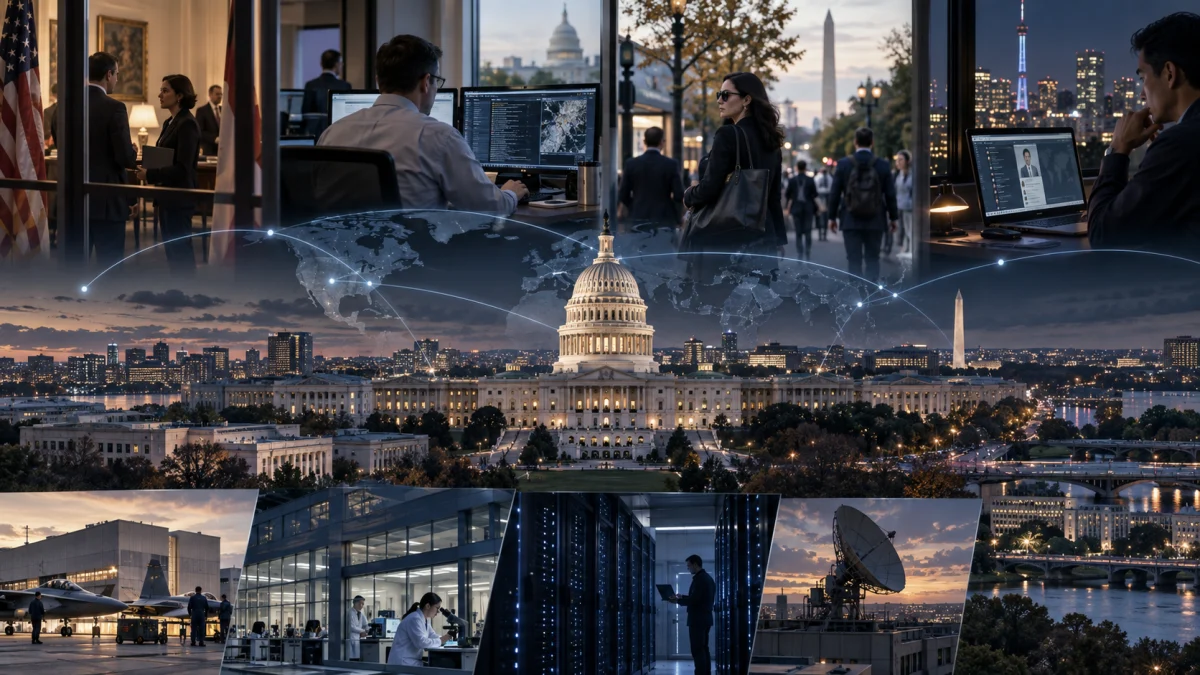
There is no publicly documented FBI count showing that more than 10,000 active spies currently live or work in Washington, D.C. The widely repeated figure traces to an estimate attributed to the International Spy Museum, and sherafy.com could not locate a public methodology explaining who was counted, when the estimate was made, what geographic area it covers, or even exactly what qualifies as a “spy.”
That does not mean the underlying espionage problem is exaggerated.
Quite the opposite.
Public FBI records, State Department disclosures, criminal cases and the U.S. government’s current counterintelligence strategy establish that Washington and the wider United States face extensive foreign intelligence activity involving intelligence officers under diplomatic and nonofficial cover, recruited American insiders, foreign-government agents, commercial intermediaries, cyber operators and increasingly people recruited entirely online.
The important correction is therefore not “there aren’t thousands of spies.”
It is this:
“10,000 spies in Washington” should not be treated as an audited FBI statistic. Modern espionage is real, extensive and increasingly difficult to reduce to a physical head count at all.
That distinction matters, because the reality is more complicated than the viral version.
Where did the “10,000 spies in Washington” claim come from?
The number recently resurfaced in a viral Instagram video from national-security correspondent J.J. Green, who said more than 10,000 active spies are working in Washington and described the figure as confirmed by the International Spy Museum and supported by the FBI’s counterintelligence division.
Green has substantial reporting behind the claim. His 2019 WTOP series, City of Secrets, investigated espionage in Washington and interviewed current and former intelligence professionals.
But the original reporting is more nuanced than a 43-second social-media video can convey.
In the 2019 WTOP report that popularized the number, Green wrote that the International Spy Museum estimated there were more than 10,000 spies in Washington. He then wrote that while the exact number could be debated, the FBI agreed with the broader premise.
The FBI official quoted in the story, Brian Dugan of the Washington Field Office’s counterintelligence operation, described the foreign espionage and economic-espionage threat as extraordinary. He did not publicly provide an FBI head count of 10,000 spies.
That is an important evidentiary distinction.
The FBI clearly corroborated the seriousness of the espionage problem. The public material we reviewed does not show the FBI independently establishing the specific 10,000 figure.
The number is older than the 2019 investigation
The trail goes back considerably farther.
A 2010 advertising-industry report records an International Spy Museum campaign titled “Spy/10,000 Spies.” The Philadelphia Business Journal’s record of the 2010 ADDY Awards shows that the campaign won an award for the museum.
A later advertising agency working for the museum describes using the same statistic directly in commuter advertising: with a “reported 10,000 spies living in DC,” the campaign suggested commuters might statistically share a bus with one. The agency’s International Spy Museum case study openly describes the campaign as part of a broader effort to increase awareness and ticket sales.
None of this proves that the International Spy Museum invented the figure for marketing.
A statistic being commercially useful does not make it false.
But the chronology matters. The 10,000-spies number was already part of the museum’s public messaging years before Green’s 2019 investigation. It should therefore not be understood as a fresh FBI estimate uncovered by that reporting.
More importantly, sherafy.com found no publicly available methodology behind it.
That leaves the exact number unverified, rather than proven false.
So how many spies are actually in Washington?
There is no defensible public number.
That may sound unsatisfying, but it follows directly from how espionage works.
Before anyone can count “spies,” they have to decide what they are counting.
An accredited intelligence officer operating from an embassy is one thing. A clandestine officer using a commercial identity is another. An American government employee secretly recruited by a foreign intelligence service is another. Someone collecting information for a foreign government without formally belonging to its intelligence service may fall into another legal category entirely.
And a foreign handler sitting in another country can now recruit someone in Washington without ever entering the United States.
Those populations overlap, change constantly and are intentionally concealed.
Even the word spy creates problems.
What actually counts as a spy?
Hollywood tends to call almost everyone involved in espionage a spy. Professional intelligence terminology is more specific.
The CIA’s own espionage glossary distinguishes an intelligence officer, who works professionally for an intelligence service, from an agent or asset, who is a clandestine source recruited to provide information.
The International Spy Museum’s own explanation of espionage terminology makes essentially the same distinction: intelligence officers recruit or manage spies, while the recruited source is technically the agent or asset.
Everyday speech ignores that distinction, which is understandable. But it makes statistics such as “10,000 spies” slippery unless the underlying methodology tells us who was included.
| Person or activity | Commonly called a “spy”? | Must be physically in Washington? |
|---|---|---|
| Foreign intelligence officer under diplomatic cover | Usually | Often, but not always |
| Intelligence officer under nonofficial cover | Usually | Sometimes |
| American insider recruited to provide secrets | Yes | Only where the useful access exists |
| Foreign handler recruiting Americans online | Usually treated as an intelligence operative | No |
| Person secretly acting under a foreign government’s direction | Sometimes | Usually must act in the U.S. for certain statutes to apply |
| Registered FARA representative or lobbyist | No, not merely because of registration | No |
| State-sponsored cyber operator | Broadly part of the intelligence threat | No |
| Ordinary foreign student, researcher or diplomat | No | Irrelevant |
The table explains why the 10,000 question becomes difficult almost immediately.
Depending on the definition, the answer could include only recruited human assets, or it could extend through professional intelligence personnel and broader foreign-intelligence networks.
The U.S. government’s own terminology has expanded accordingly.
The 2024 National Counterintelligence Strategy uses the broader term foreign intelligence entity, or FIE. Its definition can encompass not only state intelligence services but foreign cyber actors, organizations, companies, transnational criminal organizations and other actors conducting intelligence-related activity.
That is useful for national security planning.
It is useless for producing a simple head count of “spies walking around D.C.”
The “one in 70 people in D.C. is a spy” claim does not hold up
Another striking version of the statistic appeared in a 2019 WTOP podcast description.
If Washington had approximately 700,000 residents and 10,000 spies, the arithmetic gives:
700,000 ÷ 10,000 = 70.
The resulting claim was that roughly one in every 70 people you encounter in D.C. could be a spy. WTOP’s May 2019 Target USA episode used that formulation.
The math is correct.
The inference is not.
First, the 10,000 numerator is itself an estimate without a publicly documented methodology.
Second, the residential population is not the same thing as the population of people somebody encounters in Washington. Green’s own later reporting noted that Washington’s population swelled substantially during the working day as commuters, diplomats, students, tourists and others entered the city. WTOP’s City of Secrets report describes that changing daytime population.
Third, “Washington” is geographically ambiguous. An intelligence officer stationed in Northern Virginia or Maryland may plainly be part of the Washington intelligence environment while not residing inside the District.
Fourth, modern intelligence operations can involve people who never physically enter Washington at all.
So “one in 70 people you meet is a spy” is best understood as a memorable extrapolation from uncertain inputs, not a measurable personal probability.
Why Washington is such an important espionage target
The inability to verify 10,000 should not obscure why intelligence services concentrate enormous effort on Washington.
The region contains the country’s political leadership, Defense Department, intelligence agencies, federal law-enforcement headquarters, diplomatic missions, military commands, government contractors, think tanks, universities, technology firms and an enormous population of current and former officials with specialized knowledge.
And intelligence is about far more than stealing classified documents.
At its simplest, intelligence reduces uncertainty.
A foreign government may want to know what weapon the Pentagon is developing. But it may also want to know which policy is gaining support inside an administration, how a negotiation is likely to unfold, which technology a defense contractor is struggling to perfect, which official influences a decision maker, or where weaknesses exist in a supply chain.
Some of that information is classified.
Some is proprietary.
Some is technically public but becomes valuable when collected, organized and combined with information from other sources.
The 2024 National Counterintelligence Strategy says foreign intelligence entities are targeting national secrets, sensitive data, intellectual property, military and technical capabilities, infrastructure and U.S. decision-making while combining traditional human intelligence with increasingly powerful cyber and technical tools.
Washington is therefore attractive not because every person there possesses a secret document.
It is attractive because an extraordinary amount of access, knowledge, influence and decision-making capacity is concentrated there.
Yes, intelligence officers really do operate under diplomatic cover
This part is not Hollywood mythology.
Governments have long assigned intelligence personnel to embassies and diplomatic missions under official cover.
In March 2018, the U.S. State Department publicly said it was expelling 48 Russian intelligence officers operating under diplomatic cover from Russia’s bilateral diplomatic presence and another 12 intelligence officers assigned to Russia’s mission to the United Nations. The State Department’s March 2018 briefing identifies the officers explicitly.
That does not mean every embassy employee is an intelligence officer.
It demonstrates that diplomatic cover is a documented intelligence practice.
There is also a practical reason governments use it.
Accredited diplomatic agents enjoy extensive protections under international law. Current State Department guidance on diplomatic immunity states that diplomatic agents generally cannot be arrested or detained and are immune from the host country’s criminal jurisdiction unless immunity is waived.
That is not a license to conduct espionage.
A host government can monitor suspected intelligence officers, restrict their activities or declare them persona non grata and require them to leave.
This explains a recurring feature of international spy disputes: a government may publicly identify someone as an intelligence officer and expel them rather than prosecute them.
But some of the most damaging spies have been Americans
Focusing entirely on mysterious foreign embassy personnel creates another distorted picture.
Some extraordinarily damaging espionage cases involved trusted Americans already inside the U.S. government.
Ana Montes
Ana Belen Montes was a senior Defense Intelligence Agency analyst and one of the U.S. government’s leading Cuba specialists.
She was also spying for Cuba.
According to the FBI’s history of the Ana Montes case, Cuban intelligence recruited her before she joined the DIA. She then spent years providing classified information while maintaining the appearance of an ordinary U.S. intelligence professional.
She was not a foreign stranger wandering around Washington.
She was the person foreign intelligence wanted inside the building.
Robert Hanssen
Robert Hanssen illustrates the insider problem even more starkly.
Hanssen was an FBI special agent who worked in counterintelligence while secretly providing highly sensitive information to Soviet and later Russian intelligence services.
The FBI’s Robert Hanssen case history describes him as the most damaging spy in Bureau history. His access allowed him to compromise human sources, investigations, counterintelligence methods and highly classified operations.
He also demonstrates why outward appearance is nearly useless as a detection mechanism.
Hanssen was not pretending to belong inside the American national-security apparatus.
He genuinely belonged there.
Jonathan Pollard
Espionage is also not confined neatly to governments that Washington labels adversaries.
Jonathan Pollard, a civilian U.S. Navy intelligence analyst, passed classified information to Israel, a close U.S. ally. The FBI’s historical account of the 1985 “Year of the Spy” cases records Pollard’s work for Israel and his eventual arrest.
The larger lesson is uncomfortable but straightforward:
The nationality of the person standing in front of you tells you very little about whether an intelligence service has successfully penetrated an institution.
Access matters more.
A “foreign agent” is not automatically a spy
Online discussions frequently make another serious terminology mistake.
Someone registered under the Foreign Agents Registration Act, or FARA, is not therefore a “registered spy.”
The Justice Department’s explanation of FARA says the law primarily requires transparency from certain people carrying out political, public-relations, representation and related activities on behalf of foreign principals.
Those activities can be entirely lawful when properly disclosed.
A different law, 18 U.S.C. § 951, covers certain individuals operating in the United States under the direction or control of a foreign government without the required notification.
The Justice Department’s guide to FARA-related statutes explicitly distinguishes §951, and a DOJ inspector-general review described §951 cases as more commonly involving information gathering and other espionage-like activities, while FARA focuses primarily on disclosure of foreign influence activity. DOJ Inspector General’s review of FARA enforcement.
So the concepts should not be collapsed:
Foreign agent, intelligence officer, spy, diplomat, lobbyist and FARA registrant are not synonyms.
They can sometimes overlap.
They often do not.
The spy targeting Washington may never come to Washington
This is where the traditional image of espionage breaks down most dramatically.
A foreign intelligence officer no longer needs to approach someone at a reception, arrange a meeting in a park or pass instructions through a dead drop.
They can send a message.
In June 2026, the FBI issued a detailed public warning about what it calls foreign virtual targeting. The FBI’s June 24, 2026 guidance says foreign intelligence services use professional networking sites, social media, job platforms and apparently legitimate consulting opportunities to identify people with useful government, military, diplomatic, technological or economic experience.
The pattern can be deceptively mundane.
Someone receives an unsolicited consulting offer. The initial assignments involve public information or professional opinions. Payment establishes legitimacy. The relationship develops. Later requests become more specific, more valuable and more sensitive.
The target may not initially realize who is actually asking.
The FBI highlighted the case of former Army intelligence analyst Korbein Schultz. According to the Bureau, a foreign national in China contacted Schultz through a freelance work platform and requested analysis concerning U.S. military capabilities.
The requests escalated.
Schultz ultimately transmitted at least 92 sensitive U.S. military documents, according to the FBI. He never met the person directing him face to face.
That fact alone exposes a weakness in asking only how many spies are physically located in Washington.
The source can be in Washington.
The handler can be on another continent.
The recruitment office can effectively be a laptop.
What modern foreign intelligence services are actually targeting
Classified national-defense information remains an obvious objective, but today’s target set is much broader.
The National Counterintelligence Strategy identifies sensitive technology, intellectual property, critical infrastructure, data, government operations and economic advantages alongside traditional national-security secrets.
The FBI’s May 2026 budget testimony provides a contemporary snapshot. Director Kash Patel told the Senate that Russia, China and Iran continue targeting U.S. national-defense information, current and former federal employees, military personnel, decision-making processes, technology and sensitive commercial information. FBI Director’s May 12, 2026 counterintelligence testimony
According to the FBI’s own reported figures, counterintelligence arrests increased 42% in 2025. By May 2026, the Bureau also said it had facilitated 62 removals of foreign intelligence threats through its China program that year. Those agency figures are not a measure of the total number of spies in America, but they illustrate that counterintelligence activity remains substantial.
The Bureau’s current overview identifies hostile intelligence activity involving not only China, Russia and Iran but Cuba, Venezuela, North Korea and others. The FBI’s current Global Threat overview
The world of espionage therefore extends well beyond stealing a binder stamped TOP SECRET.
It can involve:
government plans;
military capabilities;
AI and semiconductor technology;
aerospace and biotechnology;
trade secrets;
critical infrastructure;
supply chains;
scientific research;
personal information useful for targeting;
and insight into how American institutions make decisions.
What about students and researchers?
This is an area where precision matters.
Students, researchers and academics can be recruited by intelligence services. Intelligence officers can also use academic or student identities as cover.
The U.S. government’s 2025 Safeguarding Academia guidance explicitly includes the targeting of students for potential intelligence recruitment among the risks universities should understand. NCSC’s Safeguarding Academia guidance
But that same guidance begins by emphasizing the importance of international academic collaboration to American research and innovation.
Those two facts belong together.
A foreign student is not suspicious merely because the person is foreign.
A professor is not suspicious because the person collaborates internationally.
A diplomat is not automatically an intelligence officer.
Counterintelligence is about behavior, access, relationships and evidence, not guessing based on nationality.
That distinction is especially important when simplified social-media discussions tell viewers that spies may look like “students” or “businesspeople.” Those covers and recruitment paths are real. Treating entire categories of ordinary people as suspects is not.
Can an ordinary person actually spot a spy?
Usually not.
Professional intelligence officers and successfully recruited agents are valuable precisely because they do not walk around announcing themselves.
Trying to identify spies based on appearance, accent, nationality, occupation or social mannerisms is therefore mostly useless.
Behavior can matter.
The FBI’s current virtual-targeting guidance advises particular caution around unexpected consulting offers aimed at people with sensitive experience, employers that cannot be independently verified, assignments that gradually move from public to nonpublic information, unusual payment arrangements, escalating requests for specialized access, and efforts to move conversations onto less transparent communications platforms.
The common pattern is not:
A sinister stranger asks for nuclear launch codes.
It may be closer to:
Someone wants your professional opinion. Then another opinion. Then something slightly harder to obtain. Then something you probably should not provide.
That incremental progression is one reason intelligence recruitment can work.
Why can’t the FBI simply count all the spies?
Counterintelligence agencies presumably maintain classified assessments of foreign intelligence personnel and networks.
But even an internal number would depend on the definition.
Consider the problem recursively.
The government may know that some accredited diplomats are intelligence officers.
It may strongly suspect others.
Some officers will operate without diplomatic cover.
Some individuals will be recruited American assets rather than foreign officers.
Some intermediaries may knowingly assist an intelligence service without being career intelligence personnel.
Others may initially cooperate without understanding who is ultimately directing them.
Cyber operators and online handlers can participate from abroad.
Networks change as people enter the country, leave, are recruited, defect, are expelled, retire, get arrested or remain undiscovered.
And the most successful unknown spy is, by definition, missing from the government’s confirmed count.
A precise public figure therefore implies a level of certainty that the nature of clandestine intelligence activity does not permit.
This is why the 10,000 figure should be treated cautiously even if the true scale of espionage is very large.
Is Washington really the “spy capital of the world”?
It is routinely described that way, and the city’s concentration of political, military, intelligence and diplomatic targets makes the description understandable.
But there is no credible worldwide census of covert operatives by city that allows Washington to be mathematically ranked against London, Brussels, Vienna, Beijing, Moscow or other intelligence centers.
So calling Washington the spy capital of the world is better understood as shorthand than as a measurable title.
The more defensible statement is that Washington is one of the world’s most important environments for intelligence collection and counterintelligence activity.
And even that increasingly understates the geographic problem.
Modern espionage networks do not respect city limits.
What the “10,000 spies” claim gets right and wrong
The evidence supports a more nuanced conclusion than either the viral claim or an easy debunk.
What is verified: Washington is an exceptionally valuable foreign-intelligence target. Intelligence officers do operate under diplomatic and nonofficial cover. Foreign governments recruit insiders. Americans holding highly trusted positions have repeatedly committed espionage. Modern intelligence services use cyber operations, professional networking platforms, consulting fronts and remote recruitment alongside traditional human intelligence.
What is not established publicly: that more than 10,000 identifiable active spies currently reside or operate physically in Washington, D.C.
What the FBI actually corroborated in the 2019 reporting: the severity and changing nature of the foreign-intelligence threat, not a publicly documented 10,000-person census.
What the chronology suggests: the number is a longstanding International Spy Museum estimate that has also been used effectively in museum marketing and media promotion. That history makes the source and methodology more important, not less.
What cannot reasonably be concluded: that the figure must therefore be fabricated. We have not found evidence establishing that.
The proper verdict is simpler:
10,000 is an unverified estimate, not a reliable head count.
The more important reality is bigger than the number
There is something almost comforting about imagining that America has a knowable population of 10,000 spies.
A number makes the threat feel measurable.
Reality is messier.
The person stealing information may be a professional intelligence officer sitting inside an embassy.
Or an officer using a business identity.
Or an American intelligence employee secretly recruited years earlier.
Or a defense contractor.
Or a former government employee answering what initially looks like a harmless consulting request.
Or a cyber operator on the other side of the planet.
The individual supplying the information may never know the real identity of the person requesting it.
The foreign officer may never meet the American source.
And the information being collected may not look like a traditional “secret” until it is combined with hundreds of other pieces.
That is why the most important lesson from the 10,000-spies claim is not whether Washington has 8,000, 10,000 or 15,000 spies.
It is that espionage has evolved beyond the mental picture most people still carry around.
The trench coat and park-bench meeting never entirely disappeared.
They simply gained company from LinkedIn messages, remote consulting contracts, cyber intrusions, research relationships, commercial intermediaries, recruited insiders and enormous quantities of digital information.
Washington remains one of the great intelligence targets on Earth.
But in 2026, the intelligence operation targeting Washington may not be in Washington at all.
References and Further Reading
Current U.S. Counterintelligence Assessments
National Counterintelligence Strategy, 2024 — National Counterintelligence and Security Center The U.S. government’s central public strategy describing the current foreign-intelligence threat landscape, including cyber activity, technology theft, influence operations and the broader definition of foreign intelligence entities.
Foreign Virtual Targeting — Federal Bureau of Investigation, June 24, 2026 Current FBI guidance explaining how foreign intelligence services use job sites, professional networks, consulting offers and online communication to recruit potential sources without face-to-face contact.
FY 2027 FBI Budget Testimony — Federal Bureau of Investigation, May 12, 2026 Includes the FBI director’s current description of counterintelligence targets and reported 2025-2026 enforcement activity.
The Global Threat — Federal Bureau of Investigation The FBI’s current overview of hostile foreign-intelligence activity involving multiple governments and types of operations.
Safeguarding Academia — National Counterintelligence and Security Center Explains foreign-intelligence risks facing universities and researchers while explicitly affirming the importance of legitimate international scientific collaboration.
Intelligence Terminology and Law
Spy Speak Glossary — Central Intelligence Agency Useful primary terminology distinguishing intelligence officers, agents, assets, handlers, cover and other intelligence concepts.
Espionage Facts — International Spy Museum The museum’s own explanation of the distinction between professional intelligence officers and recruited agents or assets, as well as official and nonofficial cover.
Foreign Agents Registration Act — U.S. Department of Justice Explains the purpose and scope of FARA and why registration under the law is not synonymous with espionage.
FARA-Related Statutes and 18 U.S.C. §951 — U.S. Department of Justice Provides the statutory distinction between FARA and people acting under the direction or control of foreign governments.
DOJ Inspector General Review of FARA Enforcement Useful explanation of how DOJ officials distinguished §951’s espionage-like information-gathering cases from FARA’s foreign-influence disclosure framework.
Diplomatic Cover and Documented Espionage Cases
State Department Briefing on Russian Intelligence Officers Under Diplomatic Cover — March 27, 2018 Documents the U.S. government’s public identification and expulsion of dozens of Russian intelligence officers operating under diplomatic cover.
State Department Foreign Affairs Manual: Diplomatic Immunities Current official guidance explaining the criminal immunity and personal inviolability generally afforded to accredited diplomatic agents.
Ana Montes — Federal Bureau of Investigation Documents the recruitment and long-running espionage activity of a senior Defense Intelligence Agency analyst working for Cuba.
Robert Hanssen — Federal Bureau of Investigation FBI account of one of the most damaging insider espionage cases in U.S. history.
Major Counterintelligence and Espionage Cases — Federal Bureau of Investigation Provides additional historical examples demonstrating the variety of people, motivations and governments involved in espionage against the United States.
The 10,000-Spies Claim and Its Provenance
City of Secrets: Estimated 10,000 People in DC Are Spies — WTOP, June 17, 2019 J.J. Green’s original reporting attributing the 10,000 estimate to the International Spy Museum and quoting the FBI on the broader foreign-intelligence threat.
Target USA Episode 169: The International Spy Museum — WTOP, 2019 A useful record of how the 10,000 estimate was converted into the widely repeated “one in 70 people” formulation.
2010 ADDY Awards Coverage — Philadelphia Business Journal Documents an International Spy Museum advertising campaign titled “Spy/10,000 Spies,” establishing that the number was already being used publicly years before the 2019 WTOP series.
International Spy Museum Marketing Campaign Case Study — January The museum’s advertising agency describes using the reported 10,000-spies statistic in commuter advertising and explains the commercial goals of the broader campaign.
Editorial currency note: Counterintelligence threats, criminal cases, diplomatic assignments and government assessments change continually. This article reflects public information reviewed through September 18, 2026. The absence of a publicly documented methodology for the 10,000 estimate does not establish that the actual number is lower; it means the exact figure cannot presently be independently verified from the public record.