The United States does not have a single law-enforcement hierarchy in which a police officer reports to a sheriff, the sheriff answers to a state trooper, and everyone ultimately answers to the FBI.
That is not how the system works.
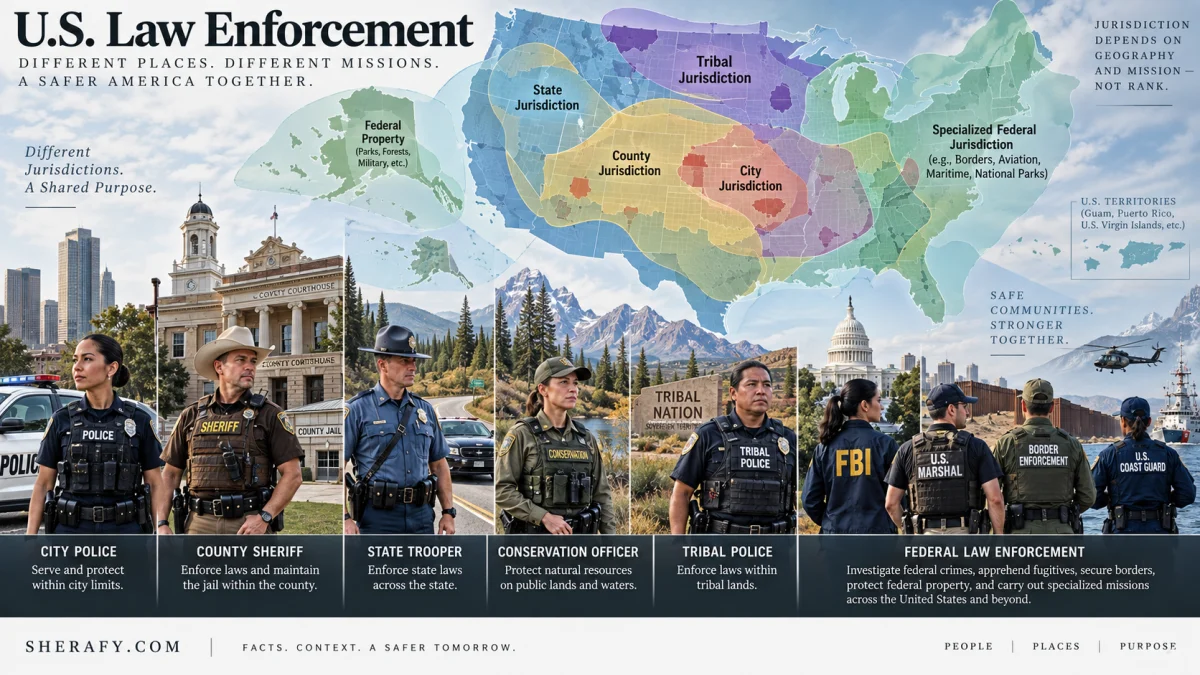
American law enforcement consists of thousands of separate local, county, state, tribal and federal agencies whose authority can overlap without one agency being "above" another.
The FBI makes this point explicitly. When conduct potentially violates local, state and federal law, state and local law-enforcement agencies are not subordinate to the FBI. The FBI does not automatically "take over" simply because a federal crime may have occurred. Agencies can instead investigate together, divide responsibilities or work through joint task forces.
The easiest way to understand American law enforcement is therefore not to ask:
Who outranks whom?
Ask instead:
Who employs this officer, what law gives the officer authority, where does that authority apply, and what kind of offense is involved?
Those questions explain the difference between a police officer, deputy sheriff, constable, state trooper, FBI agent, Deputy U.S. Marshal, Border Patrol agent, game warden, Postal Inspector and dozens of other law-enforcement occupations.
The quick answer: who does what?
| Officer or agency | Government level | Typical role | Typical jurisdiction |
|---|---|---|---|
| Municipal police | Local | Patrol, emergency response, traffic, investigations | City or municipality |
| County/regional police | Local | General police services | County or regional jurisdiction |
| Sheriff/deputy sheriff | County | Patrol, jails, courts, warrants, civil process, investigations | County, depending on state law |
| Constable | Local/county | Varies enormously; often courts, warrants, civil process, sometimes general policing | Defined by state law |
| State police/state troopers | State | Highway patrol, statewide enforcement, investigations, local assistance | Statewide, subject to state law |
| Game warden/conservation officer | State or federal | Wildlife, hunting, fishing and natural-resource enforcement | State or designated federal jurisdiction |
| Tribal police | Tribal | Policing within tribal jurisdiction | Tribal lands/jurisdiction, subject to complex federal and state rules |
| FBI special agent | Federal | Federal criminal and national-security investigations | Federal statutory jurisdiction |
| Deputy U.S. Marshal | Federal | Federal courts, fugitives, prisoners, warrants and witness security | Federal judicial authority |
| DEA special agent | Federal | Controlled-substance investigations | Federal drug laws |
| ATF special agent | Federal | Firearms, explosives, arson and related federal offenses | Assigned federal statutes |
| Secret Service agent | Federal | Protective operations and financial/cybercrime investigations | Assigned federal authorities |
| CBP officer | Federal | Customs and border inspection | Ports of entry |
| Border Patrol agent | Federal | Border enforcement | Primarily between ports of entry |
| HSI special agent | Federal | Transnational crime, smuggling, customs and related investigations | Federal statutory jurisdiction |
| ICE ERO officer | Federal | Immigration arrests, detention and removal operations | Federal immigration authority |
| Postal Inspector | Federal | Mail-related crime and postal-system investigations | Federal postal laws |
| IRS-CI special agent | Federal | Criminal tax and financial investigations | Federal tax and related financial laws |
| Federal Air Marshal | Federal | Aviation and transportation security | Transportation system |
| Federal Protective Service officer/agent | Federal | Federal-building protection | Federal facilities |
| Park ranger/federal land officer | Federal or state | Resource protection, public safety and law enforcement | Designated parks/public lands |
| Military criminal investigator | Federal/military | Serious crimes involving military services | Service and federal jurisdiction |
| Inspector General special agent | Federal or state | Fraud, corruption and crimes involving government programs | Agency/program-specific |
| Correctional officer | Federal/state/local | Custody and security of incarcerated people | Correctional institution/system |
| Probation/pretrial/parole officer | Federal/state/local | Investigation and community supervision | Court/corrections system |
That table is intentionally simplified. The important phrase is "typical jurisdiction."
There is no nationwide statute defining the powers of every sheriff, constable, university police officer or game warden. State law, local charters, federal statutes, court orders, mutual-aid agreements and special deputations can all change the answer.
Why American law enforcement is so complicated
The scale alone helps explain the confusion.
The Bureau of Justice Statistics’ Census of State and Local Law Enforcement Agencies counted 17,541 state and local law-enforcement agencies in its June 2018 census. These included local police departments, sheriffs’ offices, primary state agencies, tribal agencies, constables, marshals and special-jurisdiction agencies.
At the federal level, the newer 2023 Census of Federal Law Enforcement Officers, published in May 2026, reported 133,798 full-time federal law-enforcement officers across 88 agencies.
So there is no realistic list of six or seven badges that captures American law enforcement.
The system is decentralized by design and history.
Authority and jurisdiction are not exactly the same thing
These words are often used interchangeably, but separating them makes the system easier to understand.
Authority is the legal power an officer has. That can include powers such as arrest, detention, investigation, search pursuant to legal process, service of warrants or enforcement of particular statutes.
Jurisdiction describes the legal sphere within which that authority applies.
Jurisdiction can depend on several different things.
1. Geographic jurisdiction
A municipal police department generally serves a particular city.
A sheriff normally operates at the county level.
A state trooper ordinarily possesses authority established by state law across the state.
But geographical boundaries are not necessarily brick walls. Mutual-aid laws, fresh-pursuit rules, warrants, emergencies, task forces and other statutes can permit officers to act beyond their ordinary patrol boundaries.
2. Subject-matter jurisdiction
Some agencies exist primarily to enforce a particular body of law.
DEA investigates federal controlled-substance violations.
IRS Criminal Investigation investigates criminal tax offenses and related financial crimes.
Fish and Wildlife special agents investigate wildlife crimes.
Postal Inspectors investigate crimes involving the mail and postal system.
The officer’s jurisdiction follows the law assigned to the agency, not simply a geographic map.
3. Property or institutional jurisdiction
Some police forces exist primarily because of where something happens.
Examples include:
- university police;
- transit police;
- airport police;
- port police;
- U.S. Capitol Police;
- Supreme Court Police;
- VA Police;
- U.S. Park Police;
- Pentagon Police;
- U.S. Mint Police; and
- Federal Reserve law-enforcement officers.
A person wearing a police uniform at a federal facility may therefore be a fully sworn officer without belonging to the FBI, Marshals Service or a city police department.
4. Personal or status-based jurisdiction
Certain legal systems care about who is involved.
Military criminal jurisdiction can depend on military status.
Indian Country jurisdiction can depend on the location, the offense, federal statutes and, in some circumstances, the tribal or nontribal status of the people involved.
This is why "Who investigates the crime?" can sometimes require considerably more information than simply knowing the address.
5. Special designation
An officer can also receive additional authority through cross-deputation or task-force assignment.
The FBI describes joint task forces in which federal, state and local personnel work together when jurisdiction overlaps.
That does not erase the agencies’ separate identities. It gives the participating officers a legal framework for working across ordinary boundaries.
Local police: the officers most Americans encounter
Municipal police departments provide the familiar model of American policing.
Their officers commonly:
- answer 911 calls;
- patrol neighborhoods;
- enforce criminal and traffic laws;
- make arrests;
- investigate crimes;
- respond to crashes;
- conduct traffic stops;
- serve warrants; and
- provide emergency assistance.
But "local police" does not always mean "city police."
Some counties operate county police departments. Some areas use regional police agencies covering multiple municipalities. Other places rely primarily on the sheriff.
Police chief vs. police officer
A police chief is normally the administrative head of a police department.
Unlike sheriffs, who are commonly elected, police chiefs are generally appointed by a mayor, city manager, council or other governing authority.
A chief’s authority over officers comes from leading that particular department. Being a police chief does not make someone the commander of unrelated sheriff’s deputies, state troopers or federal agents.
Sheriff vs. police: what is the difference?
The simplest national distinction is:
Police departments generally serve municipalities or other local jurisdictions. Sheriff’s offices generally serve counties.
But that only begins the answer.
According to the Bureau of Justice Statistics, sheriffs are usually elected, while local police chiefs generally are not.
Sheriffs’ offices can perform combinations of:
- patrol;
- criminal investigations;
- operating county jails;
- courthouse security;
- serving arrest warrants;
- serving civil papers;
- prisoner transportation;
- search and rescue;
- transporting people between courts and detention facilities; and
- providing contract policing to municipalities.
The exact package varies dramatically.
Some sheriff’s offices are essentially the primary police force for large areas. Others concentrate much more heavily on courts, jails and civil process.
Does a sheriff outrank the police chief?
No universal hierarchy exists.
A sheriff and a municipal police chief ordinarily lead different agencies created under different legal authorities.
One does not become the other’s supervisor simply because the sheriff has countywide responsibilities.
What is a deputy sheriff?
The sheriff is the officeholder or agency head. A deputy sheriff is an officer exercising authority through the sheriff’s office.
But not everyone employed by a sheriff’s department necessarily possesses identical police powers.
Sheriff’s offices also employ jail officers, court personnel, communications staff and civilians. BJS specifically warns that not all personnel working for a sheriff possess general arrest authority.
What is a constable?
"Constable" may be the hardest common law-enforcement title to define nationally because its meaning changes substantially from one state to another.
In some jurisdictions, constables are elected law-enforcement officers.
In others, their work centers heavily on:
- serving court papers;
- executing warrants;
- attending local courts;
- evictions;
- civil process; or
- limited peace-officer functions.
For example, Arizona law assigns constables duties connected to justice courts and service of process, while also granting peace-officer authority when an elected or appointed constable is performing official duties.
Texas, meanwhile, establishes elected constables by precinct in the Texas Constitution.
The important lesson is broader than constables:
A law-enforcement title does not necessarily carry the same legal powers from one state to another.
What is a local or state marshal?
"Marshal" creates similar confusion because it is not exclusively a federal title.
The famous U.S. Marshals Service is federal, but some states and municipalities also use titles such as city marshal, town marshal, state marshal or court marshal.
Their duties may involve policing, warrants, courts or civil process depending on local law.
A city marshal in one state should therefore not be assumed to have the same function as a Deputy U.S. Marshal.
State police, state troopers and highway patrol
State-level law enforcement is another area where names create more confusion than clarity.
States use titles including:
- State Police;
- Highway Patrol;
- State Patrol;
- Department of Public Safety;
- State Trooper; and
- combinations of these.
These terms are not nationally standardized job descriptions.
The Bureau of Justice Statistics describes primary state law-enforcement agencies as performing some combination of highway patrol, statewide investigations, assistance to local agencies and direct policing in areas lacking local coverage.
State trooper vs. police officer
A state trooper generally works for a state-level agency rather than a city or county.
Troopers commonly perform:
- highway traffic enforcement;
- crash investigations;
- impaired-driving enforcement;
- commercial-vehicle enforcement;
- criminal interdiction;
- statewide patrol;
- assistance to local agencies; and
- criminal investigations.
The precise role depends on the state.
State police vs. highway patrol
Sometimes the difference is mostly organizational naming.
In some states the primary state agency has broad criminal investigative and patrol responsibilities. In others, the traditional highway-patrol mission is more prominent.
A page claiming that "state police investigate crimes while highway patrol only writes traffic tickets" would therefore be wrong as a nationwide rule.
Does a state trooper outrank a city police officer?
No.
A trooper’s statewide jurisdiction does not make the trooper the city officer’s supervisor.
They work for different agencies.
State bureaus of investigation and attorney-general investigators
Many states also maintain statewide investigative organizations.
Depending on the state, investigators may work for:
- a state bureau of investigation;
- state police;
- a department of justice;
- an attorney general;
- a public-safety department;
- a state fire marshal;
- a tax or revenue department; or
- another specialized agency.
These investigators may handle complex homicide cases, organized crime, public corruption, cybercrime, financial crime, forensic assistance or investigations requested by local departments.
Again, there is no one national model.
Game wardens and conservation officers
Game wardens, conservation officers and wildlife officers are real law-enforcement officers in many jurisdictions, not simply park employees who write fishing tickets.
Their responsibilities can include:
- hunting and fishing laws;
- wildlife trafficking;
- poaching;
- boating laws;
- environmental violations;
- search and rescue;
- firearms violations connected to hunting;
- public-land enforcement; and
- ordinary criminal offenses encountered during their duties.
State officers derive their powers from state law.
At the federal level, the U.S. Fish and Wildlife Service Office of Law Enforcement uses special agents and wildlife inspectors to investigate wildlife crime and illegal wildlife trade.
Fire marshals and arson investigators
"Fire marshal" is another title whose police authority varies by jurisdiction.
A fire marshal may be responsible primarily for:
- fire codes;
- inspections;
- fire prevention;
- explosives regulation; or
- fire investigations.
In some jurisdictions, fire marshals or arson investigators are sworn law-enforcement officers with arrest authority. Elsewhere, fire-code and criminal investigations are divided among different agencies.
The job title alone does not answer the question.
Campus police vs. campus security
A campus security guard and a sworn university police officer are not necessarily the same thing.
BJS reported nearly 1,300 campus law-enforcement agencies serving qualifying four-year institutions during the 2021-22 academic year.
Sworn campus police can possess government-granted arrest powers, although their jurisdiction depends on state law and institutional arrangements.
"Campus security," by contrast, may refer to nonsworn security employees with much more limited authority.
Never assume the words security, public safety and police are interchangeable.
School police and school resource officers
Some school systems operate their own police departments.
A school resource officer, however, is usually an assignment rather than a completely separate category of law-enforcement authority.
An SRO may be employed by:
- city police;
- a sheriff’s office;
- a school-district police department; or
- another local agency.
The officer’s underlying legal authority comes from the employing agency and applicable law, not from the letters "SRO."
Transit, airport, port and railroad police
Specialized transportation systems can have their own law-enforcement agencies.
Examples include:
- transit police;
- airport police;
- port police;
- bridge or tunnel police;
- railroad police; and
- transportation-authority police.
These agencies may be state, local, regional or quasi-public.
Amtrak, for example, operates the Amtrak Police Department, whose sworn officers protect the national passenger rail system. Amtrak explains that its officers’ legal authority is tied in part to railroad-police commissioning laws in the states where they operate.
The word specialized should not be confused with nonsworn. Some special-jurisdiction police officers possess substantial arrest authority.
Tribal police and Indian Country law enforcement
Tribal law enforcement requires special treatment because jurisdiction in Indian Country can be unusually complex.
The Bureau of Justice Statistics’ 2018 tribal law-enforcement census identified hundreds of tribal and Bureau of Indian Affairs law-enforcement agencies.
The Bureau of Indian Affairs Office of Justice Services provides policing, criminal-investigative and other justice services in Indian Country, while tribally operated police departments serve many individual tribal communities.
The FBI also has special federal responsibilities for serious crimes in Indian Country.
But there is no safe one-line rule such as "tribal police handle Indians and the FBI handles everyone else."
Actual jurisdiction can depend on:
- where the crime occurred;
- what offense occurred;
- whether federal statutes apply;
- tribal jurisdiction;
- the status of the accused or victim;
- state jurisdiction in particular places; and
- agreements between governments.
Indian Country jurisdiction is complex enough to justify its own dedicated explainer.
Federal law enforcement: there is no single "federal police"
This is one of the most important misconceptions to correct.
The United States has no single federal police force performing every federal law-enforcement function.
Instead, Congress has distributed different responsibilities among many agencies.
The latest BJS federal census found 88 federal agencies reporting 133,798 full-time federal law-enforcement officers in fiscal year 2023.
Most federal officers therefore do not work for the FBI.
FBI: broad federal criminal and national-security investigations
The Federal Bureau of Investigation has unusually broad investigative responsibilities, including areas such as:
- terrorism;
- counterintelligence;
- cybercrime;
- public corruption;
- civil-rights violations;
- organized crime;
- violent federal offenses;
- financial crime; and
- other federal statutes assigned to the Bureau.
But an FBI agent is not America’s national police chief.
The FBI expressly states that state and local agencies are not subordinate to it.
That means an FBI agent does not automatically walk into a city homicide investigation and become the local detective’s boss.
Federal jurisdiction must exist, and agencies commonly coordinate when multiple laws apply.
U.S. Marshals: courts, fugitives, prisoners and judicial enforcement
The U.S. Marshals Service is often confused with the FBI because both can pursue dangerous federal fugitives.
But their institutional missions are different.
The U.S. Marshals Service describes its responsibilities as including:
- protecting the federal judiciary;
- apprehending fugitives;
- managing and transporting federal prisoners;
- executing federal court orders;
- operating the federal Witness Security Program; and
- managing certain seized assets.
The Marshals Service is closely connected to the functioning of the federal courts.
FBI vs. U.S. Marshals
A useful simplification is:
FBI special agents primarily investigate federal crimes and national-security threats. Deputy U.S. Marshals are especially associated with federal judicial enforcement, fugitives, prisoners and court security.
There is overlap, and both can make arrests.
One does not simply "outrank" the other.
DEA: federal drug enforcement
The Drug Enforcement Administration primarily enforces federal controlled-substance laws and investigates major drug-trafficking organizations and related criminal activity.
DEA also has responsibilities involving the lawful controlled-substance system and diversion of pharmaceuticals.
DEA agents routinely work with state and local narcotics investigators.
ATF: firearms, explosives and arson
The Bureau of Alcohol, Tobacco, Firearms and Explosives has specialized federal responsibilities involving:
- firearms trafficking and certain federal firearms crimes;
- explosives;
- bombings;
- arson;
- criminal use of explosives; and
- certain illegal alcohol and tobacco activity.
Its official mission areas illustrate an important theme of federal law enforcement: agencies are often defined by the statutes Congress assigned to them.
Secret Service: not just presidential protection
The U.S. Secret Service has two major sides to its mission.
Most people know the protective side: presidents, vice presidents, certain former officials, candidates, visiting leaders and designated events.
But the agency originated in financial enforcement and still investigates crimes affecting the nation’s financial and payment systems.
The Secret Service describes its agents as performing both protective and investigative work, including counterfeiting and cyber-enabled financial crime.
The agency also has a Uniformed Division, whose officers provide visible police and protective functions around designated sites in Washington.
So "Secret Service agent" and "Secret Service Uniformed Division officer" are not identical positions.
CBP officer vs. Border Patrol agent
These titles are frequently treated as synonyms. They are not.
Both work within U.S. Customs and Border Protection, but their ordinary operating environments differ.
CBP officers
CBP officers primarily work at ports of entry, such as:
- airports;
- land-border crossings; and
- seaports.
They inspect travelers and goods and enforce customs, immigration and other laws at those entry points.
Border Patrol agents
U.S. Border Patrol is primarily responsible for enforcement between ports of entry along U.S. borders.
CBP also operates Air and Marine Operations, which performs aviation and maritime interdiction and law-enforcement support.
The CBP operational statistics page reflects the agency’s distinct operational components.
ICE: HSI and ERO are different
"ICE agent" can conceal two substantially different missions.
The U.S. Immigration and Customs Enforcement mission is divided principally between Homeland Security Investigations and Enforcement and Removal Operations.
Homeland Security Investigations
HSI special agents investigate transnational criminal activity such as:
- smuggling;
- human trafficking;
- narcotics;
- money laundering;
- customs fraud;
- cybercrime;
- child exploitation;
- export violations; and
- other offenses connected to ICE’s federal authorities.
Enforcement and Removal Operations
ERO focuses on immigration enforcement, including arrests, detention, case management and removal of people subject to immigration enforcement.
An HSI criminal investigator and an ERO deportation officer therefore may both work for ICE while doing substantially different jobs.
Postal Inspectors vs. Postal Police
Yes, the mail has federal law enforcement.
And there are two different titles that are easy to confuse.
U.S. Postal Inspectors
The U.S. Postal Inspection Service describes Postal Inspectors as armed federal law-enforcement officers who investigate crimes affecting the mail, postal employees and the postal system.
Their cases can involve:
- mail theft;
- mail fraud;
- dangerous mail;
- robberies;
- identity-related crimes;
- narcotics shipped through the mail; and
- attacks on postal personnel.
Postal Police officers
Postal Police officers are a separate uniformed component focused on protecting critical postal facilities, employees and assets.
So a Postal Inspector is generally an investigator, while a Postal Police officer performs a more traditional uniformed protective-policing role.
IRS Criminal Investigation
The tax agency has armed criminal investigators.
IRS Criminal Investigation investigates criminal violations of federal tax law as well as related financial crimes such as money laundering and certain Bank Secrecy Act offenses.
That does not mean the IRS sends armed agents after every person who makes an ordinary tax mistake.
Criminal Investigation handles criminal cases, while most tax administration and civil disputes are handled elsewhere in the IRS.
Diplomatic Security Service
The Department of State also has federal law-enforcement officers.
Diplomatic Security Service special agents perform functions including:
- protecting the Secretary of State and certain foreign dignitaries;
- investigating passport and visa fraud;
- conducting criminal and administrative investigations related to State Department operations; and
- protecting U.S. diplomatic personnel and facilities overseas.
This is another example of a federal law-enforcement agency that can have a large international footprint without being part of the FBI.
Federal Air Marshals
Federal Air Marshals are law-enforcement officers within the Transportation Security Administration’s Law Enforcement/Federal Air Marshal Service.
Their mission centers on threats to civil aviation and the broader transportation system.
They should not be confused with ordinary TSA screening officers working at security checkpoints.
A TSA screening officer is not automatically a federal law-enforcement officer simply because both work for TSA.
Federal police who protect particular places
Some federal law-enforcement organizations look much more like ordinary uniformed police departments.
Their authority is concentrated around particular federal facilities, people or property.
Federal Protective Service
The Federal Protective Service protects federal facilities and the people who use them.
Its work includes law enforcement, security assessment and coordination of protective security across federal buildings.
U.S. Capitol Police
The U.S. Capitol Police protects Congress, its members, employees, visitors, facilities and the legislative process.
It is a federal police department, not a unit of Washington’s Metropolitan Police Department.
Supreme Court Police
The Supreme Court of the United States Police is another distinct federal law-enforcement agency.
Its officers protect the Supreme Court building, grounds, Justices and associated personnel and enforce applicable federal and District of Columbia laws within their authority.
VA Police
The Department of Veterans Affairs operates its own VA Police.
VA Police officers protect VA medical centers and other facilities and perform law-enforcement and investigative duties under VA authority.
Pentagon Police
The Pentagon Force Protection Agency employs uniformed Pentagon Police officers responsible for law enforcement, security and force protection at the Pentagon and designated Defense Department facilities.
PFPA also employs special agents who conduct criminal, internal-affairs and protective-intelligence investigations.
U.S. Mint Police
The United States Mint has its own police force.
According to the U.S. Mint, Mint Police protect life and property, investigate criminal activity, preserve evidence and enforce applicable federal and local laws at Mint facilities.
That includes the U.S. Bullion Depository at Fort Knox.
Federal Reserve law-enforcement officers
Even the Federal Reserve has federally authorized law-enforcement officers protecting its facilities, personnel and operations.
The Federal Reserve’s governing rules establish federal law-enforcement authority for designated Board and Reserve Bank personnel.
Their primary mission is protective rather than serving as a general criminal-investigative police force. Federal Reserve rules expressly state that these officers do not have primary responsibility for investigating criminal violations generally.
That is a useful example of why having arrest authority does not make every police force a general-purpose police department.
Park rangers, land-management officers and natural-resource agents
Public lands have another collection of specialized law-enforcement occupations.
National Park Service law-enforcement rangers
NPS law-enforcement rangers are federally commissioned law-enforcement officers.
Their work can include:
- patrol;
- arrests;
- criminal investigations;
- traffic enforcement;
- search and rescue;
- visitor protection; and
- natural-resource protection.
The National Park Service also employs special agents in its Investigative Services Branch for complex, sensitive and long-term criminal investigations.
U.S. Park Police
The U.S. Park Police is a separate uniformed federal police force within the National Park Service.
Its officers police designated National Park Service areas, especially in particular urban regions.
A U.S. Park Police officer and an NPS law-enforcement ranger therefore work within the same department but are not simply two names for the same position.
Bureau of Land Management
The Bureau of Land Management employs uniformed law-enforcement rangers and criminal investigators who protect public lands and investigate offenses ranging from resource theft and vandalism to illegal dumping and other crimes on BLM-managed lands.
U.S. Forest Service
The U.S. Forest Service has its own Law Enforcement and Investigations function, including uniformed officers and special agents working on crimes affecting National Forest System lands, visitors, employees and natural resources.
Fish and Wildlife Service
The U.S. Fish and Wildlife Service Office of Law Enforcement investigates wildlife trafficking, illegal take and other violations of federal wildlife laws.
Its workforce includes criminal investigators known as special agents as well as wildlife inspectors focused heavily on wildlife commerce.
NOAA Office of Law Enforcement
The NOAA Fisheries Office of Law Enforcement enforces federal laws protecting marine resources.
Its officers and special agents investigate illegal fishing and other offenses involving protected marine species and federal fisheries.
The Coast Guard is both military and law enforcement
The U.S. Coast Guard is unusual because it is an armed service and a major federal maritime law-enforcement organization.
The Coast Guard describes itself as the nation’s lead federal maritime law-enforcement agency.
Its law-enforcement missions can include:
- drug interdiction;
- fisheries enforcement;
- migrant interdiction;
- maritime security;
- customs-related enforcement;
- safety and security boardings; and
- enforcement on the high seas under applicable law.
The Coast Guard also has a separate Coast Guard Investigative Service for serious criminal investigations involving the service and its interests.
Military police vs. military criminal investigators
Military law enforcement has another important distinction.
Uniformed military police, security forces and masters-at-arms perform installation policing, security and military law-enforcement functions.
Serious criminal investigations are often handled by specialized military criminal investigative organizations.
A 2025 Government Accountability Office review identifies four major organizations:
- Army Criminal Investigation Division, or CID;
- Naval Criminal Investigative Service, or NCIS;
- Air Force Office of Special Investigations, or AFOSI; and
- Coast Guard Investigative Service, or CGIS.
These organizations conduct federal-level investigations of serious and complex crimes connected to their respective military services.
NCIS, despite the television franchise, is therefore not simply "the Navy’s FBI." It has a particular military and federal jurisdiction.
Inspector General special agents
Many federal departments contain another category that most people rarely encounter: Office of Inspector General criminal investigators.
Inspectors general investigate matters such as:
- fraud against government programs;
- bribery;
- procurement fraud;
- employee corruption;
- theft of federal funds;
- contractor misconduct; and
- other criminal activity affecting their departments.
The 2023 BJS federal census counted 3,519 full-time federal law-enforcement officers working in Offices of Inspector General, roughly 3% of the federal total.
So when news reports say an "OIG special agent" executed a warrant or investigated fraud, that person may be a fully authorized federal criminal investigator even though the agency name is unfamiliar.
Correctional officers are law enforcement too, but their mission is different
Law enforcement does not stop after an arrest.
Federal, state and local correctional systems employ officers responsible for:
- custody;
- institutional security;
- inmate movement;
- contraband control;
- disturbances;
- escapes; and
- safety inside detention facilities.
The Federal Bureau of Prisons classifies many institution positions as federal law-enforcement positions and provides correctional personnel specialized law-enforcement training.
But correctional officers are not simply patrol police who happen to work in a prison.
Their primary authority and duties center on custody and correctional institutions.
At the county level, jail officers may work for the sheriff. In other places, a separate corrections department operates the jail or prison.
Probation, pretrial and parole officers
Probation and parole officers occupy another part of the criminal-justice system.
At the federal level, U.S. Probation and Pretrial Services identifies its officers as federal law-enforcement officers.
Their work is very different from ordinary patrol policing.
They:
- investigate defendants’ backgrounds for judges;
- prepare pretrial and sentencing reports;
- assess risks;
- supervise people released pending trial; and
- supervise people serving terms of community supervision.
State probation and parole systems vary.
Again, the broader lesson applies: law-enforcement officer does not mean patrol cop.
Special agent, detective, deputy, trooper and inspector: what the titles actually mean
A major source of confusion is mixing together job titles, ranks, legal classifications and agency names.
Police officer
Usually a sworn officer employed by a police department.
Deputy sheriff
A sworn officer working under a sheriff’s office.
"Deputy" refers to the office, not a lower national level of police power.
Trooper
Typically a sworn officer of a state police, state patrol or highway-patrol organization.
Detective
Usually an investigator inside a police or sheriff’s agency.
A detective often began as a patrol officer and moved into an investigative assignment or rank.
Investigator
A broad title.
Investigators can be sworn or nonsworn and can work for police departments, prosecutors, regulatory agencies, insurance departments, attorneys general and numerous other organizations.
Special agent
Most commonly associated with federal criminal investigators, but "special agent" is not exclusive to the FBI.
DEA, ATF, Secret Service, IRS-CI, HSI, DSS, Offices of Inspector General, military investigative agencies and numerous other organizations employ special agents.
Inspector
The word can describe wildly different occupations.
A Postal Inspector, for example, is a federal criminal investigator.
Elsewhere, an inspector may perform regulatory, code, safety or supervisory work without ordinary police authority.
Marshal
Can refer to a U.S. Marshal, Deputy U.S. Marshal or a completely different state/local office.
Always identify which government employs the marshal.
Constable
A historic title whose modern powers vary greatly by state and locality.
Ranger
Also highly variable.
A law-enforcement ranger may be a sworn police officer, while another ranger may primarily provide interpretation, resource management or visitor services.
Game warden or conservation officer
Usually a specialist in wildlife and natural-resource enforcement, often with broader police authority established by state law.
Peace officer
"Peace officer" is generally a legal classification created by state law, not one standardized American occupation.
Police officers, deputies, troopers, investigators and other officials may all qualify as peace officers under a particular state’s statutes.
The definition must be checked state by state.
SWAT, K-9 and homicide are assignments, not additional levels of government
Another easy mistake is treating specialty units as separate types of legal authority.
Terms such as:
- SWAT;
- homicide;
- narcotics;
- vice;
- gang unit;
- K-9;
- bomb squad;
- traffic unit;
- cybercrime;
- school resource officer;
- marine patrol;
- mounted unit;
- aviation unit;
- tactical team; and
- fugitive unit
usually describe assignments within an existing agency.
A SWAT officer employed by a city police department is still exercising that department’s legal authority.
A sheriff’s homicide detective remains a deputy sheriff.
A state police K-9 handler remains a state officer.
The specialty describes what the officer does, not an additional rung on some national law-enforcement ladder.
FBI vs. CIA: one is law enforcement, one is not
Movies regularly blur this distinction.
The FBI is a federal law-enforcement and domestic intelligence organization.
The CIA is principally a foreign-intelligence organization.
The CIA itself states plainly that it is not a law-enforcement organization.
Its core mission involves collecting foreign intelligence, producing analysis and conducting authorized covert action.
The CIA does operate a protective law-enforcement component for the security of its own facilities and personnel, but that does not turn the CIA itself into a domestic police agency.
Prosecutors are not higher-ranking police officers
District attorneys, state attorneys general and U.S. attorneys can exercise enormous influence over criminal cases, but prosecutors do not sit above police agencies in one national rank structure.
Police and investigators build cases.
Prosecutors decide whether and how to prosecute cases within their legal authority and litigate those cases in court.
A prosecutor’s office can also employ its own investigators, some of whom may be sworn officers.
That still does not make the prosecutor the police chief.
Private security is not the same as police
A security guard can wear a uniform, drive a marked vehicle and even be armed without becoming a government police officer.
Private security ordinarily derives its powers from:
- ordinary rights available to private persons;
- property-owner authority;
- contracts; and
- specific state licensing laws.
Some government facilities also employ contract security officers alongside sworn police.
Whether an individual has actual police powers therefore depends on legal status, not appearance.
The same caution applies to bail-enforcement agents, commonly called bounty hunters. They operate under a very different legal framework governed heavily by state law and are not ordinary government police.
Who actually investigates a crime? Real-world examples
There is often more than one correct agency.
The examples below describe common arrangements, not universal rules.
| Situation | Agency likely to be involved |
|---|---|
| Burglary inside a city | Municipal/local police |
| Crime in an unincorporated county area | Sheriff’s office or county police |
| Highway crash | State police/highway patrol or local agency, depending on the state |
| County jail incident | Sheriff/corrections agency, sometimes outside investigators |
| Federal fugitive | U.S. Marshals Service and task-force partners |
| Federally prosecutable bank robbery | Local police plus potentially FBI |
| Multi-state drug organization | DEA, FBI, HSI and/or state/local task forces depending on facts |
| Federal firearms trafficking | ATF and partner agencies |
| Bombing or explosives crime | ATF, FBI and local/state agencies depending on circumstances |
| Mail theft or mail fraud | U.S. Postal Inspection Service |
| Criminal tax evasion | IRS Criminal Investigation |
| Counterfeit U.S. currency | Secret Service |
| Cyber-enabled financial fraud | Secret Service, FBI and/or other agencies depending on facts |
| Smuggling through a port of entry | CBP and potentially HSI |
| Unlawful border crossing between ports | Border Patrol |
| Interior immigration arrest/removal | ICE Enforcement and Removal Operations |
| Crime at a VA medical center | VA Police, with other agencies as needed |
| Crime at the Pentagon | Pentagon Police/PFPA, with other agencies as needed |
| Serious crime in a national park | NPS law enforcement, FBI/local/state agencies depending on jurisdiction |
| Wildlife trafficking | U.S. Fish and Wildlife Service and other agencies |
| Illegal activity on BLM land | BLM law enforcement, often with partners |
| Federal-building security incident | Federal Protective Service plus local/federal partners |
| Threat to civil aviation | Federal Air Marshals, airport police, FBI and others depending on circumstances |
| Serious crime involving military personnel | CID, NCIS, AFOSI or CGIS, depending on the military branch |
| Serious crime in Indian Country | Tribal police, BIA, FBI, state/local authorities or combinations depending on jurisdiction |
The important word in that table is "involved."
American investigations are often multi-agency.
Does the FBI outrank local police?
No.
Federal agents and local police operate under different legal authorities and chains of command.
The FBI itself says state and local law-enforcement agencies are not subordinate to it.
An FBI special agent does not acquire command authority over a city police officer merely by showing an FBI credential.
Federal law can be controlling in areas where federal law constitutionally applies, but that is different from saying the federal officer personally outranks every state or local officer.
Does a sheriff outrank a police officer?
Not as a general rule.
A sheriff normally leads a county office. A municipal police officer works for a separate police department.
The sheriff may possess countywide statutory authority while a municipal officer’s ordinary jurisdiction is narrower, but wider geography does not equal supervisory rank.
The actual powers of both are controlled by state and local law.
Can a sheriff arrest someone inside a city?
Often, a sheriff’s legal authority extends throughout the county, including incorporated municipalities, but the precise answer depends on state law.
Even where sheriff’s deputies have authority inside a city, day-to-day policing may primarily be handled by the municipal department.
Jurisdiction and routine responsibility are not necessarily the same thing.
Can a city police officer act outside city limits?
Sometimes.
A municipal boundary usually defines the officer’s ordinary jurisdiction, but state laws can provide authority involving:
- fresh pursuit;
- warrants;
- mutual aid;
- emergencies;
- transportation of prisoners;
- joint task forces; or
- other circumstances.
The answer depends on state law and agency policy.
It is therefore inaccurate to assume an officer instantly loses every police power upon crossing a city line.
Does a state trooper have more authority than a sheriff?
There is no useful nationwide yes-or-no ranking.
A trooper may have statewide territorial authority under state law.
A sheriff may have powers tied to county policing, courts, jails and civil process that the trooper does not perform.
They have different offices and responsibilities.
What happens when local, state and federal laws are all violated?
More than one government can sometimes have jurisdiction over the same conduct.
That is called concurrent jurisdiction.
The FBI explains that federal, state and local agencies regularly work together through joint task forces when jurisdiction overlaps.
Agencies may decide who takes the investigative lead based on factors such as:
- the law violated;
- where the offense occurred;
- which agency began the investigation;
- available expertise and evidence;
- whether the conduct is part of a larger case;
- which prosecutors can bring appropriate charges;
- task-force arrangements; and
- practical investigative resources.
There is no universal rule saying the largest agency wins.
What is cross-deputization?
Cross-deputization gives an officer additional legal authority through another government or agency.
It is particularly useful when crimes routinely cross jurisdictional boundaries.
A local detective assigned to a federal task force, for example, may receive federal authority for task-force duties.
Tribal, federal, state and local governments can also use cross-commissioning or deputation arrangements where permitted.
The officer does not necessarily stop being an employee of the original agency. Instead, the officer receives additional authority for specified purposes.
How can two officers have jurisdiction over the same place?
Because jurisdiction is multidimensional.
Imagine a crime occurring inside a federally managed property located within a city and state.
Potential legal interests might include:
- city ordinances;
- state criminal law;
- federal criminal law;
- federal property regulations; and
- specialized laws governing the agency occupying the property.
Multiple officers can therefore have legitimate authority without one agency being subordinate to another.
That is not a flaw in the system. It is a consequence of American federalism and specialized law enforcement.
Which law-enforcement officer has the most power?
This question has no meaningful universal answer.
A better question is:
Power to do what?
An FBI agent may investigate a federal counterintelligence case that a local officer has no authority to run.
A local patrol officer may be the primary officer responding to an assault that gives the FBI no reason to become involved.
A game warden may possess specialized authority over wildlife offenses.
A Deputy U.S. Marshal may execute a federal court order.
A Border Patrol agent may exercise immigration authority unavailable to an ordinary city officer.
A sheriff may operate a jail and execute civil court process that a state trooper normally does not.
Authority is functional, not a video-game ranking system.
The best way to understand any unfamiliar badge
When you encounter an unfamiliar American law-enforcement title, ask five questions.
1. Who employs the officer?
City, county, state, tribe, federal government, court, transit authority, university or another institution?
2. What law creates the officer’s authority?
Federal statute? State peace-officer law? Local charter? Tribal law? Special deputation?
3. What geographic area or property does it cover?
A city? County? Entire state? Federal building? Reservation? National park? Border? Railroad?
4. What subject matter does the agency enforce?
General criminal law? Drugs? Firearms? Immigration? Taxes? Wildlife? Postal crimes? Military offenses?
5. Is the officer serving under any additional designation?
Task-force membership, cross-deputization, warrant, mutual-aid agreement or special assignment can change the answer.
Those five questions are considerably more reliable than trying to determine who has the most impressive badge.
The bottom line
American law enforcement is best understood as a network of overlapping jurisdictions, not a single ladder of rank.
Municipal police primarily handle local policing.
Sheriffs generally operate at the county level and frequently add responsibilities for jails, courts, warrants and civil process.
Constables and local marshals vary heavily by state.
State troopers and state police exercise statewide responsibilities established by state law.
Tribal agencies operate within a separate and sometimes highly complex jurisdictional system.
Federal agencies usually receive authority over particular federal offenses, institutions, people or property. The FBI has broad federal investigative responsibilities, but it does not command America’s local police departments. The Marshals Service is closely connected to federal courts and fugitives. DEA focuses on controlled substances. ATF focuses on assigned firearms, explosives and arson laws. Specialized agencies range from Postal Inspectors and IRS special agents to park rangers, wildlife agents, military investigators and officers guarding individual federal facilities.
And even that framework contains exceptions.
If there is one rule worth remembering, it is this:
In American law enforcement, the title on the badge tells you less than the law behind it.
References and Further Reading
National Law-Enforcement Data
Census of State and Local Law Enforcement Agencies, 2018 — Bureau of Justice Statistics. The most recent complete BJS census of state and local law-enforcement agencies, documenting 17,541 agencies and the major organizational categories discussed in this article.
Federal Law Enforcement Officers, 2023: Statistical Tables — Bureau of Justice Statistics, published May 2026. The latest broad federal census used here, covering 133,798 full-time federal law-enforcement officers reported by 88 agencies.
Local Police Departments: Personnel, 2020 — Bureau of Justice Statistics. National statistics on municipal and other local police departments.
Sheriffs’ Offices: Personnel, 2020 — Bureau of Justice Statistics. Provides national context on sheriff’s offices and their sworn and civilian workforces.
Primary State Law Enforcement Agencies: Personnel, 2020 — Bureau of Justice Statistics. Useful for understanding the varying highway-patrol, investigative and statewide-policing functions of state agencies.
Tribal Law Enforcement in the United States, 2018 — Bureau of Justice Statistics. National overview of tribal and Bureau of Indian Affairs law-enforcement agencies.
Campus Law Enforcement Agencies Serving 4-Year Institutions, 2021-22 — Bureau of Justice Statistics. Documents the substantial sworn law-enforcement presence on American college campuses.
Jurisdiction and Interagency Cooperation
Does the FBI take over when local, state and federal laws are violated? — Federal Bureau of Investigation. Directly addresses the widespread misconception that state and local agencies become subordinate to the FBI.
Do FBI agents work with state, local and other law-enforcement officers on task forces? — FBI. Explains concurrent jurisdiction and joint task-force operations.
Arizona Revised Statutes § 22-131: Constables — Arizona Legislature. A useful primary-law example showing why the powers of a "constable" cannot be generalized nationally.
Major Federal Investigative Agencies
U.S. Marshals Service: What We Do — U.S. Marshals Service. Describes the Service’s responsibilities for the federal judiciary, fugitives, prisoners, witness security, court orders and seized assets.
DEA Mission — Drug Enforcement Administration. Defines DEA’s federal controlled-substance and drug-enforcement responsibilities.
ATF Mission Areas — Bureau of Alcohol, Tobacco, Firearms and Explosives. Primary overview of ATF’s firearms, explosives, arson and related enforcement missions.
U.S. Secret Service FAQ — U.S. Secret Service. Plain-language official explanation of the agency’s dual protective and financial-crime investigative responsibilities.
ICE Mission — U.S. Immigration and Customs Enforcement. Explains the distinct missions of Homeland Security Investigations and Enforcement and Removal Operations.
U.S. Postal Inspection Service: How We Do It — U.S. Postal Inspection Service. Explains the powers of Postal Inspectors and distinguishes them from Postal Police officers.
IRS Criminal Investigation at a Glance — Internal Revenue Service. Describes the criminal tax and financial-investigative mission of IRS-CI special agents.
Federal Protective and Special-Jurisdiction Police
Federal Protective Service — Department of Homeland Security. Overview of the federal agency responsible for protecting federal facilities and their occupants.
U.S. Capitol Police Mission — U.S. Capitol Police. Explains the specialized federal policing mission surrounding Congress.
Supreme Court Police — Supreme Court of the United States. Describes the authority and protective responsibilities of the Court’s federal police force.
VA Police — Department of Veterans Affairs. Overview of the federal police service protecting VA facilities.
Pentagon Police Officers — Pentagon Force Protection Agency. Describes the uniformed federal police officers responsible for law enforcement and force protection at designated Defense Department facilities.
U.S. Mint Protection and Police Careers — United States Mint. Explains the duties of Mint Police in protecting facilities, people and high-value government assets.
Federal Reserve Law-Enforcement Authority — Board of Governors of the Federal Reserve System. Primary rules governing designated Federal Reserve law-enforcement officers.
Parks, Wildlife, Public Lands and Maritime Enforcement
National Park Service Law-Enforcement Rangers — National Park Service. Explains the federal commission, duties and training of NPS law-enforcement rangers.
U.S. Park Police — National Park Service. Official overview of the separate uniformed U.S. Park Police.
Bureau of Land Management Law Enforcement — BLM. Describes the work of uniformed law-enforcement rangers and special agents on federal public lands.
U.S. Fish and Wildlife Service Office of Law Enforcement — U.S. Fish and Wildlife Service. Covers federal wildlife crime investigations and wildlife-trade enforcement.
NOAA Fisheries Office of Law Enforcement — National Oceanic and Atmospheric Administration. Explains federal marine-resource enforcement by NOAA officers and special agents.
U.S. Coast Guard Maritime Law Enforcement — U.S. Coast Guard. Explains the Coast Guard’s unusual combined military and federal maritime law-enforcement mission.
Military, Courts and Corrections
Criminal Investigators: Military Criminal Investigative Organizations — U.S. Government Accountability Office, August 2025. Describes CID, NCIS, AFOSI and CGIS as federal law-enforcement organizations responsible for serious military-connected criminal investigations.
U.S. Probation and Pretrial Services Officers — Administrative Office of the U.S. Courts. Explains the law-enforcement status and court-supervision duties of federal probation and pretrial officers.
Federal Bureau of Prisons Careers and Law-Enforcement Positions — Federal Bureau of Prisons. Provides context for the law-enforcement classification of federal correctional work.
Intelligence vs. Law Enforcement
About the CIA — Central Intelligence Agency. Particularly useful because the CIA explicitly states that it is not a law-enforcement organization, clarifying one of the most common public misconceptions.
Editorial Currency Note
Law-enforcement jurisdiction is governed by federal, state, tribal and local law and can change through legislation, court decisions, reorganizations, cross-deputation agreements and agency policy. National statistics also lag because comprehensive government censuses are conducted periodically. This article uses the most recent broad federal census available as of September 2026 and identifies the year of older state, local, tribal and campus datasets where relevant. Readers evaluating a specific officer’s authority should consult the current law of the relevant jurisdiction and agency.