Pirate Ship can sometimes sell a USPS shipping label for less than you would pay to mail the same package at a Post Office because USPS itself intentionally charges different prices through different sales channels.
There is not one universal "USPS price."
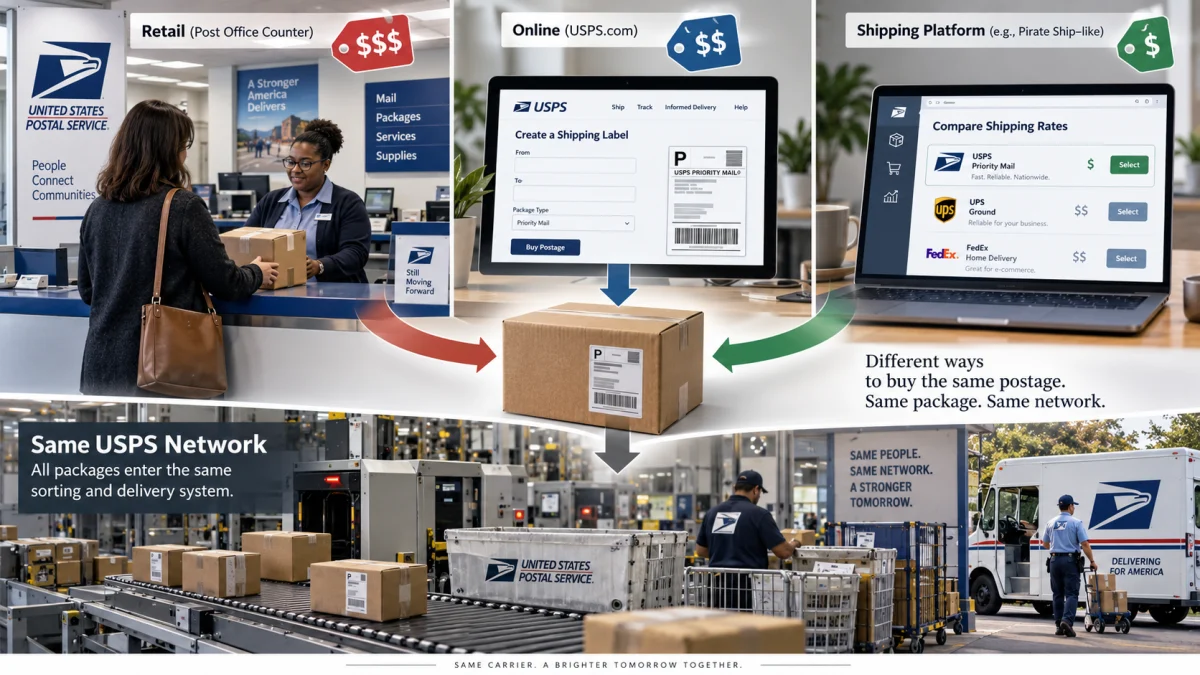
A customer walking into a Post Office generally encounters USPS Retail Pricing. A personal customer buying an eligible label through USPS Click-N-Ship now receives Commercial Pricing. Certain Click-N-Ship business customers can receive a lower Business Rate Card. And shipping platforms participating in USPS Connect eCommerce can gain access to special Merchant Rate Card pricing for eligible shipments. USPS explicitly tells participating platforms that they can receive discounted pricing and offer special pricing to their merchants. USPS Connect eCommerce program (USPS)
Pirate Ship is one of those platforms.
That is the basic answer to the apparent contradiction: the middleman can be cheaper because the supplier—in this case USPS—has deliberately given that sales channel a different price.
It is not a postage loophole, and Pirate Ship is not paying the difference out of pocket.
What Is Pirate Ship?
Despite the name, Pirate Ship is not a shipping carrier.
It does not operate a competing postal network or send pirate-themed trucks to your house. It is a web-based shipping-label platform that lets individuals and businesses enter package information, compare available USPS and UPS services, buy postage, print labels, and track shipments.
When you buy a USPS label through Pirate Ship, USPS still transports and delivers the package. If you select UPS instead, UPS handles it.
Pirate Ship describes its service as free shipping software with no monthly subscription, per-label charge or postage markup. USPS itself lists Pirate Ship among the platforms participating in its Connect eCommerce program, although USPS notes that inclusion on its platform list is not an endorsement of any particular company. USPS’s list of Connect eCommerce platforms Pirate Ship’s explanation of its service (USPS)
For a basic shipment, the process looks like this:
- Enter where the package is going.
- Enter its weight and dimensions.
- Compare available USPS and UPS options.
- Buy the selected label through Pirate Ship.
- Print and attach the label.
- Give the package to USPS or UPS.
The USPS Office of Inspector General describes essentially the same process for Connect eCommerce platforms: a merchant enters package attributes into a platform, the software displays USPS and competing options, the customer pays the platform, and the platform electronically sends the shipment information and payment to USPS. USPS OIG’s Merchant Rate Card audit (Office of Inspector General)
So Pirate Ship is best understood as the storefront and software layer for buying the shipment—not the company actually carrying the box.
There Is No Single USPS Price
This is the part that makes the whole situation easier to understand.
USPS maintains several pricing structures for parcels.
| How postage is purchased | Typical pricing structure | What it means |
|---|---|---|
| Post Office counter | Retail Pricing | Published consumer counter prices |
| Personal USPS Click-N-Ship account | Commercial Pricing | Lower published online pricing for eligible services |
| Business Click-N-Ship account | Business Rate Card | Additional pricing available on eligible Priority Mail and Ground Advantage shipments |
| Eligible Connect eCommerce platform | Merchant Rate Card or other applicable pricing | Special USPS pricing offered through participating platforms |
| Certain large customers/platforms | Negotiated Service Agreement | Customized contractual pricing and terms |
The categories are important, but they should not be interpreted as a permanent cheapest-to-most-expensive ranking. Pricing varies by service, weight, dimensions, destination and eligibility, and some of the non-public rate structures can change.
USPS’s current Click-N-Ship guidance is especially important because older explanations of online USPS pricing are now outdated.
USPS says personal Click-N-Ship customers receive Commercial Pricing for eligible postage. Business customers are automatically enrolled in the Business Rate Card, which currently provides lower prices for eligible Priority Mail and USPS Ground Advantage purchases weighing less than 20 pounds. Packages weighing 20 pounds or more revert to Commercial Pricing under the current BRC rules. current USPS Click-N-Ship pricing rules
So in 2026, the choice is no longer simply:
Post Office = expensive third-party website = cheap
USPS itself has joined the discounted-online-pricing game.
The Same USPS Package Can Really Have Two Different Published Prices
We do not need Pirate Ship’s advertising to demonstrate the basic phenomenon.
USPS’s own Notice 123 price list, effective July 12, 2026, publishes separate Retail and Commercial prices. USPS Notice 123 price list (Postal Explorer)
Take a one-pound USPS Ground Advantage package going to Zone 5.
The published rates are:
Retail price: $10.95
Commercial price: $8.74
That is a $2.21 difference for the same one-pound Ground Advantage rate cell, before considering any other pricing arrangement for which a shipper might qualify. (Postal Explorer)
The Postal Service still transports the package.
The difference is how the postage entered the system.
And Commercial Pricing is not necessarily the lowest price available. USPS’s Connect eCommerce program advertises additional discounted pricing for platforms and their merchants, while Pirate Ship says qualifying shipments can receive Merchant Rate Card pricing below ordinary Commercial Pricing. USPS Connect eCommerce merchant benefits Pirate Ship’s current explanation of USPS rate tiers (USPS)
Why Would USPS Let Another Company Sell USPS Shipping for Less?
Because Pirate Ship is not merely an unnecessary middleman standing between USPS and a customer.
For USPS, shipping platforms are also distribution channels that can bring the Postal Service large numbers of small and midsize e-commerce customers.
USPS’s Office of Inspector General says the Postal Service developed the Merchant Rate Card in 2022 as part of an effort to support small and midsize businesses, remain competitive, and grow parcel volume and revenue. The program lets USPS adjust competitive rates more quickly in response to changing market conditions. USPS OIG’s Merchant Rate Card Management report (Office of Inspector General)
Think about what happens when someone opens Pirate Ship.
USPS is not competing only against the Post Office price displayed on another webpage. USPS can be appearing beside UPS in the same rate-shopping interface.
The shipper may simply choose whichever service offers the best combination of price and delivery speed.
That changes the economics.
USPS has an incentive to make its product competitive at exactly the point where the customer decides which carrier gets the package.
Its current Connect eCommerce page makes that strategy unusually explicit: platforms and marketplaces can receive discounted USPS pricing and then offer discounted rates to the merchants who use their services. (USPS)
The program is not trivial. The USPS OIG reported that Merchant Rate Card agreements accounted for more than $1 billion in Postal Service revenue in fiscal 2024. (Office of Inspector General)
So the discount is better understood as competitive channel pricing designed to attract parcel volume, not as USPS accidentally allowing another company to undercut it.
USPS Once Had an Even Stranger Problem: Third Parties Could Undercut USPS’s Own Website
The history makes the current system much easier to understand.
When USPS was developing its Business Rate Card in 2023, the Postal Regulatory Commission’s Public Representative examined a peculiar situation involving Click-N-Ship.
USPS was preparing to bring published Commercial Pricing to Click-N-Ship, but merchants could still access Merchant Rate Card prices through external Connect eCommerce platforms that were below those published Commercial rates.
The Public Representative observed that this meant merchants could buy Postal Service products from third parties for less than USPS itself was then offering directly through Click-N-Ship. He called the result "bizarrely" structured. Postal Regulatory Commission comments in Docket CP2023-155
USPS’s response was not to eliminate the third-party discounts.
Instead, it sought another pricing mechanism—the Business Rate Card—that would let its own Click-N-Ship business channel offer pricing more comparable to external platforms and adjust rates as competitive conditions changed. The PRC record says those dynamic rates still had to remain above established cost-coverage floors.
That tells us something important about the system.
USPS did not view cheaper platform pricing as an unauthorized loophole.
USPS created another discounted pricing structure for its own direct channel so it could compete with it.
How Does Pirate Ship Make Money If It Doesn’t Mark Up the Label?
This is the natural next question.
If a label costs less than the Post Office price, Pirate Ship says it charges no subscription and does not mark up USPS postage, where is its revenue coming from?
Pirate Ship’s answer is that the carriers pay it through their commercial partnerships rather than Pirate Ship adding customer-facing fees to each label. Pirate Ship’s explanation of how it makes money (Pirate Ship Support)
Because Pirate Ship is an interested party when describing its own business model, it is useful that USPS’s own watchdog independently documents the broader Connect eCommerce economics.
The OIG found that platforms can receive contract discounts and commissions when merchants select USPS. Its report even contains a demonstration table separating the Merchant Rate Card price paid by the merchant, the platform discount, the platform commission and the amount USPS receives. Some actual contract amounts were redacted because they are commercially sensitive. (Office of Inspector General)
USPS management also told the OIG that platforms must certify that the Merchant Rate Card rate is the final price presented to merchants, with agreements potentially subject to cancellation if they do not comply. (Office of Inspector General)
That reveals how the apparent paradox can work.
Suppose a customer sees an authorized USPS platform price.
The platform does not necessarily need to:
buy the postage for $7 → secretly add $1 → sell it for $8.
Instead, the customer’s displayed rate can itself be the authorized Merchant Rate Card price, while the economic compensation between USPS and the platform occurs under their contract.
The OIG even noted that different package categories can produce different platform incentives and commissions. (Office of Inspector General)
What we cannot establish from public records is Pirate Ship’s exact USPS commission schedule. Those contractual economics are not publicly disclosed in the material reviewed for this article.
So it would be inaccurate to attach a specific dollar amount or percentage to Pirate Ship’s USPS compensation.
Is Pirate Ship Just Getting a Huge Bulk Discount?
That explanation contains a grain of truth but oversimplifies how USPS currently handles these relationships.
Historically, USPS relied on a Channel Partner strategy involving third-party postage resellers. Small and midsize shippers could obtain commercial postage through those intermediaries.
But according to the USPS OIG, the Postal Service terminated its reseller agreements and shifted in 2022 toward USPS Connect eCommerce, which connects USPS directly with multi-carrier platforms. (Office of Inspector General)
The distinction matters.
Under the newer system, the merchant is the end shipper, while the platform has its own agreement with USPS and transmits merchant and shipment information to the Postal Service.
Large aggregated shipping volume is obviously part of why platforms matter economically. But saying:
Pirate Ship buys millions of labels wholesale and resells them
misses the actual architecture.
A more accurate description is:
USPS has intentionally created a platform pricing system in which participating shipping platforms can present specially priced USPS services to the merchants using those platforms.
That is much closer to what the primary records describe.
Does an Online Label Actually Cost USPS Less to Process?
Probably in some respects—but that answer needs a caveat.
A platform shipment is already associated with electronically transmitted package information and payment. The OIG says platforms send USPS a manifest containing package and merchant information, and USPS later compares the declared package attributes with measurements collected by its equipment through the Automated Package Verification system. (Office of Inspector General)
That is operationally different from a customer arriving at a retail counter and asking a clerk to process a package transaction.
It would therefore be reasonable to infer that there can be differences in transaction and processing costs.
What the public evidence reviewed for this article does not establish, however, is a simple equation such as:
USPS saves $2 by avoiding the counter, therefore the online label costs $2 less.
The USPS and PRC records much more directly emphasize competition, small-business acquisition, changing market conditions, parcel volume and revenue growth as reasons for Merchant Rate Card and Business Rate Card pricing. (Office of Inspector General)
So lower processing costs may be part of the economics, but they should not be presented as the proven primary reason Pirate Ship can be cheaper.
Why Doesn’t USPS Just Give Everyone the Lowest Price?
Because USPS is pricing different ways of acquiring and serving customers differently.
Retail customers get the convenience of walking into a postal facility and completing the transaction there.
Online customers can move into Commercial Pricing.
Business customers using USPS’s own digital channel can qualify for another pricing program.
Connect eCommerce platforms place USPS inside competitive shipping marketplaces where prices may need to respond more quickly to rival carriers.
That is a form of channel-based pricing.
USPS’s OIG says Merchant Rate Card pricing was specifically designed to facilitate competitive rates that could be adjusted more rapidly as market conditions changed. The PRC record similarly describes Business Rate Card pricing as dynamically adjustable in response to competitors’ targeted pricing, while still subject to price floors. (Office of Inspector General)
In other words, the lowest available price is not intended to function as a universal walk-up rate.
It is attached to particular customers, channels and competitive circumstances.
Pirate Ship vs. USPS.com vs. the Post Office: Which Is Cheapest?
There is no universal winner.
The useful general rule in 2026 is:
Post Office
You will generally encounter Retail Pricing for ordinary retail parcel transactions.
This is often the highest of the commonly available rates, although the exact comparison depends on the product.
USPS.com Click-N-Ship — Personal Account
USPS says personal Click-N-Ship users receive Commercial Pricing on eligible services.
That means the widespread advice that you must use third-party shipping software just to obtain ordinary Commercial Pricing is no longer correct.
USPS.com Click-N-Ship — Business Account
Eligible business customers can receive Business Rate Card prices on certain Priority Mail and Ground Advantage shipments under 20 pounds.
USPS developed this channel precisely because its own online offering needed to be more competitive with third-party platforms.
Pirate Ship
Pirate Ship can offer normal Commercial Pricing and says eligible shipments may receive lower Merchant Rate Card pricing through USPS Connect eCommerce. Its software automatically compares the applicable USPS rates and can also compare USPS against UPS. (Pirate Ship Support)
That can make Pirate Ship cheaper than both the Post Office and ordinary published Commercial Pricing on certain packages.
But not every package qualifies for the same discount.
Pirate Ship Is Not Always Cheaper
The headline question needs this qualification.
There is no rule stating:
Pirate Ship always beats USPS.
Some shipments may receive ordinary Commercial Pricing rather than a deeper platform rate. Merchant Rate Card eligibility can vary with destination and package characteristics. Pirate Ship also describes a separate MRC Rural structure for certain destinations. (Pirate Ship Support)
And some services simply do not have a meaningful platform discount. Pirate Ship’s current rate comparison, for example, lists Media Mail with 0% maximum savings compared with the standard rate. (Pirate Ship)
Meanwhile, USPS’s Business Rate Card can make Click-N-Ship considerably more competitive for qualifying business shipments.
Package dimensions can also completely alter the comparison. Large lightweight boxes may be subject to dimensional-weight pricing, and nonstandard packages can trigger additional USPS fees regardless of where the label was purchased. (Pirate Ship Support)
The reliable approach is therefore to compare the exact same package, service and destination at the time of purchase.
Is Pirate Ship Legitimate?
Yes, in the straightforward sense that it is an established third-party shipping platform with formal carrier relationships.
USPS currently lists Pirate Ship among participating USPS Connect eCommerce platforms. Pirate Ship also identifies itself as a licensed USPS Connect eCommerce platform. (USPS)
That does not mean Pirate Ship is part of USPS, nor should USPS’s platform listing be interpreted as an endorsement. USPS explicitly says its list is provided for convenience and informational purposes.
When you purchase USPS postage through Pirate Ship, however, the resulting package is entering the real USPS network under an authorized platform relationship.
Does USPS Lose Money When You Use Pirate Ship?
The available evidence does not support that conclusion.
USPS deliberately created Merchant Rate Card pricing as part of an effort to remain competitive and grow parcel volume and revenue, and the PRC process establishes price floors intended to satisfy applicable cost-coverage requirements. (Office of Inspector General)
That does not mean every discounted shipment is as profitable as every full-retail shipment. Public information is not detailed enough to establish the margin on a particular label.
But this much is clear:
USPS is intentionally offering the pricing.
The OIG reported more than $1 billion in FY2024 revenue associated with Merchant Rate Card agreements. This is a meaningful Postal Service sales channel, not a pricing error that shippers discovered. (Office of Inspector General)
Is USPS.com Still Retail Pricing?
Not for eligible Click-N-Ship purchases.
This is one of the most important pieces of outdated information still circulating online.
USPS currently says:
Personal Click-N-Ship account → Commercial Pricing
Business Click-N-Ship account → Business Rate Card for eligible shipments
So someone looking only to avoid Post Office Retail Pricing does not necessarily need Pirate Ship anymore.
Pirate Ship’s possible advantage is deeper: eligible shipments can potentially access a different platform-specific pricing structure, while its software also rate-shops services and carriers.
Why the "Middleman" Can Be Cheaper Than USPS
The mystery disappears once the transaction is viewed from USPS’s side.
Pirate Ship is a middleman in one sense: the customer buys a USPS label through another company.
But it is also a customer-acquisition and distribution channel for USPS.
It gathers shippers in one place.
It handles the label-purchasing interface.
It transmits electronic package and merchant information.
It presents USPS alongside competing shipping services.
And it can steer real parcel volume toward USPS when the Postal Service’s rate is attractive.
USPS therefore gives participating platforms access to pricing structures designed for that competitive environment.
The Postal Service still gets the package.
Pirate Ship can receive compensation through the carrier relationship.
And the shipper can receive a price unavailable at the retail counter.
There is nothing economically impossible about the arrangement once those three transactions are separated.
Pirate Ship can sometimes sell USPS shipping for less than the Post Office because USPS wants it to.
That is the real answer.
Frequently Asked Questions
Does Pirate Ship deliver packages?
No. Pirate Ship sells shipping labels and provides shipping software. USPS or UPS performs the physical transportation and delivery.
Is Pirate Ship part of USPS?
No. It is an independent third-party platform. USPS lists it as a participating Connect eCommerce platform.
Why is Pirate Ship free?
Pirate Ship says it relies on revenue from its carrier partnerships rather than monthly subscription or per-label fees. USPS OIG records independently show that Connect eCommerce platforms can receive contractual commissions or discounts, although Pirate Ship’s specific USPS contract terms are not public. (Pirate Ship Support)
Is Pirate Ship cheaper than going to the Post Office?
It frequently can be because Post Office customers generally pay Retail Pricing while online channels can access lower pricing. The exact difference depends on the shipment.
Is Pirate Ship cheaper than USPS.com?
Sometimes, but not always. Personal Click-N-Ship customers already receive Commercial Pricing, and qualifying business accounts receive Business Rate Card pricing. Eligible Pirate Ship shipments may receive Merchant Rate Card pricing below published Commercial Pricing.
Does Pirate Ship mark up USPS labels?
Pirate Ship says it does not. USPS’s OIG also says Merchant Rate Card platforms are required to certify that the MRC rate is the final price presented to merchants. That supports the broader mechanics of the program, although it is not an audit of Pirate Ship’s entire business. (Pirate Ship Support)
Can ordinary people use Pirate Ship, or is it only for businesses?
Pirate Ship says there are no minimum shipping volumes and describes the service as available for both personal and business shipments. (Pirate Ship Support)
What happened to USPS Commercial Plus Pricing?
For the domestic pricing discussed here, the older Commercial Base and Commercial Plus structure was consolidated into Commercial Pricing in 2019. Today’s system includes additional structures such as Merchant Rate Card and Business Rate Card pricing rather than simply recreating the old Commercial Plus tier. (Pirate Ship Support)
References and Further Reading
USPS Pricing and Programs
USPS Notice 123 — Price List, Effective July 12, 2026 — The Postal Service’s official published rate schedule, including separate Retail and Commercial prices for USPS Ground Advantage, Priority Mail and other services.
USPS Click-N-Ship: The Basics — Current USPS guidance documenting Commercial Pricing for personal Click-N-Ship customers and Business Rate Card pricing for eligible business customers.
USPS Connect eCommerce for Platforms and Marketplaces — USPS’s description of special Merchant Rate Card pricing and discounted rates that participating platforms can offer merchants.
USPS Connect eCommerce for Merchants and Sellers — USPS’s current directory and explanation of discounted shipping through participating platforms, including Pirate Ship.
Postal Oversight and Regulatory Records
USPS Office of Inspector General — Merchant Rate Card Management — The key independent government audit explaining why USPS developed Merchant Rate Card pricing, how platforms operate, platform incentives, rate oversight and the program’s more than $1 billion in FY2024 revenue.
Postal Regulatory Commission Docket CP2023-155 — Public Representative Comments — Primary regulatory record describing how Merchant Rate Card prices could undercut USPS’s own Click-N-Ship pricing and why USPS proposed the Business Rate Card.
Pirate Ship Documentation
Pirate Ship — What Is Pirate Ship? — The company’s description of its shipping-label platform, supported carriers, fees and basic operation.
Pirate Ship — How Does Pirate Ship Make Money? — Pirate Ship’s description of its carrier-funded business model. This is an interested-party source and is used primarily for the company’s claims about its own fees and revenue model.
Pirate Ship — Current USPS Commercial and Merchant Rate Card Pricing Explanation — Current platform documentation distinguishing Commercial Pricing, Merchant Rate Card pricing and MRC Rural pricing.
Editorial currency note: USPS pricing programs, eligibility requirements and postage rates change periodically. Dollar examples and Click-N-Ship rules in this article were checked against sources current through September 2026, including the USPS price schedule effective July 12, 2026.