The world is now expected to exceed the Paris Agreement’s 1.5°C long-term warming goal. But the most important thing to understand is what that does—and does not—mean.
It does not mean Earth suddenly becomes uninhabitable at 1.5°C. It does not mean humanity has crossed a single physical cliff after which nothing matters. And it does not mean that because 1.5°C will be exceeded, cutting emissions becomes pointless.
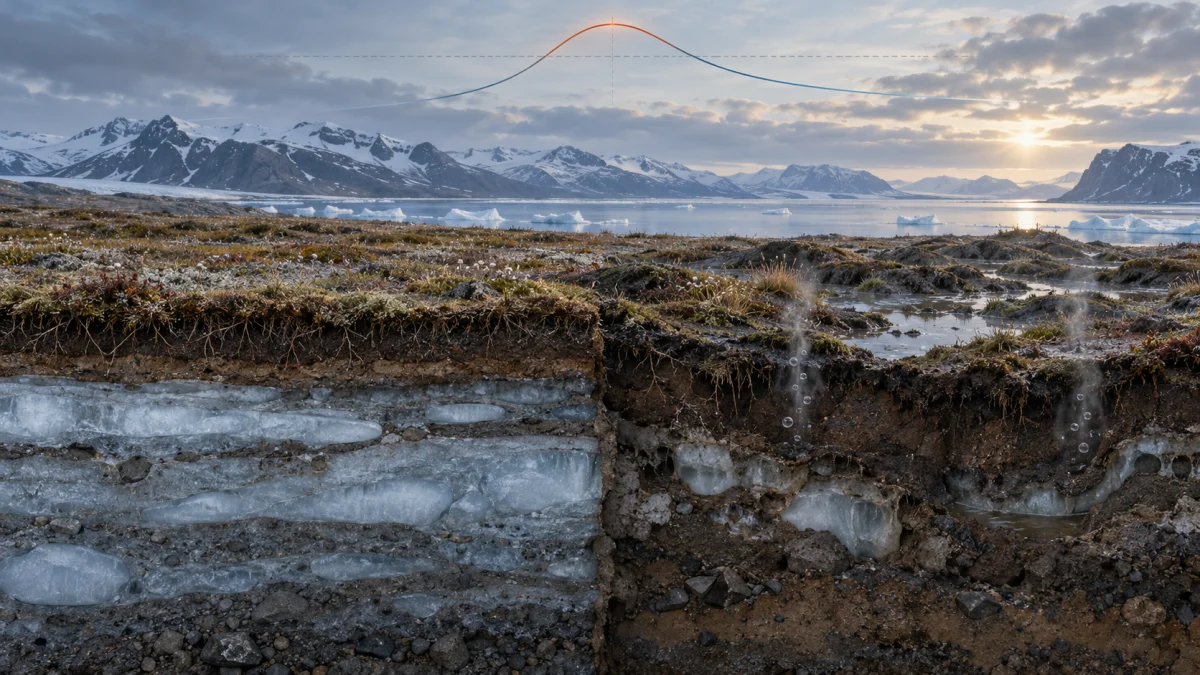
The more consequential reality is this: climate risk keeps increasing with additional warming, and temporarily bringing temperatures above a target can cause changes that do not simply reverse when temperatures eventually come back down.
That is the problem scientists call temperature overshoot.
A major UN Environment Programme report released September 2, 2026 concludes that, under current policies and plausible near-term trajectories, exceeding 1.5°C is now “widely assessed as unavoidable.” UNEP says the remaining strategy is an “overshoot, peak and decline” pathway: limit how high temperatures rise, minimize how long they remain elevated, and ultimately bring warming back down. (UNEP – UN Environment Programme)
That distinction matters enormously.
A short overshoot to 1.6°C is not equivalent to decades near 2°C. And lowering global temperature later is not equivalent to having never reached the higher temperature in the first place.
New research on permafrost published in 2025 and 2026 provides one of the clearest examples. Models suggest that some frozen ground can eventually recover as temperatures fall. Carbon released from thawing permafrost largely does not. (Nature)
In other words, the thermometer can move backward while some of the damage does not.
What did the new UN report actually say about 1.5°C?
The headline finding is serious, but it needs to be stated precisely.
The Paris Agreement calls for holding global warming “well below 2°C” above preindustrial temperatures while pursuing efforts to limit it to 1.5°C. The reason for the lower target was never that 1.499°C is safe and 1.501°C is catastrophic. The agreement explicitly recognizes that limiting warming to 1.5°C would significantly reduce climate risks compared with greater warming. (UNFCCC)
UNEP now concludes that insufficient emissions reductions have effectively closed off the earlier pathways that avoided a significant overshoot.
Under policies currently implemented or planned, UNEP’s central estimate is approximately 2.6°C of warming by 2100, with a modeled range of 1.9–3.6°C.
Even one of UNEP’s more optimistic cases—assuming full implementation of countries’ climate pledges and their longer-term net-zero targets—has a central estimate of approximately 1.8°C peak warming, with a range of 1.7–2.2°C. UNEP says its central projections cross 1.5°C within the next decade. (Wedocs)
That does not mean scientists have discovered that exactly 1.8°C is inevitable.
The 1.8°C figure comes from a particular scenario with particular assumptions about governments actually fulfilling their commitments. UNEP notes that uncertainty around even that optimistic scenario still includes 1.5°C, although with only about a 20 percent probability. (Wedocs)
The defensible conclusion is narrower:
Avoiding any meaningful long-term exceedance of 1.5°C is now extremely unlikely under the trajectories being assessed. Exactly how large the overshoot becomes remains a choice.
Didn’t Earth already exceed 1.5°C in 2024?
Yes—but there are two different measurements being discussed.
The World Meteorological Organization found that the average global surface temperature in 2024 was about 1.55°C ± 0.13°C above the 1850–1900 average, making it likely the first calendar year above 1.5°C. (World Meteorological Organization)
But the Paris Agreement’s temperature goal concerns long-term global warming, generally assessed over decades, not the temperature of one unusually warm year.
Natural variability can push an individual year above or below the underlying warming trend. WMO has therefore explicitly cautioned that one calendar year above 1.5°C does not by itself mean the Paris long-term level has been crossed. (World Meteorological Organization)
The distinction is becoming less reassuring with time, however.
WMO’s May 2026 forecast gives a 91 percent probability that at least one year from 2026 through 2030 will exceed 1.5°C, and a 75 percent probability that the five-year average for 2026–2030 will exceed 1.5°C. (World Meteorological Organization)
What used to be an exceptional annual excursion is increasingly becoming the neighborhood in which the climate operates.
1.5°C is not a cliff
This is probably the most important misconception to correct.
There is no known physical mechanism that suddenly activates when global temperature reaches exactly 1.500°C.
Climate risk generally rises with warming. Different systems have different thresholds, responses and uncertainties.
That means neither of these statements is scientifically defensible:
“We are below 1.5°C, so we’re safe.”
or:
“We crossed 1.5°C, so it’s over.”
The IPCC has found that an overshoot above 1.5°C exposes human and natural systems to additional severe risks compared with remaining below it. Some consequences can become irreversible even if temperatures subsequently fall. (IPCC)
UNEP reaches essentially the same conclusion in its new report: higher peaks produce greater risks, and longer overshoots increase the probability of irreversible changes and adaptation limits being reached. (UNEP – UN Environment Programme)
So 1.6°C is preferable to 1.8°C. 1.8°C is preferable to 2°C. And preventing 2.1°C remains worthwhile even if 1.5°C has already been exceeded.
There is no scientifically meaningful temperature at which preventing additional warming suddenly stops mattering.
What exactly is a climate “overshoot”?
An overshoot has three basic stages.
Global temperature first exceeds a target, then reaches a peak, and eventually declines.
Getting from the peak to the decline is the difficult part.
Deep emissions reductions can stop temperatures from continuing upward. Bringing temperatures meaningfully downward requires the world eventually to remove more CO₂ from the atmosphere than it adds—what scientists call net-negative CO₂ emissions—alongside continued reductions in other greenhouse gases.
And reversing warming requires enormous quantities of carbon removal.
The IPCC’s best estimate is that lowering global temperature by just 0.1°C through net-negative CO₂ emissions would require about 220 billion tonnes of net CO₂ removal, with a likely range of 160–370 billion tonnes. (IPCC)
That is one reason preventing warming in the first place is much easier than trying to reverse it afterward.
UNEP also warns that most pathways capable of returning to 1.5°C this century peak at no more than roughly 1.8–1.9°C, because the carbon-removal requirements become increasingly difficult as the peak rises. (Wedocs)
Why the length of an overshoot matters
A particularly useful concept has emerged from recent climate research: degree-years of overshoot.
Think of it as measuring not simply the highest temperature reached, but the accumulated excess warming over time.
For illustration, 0.2°C of excess warming sustained for 50 years represents 10 degree-years. So does 0.5°C sustained for 20 years.
That does not mean those two climate histories would be identical. Different systems can respond differently to a high, short spike versus a lower, longer one.
But for some slow-moving parts of the Earth system, researchers are finding that the area under the temperature curve contains important information.
A June 2026 study in Communications Earth & Environment examined 42 pairs of modeled overshoot and non-overshoot scenarios. For highly persistent changes involving permafrost and the ocean, the researchers found that the eventual difference was strongly related to the accumulated degree-years of overshoot. (Nature)
Then, in July, another team reached a strikingly similar conclusion specifically for permafrost carbon.
Using three climate models of different complexity, researchers reported that modeled permafrost carbon losses scaled approximately linearly with cumulative overshoot warming. Their central model estimates ranged from 11 to 21 petagrams of carbon for every 100 degree-years of overshoot exposure, with a much wider overall modeled range of 3–43 petagrams. One petagram of carbon is one billion metric tonnes. (Nature)
These numbers should not be treated as a precise prediction of how many tonnes of carbon any particular future overshoot will release. They come from idealized modeling experiments, and real permafrost processes remain uncertain.
But the qualitative result appeared across several models:
How long the planet stays hotter can matter alongside how hot it gets.
Bringing the temperature back down does not reset the climate
The word “overshoot” can make the problem sound temporary.
Some consequences are.
Others are not.
| Climate change | What happens if temperature later declines? |
|---|---|
| Global surface temperature | Can decline if sufficiently large and sustained net-negative emissions are achieved. |
| Permafrost area | Models suggest substantial recovery is possible, but with significant delays and hysteresis. |
| Carbon lost from permafrost | Much less reversible; models find substantial losses persist long after temperature falls. |
| Glacier and ice-sheet losses | Some losses and their sea-level consequences persist for centuries to millennia. |
| Committed sea-level rise | Does not simply reverse when global surface temperature declines. |
| Destroyed ecosystems or extinct species | Some losses are inherently irreversible. |
The IPCC specifically warns that overshooting 1.5°C increases the risk of irreversible effects in polar, mountain and coastal ecosystems and can accelerate glacier loss, ice-sheet loss and committed sea-level rise. It also identifies permafrost thaw, wildfires, peatland drying and weakened natural carbon sinks as processes that could release additional greenhouse gases and make temperature reversal harder. (IPCC)
Permafrost demonstrates the problem unusually well.
Permafrost is not a giant slab of Arctic ice
A common social-media explanation begins by saying that permafrost means “permanent frost” and therefore must remain frozen permanently.
That’s memorable, but scientifically inaccurate.
Permafrost is ground—soil, sediment, sand or rock—that remains at or below 0°C for at least two consecutive years. Some permafrost has remained frozen for thousands of years. Some contains enormous quantities of ground ice. But ice content is not what defines it. (National Snow and Ice Data Center)
The surface above permafrost can also thaw every summer and refreeze in winter. Scientists call this the active layer.
And strictly speaking, permafrost does not “melt.” It thaws. Soil that thaws is still soil. Ice inside that soil can melt, sometimes causing the ground to collapse, slump or form thermokarst landscapes. (National Snow and Ice Data Center)
Those distinctions may sound pedantic, but they matter because describing permafrost as a gigantic block of ice creates the wrong mental model of what is actually changing.
The real danger is the carbon stored in the ground
The freezer analogy works better here.
Cold conditions have allowed huge quantities of incompletely decomposed organic material to accumulate in northern soils over thousands of years.
NOAA estimates that at least 1.4–1.6 trillion tonnes of carbon are stored in terrestrial soils and permafrost across the northern permafrost region. (NOAA Arctic)
When previously frozen organic material thaws, microorganisms can begin decomposing it.
That process can release carbon dioxide and methane. The proportions depend on local conditions: oxygen-rich environments favor more CO₂ production, while waterlogged, oxygen-poor conditions can produce more methane.
This creates a feedback:
warming → permafrost thaw → greenhouse-gas release → additional warming.
Importantly, that is a feedback, not evidence that all Arctic permafrost has one giant trigger temperature beyond which a runaway collapse becomes inevitable.
That distinction frequently disappears in climate coverage.
Has the Arctic already changed from a carbon sink into a source?
There is an important finding here, but it is often stated too broadly.
For thousands of years, Arctic ecosystems accumulated carbon in vegetation, soils and frozen ground.
NOAA’s 2024 Arctic Report Card concluded that, when wildfire emissions are included, the Arctic tundra region has shifted to being a source of CO₂ and remains a consistent methane source. (NOAA Arctic)
That does not mean every Arctic ecosystem, every permafrost region or every square kilometer of tundra has simultaneously become a carbon source.
Vegetation growth still removes CO₂ in many locations. Conditions vary enormously.
The significant finding is that increasing microbial decomposition and wildfire emissions are now large enough that, at the regional scale NOAA assessed, they can overwhelm some of the carbon uptake that historically helped make the tundra a sink.
New research shows why overshoot matters for permafrost
This is where recent research changes the way the 1.5°C story should be understood.
A 2025 Earth System Dynamics study simulated both stabilization and overshoot pathways. When temperature eventually returned toward 1.5°C, permafrost area largely recovered in the model.
The carbon did not.
Compared with simply stabilizing at 1.5°C, the overshoot scenarios retained substantial additional permafrost carbon losses. The authors described the carbon loss as largely irreversible over the timescales studied. (Earth System Dynamics)
A second paper published in August 2026 found another complication: permafrost thaw can continue for decades after surface warming starts to decline.
The reason is thermal inertia. Heat penetrates the soil, and deeper layers do not immediately follow changes in surface temperature. In those simulations, permafrost area eventually responded substantially to cooling, but deeper soil properties showed hysteresis and incomplete reversal. (Earth System Dynamics)
The simplest way to understand the distinction is:
Frozen ground can eventually refreeze. Carbon that was already decomposed and released does not simply climb back into the ground when it does.
That is why “we’ll cool the planet back down later” is not equivalent to avoiding the overshoot.
Is permafrost a climate tipping point?
Not in the simplistic way the term is often used.
Permafrost contains many nonlinear processes. Ice-rich ground can collapse abruptly. Wildfires can remove insulating vegetation and soil layers, accelerating thaw. Local landscapes can undergo dramatic transformations.
But current modeling does not establish one single pan-Arctic temperature threshold at which the entire permafrost system suddenly becomes a self-sustaining runaway process.
The 2025 overshoot study explicitly found that its simulations did not produce a self-perpetuating global permafrost tipping process. (Earth System Dynamics)
The July 2026 multi-model study likewise found something closer to a continuous relationship: more accumulated warming produced more carbon loss. (Nature)
That should not be interpreted as reassuring.
It arguably gives every increment of warming greater significance.
If there is no single global permafrost cliff, there is also no temperature immediately below that cliff at which the damage is zero.
Scientists may still be underestimating some permafrost emissions
Permafrost modeling remains difficult, particularly because some processes are poorly represented in global climate models.
Gradual top-down thaw is easier to simulate than sudden ground collapse, wildfire, combustion of organic soils and post-fire thaw.
A 2026 Communications Earth & Environment study added several of these underrepresented processes to a compact Earth-system model. Relative to simulations with permafrost-carbon dynamics switched off, including gradual thaw, abrupt thaw and wildfire reduced the model’s remaining emissions budgets for avoiding 1.5°C by 25% ± 12% and for avoiding 2°C by 17% ± 7%. (Nature)
That should not be reported as “scientists discovered the world’s carbon budget is 25 percent smaller.”
It is one modeling framework, and the comparison was against model runs excluding those permafrost processes.
The defensible conclusion is that abrupt thaw and wildfire are potentially important sources of additional permafrost emissions that remain incompletely represented in many climate projections.
That uncertainty cuts in an uncomfortable direction.
Did thawing permafrost really release anthrax from a 70-year-old reindeer?
The famous story is more uncertain than the internet version suggests.
A major anthrax outbreak occurred on Russia’s Yamal Peninsula during an exceptionally warm summer in 2016. One epidemiological study reported 2,650 affected reindeer, 2,350 animal deaths, 36 human infections and one human death, a child. (PubMed Central (PMC))
The region had experienced no recognized anthrax outbreak since 1941.
The commonly repeated explanation is that unusually deep thaw exposed a roughly 70-year-old infected reindeer carcass, releasing long-dormant anthrax spores.
That is plausible.
It is not established as the specific chain of events.
Research supports climatic conditions as a possible trigger for re-exposure to old anthrax reservoirs, and another study found that permafrost had been degrading during the years preceding the outbreak while 2016 was exceptionally hot and dry. (PubMed Central (PMC))
But there was another major factor: routine anthrax vaccination of Yamal reindeer had been discontinued in 2007, leaving much of the herd susceptible when the outbreak occurred. (PubMed Central (PMC))
The strongest evidence therefore supports a more nuanced conclusion:
Warming and thaw may have helped bring anthrax spores back into contact with susceptible animals, but scientists have not demonstrated that one particular thawed 70-year-old carcass caused the outbreak.
What about the ancient “zombie viruses” found in permafrost?
This claim also contains a remarkable fact wrapped in misleading framing.
Scientists really have recovered ancient viruses from Siberian permafrost and demonstrated that some remained infectious after tens of thousands of years.
A 2023 study reported viruses remaining infectious after more than 48,500 years.
But there is a crucial detail frequently omitted from headlines:
The revived viruses infected Acanthamoeba—amoebae—not humans. (PubMed)
That experiment demonstrates that viral infectivity can survive extraordinary periods under permafrost conditions. It does not demonstrate that a 48,500-year-old human pathogen is about to emerge.
A subsequent review in the American Society for Microbiology journal mSystems concluded that current evidence does not show an increased risk of human viral pathogens emerging from permafrost compared with other environmental sources, nor evidence of an imminent human or animal outbreak from ancient permafrost viruses. The authors did not argue that the risk is literally zero. (ASM Journals)
Ancient pathogens are scientifically interesting.
They are not presently the strongest reason to be concerned about permafrost thaw.
The carbon feedback is.
Does passing 1.5°C mean catastrophe is now inevitable?
No.
It means some earlier options have been lost.
Those are different statements.
Calling 1.5°C a universal “death sentence” is not a scientific description. There is no population-level switch at that temperature that converts survival into death.
At the same time, portraying 1.5°C as arbitrary or unimportant is equally misleading.
Climate risks are already substantial, and the IPCC finds that overshooting 1.5°C adds further severe risks, including some irreversible ones. (IPCC)
The number matters because additional warming increases the probability and severity of harmful outcomes, not because 1.5°C is a magical boundary.
This distinction also avoids one of the most dangerous conclusions people can draw from the new report:
If we’re going to miss 1.5°C anyway, why bother?
Because the alternative to 1.5°C is not simply “failure.”
It is 1.6°C, 1.7°C, 1.8°C, 2°C or considerably more—and those are materially different worlds.
Can we still return below 1.5°C?
Physically, yes.
Whether humanity actually will is much less certain.
UNEP’s report says returning below 1.5°C remains possible if warming peaks low enough, emissions are cut deeply, and the world eventually sustains sufficiently large net-negative emissions. But it also stresses that the practical difficulty increases sharply with greater peak warming. (Wedocs)
Carbon removal is not a substitute for reducing emissions now.
The larger the overshoot, the more CO₂ must later be removed; the longer the overshoot, the more time vulnerable systems spend under elevated stress; and for some impacts, later cooling cannot reconstruct what was lost.
This is the part of the 1.5°C story that is easy to miss when the conversation is reduced to whether the “target is dead.”
The relevant questions have changed.
They are now:
How high will we let warming peak? How long will we remain above 1.5°C? And how much irreversible change will occur before temperatures can be brought back down?
The bottom line
The new UNEP report is bad news, but not for the reason implied by the most dramatic social-media posts.
There is no single 1.5°C apocalypse switch.
What has happened is more concrete: years of insufficient emissions reductions have made a meaningful overshoot increasingly difficult to avoid. That leaves humanity with a narrower and harder set of options.
The science increasingly indicates that both sides of an overshoot matter—the height of the peak and the time spent above the target.
And permafrost demonstrates why.
The ground may eventually cool.
Some of it may refreeze.
But carbon released while it was thawed can remain in the climate system long afterward.
That is the deeper meaning of overshoot: bringing the temperature back does not necessarily bring the old world back with it.
And that is why every additional fraction of a degree still matters.
References and Further Reading
UN climate assessments
UNEP — Limiting Overshoot: Navigating Exceedance of 1.5°C and Pathways Towards Return — The September 2, 2026 report underlying the current overshoot finding and its implications for peak warming, duration, adaptation and temperature reversal.
Paris Agreement — Official UNFCCC Text — Primary text establishing the “well below 2°C” and 1.5°C temperature goals.
IPCC AR6 Synthesis Report — Longer Report — Authoritative assessment of overshoot, irreversibility, carbon removal and risks associated with warming above 1.5°C.
Temperature observations and forecasts
WMO — State of the Global Climate 2024 — Establishes 2024 as likely the first calendar year averaging more than 1.5°C above the 1850–1900 baseline while distinguishing an annual exceedance from long-term warming.
WMO — Global Annual-to-Decadal Climate Update for 2026–2030 — Provides current probabilities for annual and five-year-average exceedance of 1.5°C.
Permafrost and overshoot research
Nature Communications — Permafrost Carbon Release Scales Linearly With Overshoot Warming — July 2026 multi-model study quantifying the relationship between cumulative overshoot warming and permafrost carbon loss.
Communications Earth & Environment — Irreversible Climate Changes Driven by Degree-Years of Temperature Overshoot — June 2026 analysis of 42 modeled scenario pairs showing why the duration as well as magnitude of overshoot can matter.
Earth System Dynamics — Hysteresis and Irreversibility in Permafrost Physical Response to Increasing and Decreasing CO₂ Emissions — August 2026 modeling study showing delayed permafrost recovery and persistent changes after surface temperature declines.
Earth System Dynamics — Permafrost Response and Feedback Under Temperature Stabilization and Overshoot Scenarios — Finds much greater reversibility in modeled permafrost area than in permafrost carbon losses.
Communications Earth & Environment — Permafrost and Wildfire Carbon Emissions and Paris-Compatible Carbon Budgets — 2026 modeling study examining abrupt thaw and wildfire processes that are underrepresented in many climate models.
Permafrost fundamentals
National Snow and Ice Data Center — Frozen Ground and Permafrost — Authoritative definition of permafrost and explanation of frozen-ground processes.
NOAA Arctic Report Card — Arctic Terrestrial Carbon Cycling — Source for the estimated 1.4–1.6 trillion tonnes of stored carbon and evidence concerning the Arctic tundra carbon balance.
Anthrax and ancient viruses
Reindeer Anthrax in the Russian Arctic, 2016: Climatic Determinants and Vaccination Effectiveness — Epidemiological analysis of the Yamal outbreak, including climate conditions, animal and human cases and the cessation of vaccination.
An Update on Eukaryotic Viruses Revived From Ancient Permafrost — Original research describing infectious Acanthamoeba viruses recovered from ancient Siberian permafrost.
mSystems — Cooling Perspectives on the Risk of Pathogenic Viruses From Thawing Permafrost — Review assessing the evidence for human and animal disease risks from ancient permafrost viruses.
Editorial currency note: Climate projections, global temperature observations and estimates of the remaining carbon budget are continually updated. Figures and assessments in this article were checked against sources available through September 6, 2026. The permafrost overshoot studies discussed above are model-based research; their numerical estimates should not be interpreted as precise forecasts of a particular future emissions pathway.