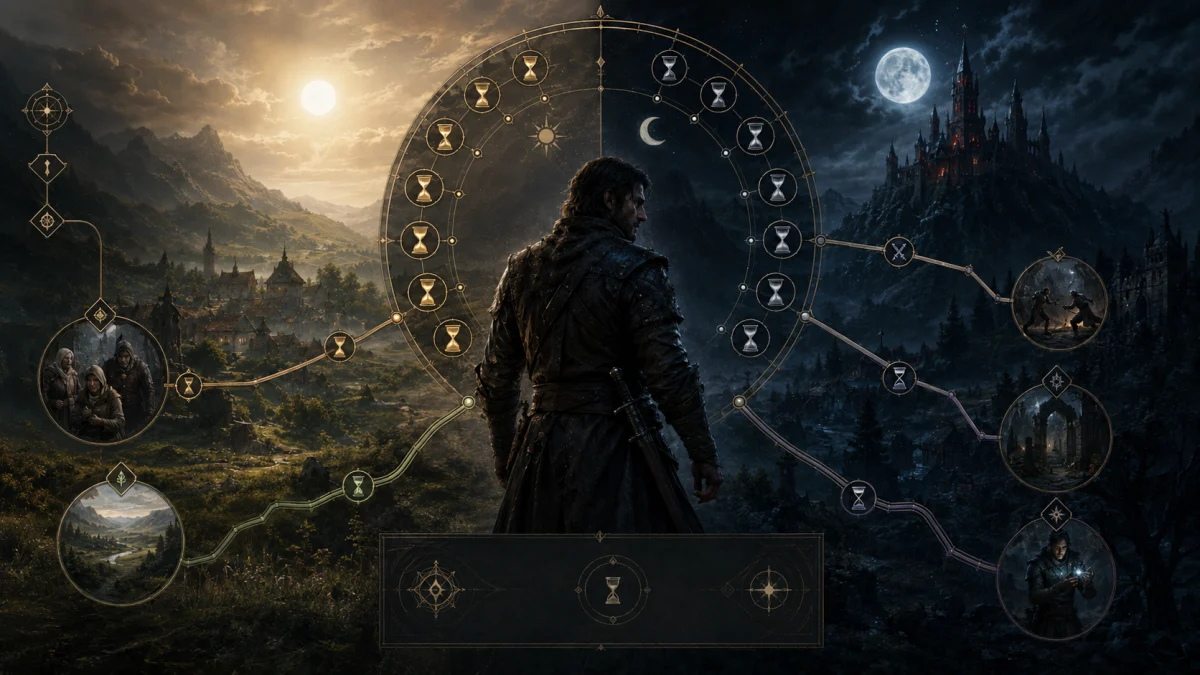
The short answer: The Blood of Dawnwalker does have a 30-day deadline, but it is not a continuously running timer.
You can spend as much real-world time as you want exploring Vale Sangora without burning through Coen’s 30 days. Instead, time works more like a currency. Certain quest actions, dialogue choices, story events and character upgrades consume visible portions of the calendar. Ordinary exploration does not.
That distinction matters because calling it a "30-day timer" makes the system sound considerably more stressful than it actually is.
Rebel Wolves and publisher Bandai Namco have repeatedly explained that time does not advance merely because you are walking around the world. The pressure comes when you choose to commit to something that costs time.
There is another important piece that is easy to miss: reaching the end of the 30 days does not automatically give you a game-over screen. The story can continue, although failing the deadline has major consequences for Coen’s original objective.
So if the timer is making you wonder whether you need to sprint past every cave, conversation and interesting ruin: you don’t.
How the 30-day clock actually works
After the prologue, Coen’s surviving family is being held by Brencis, and he has 30 days and nights before Brencis’s coronation.
The important word is in-game.
The calendar is not tied directly to minutes or hours you spend playing. You could theoretically wander around for a very long time in real life without advancing the story clock at all.
Official PlayStation material explains the underlying concept particularly clearly: during the opening, the sun effectively remains where it is while Coen merely wanders, observes and gathers information. Progressing time requires player action.
Each daytime period is divided into eight time segments. Launch-build guides report the same eight-segment structure at night, giving each complete day-and-night cycle 16 segments. Across 30 complete cycles, that represents a theoretical calendar budget of:
30 × 16 = 480 time segments
That does not mean you can perform 480 quests. Some actions consume multiple segments, some events advance the calendar automatically, and plenty of gameplay costs no time at all.
Think of those 480 segments as the units from which the game charges you when an action actually carries a time cost.
What actually advances time in The Blood of Dawnwalker?
This is where some early guides are becoming misleading.
It is too broad to say "quests advance time," because not every moment of every quest does. It is also wrong to assume that all optional content is free.
The safer rule is:
Watch the time-cost indicator attached to the specific action you are about to take.
Official sources confirm that starting or advancing certain quests, making certain dialogue choices and learning abilities can consume time. The game is designed to show those costs to the player rather than secretly running the calendar in the background.
| Action | Does it use the 30-day budget? | Evidence status |
|---|---|---|
| Freely exploring Vale Sangora | No | Officially confirmed |
| Walking or riding around the map | No passive countdown | Officially confirmed |
| Starting or advancing certain quest objectives | Yes | Officially confirmed |
| Certain dialogue choices | Yes | Officially confirmed |
| Unlocking or improving abilities | Yes | Officially confirmed |
| Deliberately advancing the day/night cycle | Yes | Launch-build confirmed |
| Ordinary free-roam combat | Generally no | Launch-guide observation |
| Gathering and looting | Generally no | Launch-guide observation |
| Crafting and normal merchant activity | Generally no | Launch-guide observation |
| Fast travel | Reported as free in the launch build | Launch-guide observation; recheck after patches |
Bandai Namco specifically confirms that improving Coen’s abilities requires both Skill Points and time. That means character progression itself competes with the rescue deadline; simply having enough XP does not make every upgrade free.
This is one of the most important mechanics to understand early.
A powerful ability may be worth spending time on. Unlocking three marginal abilities simply because you have Skill Points available may not be.
Does exploring use time?
No.
This is the simplest and most important answer in the entire guide.
Bandai Namco explicitly says time does not pass simply from exploring Vale Sangora. The clock advances when you spend segments starting or progressing certain quests and other meaningful actions.
That means you do not need to rush through:
- unexplored roads and ruins;
- ordinary environmental exploration;
- scouting an objective before committing;
- looking for useful equipment or resources;
- simply figuring out where you want to go next.
The system is designed to make you deliberate over decisions, not punish you for admiring the scenery.
That also means one of the most efficient ways to play is to do your free preparation before accepting the time cost attached to the next major action.
Does fighting enemies use time?
Ordinary combat does not appear to consume time simply because you entered a fight.
Launch guides distinguish ordinary exploration and combat from objectives or activities that actually carry a displayed time cost. A fight that completes a cost-bearing activity can therefore advance the clock even though fighting a random enemy encountered while exploring does not.
The practical rule remains the same:
The objective matters more than the animation.
Killing an enemy is not inherently "one hour." Completing the activity surrounding that enemy may be.
Do skills and leveling consume time?
This requires another distinction.
Earning XP does not itself mean the clock advances. Learning or improving an ability can.
Bandai Namco says Coen earns XP through combat, quests, discovering locations and special encounters. Leveling awards Skill Points. But actually unlocking and improving abilities requires a combination of Skill Points and time.
So there are effectively two separate questions:
Can I gain XP without wasting my calendar? Frequently, yes.
Can I spend every Skill Point I earn without affecting my calendar? No.
This makes skill selection part of the same resource-management problem as quests.
Does fast travel use time?
Current launch-build reporting indicates that ordinary fast travel does not consume a time segment.
That detail is less firmly established by official pre-release material than free exploration itself, so it should be treated as a current-build observation rather than an immutable rule. If a later patch or special journey presents an explicit time cost, trust the game’s current interface over an older guide.
That version distinction matters because The Blood of Dawnwalker began receiving fixes almost immediately after launch.
As of September 3, 2026, Rebel Wolves had already rolled out Hotfix 1.0.2 on PC. Its published notes do not list a change to the time system.
Is 30 days actually enough time?
For a normal playthrough, yes—the developers say the system was deliberately balanced so players should not need to obsess over every segment.
Game director Konrad Tomaszkiewicz said the team wanted players to feel the approaching deadline without feeling punished by it. Creative director Mateusz Tomaszkiewicz separately told PlayStation that players should be able to complete a majority of the game before the deadline expires.
That is probably the most useful official answer to completionist anxiety.
The game is not giving you barely enough time to reach Brencis.
It is giving you enough time to experience a substantial amount of Vale Sangora while still forcing choices about what matters.
A PowerPyx launch walkthrough goes further and estimates that a player focusing heavily on the Court Activities required for story progression can reach the end in roughly 7–10 in-game days. That is a guide author’s route estimate rather than an official guarantee, but it suggests the central story itself does not require anywhere close to all 30 days.
Can you complete everything before the 30 days run out?
This question has two different meanings.
If "everything" means a large amount of quests, exploration and character development, the developers say you can complete a majority of the game before the deadline.
If "everything" means every possible outcome, mutually exclusive decision and branching story path, then no single playthrough should be expected to contain every version of the story.
That is intentional.
The Blood of Dawnwalker is built as what Rebel Wolves calls a "narrative sandbox." Choosing one course of action can close another, NPCs can die, and even ignoring a situation can become a meaningful choice.
The calendar is therefore only one reason you may not see everything.
Choice itself is another.
A completionist should think less in terms of "Can I clear every icon before Day 30?" and more in terms of "Can I experience most of what matters to this version of Coen before Day 30?"
The answer to the second question appears to be yes.
Some quests have their own deadlines
The 30-day coronation deadline is not the only form of time pressure.
Some objectives can become time-sensitive once you begin them. Launch guides report day-only and night-only objectives as well as quests where delaying an already-triggered event can cause it to fail or resolve without you.
This creates an important strategy:
Do not start every quest simply because you discovered it.
Learning that someone needs help may cost nothing. Actually setting an event in motion can create a smaller deadline inside the larger 30-day calendar.
The prologue deserves extra caution because several of its events are specifically designed around limited time and missable outcomes.
What happens when the 30 days run out?
Spoiler-light answer: The game does not immediately end.
This was confirmed before release. Rebel Wolves told PlayStation that reaching the deadline has consequences but is not necessarily game over, while an Xbox hands-on preview reported that the game continues after the 30 days expire.
That means the 30-day deadline should not be thought of as:
Day 29 → Day 30 → GAME OVER → reload save
It is a story deadline.
Failing it creates a different story.
What exactly happens after Day 30? — story spoiler
If you want to remain spoiler-free, skip this subsection.
If Coen has not rescued his remaining captive family before the coronation deadline, Brencis follows through on the threat against them. Coen’s playthrough can continue, but the original rescue objective is gone and the story shifts toward dealing with what happened.
So the deadline absolutely matters.
It just does not function as a conventional fail screen.
That distinction is arguably the entire point of the system: failure becomes part of the narrative rather than necessarily erasing your progress.
Can you attack Brencis before Day 30?
Yes.
The game does not force you to spend all 30 days preparing.
Rebel Wolves has explained that once the relevant portion of the game opens up, players can choose to pursue Brencis without completing the enormous amount of other content available first. The obvious tradeoff is that an early confrontation leaves Coen less developed and the fight considerably harder.
The 30 days are therefore a maximum rescue window, not a mandatory 30-day campaign.
You decide how much of that window to spend becoming powerful enough to finish the job.
The safest way to manage time on a first playthrough
The system becomes much less intimidating once you stop treating it as a clock running behind you.
- Explore before committing. Free exploration is one of your greatest advantages. Find locations, resources and routes before spending a segment.
- Read the time cost before choosing. Pay attention whenever the interface signals that an action will advance time.
- Do not automatically buy every skill. Ability upgrades consume both Skill Points and calendar time.
- Be cautious about triggering time-sensitive quests. If you are not ready to deal with an objective, discovering it may be safer than committing to it.
- Plan around day and night. Coen’s human and vampiric abilities differ dramatically between the two phases, and some objectives are phase-specific.
- Keep manual saves. Especially save before expensive commitments, major story decisions and the final stretch of the campaign.
PowerPyx reports that the game supports numerous manual save slots and specifically recommends maintaining separate saves throughout the calendar rather than relying on one rolling file.
Is there really a "timer" at all?
Technically, yes.
But time budget is a better description.
There is a hard narrative horizon 30 days away. There are finite units of time between Coen and that event. What makes Dawnwalker unusual is that those units generally do not disappear simply because the player exists in the world.
You spend them.
That makes the system closer to action points in a strategy game than the constantly ticking timer players may remember from games where simply standing around wastes precious minutes.
The anxiety comes from deciding:
Is this person worth helping?
Is this ability worth learning?
Is this investigation worth another piece of the month?
—not from wondering whether reading a menu for five minutes just killed Coen’s family.
What we are not going to pretend is known yet
The game launched on September 3, 2026, and detailed guide sites are already publishing supposedly complete rules and tables.
Some of those pages contradict one another.
For that reason, this guide does not claim that every quest costs the same amount of time, that every optional activity is free, or that every possible action has already been mapped.
Those claims require retail-build verification.
The useful long-term resource will be a versioned database recording individual quest steps, their actual segment costs, day/night requirements, deadlines and consequences. Until those values have been independently reproduced, the safest source is still the cost displayed by the game itself.
We will update this guide as those mechanics are verified rather than filling the gaps with estimates.
Frequently Asked Questions
Does walking around advance the 30-day timer?
No. Normal exploration does not continuously advance the story calendar.
Can I take my time exploring dungeons?
Yes, provided you are not triggering an action specifically marked as costing time. The game does not punish ordinary exploration with a continuously running clock.
Does leveling up cost time?
Gaining XP does not automatically consume time. Unlocking and improving abilities can, in addition to costing Skill Points.
Do side quests cost time?
Some do, or contain individual actions that do. Do not assume that "side quest" automatically means free or that accepting a quest means its entire cost is paid immediately.
Does fast travel cost time?
Launch-build reporting indicates ordinary fast travel is currently free, but this is better treated as a version-specific observation than a permanent rule.
Is Day 30 game over?
No. The story can continue after the deadline, although failing to rescue Coen’s family produces major narrative consequences.
Can I finish the game before Day 30?
Yes. You can confront Brencis without using the entire available month, although going early means giving up preparation and progression that could make the confrontation easier.
Can I see everything in one playthrough?
You can see a large amount of the game, but some decisions and outcomes are mutually exclusive. Rebel Wolves describes choice and consequence—not simply completion—as a central part of the game’s structure.
Bottom line
You do not need to rush through The Blood of Dawnwalker because of the 30-day timer.
The 30 days are real, but they are spent through decisions rather than continuously drained by real-world playtime.
Explore freely. Scout before committing. Watch the displayed cost of quests and dialogue choices. Remember that upgrading Coen can cost time too. And do not assume reaching Day 30 automatically ends your save.
The real constraint is not how quickly you play.
It is what you decide is worth spending Coen’s remaining time on.
References and Further Reading
Official and developer sources
Bandai Namco — Explore The Blood of Dawnwalker’s Features Ahead of Release The clearest official summary of the 30-day system, including confirmation that exploration itself does not advance time and that certain quests consume segments.
PlayStation Blog — The Blood of Dawnwalker: Unique Time-Driven Quest System and Player Choice Detailed Detailed official explanation of the eight-part daytime structure and how player decisions, rather than passive exploration, advance the clock.
PlayStation Blog — Choices and Consequences in The Blood of Dawnwalker Includes direct developer comments about balancing the 30-day deadline, how much content players should be able to complete, and what happens conceptually if time expires.
Bandai Namco — Community Bulletin Board #11: Skills & Power Official explanation confirming that unlocking and improving abilities requires both Skill Points and time.
Xbox Wire — The Blood of Dawnwalker: Dead and Loving It Hands-on reporting from the official Xbox site covering the narrative sandbox and confirmation that the game can continue beyond the 30-day deadline.
Steam Community — The Blood of Dawnwalker Hotfix 1.0.2 Current launch-day PC patch information. Hotfix 1.0.2 does not list changes to the underlying time system.
Launch-build guides and verification
PowerPyx — The Blood of Dawnwalker Walkthrough: All Quests Useful launch-build observations on quest timing, time-sensitive objectives, manual saves and the estimated calendar required by a story-focused route.
Gamer Guides — Time Management Explained Detailed gameplay observations distinguishing generic exploration, crafting, looting and other free actions from actual time-consuming commitments.
AltChar — The Blood of Dawnwalker: How Time Progression Works Useful visual explanation of the segment meter, displayed time costs and time-sensitive objectives.
The Big Lead via Yahoo — What Happens When 30 Days Expire? Launch-day verification of the specific story consequence of allowing the 30-day rescue deadline to expire.
Editorial currency note: The Blood of Dawnwalker launched September 3, 2026, and game mechanics may change through patches. This article reflects official information and launch-build reporting available through September 3, including PC Hotfix 1.0.2. Version-sensitive mechanics should be rechecked after significant updates.