

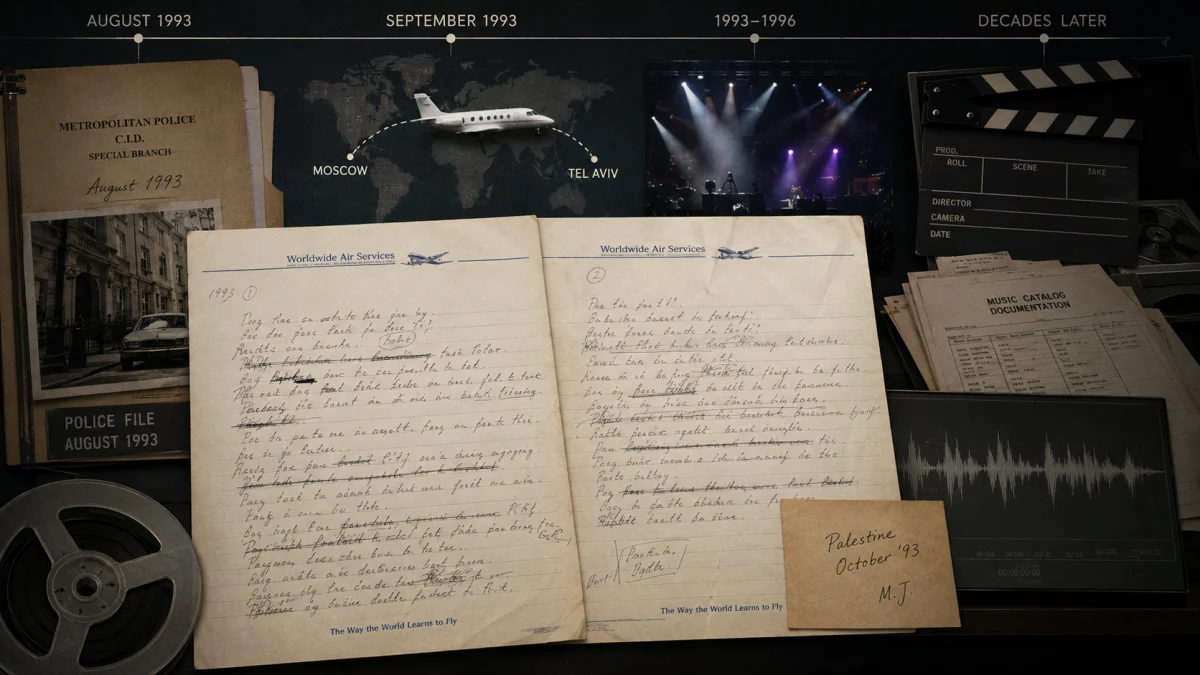
Michael Jackson appears to have written a set of handwritten lyrics about Palestine in 1993, commonly referred to as “Palestine, Don’t Cry.” There is a real archival trail connecting the pages to a 2010 Julien’s Auctions sale.
But the much larger story now circulating online goes far beyond what that evidence proves.
There is no reliable public evidence that Jackson recorded “Palestine, Don’t Cry,” submitted it to Sony for release, or had it rejected by Sony because of its subject matter. And the viral version claiming Jackson visited Israel, wrote the Palestine piece and was then hit with the first child-abuse allegations has a major chronological problem: the police investigation had already begun one month before Jackson arrived in Israel. (UPI)
Other elements of the viral story contain genuine facts. Evan Chandler and Jackson’s representatives really did have contentious financial negotiations before the allegations became public. La Toya Jackson really did publicly accuse her brother in 1993 and later say her abusive husband forced her to do it. Her husband’s violence toward her was independently documented months before that press conference. Jackson later had a very real and very public war with Sony.
Those facts deserve scrutiny.
What the evidence does not establish is that they were pieces of a coordinated Jewish campaign against Michael Jackson.
| Viral claim | What the evidence supports |
|---|---|
| Jackson wrote Palestine-themed lyrics in 1993 | Supported by the surviving auction trail |
| He wrote them flying home from Tel Aviv | Not established |
| Jackson recorded the song | No verified recording established |
| Sony refused to release it | No supporting documentation found |
| The 1993 allegations began after his Israel trip | False |
| Richard Gardner conducted the interview that started the investigation | Misleading; Mathis Abrams conducted the triggering interview |
| Chandler’s financial demands were invented | False; financial negotiations are documented |
| Chandler was proven to have extorted Jackson | False; prosecutors declined extortion charges |
| La Toya later said her husband forced her accusations | True as La Toya’s own account |
| Her husband physically abused her | Independently documented |
| Jackson was ever convicted of child molestation | No |
| The people behind the 1993 case later obtained his movie rights | No evidence supports that claim |
| A Jewish network coordinated the events | No evidence found |
What exactly was “Palestine, Don’t Cry”?
The most defensible starting point is narrower than many viral posts suggest.
Julien’s Auctions held its Music Icons 2010 auction in Las Vegas from June 24 through June 26, 2010. Its surviving records confirm the auction, and Julien’s terms for lots in that catalog stated that the auction house guaranteed the authenticity of the cataloged attribution, subject to its stated terms and limitations. (Julien’s Auctions)
An old Julien’s URL repeatedly preserved in 2010–2012 internet archives identifies Lot 424 as Michael Jackson handwritten material concerning Palestine. Contemporary fan posts from May 2010—before the current political controversy or today’s viral narrative—also discussed the upcoming Julien’s lot and reproduced images of the pages. Those fan archives are useful for recovering a dead auction listing, but they should not be mistaken for independent authentication.
The old auction description, as preserved by archival copies, described two pages of working lyrics written in black pen on British Airways Concorde stationery and attributed them to 1993. One surviving archive reproduces the old Julien’s description.
Julien’s newer website still contains a page titled “Michael Jackson Handwritten Lyrics,” but its current migration no longer exposes the original descriptive text or provenance information for the old lot. (Julien’s Auctions)
That leaves us with a strong historical trail that Julien’s attributed the pages to Jackson—but not enough surviving primary documentation to confidently reconstruct every detail about when, where or under what circumstances he wrote them.
That distinction matters enormously.
The pages are real evidence of Jackson thinking about Palestine—not proof of a suppressed Sony single
The manuscript contains working lyrics expressing compassion for Palestinians suffering from war and violence.
That is meaningful evidence about what Jackson was writing and thinking.
It is not automatically evidence that there was a completed Michael Jackson recording called “Palestine, Don’t Cry.”
There is a substantial chain of events that would normally exist between handwritten lyrics and a record company suppressing a song:
written lyrics → composition → demo or studio recording → finished or proposed track → submission to the label → label decision → rejection.
The publicly available record currently establishes the first link.
It does not establish the rest.
sherafy.com could find no verified master recording, studio tape, Sony A&R memorandum, release schedule, rejection letter, label correspondence or contemporaneous report documenting Sony’s refusal to release “Palestine, Don’t Cry.”
That does not prove such records could never exist.
It means the statement “Sony refused to release Michael Jackson’s Palestine song” is currently an unsupported claim, not a documented fact.
That difference gets erased repeatedly online.
No, the evidence does not show Jackson wrote it on a Concorde flight home from Tel Aviv
This is one of the clearest places where repetition has hardened an assumption into supposed history.
The pages were reportedly written on British Airways Concorde stationery.
That tells us something about the paper.
It does not tell us what airplane Jackson was aboard when he put pen to it.
Contemporaneous UPI reporting documents Jackson’s actual September 1993 Israel travel.
Jackson arrived at Ben Gurion Airport from Moscow on September 17 aboard his private jet. (UPI)
Five days later, on September 22, UPI reported that Jackson left Israel aboard his private jet for Turkey. (UPI)
So the documented itinerary was not:
Tel Aviv → British Airways Concorde → home.
At least for the Israel departure documented contemporaneously, it was:
Israel → private jet → Turkey.
Jackson could obviously have possessed British Airways stationery from another flight. He traveled constantly. He could also have written on airline stationery somewhere other than an airplane.
But Concorde stationery cannot be treated as a boarding pass.
Unless stronger provenance emerges from Julien’s or Jackson’s archives, the claim that he wrote “Palestine, Don’t Cry” while flying home from Israel should be labeled unverified.
The 1993 allegations were already underway before Michael Jackson reached Israel
This is the hardest problem for the viral version of the story.
UPI reported on August 24, 1993 that Los Angeles police confirmed their investigation had begun on August 17. (UPI)
The controversy was already worldwide news while Jackson continued his Dangerous Tour through Asia. UPI was reporting on the investigation in Bangkok and Singapore in late August. (UPI)
On September 14, the then-13-year-old accuser filed a civil lawsuit against Jackson in Los Angeles while Jackson was in Moscow. (UPI)
Only three days later, on September 17, Jackson arrived in Israel.
UPI’s dispatch from Ben Gurion Airport explicitly described Jackson as arriving while already being pursued around the world by the molestation allegations. (UPI)
The sequence therefore looks like this:
| Date | Documented event |
|---|---|
| Aug. 17, 1993 | Child-abuse investigation begins |
| Aug. 24 | Investigation becomes public internationally |
| Aug. 26–29 | Financial dispute and alleged extortion narrative publicly reported |
| Sept. 14 | Civil abuse lawsuit filed |
| Sept. 17 | Jackson arrives in Israel from Moscow |
| Sept. 22 | Jackson leaves Israel for Turkey |
| 1993 — exact date unresolved | Palestine manuscript attributed to Jackson |
| Dec. 9 | La Toya Jackson publicly says she believes allegations against Michael may be true |
This does not prove the manuscript itself was written after August 17.
That date remains unresolved.
It does prove something narrower and important:
The popular story in which Jackson visited Israel, wrote a Palestine song on the trip home and was then suddenly hit with his first abuse allegations has the documented chronology backwards.
The allegations were already under police investigation before he set foot in Israel.
If someone instead proposes that Jackson wrote the manuscript earlier in 1993, before August, that would remove the chronological contradiction—but it would still leave the much larger evidentiary problem: there is no proof Sony received the work, rejected it or retaliated against him because of it.
Did Sony suppress “Palestine, Don’t Cry”?
There is currently no evidence sufficient to say yes.
That should not be confused with blindly defending Sony.
Michael Jackson’s relationship with Sony eventually became openly hostile.
In 2002, Jackson publicly accused Sony Music and executive Tommy Mottola of racism and of mistreating Black recording artists. CNN preserved Jackson’s own statements and Sony’s denial. (CNN Transcripts)
SEC filings confirm Mottola’s senior role: he served as Sony Music’s president before becoming chairman and chief executive.
There were therefore real disputes between Michael Jackson and Sony.
We do not need to sanitize them.
But a documented confrontation in 2002 does not prove Sony secretly suppressed a Palestine composition nine years earlier.
The evidentiary question is simple:
Who rejected “Palestine, Don’t Cry”?
No documented decision-maker has been identified.
When was it rejected?
No date has been established.
Where is the rejection?
No memo, letter, email, studio record or other contemporaneous documentation has surfaced.
Without those missing links, the Sony-suppression claim remains speculation.
The viral claim about “Jewish producers at Sony” has another basic problem
Before someone’s religion can explain why a song was rejected, we first need evidence that someone actually rejected the song.
The viral narrative skips that step entirely.
It does not produce a Sony executive’s name attached to a documented “Palestine, Don’t Cry” decision. It does not produce an internal Sony record. It does not produce a producer saying the song was blocked.
Instead, it moves directly from an alleged decision to the supposed religious identity of unidentified or loosely connected people.
That reverses the normal evidentiary process.
If an executive improperly suppressed Jackson’s work, investigate the executive.
If a record label mistreated Jackson, document the label’s conduct.
If people coordinated against him, find the communications, money, instructions, contracts or common strategy establishing coordination.
A person’s Jewish identity is not evidence that another Jewish person thirty years later was acting with them.
That would be no more logical if the people were Catholic, Muslim, Black, Italian, gay, Republican or members of any other group.
Evan Chandler’s financial negotiations were real
The viral story does contain an important fact that should not be minimized: money and proposed film projects were part of the dispute before the allegations became public.
UPI reported on August 26, 1993 that the accuser’s father, Evan Chandler, had sought a proposed $20 million film-production arrangement involving Jackson. Jackson’s private investigator Anthony Pellicano characterized the demand as attempted extortion. Representatives of the other side disputed that characterization. (UPI)
Calling Chandler merely a “failed dentist” is also inaccurate rhetoric.
Contemporaneous reporting described him as a Beverly Hills dentist, and the American Film Institute confirms that Chandler received story and screenplay credit on Mel Brooks’s 1993 film Robin Hood: Men in Tights and was credited as an associate producer. (AFI Catalog)
None of that resolves what motivated his conduct.
It simply tells us what the record actually contains.
There is legitimate reason to scrutinize the financial negotiations.
But there is an equally important legal fact.
Los Angeles County prosecutors investigated the extortion allegation for months and ultimately declined to prosecute Chandler. Deputy District Attorney Michael Montagna said at the time that the evidence did not establish that a crime had been committed and characterized the discussions as appearing to involve efforts to resolve a potential civil claim. (Los Angeles Times)
So the defensible formulation is:
Substantial financial negotiations occurred before the allegations became public. Jackson’s camp alleged extortion. Prosecutors investigated that allegation and did not charge Chandler.
Anyone claiming either that there was no money dispute at all or that criminal extortion was conclusively proven is overstating the evidence.
Richard Gardner really did interview the accuser—but he did not conduct the interview that started the case
This part of the viral story mixes two different events.
Contemporaneous reporting identified Dr. Mathis Abrams, not Richard Gardner, as the therapist who conducted the crucial three-hour August 17 interview.
Abrams reported the allegations, triggering involvement by child-protection authorities and the criminal investigation. (Los Angeles Times)
Richard Gardner did separately interview the boy later.
So saying simply “Richard Gardner interviewed Jackson’s accuser” is not necessarily false.
What is misleading is presenting Gardner as the psychologist whose interview originally produced the report that started the 1993 investigation.
That was Abrams.
The distinction matters because Gardner’s name is frequently inserted into the viral theory as though he were the first psychological link in the chain. The documented chronology does not support that portrayal.
La Toya Jackson’s later coercion account deserves to be taken seriously
La Toya Jackson’s role is one of the more substantive elements buried inside the viral narrative.
On December 9, 1993, La Toya publicly stated that she believed accusations against her brother could be true.
But even on that same day, when questioned more specifically by Katie Couric, La Toya acknowledged that she did not personally possess evidence proving Michael had abused children or that payments to families represented hush money. (UPI)
Years later, La Toya said something very different.
She told CNN’s Piers Morgan in 2011 that her husband and manager, Jack Gordon, had forced her to publicly reverse her defense of Michael. She said Gordon controlled her, physically assaulted her and threatened Michael’s life if she refused to make the statements he demanded. She also acknowledged that she herself had to take responsibility for having publicly made them. (CNN Transcripts)
That could be dismissed as a later attempt to repair family relationships—except there is independent evidence that Gordon was physically violent toward her before her December 1993 statements.
On April 21, 1993, New York police arrested Gordon after La Toya was hospitalized with injuries to her face, legs, arms and back. He was charged with second-degree assault and criminal possession of a weapon. (UPI)
At his arraignment the next day, a prosecutor quoted Gordon as admitting he had hit her. La Toya was reported to have suffered a split lip and extensive bruising; authorities alleged that a dining-room chair and a shoe were used during the assault. (UPI)
That permits a much stronger conclusion than merely saying La Toya later “changed her story.”
Verified: Jack Gordon physically abused La Toya Jackson.
Verified: La Toya publicly made allegations against Michael in December 1993.
Verified as La Toya’s testimony: she later said Gordon forced her to make those accusations and threatened Michael if she refused.
Not independently established: every detail of precisely what Gordon instructed her to say.
That is the evidentiary distinction the story deserves.
Michael Jackson was never convicted—but 1993 and 2005 were different cases
Michael Jackson was never convicted of child sexual abuse.
That statement is straightforwardly true.
But it is frequently followed by claims that go further than the record allows.
The original 1993 investigation did not end in a trial and acquittal.
Prosecutors announced in September 1994 that they would not file criminal charges. The principal accuser was unwilling to testify in a criminal proceeding, substantially undermining prosecutors’ ability to proceed. Jackson consistently maintained his innocence. (UPI)
That decision should not be rewritten as a criminal conviction.
It also should not be rewritten as a jury verdict declaring the 1993 allegation false.
Neither happened.
The 2005 prosecution was different.
That case involved a separate accuser and went all the way to trial. On June 13, 2005, the jury found Jackson not guilty on every count. Associated Press reporting from the courthouse documented the complete acquittal. (CBS News)
So the accurate summary is:
1993: investigation, civil litigation and settlement, but no criminal charges or trial.
2005: criminal trial involving a different accuser; Jackson acquitted on all charges.
Conflating the two helps neither Jackson nor his accusers.
Who actually obtained the rights to the Michael Jackson biopic?
This is where the modern part of the conspiracy collapses most clearly.
The authorized film was not created because people from the 1993 Chandler dispute somehow acquired Michael Jackson’s life story.
Reuters reported in 2019 that producer Graham King secured the film rights, including access to music, from the Michael Jackson Estate. (Yahoo)
By the film’s 2026 release, Sony Music’s own announcement identified the producers as Graham King, John Branca and John McClain.
It identified Lionsgate as the film’s U.S. distributor and Universal Pictures as distributor in most international markets.
Sony Music’s role included releasing the official companion album. (Sony Music)
Sony also has a major financial interest in Michael Jackson’s music.
That part is real.
Sony previously purchased the Jackson Estate’s remaining stake in Sony/ATV Music Publishing in 2016, and Sony now says Michael Jackson’s catalog is co-owned by Sony Music Group. (Sony)
But music-catalog ownership, soundtrack participation and film rights are different things.
The available record shows:
Jackson Estate → authorizes/licences biopic → Graham King and Estate representatives produce → Lionsgate/Universal distribute → Sony Music participates through Jackson’s music and companion album.
I found no evidence that Evan Chandler, Mathis Abrams, Richard Gardner or Jack Gordon had anything to do with obtaining or producing the biopic.
Calling them “the same people” is simply not supported by the rights chain.
The conspiracy claim substitutes religious identity for missing evidence
The viral argument is compelling to some viewers because it does not consist entirely of fabricated events.
It combines a series of genuine facts:
Michael Jackson wrote about Palestine.
A serious scandal erupted in 1993.
There were financial negotiations involving the accuser’s father.
La Toya later repudiated her allegations and described an abusive husband.
Jackson eventually became publicly hostile toward Sony.
Sony now owns an enormous financial interest in Jackson’s music.
An authorized Michael Jackson movie was released decades later.
Every one of those subjects can be investigated.
The problem occurs in the spaces between the facts.
To establish that these events formed one coordinated operation, we would need connective evidence: communications, common instructions, shared financial arrangements, a documented organizational relationship, evidence that one participant recruited another, or records showing that Sony’s treatment of Jackson was tied to his Palestine manuscript.
None has surfaced.
Instead, the viral version repeatedly points to the actual or alleged Jewish identity of various people as though ethnicity or religion itself supplies those missing connections.
It does not.
That does not mean a Jewish executive, dentist, psychologist, lawyer or producer is immune from scrutiny.
It means they are accountable for their own documented conduct, not presumptively accountable for the conduct of unrelated Jewish people.
The same evidentiary rule should apply to everyone.
What the evidence actually allows us to conclude
The best-supported reconstruction is less sensational than the viral conspiracy, but considerably more interesting than a simple “nothing to see here” dismissal.
| Evidence category | Conclusion |
|---|---|
| Verified or strongly supported | Jackson left behind handwritten 1993 lyrics concerning Palestine that entered the Julien’s auction record. |
| Verified | The child-abuse investigation began August 17, 1993. |
| Verified | Jackson did not arrive in Israel until September 17. |
| Verified | He arrived from Moscow and departed Israel for Turkey by private jet. |
| Verified | Financial negotiations involving Chandler preceded the allegations becoming public. |
| Verified | Prosecutors investigated but declined to charge Chandler with attempted extortion. |
| Verified | La Toya publicly accused Michael and later said an abusive husband forced her to do so. |
| Verified | Gordon’s physical violence against La Toya was independently documented before her accusations. |
| Verified | Jackson was never convicted; he was acquitted on every count in the separate 2005 criminal case. |
| Verified | The Michael Jackson Estate supplied the rights for the authorized biopic. |
| Not established | The exact date or flight on which Jackson wrote the Palestine lyrics. |
| Not established | That Jackson recorded “Palestine, Don’t Cry.” |
| Not established | That Sony received or rejected it. |
| Contradicted by chronology | The common claim that Jackson went to Israel, wrote the song and only afterward faced his first 1993 allegations. |
| Unsupported | That the 1993 accusations were retaliation for the Palestine lyrics. |
| Unsupported | That Jewish participants across these events operated as a coordinated group against Jackson. |
There is still a legitimate unanswered question worth pursuing:
What exactly happened to Michael Jackson’s “Palestine, Don’t Cry” manuscript between 1993 and its appearance at Julien’s in 2010?
If Jackson’s archive contains a demo, studio log, correspondence with Epic/Sony, a dated manuscript provenance or a rejected track list, that could materially change the story.
Until such evidence emerges, however, the responsible conclusion is straightforward.
Michael Jackson wrote about Palestine.
His later battle with Sony was real.
His 1993 scandal contained financial disputes and complicated circumstances worthy of continued scrutiny.
But there is presently no evidence that Sony suppressed “Palestine, Don’t Cry,” no evidence that the 1993 allegations were triggered by it, and no evidence that a Jewish network coordinated Jackson’s downfall and later took control of his movie.
Those are not inconvenient details.
They are the boundary between what the historical record shows and what the internet has added to it.
References and Further Reading
Primary, contemporaneous and institutional sources
- UPI — August 24, 1993: Los Angeles police investigation becomes public — Contemporaneous wire report confirming police said the investigation began August 17.
- UPI — September 14, 1993: Civil lawsuit filed against Michael Jackson — Establishes that civil litigation was underway before Jackson reached Israel.
- UPI — September 17, 1993: Michael Jackson arrives in Israel from Moscow by private jet — Critical contemporaneous evidence for the Israel chronology.
- UPI — September 22, 1993: Jackson leaves Israel for Turkey aboard his private jet — Undercuts the unsupported assumption that British Airways Concorde stationery proves he wrote the lyrics flying home from Tel Aviv.
- UPI — August 26, 1993: Report on the proposed $20 million film arrangement — Documents the financial component without requiring acceptance of either side’s interpretation.
- UPI — August 29, 1993: Jackson investigator details the alleged extortion narrative — Contemporary account of Jackson investigator Anthony Pellicano’s version of the pre-allegation negotiations.
- Los Angeles Times — January 25, 1994: Prosecutors decline attempted-extortion charges — Local contemporaneous reporting quoting the Los Angeles County deputy district attorney explaining why no extortion charge was filed.
- UPI — September 21, 1994: Prosecutors decline to file child-molestation charges — Contemporary report on the end of the original criminal investigation.
- CBS/AP — Michael Jackson acquitted on all counts in 2005 — Associated Press reporting of the separate 2005 criminal verdict.
- UPI — April 21, 1993: Jack Gordon arrested after La Toya Jackson assault — Independently documents Gordon’s violence months before La Toya’s statements about Michael.
- UPI — April 22, 1993: Court details following La Toya Jackson assault — Contains prosecutor and police descriptions of the incident.
- UPI — December 9, 1993: La Toya publicly addresses allegations against Michael — Contemporary documentation of her original statements.
- UPI — December 9, 1993: La Toya acknowledges lacking evidence when questioned — Important qualification to the stronger language used at her press conference.
- CNN transcript — La Toya Jackson’s 2011 account of coercion by Jack Gordon — Direct transcript of La Toya describing Gordon’s control, violence and alleged coercion.
- American Film Institute — Robin Hood: Men in Tights production record — Independent confirmation of Evan Chandler’s story/screenplay and associate-producer credits.
- Julien’s Auctions — Music Icons 2010 auction archive — Primary confirmation of the auction in which the Palestine manuscript was historically listed.
- Julien’s Auctions — surviving Michael Jackson handwritten-lyrics page — Current Julien’s record; the site’s migration no longer exposes the complete original lot description.
- SEC filing — Tommy Mottola’s Sony Music executive history — Primary regulatory record documenting his Sony leadership positions.
- CNN — Michael Jackson’s 2002 accusations against Sony and Tommy Mottola — Direct contemporary record showing that Jackson’s later Sony conflict was real rather than something invented after his death.
- Reuters — Graham King obtained Michael Jackson film rights from the Estate — Establishes the origin of the authorized biopic rights.
- Sony Music — official 2026 Michael film and companion-album announcement — Interested-party source used only for its own corporate role, producer credits and distribution information.
- Sony Group — 2016 Sony/ATV transaction with the Michael Jackson Estate — Primary corporate documentation distinguishing music-publishing ownership from the later biopic-rights transaction.
- Sony Group — 2026 statement on its current Michael Jackson catalog interest — Current corporate confirmation that Sony Music Group co-owns Jackson catalog assets.
Source note: No Israel/Palestine advocacy organization, Israeli government source, Zionist advocacy outlet, anti-Israel advocacy outlet, pro-Jackson campaign site or anti-Jackson campaign site is used as the factual foundation for the conclusions above. Interested-party records such as Sony’s own announcements are used only to establish what Sony says it owns or did, and are cross-checked against independent reporting where material. Research reviewed through September 1, 2026.