No. The FDA did not expand the Taylor Farms iceberg lettuce recall on August 28, 2026.
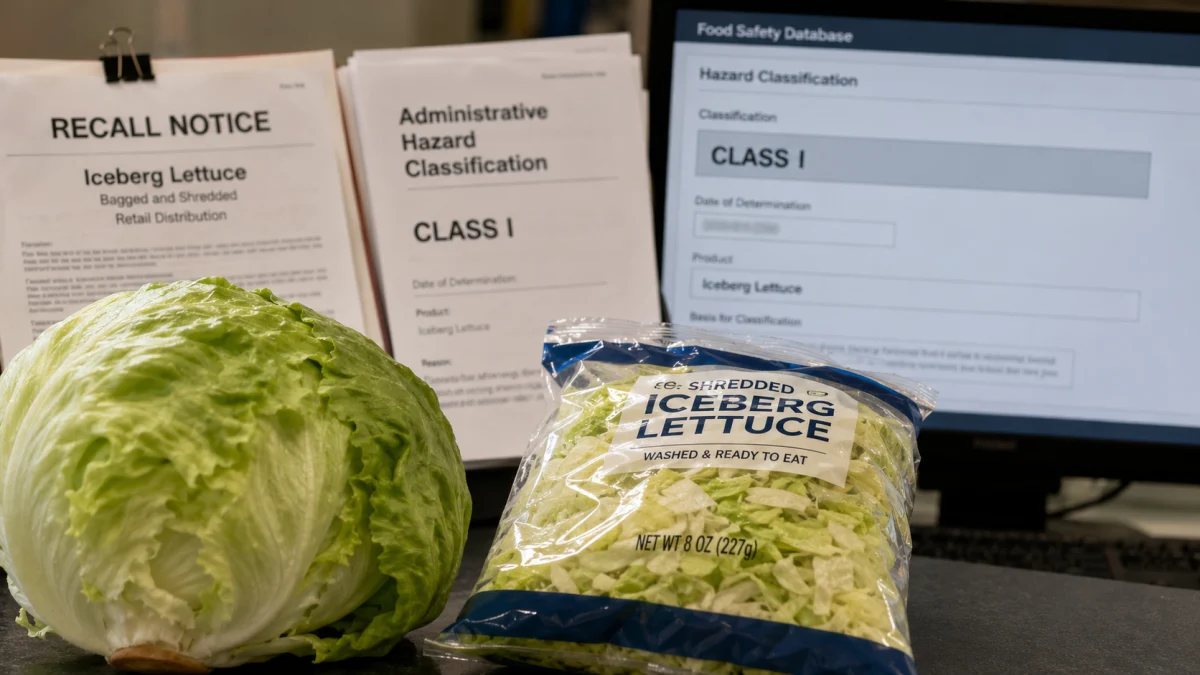
What the agency did was classify the existing July 17 recall as Class I, the most serious of its three recall health-hazard classifications. FDA explicitly says the new classification “does not mean the recall has been expanded, upgraded, or elevated.” The products covered by the July recall did not suddenly change on August 28.
Something else has changed, however.
The outbreak linked to the recalled lettuce has continued to grow. As of August 27, federal officials reported 11,458 illnesses, 495 hospitalizations and two deaths across 20 states. Investigators have also developed a more complete picture of where recalled products had previously been distributed.
Those are real developments. But they are not the same thing as FDA expanding the recall.
That distinction matters because four separate concepts are now being compressed into one alarming headline:
- the original recall;
- FDA’s later Class I classification;
- the expanding outbreak case count;
- and investigators’ evolving knowledge of where the recalled lettuce had been distributed.
Once those are separated, the August 28 announcement becomes much easier to understand.
Why We Investigated This
A reader seeing that FDA had suddenly labeled the Taylor Farms recall “Class I” more than a month after the recall began could reasonably assume something new had gone wrong: more products were recalled, more stores were affected, or FDA had discovered evidence making the lettuce more dangerous than previously believed.
That is not what FDA says happened.
We compared the August 28 classification notice with the original July 17 recall, FDA’s Enforcement Report rules, and the latest FDA and CDC outbreak data to determine exactly what changed—and what did not.
What happened on August 28?
FDA published its formal classification of the Taylor Farms de Mexico iceberg lettuce recall in its Enforcement Report.
The agency assigned the recall Class I.
FDA also said it posted a classification for a related downstream recall. But the important part is what FDA immediately clarified about those postings: they are evaluations of the public-health hazard associated with recalls that had already occurred. They are not announcements that the original recall has grown larger.
Taylor Farms initiated the recall on July 17, more than six weeks earlier.
The simplest way to understand the timeline is:
July 17: Taylor Farms recalls the affected lettuce.
July and August: FDA and CDC continue investigating the outbreak and collecting epidemiological, traceback and health-outcome data.
August 28: FDA completes its hazard assessment and formally classifies the existing recall as Class I.
The August 28 action therefore changes the classification attached to the recall, not the date or underlying scope of the original recall.
What does an FDA Class I recall actually mean?
FDA divides recalls into three health-hazard classifications:
| Classification | What FDA is saying |
|---|---|
| Class I | Exposure creates a reasonable probability of serious health consequences or death |
| Class II | Harm may be temporary or medically reversible, or serious harm is considered remote |
| Class III | Exposure is unlikely to cause adverse health consequences |
The important word is hazard.
The classification describes FDA’s assessment of the potential health consequences associated with exposure to the recalled product.
It does not tell you how geographically large the recall is.
It does not tell you how many packages were recalled.
It does not mean FDA has added new products.
And moving a database entry from “not yet classified” to “Class I” does not mean the agency just initiated a new recall.
That last point is important enough that FDA includes a warning about it in its general Enforcement Report instructions—not just in today’s Taylor Farms statement.
FDA says recall classifications are often determined after a company has already announced its recall, and that publication of the classification should not be interpreted as an expansion or change to the company’s warning.
Why can a recall happen before FDA decides whether it is Class I?
Because waiting could defeat the purpose of warning consumers.
Since 2017, FDA’s Enforcement Report has allowed recalls to appear as “not yet classified” while the agency completes its health-hazard assessment.
That means these are two separate decisions:
- Has a recall occurred?
- How serious is the health hazard associated with that recall?
The public can therefore be warned before FDA finishes step two.
Once the hazard assessment is complete, FDA changes the Enforcement Report entry from “not yet classified” to Class I, II or III.
That appears to be exactly what happened here.
The Taylor Farms recall was already visible in FDA’s enforcement system before today’s classification. The underlying enforcement event was initiated July 17 and had previously appeared as Not Yet Classified.
So the better way to describe August 28 is not:
FDA upgraded the Taylor Farms recall.
It is:
FDA finished classifying the Taylor Farms recall.
Then why did Taylor Farms receive the most serious classification?
Because FDA concluded that the consequences associated with this particular outbreak satisfy the Class I standard.
The agency specifically points to the strength of the epidemiological evidence, along with the scope and severity of the outbreak. FDA described those circumstances as significant and unprecedented compared with previous Cyclospora incidents.
And the numbers are substantial.
As of August 27:
- 11,458 illnesses had been linked to the outbreak;
- 495 people had been hospitalized;
- two deaths had been reported;
- confirmed outbreak cases had been identified in 20 states;
- Georgia, Tennessee and Texas were the latest states added.
A Class I classification therefore should not be dismissed as meaningless paperwork.
It is FDA saying the health consequences associated with exposure are serious enough to meet its highest recall-hazard category.
But seriousness and expansion are different questions.
The hazard classification changed. The July 17 recall did not expand on August 28.
What actually changed—and what didn’t?
This is where most of the confusion disappears.
| Question | What changed? |
|---|---|
| Was a new Taylor Farms recall announced August 28? | No. |
| Were new products added to the July 17 recall on August 28? | No, according to FDA. |
| Did FDA formally classify the recall? | Yes. It is now Class I. |
| Has the outbreak grown? | Yes. It reached 11,458 confirmed illnesses across 20 states by August 27. |
| Has FDA learned more about past product distribution? | Yes. |
| Does FDA say recalled lettuce is still being sold? | No. FDA says it is confident the recalled product is off the market. |
| Did today’s Class I notice establish a new positive lettuce test? | No. FDA cited epidemiology, outbreak severity and other available evidence—not a newly announced positive product sample. |
This distinction also explains why consumers may be seeing seemingly contradictory news.
On August 27, federal officials announced that the outbreak had expanded to include cases in three additional states.
On August 28, FDA announced that the recall had been classified Class I.
Read back-to-back, those developments can easily become:
“FDA expanded the Taylor Farms recall and upgraded it to Class I.”
But that combines two separate events into a conclusion FDA explicitly says is incorrect.
The outbreak expanded to 20 states. That does not mean contaminated lettuce just reached three new states
Georgia, Tennessee and Texas were added to the federal outbreak count on August 27.
But that does not necessarily mean people there were newly exposed this week.
Cyclospora investigations have a substantial reporting lag.
FDA has said it can take as long as six weeks for CDC and state officials to determine whether a sick person belongs to this particular outbreak. That process includes becoming ill, seeking care, getting tested, reporting the infection, interviewing the patient and connecting that case epidemiologically to the outbreak.
Most illnesses in this outbreak began before the July 17 recall.
So:
A newly reported case is not necessarily a new infection.
And:
A newly added outbreak state does not necessarily mean recalled lettuce is currently circulating there.
The latest reported illness onset was August 15, according to FDA’s August 27 update.
The known distribution footprint also grew—but that is different from expanding the recall
There is another source of understandable confusion.
Taylor Farms’ original July announcement said shredded iceberg product had been distributed from June 29 through July 16 to 27 states.
FDA’s current investigation lists confirmed foodservice distribution in 31 states, with possible further distribution into additional jurisdictions including Washington, D.C., Delaware, North Dakota, Puerto Rico, Rhode Island, South Dakota, Vermont and Washington state.
That matters.
It means investigators’ understanding of where previously recalled product traveled became more complete as traceback work continued.
But again, that is not the same as Taylor Farms deciding on August 28 to recall a new category of lettuce.
The underlying July action was already exceptionally broad: Taylor Farms announced that it was removing all iceberg lettuce sourced from central Mexico from the U.S. market.
So there are two different concepts:
Recall scope: What product Taylor Farms said should be removed.
Distribution footprint: Where investigators later determined that recalled product had actually gone.
Those numbers can evolve independently.
Which Taylor Farms products were actually recalled?
The July 17 action covered iceberg lettuce sourced from central Mexico and numerous products containing that iceberg lettuce.
The retail portion included Marketside products sold at Walmart:
- Marketside Iceberg Salad, 12-ounce and 24-ounce packages;
- Marketside Shredded Lettuce, 8-ounce and 16-ounce packages;
- affected best-if-used-by dates ran through August 3, 2026.
The recall also included a much larger list of foodservice products under several identifiers and configurations, including chopped lettuce, shredded lettuce and blends containing iceberg lettuce.
That means the recall was broader than one recognizable Taylor Farms-branded bag sitting in a supermarket produce case.
But today’s announcement does not mean every Taylor Farms salad, every lettuce product sold today, or all lettuce from Mexico is now recalled.
The relevant products remain the products covered by the July action.
Does Class I mean FDA finally found Cyclospora in the lettuce?
No.
This is another distinction worth preserving.
On July 18, FDA initially reported that a lettuce sample had tested positive for Cyclospora. FDA laboratory experts subsequently re-reviewed the result and announced on July 19 that it should be considered a false positive.
At that point, FDA said there were no confirmed positive product-testing results for Cyclospora.
The recall nevertheless remained in place.
That is because a foodborne-outbreak investigation does not depend exclusively on finding the pathogen in a leftover sample of food.
FDA said its traceback investigation and epidemiological evidence continued to converge on Taylor Farms de Mexico iceberg lettuce. CDC has also reported that genetic analysis of Cyclospora samples taken from sick people showed that the parasites responsible for illnesses in this outbreak were genetically related—additional evidence that patients were infected from a common source.
Today’s Class I announcement does not say FDA discovered a new positive lettuce sample.
Instead, FDA says its classification was based on the available evidence and the serious health consequences observed in the outbreak, including the strength of the epidemiological link.
That is a materially different claim.
Is the recalled Taylor Farms lettuce still in stores or restaurants?
FDA says it should not be.
All of the listed best-by dates have passed.
More importantly, FDA says its recall audit checks give the agency confidence that none of the recalled iceberg lettuce remains on the market. CDC similarly says the affected products should no longer be available in stores or restaurants.
That does not mean the outbreak investigation is finished.
FDA says inspections and sampling at iceberg-lettuce growers and the processing facility in Mexico remain ongoing.
It also does not mean every illness associated with the outbreak has already been counted. Reporting delays mean federal totals can continue increasing after the contaminated food has disappeared from commerce.
Consumers who somehow still possess a package matching the recalled product information should not eat it.
And anyone experiencing symptoms consistent with cyclosporiasis after a relevant past exposure should contact a healthcare provider. CDC notes that routine stool testing does not always include testing for Cyclospora, so patients with compatible symptoms may need to specifically discuss the possibility with their provider.
Why “FDA upgraded the recall” is such an easy headline to get wrong
The phrase sounds intuitive.
A recall went from having no classification to Class I, the most serious category.
Calling that an “upgrade” feels natural.
The problem is what ordinary readers understand the word to mean.
If a hurricane is upgraded, the storm became more intense.
If an emergency response is elevated, authorities have escalated the response.
If a recall is “upgraded,” most people will reasonably understand that something about the recall itself became broader or more urgent.
FDA says that is not how its recall-classification system works.
The company can initiate the recall first. FDA can classify it weeks later. The classification communicates FDA’s assessment of the associated health hazard after the agency has reviewed the available information.
In fact, FDA’s general Enforcement Report guidance specifically warns readers not to treat later classification as an expansion or change to the company’s original recall warning.
The problem, then, is not that Class I is unimportant.
The problem is collapsing four different pieces of information into one:
The recall happened July 17.
FDA classified it Class I on August 28.
The outbreak reached 20 states and 11,458 confirmed illnesses by August 27.
Investigators have continued refining where the recalled product had previously been distributed.
All four statements can be true without there having been a new nationwide Taylor Farms recall today.
The bottom line
FDA did not expand the Taylor Farms iceberg lettuce recall on August 28.
Taylor Farms initiated the recall on July 17. FDA has now completed its separate health-hazard assessment and classified that existing action as Class I, meaning the agency believes exposure to the recalled products carried a reasonable probability of serious health consequences or death.
The classification is serious. The underlying outbreak is serious.
But neither fact means new Taylor Farms products were added to the recall today.
What has continued to change is investigators’ understanding of the outbreak: 11,458 confirmed illnesses, 495 hospitalizations, two deaths and cases in 20 states as of August 27, along with a more complete reconstruction of the recalled lettuce’s distribution network.
That is the distinction today’s headlines can easily obscure:
The outbreak grew. The evidence developed. The recall received its formal hazard classification. The July 17 recall itself did not suddenly get bigger on August 28.
For the deeper question of how investigators connected the outbreak to Taylor Farms despite the withdrawn positive lettuce test, see our full Taylor Farms and Cyclospora evidence review.
References and Further Reading
Primary FDA and CDC records
- FDA — Explaining the FDA’s Classification of the Taylor Farms de Mexico Iceberg Lettuce Recall — FDA’s August 28, 2026 explanation of the Class I classification and its explicit statement that the classification did not expand, upgrade or elevate the original recall.
- FDA — Taylor Fresh Foods Recalls Iceberg Lettuce from Central Mexico Because of Possible Health Risk — The original July 17 recall announcement, including affected products, dates and the original distribution information.
- FDA — Investigation of Multistate Outbreak of Cyclospora Illnesses: Iceberg Lettuce — FDA’s continually updated outbreak record, including the August 27 case count, distribution information, investigation chronology and laboratory-test correction.
- CDC — Cyclospora Outbreak Linked to Iceberg Lettuce — CDC’s current consumer and outbreak guidance, including case totals, symptoms and testing information.
- CDC — Investigation Update: Cyclospora Outbreak, July 2026 — CDC’s detailed epidemiological investigation, including traceback evidence and genetic analysis of patient samples.
Understanding FDA recall classifications
- FDA — Enforcement Report Information and Definitions — FDA’s definitions for Class I, II and III recalls and its general warning that later classification should not be interpreted as expanding a company’s recall.
- FDA — Enforcement Reports and Pending Recall Classifications — Explains FDA’s “not yet classified” system and why recalls may be publicly listed before the agency completes its hazard assessment.
Editorial currency note: This outbreak investigation remains open. Illness totals, hospitalization counts, distribution findings and investigative conclusions may change after publication. Figures in this article are current through the FDA and CDC updates available on August 28, 2026.