If mosquitoes keep appearing inside your home, stop treating them as individual bugs.
Treat the house as a mosquito population system.
There are only three ways an adult mosquito can be inside tomorrow: one already inside survives; a new mosquito enters from outside; or a new adult emerges from water somewhere in or around the structure.
That gives us a simple working model:
Indoor mosquitoes tomorrow = surviving adults + new mosquitoes entering + new mosquitoes emerging − mosquitoes removed or killed.
To actually make a house mosquito-free, you therefore have to attack all three sources at roughly the same time:
- Stop new mosquitoes from getting inside.
- Stop mosquitoes from being produced inside.
- Remove the adults already there.
Everything else—fans, repellents, traps, sprays, plug-ins, zappers—is secondary.
A fan can keep mosquitoes off your child while they sleep. It does not eliminate the population.
A spray can kill adults. It does not stop another mosquito from entering tomorrow.
Emptying water may stop larvae. It does not kill the adult hiding underneath a dresser.
A trap can catch mosquitoes. It does not solve a continuously open patio door.
That is why people can try five supposedly effective mosquito remedies and still get bitten every night.
The goal of this protocol is different: make the indoor population unable to replenish itself, eliminate what remains, and then verify that you actually succeeded.
The strategy is our synthesis of CDC and EPA guidance, mosquito-control research and published studies of mosquito behavior. The 14-day verification period described below is a sherafy.com diagnostic framework, not an official CDC protocol.
If Mosquitoes Are Biting You Tonight, Do This First
Before investigating where the mosquitoes came from, protect the people being bitten.
Close exterior doors and windows that are not screened. Check that the garage door is down. Run a fan so airflow crosses the area where people are sitting or sleeping. If appropriate, use an EPA-registered skin repellent according to its label. For babies, CDC recommends clothing that covers the arms and legs and mosquito netting over strollers and baby carriers. Products containing oil of lemon eucalyptus, or OLE, and PMD should not be used on children under 3. (CDC)
The fan deserves more credit than most household mosquito guides give it, although it should not be mistaken for eradication. Experiments have found that fan-generated airflow can disrupt mosquito host-finding. Research suggests moving air can dilute the chemical cues mosquitoes use to locate hosts, not merely make flight physically difficult. (PubMed)
Then start removing the adults you can find.
A mosquito flying around the room is actually harder to locate than one that has landed. Instead of staring at the ceiling, search the places mosquitoes disproportionately choose when they rest.
That leads to the first major advantage science gives us.
Stop Looking for the Mosquito on the Ceiling
One of the most useful studies for a homeowner trying to eliminate an indoor mosquito infestation examined 979 homes in Acapulco, Mexico.
Investigators collected 1,403 adult Aedes aegypti. About 98% of the adults they collected were indoors. Among indoor resting locations, 44% were found in bedrooms, 25% in living rooms, 20% in bathrooms and 9% in kitchens.
The striking finding was height.
About 82% of the adult mosquitoes were resting below 1.5 meters, or roughly five feet, from the floor. The odds of finding an adult below 1.5 meters were about 17 times the odds of finding one above that level. (PubMed)
Another study mapped resting behavior at even finer resolution. Aedes aegypti showed a disproportionate preference for the lowest 0–20 centimeters of walls. That strip represented only 12.3% of total wall area in the experiment. Researchers were able to exploit the behavior experimentally with targeted insecticide treatment, producing substantial mosquito mortality under controlled conditions. (PubMed Central (PMC))
This does not mean every mosquito species in every American home will sit along the bottom eight inches of a wall.
It means the conventional approach of staring upward and waiting for the mosquito to fly past a lamp is inefficient—particularly when Aedes is involved.
CDC separately advises searching dark, humid indoor areas including underneath sinks, showers, closets, beneath furniture and laundry rooms. (CDC)
The bedroom search pattern
If one mosquito is terrorizing a bedroom, close the door and search methodically rather than randomly.
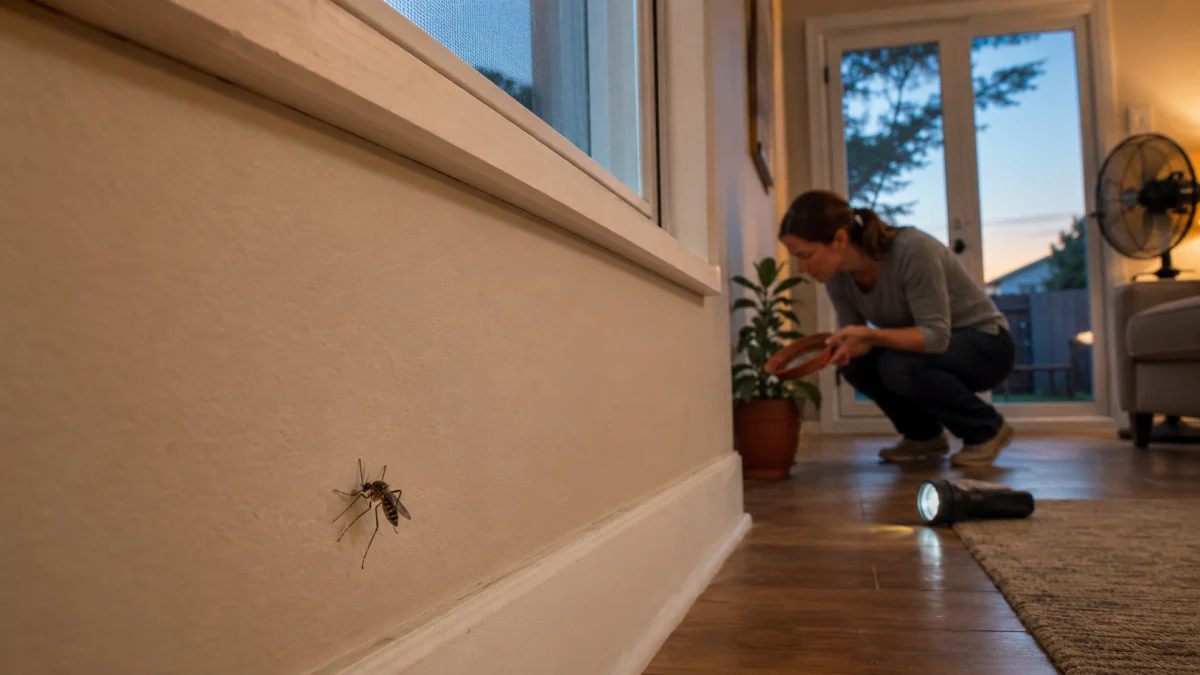
Start with the lower half of the room. Inspect the wall behind and beside the bed, headboard area, beneath nightstands, lower wall behind furniture, closets, bathroom entrances, underneath desks and other sheltered surfaces.
A bright flashlight held at an oblique angle can make the silhouette of a resting mosquito easier to see against a wall. That specific flashlight technique is a practical inference from the resting-location research rather than a formally tested mosquito-control intervention.
If you find the mosquito, physically remove it with an electric swatter, vacuum or other direct method.
Then keep going.
Killing one mosquito answers what was biting you.
It does not answer why it was there.
Phase 1: Turn the House Into a Closed System
Before attempting population elimination, reduce mosquito entry as close to zero as realistically possible.
CDC’s recommendations are straightforward: repair and use window and door screens, keep doors closed—including garage doors—and use air conditioning when practical. (CDC)
But “use screens” is not a sufficient home inspection protocol.
Check the entire interface between indoors and outdoors:
- Run your fingers around screen frames and check whether the screen actually meets the frame.
- Look for torn corners and holes around screen hardware.
- Check sliding doors, particularly damaged screens and gaps created when doors do not close completely.
- Inspect doors frequently used by children or pets.
- Check whether the garage is routinely left open with the interior door open.
- Look at windows that are supposedly closed but do not fully seat.
- Watch what actually happens during an ordinary afternoon. A theoretically sealed house can have an exterior door open dozens of times.
There is randomized evidence that screening matters.
In a cluster-randomized trial in Mérida, Mexico, homes received fixed fiberglass screening on doors and windows. Screened homes had significantly lower odds of containing female Aedes aegypti and blood-fed females than control homes. The respective odds ratios were approximately 0.56 and 0.53. (PubMed Central (PMC))
That does not mean screens reduce every home’s mosquitoes by exactly 44% or 47%. An odds ratio is not equivalent to an individual household percentage reduction.
It does establish that exclusion is a real vector-control intervention, not merely household folklore.
The overlooked problem: the door everyone actually uses
A family can have perfect window screens and still have a mosquito problem because the patio door remains open while children move between the yard and house.
If that is your household, fix the highest-volume breach first.
A properly fitted, self-closing screen door can be more consequential than obsessing over tiny cracks elsewhere while the main doorway repeatedly opens to the outdoors.
There is an advanced engineering option for unusual situations where an opening genuinely needs to remain accessible. In a simulated-aircraft experiment, commercial air curtains configured to create strong airflow across an open doorway excluded approximately 95–99% of mosquitoes, with effective configurations producing mean airflow above about 4 m/s in the critical zone. (PubMed)
That was an aircraft simulation, not a residential trial, so it would be irresponsible to claim an air curtain is proven to reduce household mosquitoes by 95%.
But the experiment demonstrates an important principle: if a doorway must remain open, an engineered air barrier can physically interfere with mosquito ingress. It is an option worth considering in unusually high-traffic openings after ordinary screening has been exhausted.
Phase 2: Assume There Could Be a Mosquito Nursery Inside
If mosquitoes continue appearing even when doors and windows stay closed, the problem changes.
You should now be asking:
Where is the water?
Not “is there a swimming pool?”
Not “do I have a bucket?”
You are looking for any water accessible to a female mosquito that remains there long enough for immature mosquitoes to develop.
CDC specifically warns that mosquitoes entering a house can lay eggs indoors and tells residents to empty and scrub water-holding items such as vases and flowerpot saucers. (CDC)
The important word is indoors.
Conduct a forensic water audit
Do not walk through the house once and declare there is no standing water. Inspect it like you are trying to disprove yourself.
In living areas, check flower vases, plant-propagation jars, potted-plant saucers, self-watering planters, decorative fountains and other water features.
In bathrooms, look at rarely used toilets, toilet-brush holders and any unusual standing water.
In utility spaces, inspect sump pits, floor drains, condensate collection areas and anything that stores rather than immediately drains water.
Check garages, enclosed patios and attached structures as part of the indoor system rather than assuming the exterior wall is where “inside” ends.
Local mosquito-control agencies have documented surprisingly mundane sources. Southern California guidance includes flower vases, potted-plant saucers, pet bowls, toilet-brush holders, stagnant toilets, decorative fountains and even Christmas-tree stands. Another California vector district notes invasive Aedes larvae have been found in coffee-maker reservoirs and toothbrush cups. (SGV Mosquito Control)
That illustrates why “remove standing water” is such inadequate advice.
A homeowner hears “standing water” and looks for a bucket.
The mosquito may need far less imagination.
Do Not Just Dump the Water. Scrub the Container.
This is probably the most important technical distinction in the entire guide.
Aedes aegypti and Aedes albopictus females lay eggs on the inner walls of containers above the waterline.
The eggs adhere to the surface. CDC describes them as sticking to the wall “like glue.”
And those eggs can survive drying for up to eight months.
Once they are submerged again, they can hatch. Under suitable conditions, development from egg to adult can take only about 7–10 days. (CDC)
That means this sequence can fail:
Dump water → put container back → refill container later.
You removed the water.
You may not have removed the eggs.
This is why CDC’s advice repeatedly says to empty and scrub, not merely empty. (CDC)
If you find an indoor flowerpot saucer, vase or similar container that may have supported Aedes, scrub the interior surfaces and waterline rather than simply tipping it out.
The same principle explains why prevention has to continue even after the house appears mosquito-free. Dry Aedes eggs can remain viable long after every flying adult has disappeared.
What If the Water Cannot Be Removed?
Sometimes water cannot simply be dumped.
A sump basin may retain water below the threshold that activates the pump. A decorative feature may be intended to contain water. Some drainage infrastructure retains water by design.
San Diego County specifically warns that sump basins can retain enough water beneath the pump’s trigger level for mosquitoes to breed. Its guidance recommends limiting mosquito access with fine screening where appropriate and controlling larvae in retained water with Bti. (County of San Diego)
This is where larvicides become useful.
Bti, or Bacillus thuringiensis israelensis, is a bacterial larvicide used against mosquito larvae. EPA says registered Bti products are used in residential settings and can be applied to water where mosquito larvae develop. CDC recommends larvicides for standing water that cannot be dumped, removed or covered. (US EPA)
That does not mean putting mosquito dunks into every wet object in the house.
The hierarchy should be:
Remove the water if possible.
If removal is impossible, prevent mosquito access if appropriate.
If water necessarily remains and the product label permits the use, treat the aquatic habitat with an appropriate registered larvicide.
Never improvise pesticide use. The product’s EPA-approved label determines where, how and how frequently it may be applied.
Drains Deserve Special Attention—but Do Not Blame Every Sink
People with mosquitoes clustered in a bathroom or basement often conclude that mosquitoes are “coming out of the drain.”
Sometimes a water-holding drainage system really can produce mosquitoes. Research has demonstrated mosquito development in floor-drain configurations, and field studies have found stormwater infrastructure capable of producing large numbers of Aedes and Culex. (PubMed Central (PMC))
But there is an important trap here.
Not every small flying insect around a drain is a mosquito.
Drain flies are commonly mistaken for mosquitoes. So are fungus gnats and other small flies.
If the insects appear concentrated around plumbing but you are not actually seeing mosquito-like adults or receiving characteristic bites, identification should come before treatment.
Capture one if possible.
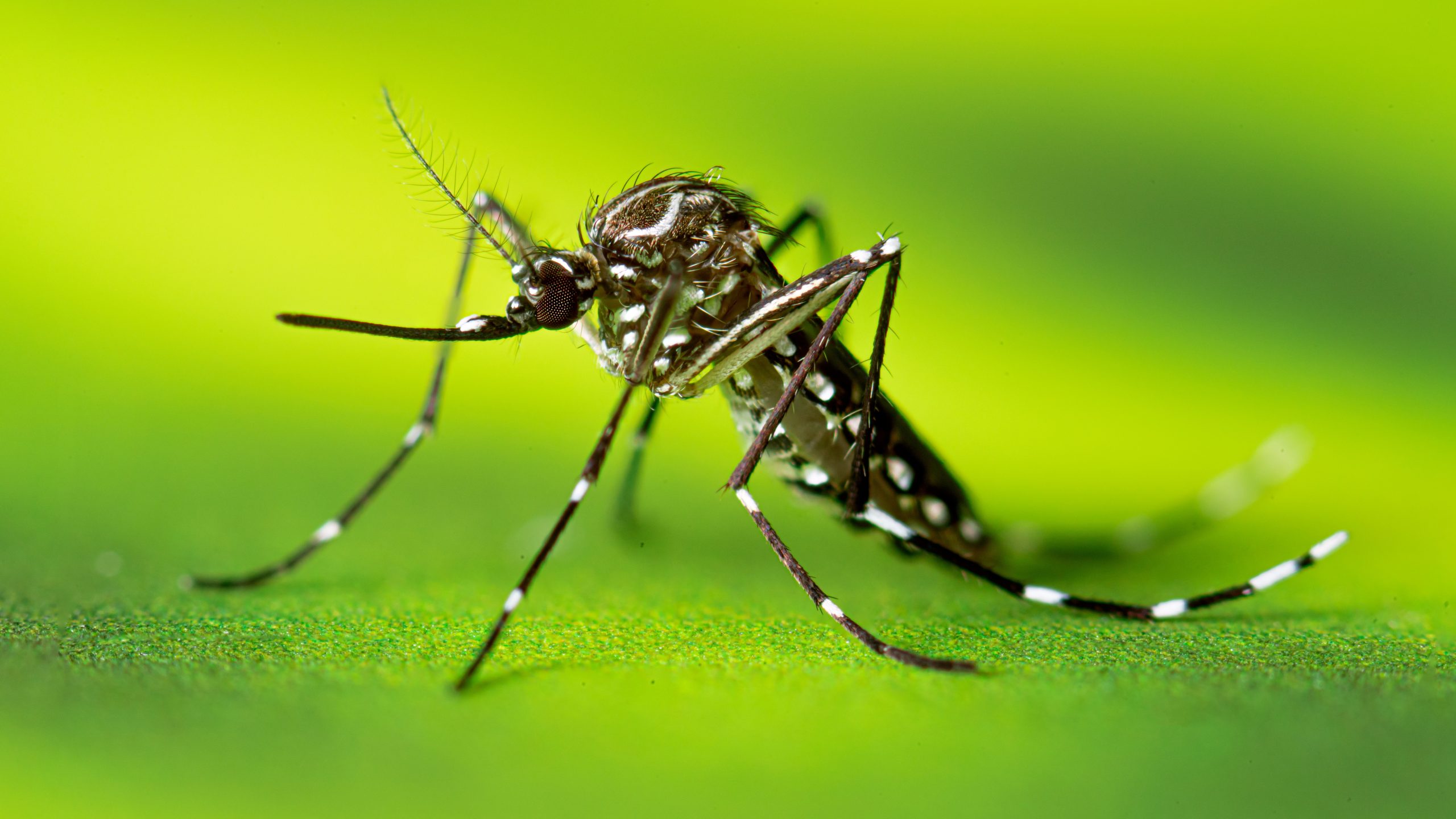
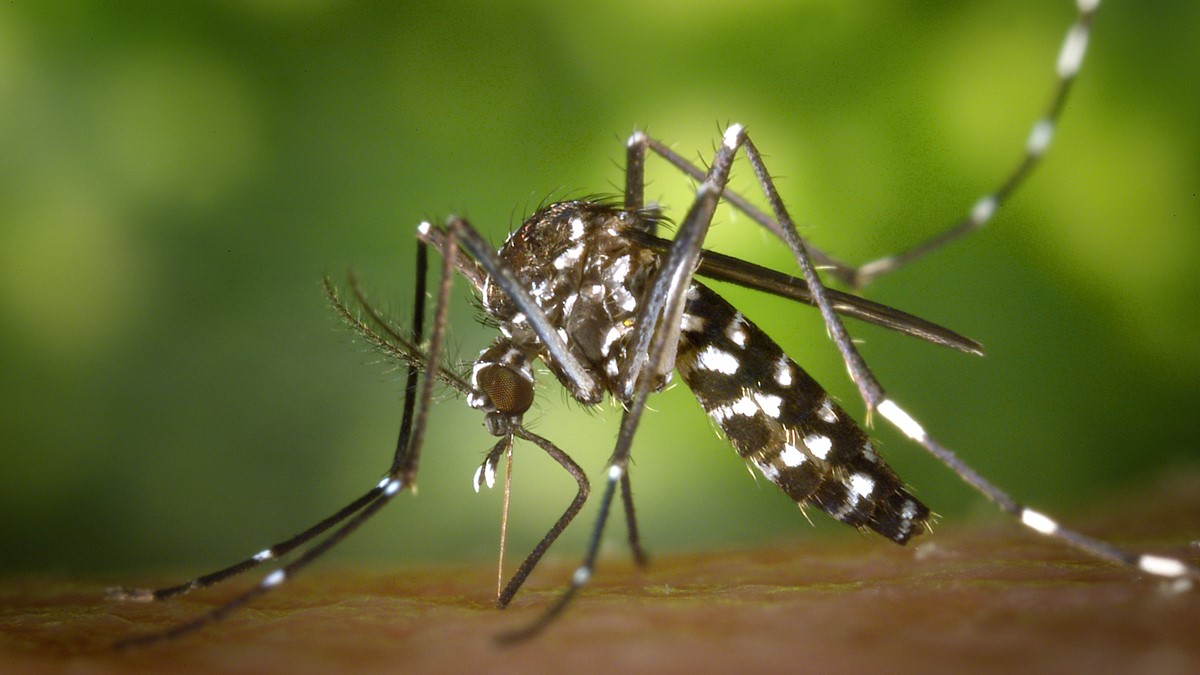
Mosquitoes generally have a narrow body, long legs and a conspicuous proboscis. Drain flies tend to look fuzzy and moth-like. If you remain uncertain, a local mosquito/vector-control program, cooperative-extension service or pest professional may be able to identify a specimen or photograph.
That single identification can save days of attacking the wrong pest.
Phase 3: Remove the Adult Population
Once ingress is controlled and breeding sources are being eliminated, the adults already inside become a finite population.
This is the point at which killing mosquitoes becomes highly effective.
If ten mosquitoes remain indoors but no new mosquitoes can enter and no new adults can emerge, the population cannot replenish itself.
You do not need an exotic gadget for a small infestation. Direct removal is perfectly rational: locate resting mosquitoes and kill or capture them.
For a more persistent population, trapping can play a useful role—but there is a major difference between a mosquito-specific trap and a generic glowing bug zapper.
The best role for a mosquito trap is partly as a sensor
Professional mosquito surveillance uses traps specifically designed around mosquito biology.
CDC describes BG-Sentinel traps, for example, as adult mosquito traps that can use human-scent lures, octenol or carbon dioxide to improve attraction. Different trap designs target different species and physiological states. (CDC)
Household trap research is not uniformly positive, but there is evidence that good designs can reduce mosquito density.
A systematic review found one household study in which a BG-Sentinel intervention reduced Aedes aegypti adult density from 1.35 to 0.62, approximately a 54% reduction. Other autocidal gravid-trap interventions produced substantial reductions, although results across trap studies were mixed. (PubMed Central (PMC))
The practical lesson is not “buy this trap.”
It is:
A trap can remove mosquitoes, but its greatest value in an eradication campaign may be telling you whether mosquitoes are still appearing.
That transforms it from a gadget into a monitoring instrument.
If the house is supposedly sealed and the trap continues collecting mosquitoes, something in your model is wrong.
Either adults survived your initial cleanup, mosquitoes are still entering, or adults are still emerging.
That information tells you to keep investigating rather than declaring victory.
Why a Bug Zapper Is Not the Same Thing
Traditional ultraviolet electrocution devices are notoriously indiscriminate.
In one suburban study frequently cited in mosquito-control literature, a black-light electrocuting trap killed 13,789 insects over a summer. Only 31—0.22%—were biting flies. (Yard and Garden)
That old outdoor study does not prove that every modern indoor light-and-suction device is worthless.
It does demonstrate why “it kills lots of bugs” is a terrible measure of mosquito effectiveness.
If you use a trap, evaluate whether its attraction mechanism is actually designed around mosquito host- or oviposition-seeking behavior.
A bucket full of dead moths is not evidence that your mosquito problem has been solved.
Phase 4: Read the Mosquitoes’ Behavior as Evidence
You do not always need perfect species identification before making progress.
Behavior can help narrow the search, although it should be treated as a clue rather than proof.
If they attack during the day
Aedes aegypti and Aedes albopictus live close to people and can bite during daytime and nighttime. Older CDC material also notes the familiar pattern of Ae. aegypti biting around ankles and elbows. (CDC)
Daytime biting, especially from aggressive mosquitoes around the lower legs, therefore increases suspicion of invasive Aedes in places where those species occur.
That should push the investigation toward small containers around the home and immediate neighboring properties.
A meta-analysis pooling 27 experiments estimated the average natural flight distance of Aedes aegypti at approximately 106 meters, although individual movements can be much farther and study methods affect estimates. (OUP Academic)
That means a chronic Aedes problem can plausibly originate from a surprisingly local source: your property, the house next door, a courtyard or another nearby container habitat.
If bites mostly occur from dusk through the night
Culex mosquitoes, including important West Nile virus vectors, are most active from dusk to dawn. CDC notes that some Culex can travel as far as about two miles. They use larger permanent or stagnant water sources but can also exploit containers around homes. (CDC)
A nighttime pattern should therefore expand the search toward drainage systems, neglected pools, stormwater, wastewater-related sites and larger neighborhood sources.
Again, this is triage—not species identification.
Mosquito behavior varies, species overlap and indoor lighting can alter activity.
The Indoor Mosquito Diagnostic Table
| What you observe | What moves higher on the suspect list | What to do next |
|---|---|---|
| Mosquito appears shortly after doors are repeatedly opened | Continued ingress | Audit the exact doorway and screen behavior |
| New mosquitoes appear despite the house remaining closed | Indoor/attached-structure breeding or missed entry point | Repeat water audit and inspect utility spaces |
| Mosquitoes concentrate in bathroom, basement or laundry area | Retained water, sump, drain system or nearby breeding source | Inspect water-holding infrastructure and confirm species |
| Daytime mosquitoes repeatedly attack legs/ankles | Aedes becomes more plausible | Search small container sources nearby |
| Mosquitoes mostly attack dusk through night | Culex becomes more plausible | Expand search to drains, stagnant pools and neighborhood water |
| Only one room remains active | Local resting zone, water source or room-specific entry | Concentrate inspection in that room and adjacent structure |
| Multiple apartments have the same problem | Shared building or exterior source | Escalate to building management/vector control |
| Adults disappear, then another burst appears roughly a week later | Missed breeding habitat becomes more suspicious | Repeat water audit aggressively |
The important point is the reasoning process.
Do not repeat the same intervention after it fails. Use the failure to identify which pathway remains open.
Phase 5: Use the 14-Day Mosquito Reset
Once you have:
- closed the major entry routes;
- emptied and scrubbed accessible breeding containers;
- treated or isolated unavoidable water where appropriate; and
- aggressively removed adult mosquitoes,
start a 14-day observation period.
Why 14 days?
For Aedes, CDC says development from egg to adult can occur in roughly 7–10 days. A two-week window therefore spans more than one rapid immature-development cycle under favorable conditions. (CDC)
This is not an official biological cutoff, and it does not prove that no viable dry eggs remain. Adult mosquitoes can also live approximately 2–4 weeks depending on species and environmental conditions. (CDC)
Think of the reset as a diagnostic challenge to your intervention.
Days 0–3
Immediately remove every mosquito encountered and record the room and approximate time.
A few residual adults do not automatically mean the protocol failed.
Days 4–7
The population should be noticeably collapsing.
If you are killing mosquitoes every day at approximately the same rate as before, do not simply keep swatting them. Your house is probably not a closed system yet.
Look again for ingress or emergence.
Days 8–14
Repeated appearance of new adults becomes increasingly valuable evidence.
If the exterior remains sealed, a hidden aquatic habitat becomes more suspicious. If mosquitoes correlate with door use, ingress becomes more suspicious.
If you reach 14 consecutive days with no bites, sightings or trap catches, you have strong practical evidence that the active indoor cycle has been interrupted.
You have not permanently sterilized the home.
That distinction matters because Aedes eggs stuck to an overlooked dry container can remain viable for months. If that container later fills with water, the system can restart. (CDC)
The weekly water audit is therefore maintenance, not a temporary treatment.
What If the 14-Day Reset Fails?
This is where the protocol becomes recursive.
Do not begin again at random.
Ask what the failure tells you.
Mosquitoes never meaningfully decreased
Continued ingress or a productive breeding source is still active.
Reassess the building envelope and the places where water persists.
They disappeared, then returned
Look for a source that periodically receives water: plant watering, irrigation, condensate, rain, a sump cycle, infrequently used plumbing or another intermittent reservoir.
Only one part of the house remains affected
Concentrate your investigation there.
A whole-house intervention followed by a one-room failure is not bad news. You have narrowed the system.
Your apartment is sealed but mosquitoes continue appearing
Stop assuming the relevant system ends at your walls.
Shared hallways, parking garages, basements, courtyards, plumbing infrastructure, roof areas, sumps, neighboring units and common landscaping may be maintaining the population.
At that point, building management or local vector control may need to investigate.
Your property is clean but invasive Aedes remain abundant outside
The source may be nearby rather than on your parcel.
The roughly 106-meter pooled average dispersal estimate for Ae. aegypti is useful here: a neighboring yard or shared space can realistically matter. (OUP Academic)
This is one of the situations where local mosquito-control agencies become especially valuable because they can investigate beyond one homeowner’s property line.
When an Indoor Insecticide Actually Makes Sense
Chemical control has a legitimate role.
It simply should not be mistaken for the entire solution.
CDC says indoor insecticides can be used when mosquitoes remain after screens have been installed or repaired and water-holding containers have been emptied and scrubbed. CDC also explicitly warns that using an indoor insecticide alone will not keep a home mosquito-free. (CDC)
Research on mosquito resting behavior suggests why targeted application can outperform indiscriminate spraying.
A major randomized trial published in the New England Journal of Medicine evaluated targeted indoor residual spraying, or TIRS, aimed at common Aedes aegypti resting surfaces such as lower walls and areas beneath furniture.
Indoor Ae. aegypti density was 59% lower in intervention areas. (PubMed Central (PMC))
There is an important scientific qualification.
Despite the large reduction in mosquitoes, the trial’s primary analysis did not find a statistically significant reduction in laboratory-confirmed symptomatic Aedes-borne disease among the enrolled children. A separate community-level analysis estimated a 24% reduction using national surveillance data, but that was a secondary analysis. (PubMed Central (PMC))
That is exactly the distinction a good mosquito guide should preserve:
The evidence supports a substantial effect on indoor mosquito density. It does not justify claiming that this particular trial proved an equivalent reduction in disease.
Homeowners also should not attempt to reproduce a research spraying protocol themselves.
If persistent mosquitoes require residual pesticide treatment, consider a licensed professional and ask a better question than “Can you spray my house?”
Ask:
Where do you believe the mosquitoes are breeding or entering, what species do you believe we have, and which resting surfaces are you targeting?
A pest-control company that cannot answer those questions may simply be treating symptoms.
Be More Cautious With Foggers Than With a Swatter
CDC includes appropriately labeled indoor foggers among products that can kill mosquitoes.
But total-release foggers—commonly called bug bombs—come with additional safety issues. EPA warns that the propellants can be flammable and that improper use can cause fires, explosions or illness from exposure. Everyone and all pets must leave for the time required by the label, and the building must be ventilated as directed before reentry. (US EPA)
For a family dealing with a few mosquitoes inside one or two rooms, jumping immediately to whole-room fogging is therefore a poor troubleshooting strategy.
Find the source first.
If pesticides are used around children, EPA advises removing children, their toys and pets during application and keeping them away until the pesticide has dried or for however long the label specifies. (US EPA)
Never improvise pesticide applications onto toys, bedding, skin, food-contact surfaces or other locations not permitted by the product label.
What About Repellent Plug-Ins and Spatial Repellents?
A repellent and an insecticide solve different problems.
Repellents reduce mosquito-human contact.
That can be extremely valuable.
But a repelled mosquito is still a mosquito.
EPA notes that some spatial repellents are registered and have supporting safety and effectiveness data, but many are designed for outdoor use unless the label specifically permits indoor use. (US EPA)
So an indoor repellent may have a place as temporary bite protection.
It should not substitute for discovering why mosquitoes keep appearing.
The same principle applies to topical DEET, picaridin and other EPA-registered repellents. They are useful protection tools and have been evaluated for efficacy when used as directed. (CDC)
They are not household eradication tools.
What Not to Waste Your Time On
The question is not whether a product can influence a mosquito under some circumstance.
The question is whether it closes one of the three pathways maintaining your indoor population.
Ultrasonic mosquito devices: EPA says sound-wave mosquito products are not registered as repellents and that it does not have the safety and effectiveness data it requires for registered repellents. They should not be the foundation of a serious mosquito-elimination strategy. (US EPA)
Random essential-oil mixtures: Some botanical ingredients appear in registered products, while other minimum-risk products are exempt from EPA registration and have not been evaluated by EPA for effectiveness. “Natural” therefore does not automatically mean either effective or ineffective; it means you need to examine the actual product and evidence. An untested essential-oil diffuser is not a substitute for source elimination. (US EPA)
Traditional UV bug zappers: They kill insects, but historical field research shows they can be extraordinarily poor at selectively killing biting insects. (Yard and Garden)
DIY sugar, vinegar or soap traps: These may attract or kill some insects under some conditions, but they do not close the fundamental population pathways. They should not consume time while an actual breeding container remains in the house.
Repeated spraying without a source investigation: This is perhaps the most expensive mistake. CDC itself warns that insecticide alone will not keep a home mosquito-free. (CDC)
The Mosquito-Free Home Checklist
For someone who wants the entire strategy condensed into one operational sequence, use this order:
Tonight: Close the house, run airflow across occupied areas, use appropriate bite protection, and remove visible adult mosquitoes.
Then: Inspect screens, exterior doors, sliding doors, garage access and the openings your family actually uses.
Next: Search every room and attached structure for water. Do not stop at obvious buckets. Inspect plant saucers, vases, decorative water, rarely used toilets, toilet-brush holders, sump basins, floor drains and other persistent reservoirs.
When you find container water: Empty it and scrub the container, especially around the former waterline.
When water cannot be removed: Prevent mosquito access where practical and use an appropriately labeled larvicide such as Bti when the use is permitted and appropriate.
Then hunt resting adults: Search lower walls, underneath furniture, closets, bathrooms, laundry rooms and other dark protected areas instead of staring at the ceiling.
Use traps intelligently: Treat a mosquito-specific trap primarily as supplementary removal and a monitoring instrument, not permission to ignore the source.
Start the 14-day clock: Record every bite, sighting or catch and use the timing and location to diagnose the remaining pathway.
If the reset fails: Do not repeat the same solution. Determine whether the evidence points toward surviving adults, continued ingress or continued emergence.
If the source extends beyond your property: Escalate to building management, a licensed mosquito professional or local mosquito/vector control.
That is the entire strategy.
Not “repel mosquitoes.”
Not “kill mosquitoes.”
Break the population.
The Bottom Line
A truly mosquito-free home is not achieved by finding the strongest spray or buying the best gadget.
It comes from understanding why another mosquito is able to replace the one you just killed.
If mosquitoes can no longer enter, no larvae can mature inside, and the remaining adults are systematically removed, the indoor population has no mechanism for sustaining itself.
That is why the most effective sequence is:
exclude → eliminate water → scrub eggs → remove adults → monitor → diagnose any failure.
The science also gives homeowners several advantages that generic mosquito advice often misses.
Aedes eggs can survive dry for months, so dumping water without scrubbing may not solve the problem. Many indoor Aedes rest low rather than near the ceiling, so searching lower walls and sheltered spaces is more rational. Screens have randomized evidence behind them. Mosquito-specific traps can help measure whether an intervention is actually working. Fans can reduce exposure while the source is being eliminated. Targeted insecticide can substantially reduce indoor mosquito density when genuinely necessary.
Most importantly, every mosquito that appears after the reset is information.
If the house has been sealed, where did it come from?
If every visible container was scrubbed, what water was missed?
If mosquitoes only appear after the patio door opens, is there really an indoor breeding problem at all?
Keep asking those questions until the system closes.
That is how you get from fewer bites tonight to no active mosquito population in the house.
References and Further Reading
U.S. Public-Health Guidance
CDC — Mosquito Control at Home The CDC’s core guidance on indoor and outdoor source reduction, screening, standing water and indoor insecticide use.
CDC — Life Cycle of Aedes Mosquitoes Primary source for the 7–10-day developmental cycle, egg placement above the waterline and survival of dried Aedes eggs.
CDC — Larvicides Explains when homeowners should consider larvicides for water that cannot be dumped or removed.
EPA — Bti for Mosquito Control EPA overview of residential Bti use, efficacy and human-health assessment.
CDC — Mosquito Surveillance Traps Explains BG-Sentinel, gravid and other mosquito-specific surveillance traps and the cues they use.
CDC — Preventing Mosquito Bites Current recommendations on EPA-registered repellents and protecting babies and children.
EPA — Pesticide Safety Tips Important safety guidance for pesticide use around children, toys, pets and food.
EPA — Safety Precautions for Total Release Foggers Explains the exposure, fire and explosion risks associated with total-release foggers.
Mosquito Behavior and Intervention Research
Indoor Resting Behavior of Aedes aegypti in 979 Houses in Acapulco The major field study showing that indoor Ae. aegypti disproportionately rested below 1.5 meters and identifying the rooms where adults were most often found.
Mapping Aedes aegypti Indoor Resting Behavior Reveals a Preference Vulnerable to Householder-Led Vector Control Detailed experimental mapping of the strong resting preference for the lowest portion of walls.
Protective Effect of House Screening Against Indoor Aedes aegypti: Cluster Randomized Trial Randomized evidence that fixed door and window screening significantly reduced indoor female Ae. aegypti infestation.
Randomized Trial of Targeted Indoor Spraying to Prevent Aedes-Borne Diseases The 2025 New England Journal of Medicine trial showing a 59% reduction in indoor Ae. aegypti density while finding no significant disease reduction in the trial’s primary child-cohort endpoint.
Interventions Against Aedes/Dengue at the Household Level: Systematic Review and Meta-Analysis Useful synthesis of household mosquito interventions, including adult and oviposition traps.
Estimating Aedes aegypti Flight Distance: Meta-Data Analysis Pooled analysis estimating an average natural Ae. aegypti travel distance of approximately 106 meters.
Prevention of Mosquitoes From Entering a Simulated Aircraft Using Commercial Air Curtains Experimental evidence supporting airflow barriers across open doorways; included here as an engineering concept, not proof of residential effectiveness.
Reassessment of the Role and Utility of Wind in Suppression of Mosquito Host Finding Experimental research supporting fan-generated airflow as a practical means of interfering with mosquito host finding.
Practical Source Identification
San Gabriel Valley Mosquito & Vector Control District — Indoor Mosquito Sources Useful documentation of easily overlooked household habitats including toilet-brush holders, stagnant toilets and tree stands.
San Diego County — Drainage and Sump-Pump Mosquito Prevention Explains how residual sump water can remain below the pump activation point and become mosquito habitat.
Editorial currency note: CDC/EPA guidance and pesticide registrations can change. Recommendations and source pages were checked August 28, 2026. Always follow the current label of any pesticide or repellent product used in the home.
Editorial Visual Reference