

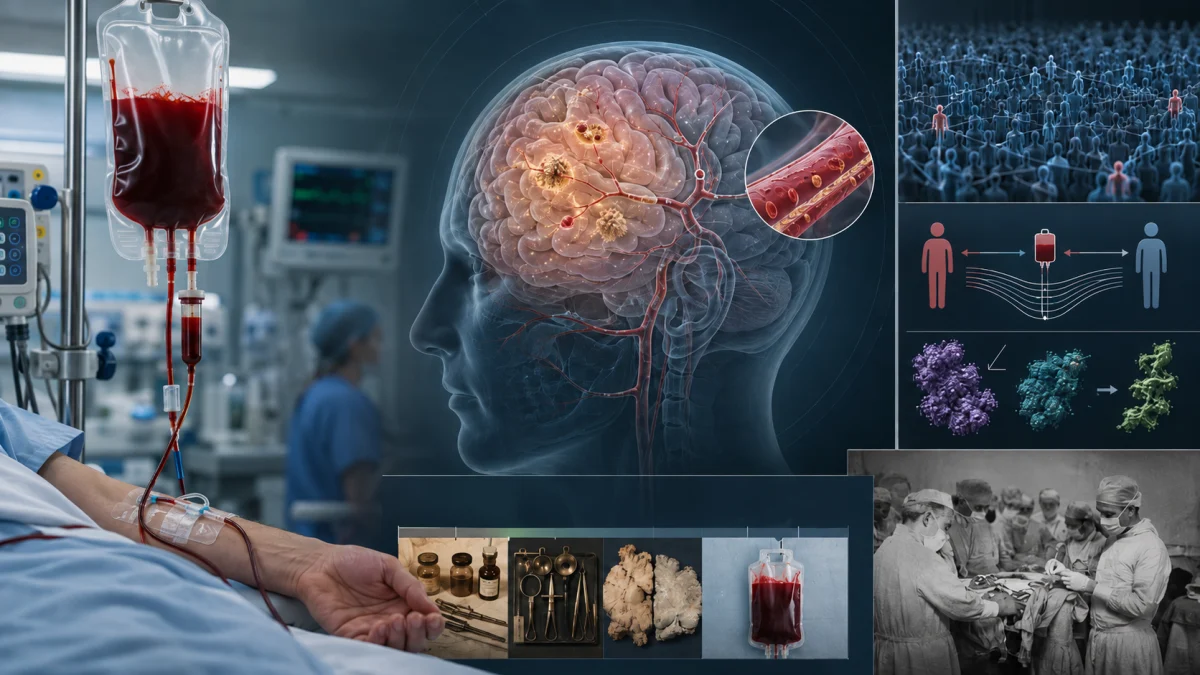
No human study has demonstrated that receiving a blood transfusion can give someone Alzheimer’s disease.
The Lancet paper behind a viral August 2026 claim about Alzheimer’s spreading through transfusions is not a new transfusion experiment, clinical trial, or patient study. It is explicitly classified by The Lancet as a Viewpoint: researchers reviewed existing evidence and argued that the possibility of bloodborne transmission of amyloid-beta pathology deserves further investigation.
There were no newly recruited patients. No researchers transfused blood and watched for Alzheimer’s. There is no new sample size because this was not that kind of study.
But dismissing the entire concern as nonsense would also be wrong.
Scientists now have compelling evidence that amyloid-beta pathology can, under extremely unusual medical circumstances, be transmitted from one person to another through contaminated human-derived material. A 2026 autopsy also strengthened the evidence that such exposure can, in rare cases, lead to a disease with the classic brain pathology of Alzheimer’s.
What has not been demonstrated is the crucial next step driving the viral story: that amyloid-beta is transmitted through donated blood in humans, much less that receiving a blood transfusion causes Alzheimer’s disease.
The science is real.
The viral conclusion is several steps ahead of it.
What the new Lancet paper actually says
The paper, “Risk of transmission of amyloid β pathology via transfused blood products,” was published in The Lancet in August 2026.
Its authors examine a legitimate blood-safety question:
Could abnormal amyloid-beta “seeds” present in donated blood eventually trigger amyloid pathology in a recipient?
They argue that the possibility deserves investigation because several pieces of evidence now exist:
- amyloid-beta can undergo a self-propagating process sometimes described as prion-like seeding;
- human amyloid pathology has apparently been transmitted through certain historical medical procedures involving cadaver-derived human material;
- a large Scandinavian transfusion study found an unusual association between donors who later suffered repeated brain hemorrhages and hemorrhage risk among their blood recipients;
- bloodborne transmission has previously occurred with an actual prion disease, variant Creutzfeldt-Jakob disease.
Those facts make the question scientifically reasonable.
They do not establish the answer.
The Lancet authors themselves describe unresolved questions about whether blood transmission occurs, what level of risk might exist, and what measures—if any—blood services should eventually take.
The most important distinction: amyloid pathology is not the same thing as Alzheimer’s disease
Much of the confusion begins with the term amyloid-beta.
Amyloid-beta is a protein strongly associated with Alzheimer’s disease. In Alzheimer’s, abnormal amyloid accumulates in brain tissue, while another abnormal protein, tau, forms characteristic tangles. The disease involves a much broader neurodegenerative process than the mere presence of amyloid.
Amyloid-beta can also accumulate in the walls of small blood vessels in the brain. That condition is called cerebral amyloid angiopathy, or CAA.
CAA can weaken those vessels and cause brain hemorrhages.
Alzheimer’s disease and CAA are biologically related and frequently coexist, but they are not interchangeable diagnoses.
That matters because the strongest transfusion evidence cited in this debate concerns brain hemorrhage and possible CAA—not demonstrated transmission of Alzheimer’s disease.
Yes, amyloid pathology really has been transmitted through medicine before
This is the part of the story that should not be minimized.
Beginning decades ago, some children were treated with human growth hormone extracted from the pituitary glands of deceased people. Other patients received grafts made from cadaveric dura mater, one of the membranes surrounding the brain.
Those practices were subsequently abandoned.
Researchers later discovered that some recipients developed unusually early amyloid-beta deposition and cerebral amyloid angiopathy decades after exposure.
The evidence eventually became strong enough for researchers to describe these cases as iatrogenic, meaning medically acquired, amyloid disease.
A 2020 review in The Lancet Neurology concluded that convincing evidence already existed for human iatrogenic transmission of amyloid-beta following contaminated cadaver-derived growth hormone treatment or dura mater grafting. At that time, however, the authors emphasized that there was no proof that transmitted amyloid-beta could produce Alzheimer’s dementia itself.
Then the evidence advanced.
The controversial 2024 Alzheimer’s report
In 2024, researchers reported several former recipients of cadaver-derived human growth hormone who developed unusually early dementia and biological findings that they argued represented an acquired form of Alzheimer’s disease.
The Nature Medicine paper described eight patients and proposed that Alzheimer’s can, in rare circumstances, have an iatrogenic form produced by exposure to amyloid-beta seeds.
Other scientists challenged that conclusion.
A subsequent critique argued that the patients did not adequately demonstrate the full combination of amyloid and tau pathology required to establish Alzheimer’s disease and warned that the authors had moved beyond what their evidence showed.
That disagreement was scientifically important.
The 2026 autopsy substantially strengthened the case
In March 2026, researchers published important new evidence in JAMA Neurology.
They described four additional former recipients of cadaver-derived growth hormone. One patient, who developed dementia beginning at age 47 and died at 57, underwent a postmortem examination.
The brain showed unequivocal Alzheimer-type neuropathology, including severe tau pathology.
That addressed one of the biggest objections to the earlier report.
It is therefore no longer accurate to wave away medically acquired Alzheimer-type disease as merely speculative.
The evidence now strongly supports the conclusion that extraordinary exposure to contaminated human-derived material can seed amyloid pathology and, at least in rare circumstances, eventually produce the neuropathological features of Alzheimer’s disease.
But this historical medical transmission involved specific contaminated biological preparations and procedures.
It does not demonstrate that Alzheimer’s spreads through everyday contact.
And it does not demonstrate that the same process occurs through blood transfusion.
Where did the blood-transfusion concern come from?
The most provocative evidence comes from a 2023 JAMA study using nationwide blood-bank and health records from Sweden and Denmark.
Researchers examined:
- 759,858 transfusion recipients in Sweden
- 329,512 transfusion recipients in Denmark
They asked an unusual question.
If a blood donor later developed repeated spontaneous intracerebral hemorrhages—a possible sign of cerebral amyloid angiopathy—were recipients of that donor’s blood also more likely to suffer a spontaneous brain hemorrhage?
Recipients whose donors later experienced multiple spontaneous hemorrhages did show higher hemorrhage rates.
In Sweden, the adjusted hazard ratio was 2.73.
In Denmark, it was 2.32.
At first glance, that sounds dramatic.
But several details fundamentally change what the study tells us.
The study did not diagnose transmitted amyloid
Researchers did not demonstrate amyloid-beta in the donated blood and then show the same pathological material establishing itself in the recipient.
They did not establish that the donors’ hemorrhages were caused by CAA.
They did not establish CAA in the affected recipients.
They did not diagnose those recipients with Alzheimer’s disease.
The endpoint was intracerebral hemorrhage.
Repeated hemorrhages were being used as an indirect clue because CAA is one cause of recurrent bleeding in the brain.
Independent neuroscientist Tara Spires-Jones noted that many hemorrhagic strokes are caused by conditions other than CAA, including hypertension. The transfusion study therefore provides, at most, an epidemiological signal that needs a biological explanation.
A single hemorrhage produced no comparable signal
The association was specifically seen when donors later suffered multiple spontaneous hemorrhages.
Recipients of blood from donors who later had only one spontaneous hemorrhage did not show a statistically significant increase.
That makes the repeated-hemorrhage finding interesting, but it also illustrates how narrow the signal was.
The researchers themselves did not claim causation
The JAMA paper was explicitly described as an exploratory retrospective cohort study.
Its authors warned that the findings could be affected by selection bias and residual confounding and concluded that further research was needed to determine whether transfusion transmission of CAA might explain the association.
That is very different from showing that Alzheimer’s was transmitted through blood.
A much larger transfusion study found no evidence of Alzheimer’s transmission
There is another major piece of evidence that becomes especially important when a viral story jumps directly from “possible amyloid transmission” to “Alzheimer’s may be contagious.”
In 2016, researchers analyzed 1,465,845 blood-transfusion recipients in Sweden and Denmark.
They compared people who received blood from donors who were later diagnosed with neurodegenerative disease against recipients whose donors were not.
About 2.9% of the recipients had received blood from someone later diagnosed with one of the neurological diseases being studied.
Researchers looked specifically at subsequent:
- dementia;
- Alzheimer’s disease;
- Parkinson’s disease.
They found no evidence that any of those diseases were transmitted through blood transfusion.
For Alzheimer’s disease specifically, the hazard ratio was 0.99, with a 95% confidence interval of 0.85 to 1.15—essentially a null result.
The study was observational and could not rule out an extraordinarily rare effect. The authors themselves acknowledged limitations including possible underdiagnosis and insufficient statistical power for very rare transmission.
Their conclusion was appropriately narrow:
The data provided no evidence of transfusion transmission and suggested that if such transmission occurs, it is rare.
That study does not close the case on CAA.
But it is difficult to reconcile with the much broader public impression that blood transfusions are an established route for spreading Alzheimer’s disease.
They aren’t.
So why are serious scientists still investigating this?
Because a risk does not need to be proven before it is reasonable to investigate it.
This is where the Lancet authors’ argument deserves to be taken seriously rather than caricatured.
Blood safety is an area where extremely rare events matter. A harmful agent transferred through donated blood can expose many people before an unusually long incubation period makes the pattern visible.
The authors specifically invoke lessons from the UK’s Infected Blood Inquiry, which examined the catastrophic transmission of HIV and hepatitis viruses through contaminated blood and blood products.
Their argument is essentially precautionary:
If amyloid-beta transmission through blood is biologically plausible, researchers should develop the tools necessary to determine whether it actually occurs rather than waiting decades for incontrovertible clinical evidence.
The UK government is already studying the issue.
Its Advisory Committee on the Safety of Blood, Tissues and Organs, known as SaBTO, has established an Amyloid Beta Pathologies Working Group. According to its July 2026 annual report, the group is evaluating potential transmission risks through donated blood, tissues and organs, considering surveillance strategies, assessing possible blood-based tests and examining the practical implications of introducing such testing.
That is what responsible investigation of an uncertain risk looks like.
It is not evidence that the risk has already been demonstrated.
Is Alzheimer’s contagious?
No evidence suggests Alzheimer’s disease is contagious in the ordinary meaning of the word.
There is no evidence that Alzheimer’s spreads through:
- touching someone;
- living with someone;
- caring for someone;
- sharing food;
- coughing or breathing;
- sexual contact;
- normal exposure to bodily fluids.
The iatrogenic cases involve extraordinary medical exposure to human-derived biological material contaminated with amyloid seeds.
Even the researchers who argue that iatrogenic Alzheimer’s exists explicitly state that there is no suggestion that amyloid-beta is transmitted through ordinary activities of daily life.
Calling Alzheimer’s “contagious” therefore creates a badly misleading mental model.
What does “prion-like” actually mean?
This terminology also generates confusion.
A prion is an abnormally folded protein capable of inducing normally folded versions of the same protein to change shape, creating a self-propagating chain reaction.
Amyloid-beta can display some similar seeding behavior.
Scientists therefore sometimes describe its propagation as “prion-like.”
But “prion-like” does not automatically mean:
infectious between people.
A molecular mechanism occurring inside tissue is not the same thing as an organism or protein being efficiently transmitted between humans.
Professor Bart De Strooper, commenting independently on the 2026 Lancet Viewpoint, warned that making parallels with prions at this stage was premature and could create public fear unsupported by the existing transfusion evidence.
That distinction is essential.
Can amyloid-beta spread between people?
Yes, apparently—but only under very unusual conditions demonstrated so far.
Evidence strongly supports transmission of amyloid-beta pathology following certain obsolete procedures involving contaminated cadaver-derived medical material.
That makes amyloid-beta different from an ordinary nontransmissible disease marker.
But the route matters.
Evidence that contaminated pituitary extracts or transplanted dura mater can introduce amyloid seeds does not automatically mean that the much smaller amounts, different forms or different biological environment potentially encountered in circulating blood can do the same thing.
That is precisely the unanswered question.
Can dementia be transmitted through blood?
No human evidence currently demonstrates that dementia is transmitted through blood transfusion.
The large 2016 Scandinavian cohort specifically searched for such an association and found none.
The 2023 signal involved intracerebral hemorrhage—not dementia—and researchers have not demonstrated that amyloid transmission caused those hemorrhages.
Those findings can coexist:
There may be an unresolved question about extremely rare bloodborne CAA transmission while there remains no evidence that transfusions transmit Alzheimer’s dementia.
Should donated blood now be screened for amyloid-beta?
There is currently insufficient evidence to conclude that universal amyloid screening of blood donations is necessary.
That does not mean the question should be ignored.
The UK SaBTO working group is specifically examining available blood-based tests, surveillance options and the practical consequences of introducing screening should the evidence eventually justify it.
This is an important distinction between investigating a precaution and establishing that a hazard exists.
The former is happening.
The latter has not yet happened.
What if you received blood from someone who later developed Alzheimer’s?
The existing evidence does not establish that you acquired an increased Alzheimer’s risk from that transfusion.
The largest direct epidemiological study found no increased Alzheimer’s incidence among people who received blood from donors later diagnosed with Alzheimer’s disease.
Independent researchers responding to the 2026 Lancet paper were also clear that patients should not avoid medically necessary blood transfusions because of this hypothesis.
Alzheimer’s Research UK noted that the paper does not show that transfusions cause Alzheimer’s and emphasized that people who require blood should continue to follow the advice of their medical teams.
That is especially important because the known benefit of a medically necessary transfusion can be immediate and lifesaving, while the proposed amyloid risk remains unproven.
What evidence would actually establish a transfusion risk?
The current evidence chain contains several missing links.
To move from an interesting hypothesis to a demonstrated human risk, scientists would need much stronger evidence showing that:
- biologically active amyloid-beta seeds are present in relevant donated blood components at levels capable of causing disease;
- recipients exposed to those components develop amyloid pathology at higher rates than comparable unexposed recipients;
- the recipient pathology can actually be demonstrated with appropriate biomarkers, imaging or tissue evidence rather than inferred from an indirect outcome such as hemorrhage;
- the association is replicated in separate populations;
- plausible alternative explanations such as age, vascular disease, follow-up differences and other confounders cannot account for the result;
- the effect is consistent with a biologically credible latency period and, ideally, some relationship between exposure and risk.
The 2023 hemorrhage study provides an intriguing epidemiological clue.
It does not yet fill those gaps.
The viral claim skips from a question to an answer
The underlying science is more interesting than either extreme version of this story.
It would be wrong to say:
“Alzheimer’s can never be medically transmitted.”
Evidence from historical cadaver-derived treatments and the 2026 autopsy now makes that position very difficult to defend.
But it is equally wrong—and far more immediately misleading—to turn that evidence into:
“Alzheimer’s may be contagious and spread through blood transfusions.”
Those statements collapse different diseases, different routes of exposure and different levels of evidence into one frightening conclusion.
The evidence currently supports a much more precise answer:
Amyloid-beta pathology can apparently be transmitted through certain rare, obsolete medical exposures. Scientists have a legitimate reason to investigate whether blood could provide another route. A 2023 transfusion study produced a possible CAA-related signal, but it did not demonstrate amyloid transmission or Alzheimer’s disease. And a study involving nearly 1.5 million transfusion recipients found no evidence that blood transfusions transmitted Alzheimer’s, dementia or Parkinson’s disease.
The possibility deserves research.
It does not deserve to be reported as a discovery.
Bottom line
Can you catch Alzheimer’s from a blood transfusion?
Based on current evidence, there is no demonstrated human transmission of Alzheimer’s disease through blood transfusion.
The August 2026 Lancet paper does not change that. It contains no new transfusion experiment or patient cohort and does not claim to have proved such transmission.
What it does show is why scientists are asking the question.
Rare historical medical exposures have demonstrated that amyloid-beta pathology—and probably, under extraordinary circumstances, Alzheimer-type disease itself—can be acquired iatrogenically. A later blood-transfusion study found a possible association involving recurrent brain hemorrhage that could be related to cerebral amyloid angiopathy.
That signal deserves serious investigation.
But a biologically plausible hypothesis, an epidemiological association and a demonstrated transmission route are three different things.
The viral version turns the first two into the third.
The evidence does not.
References and Further Reading
Primary research and scientific reviews
-
The Lancet — “Risk of transmission of amyloid β pathology via transfused blood products” — The August 2026 Viewpoint underlying the current discussion. It reviews existing evidence and proposes further investigation; it does not report a new transfusion experiment or patient cohort.
-
JAMA — “Intracerebral Hemorrhage Among Blood Donors and Their Transfusion Recipients” — The 2023 Scandinavian observational study that found higher hemorrhage risk among recipients of blood from donors who later experienced multiple spontaneous brain hemorrhages.
-
Annals of Internal Medicine / PubMed — “Transmission of Neurodegenerative Disorders Through Blood Transfusion: A Cohort Study” — Study of 1,465,845 transfusion recipients that found no evidence of transfusion transmission of dementia, Alzheimer’s disease or Parkinson’s disease.
-
Nature Medicine / PubMed — “Iatrogenic Alzheimer’s disease in recipients of cadaveric pituitary-derived growth hormone” — The 2024 report proposing an acquired form of Alzheimer’s following historical treatment with cadaver-derived growth hormone.
-
Alzheimer’s & Dementia — “Insufficient evidence for an association between iatrogenic Alzheimer’s disease and cadaveric pituitary-derived growth hormone” — Scientific critique of the 2024 Alzheimer’s interpretation, particularly the limited evidence for tau pathology in the original cases.
-
JAMA Neurology — “High-Level Alzheimer Disease Neuropathological Change Following Iatrogenic Exposure” — 2026 follow-up including autopsy evidence of unequivocal Alzheimer-type pathology and severe tauopathy in a former cadaver-derived growth hormone recipient.
-
The Lancet Neurology / PubMed — “Potential human transmission of amyloid β pathology: surveillance and risks” — 2020 review of the evidence for iatrogenic amyloid-beta transmission and the remaining uncertainty over whether such transmission could cause Alzheimer’s dementia.
Independent expert assessment and blood-safety policy
-
Science Media Centre — Independent expert reaction to the 2026 Lancet Viewpoint — Comments from Alzheimer’s and dementia researchers emphasizing that the paper contains no new data and does not show that Alzheimer’s is contagious or transmitted through transfusions.
-
UK Advisory Committee on the Safety of Blood, Tissues and Organs — 2024–2025 Annual Report — Documents the Amyloid Beta Pathologies Working Group and its ongoing evaluation of surveillance, potential blood tests and transfusion risk.
Editorial currency note: Evidence and blood-safety recommendations in this area are evolving. This article reflects research and UK policy information available through August 25, 2026. Future donor-recipient studies, amyloid assays or regulatory recommendations could materially change the risk assessment.