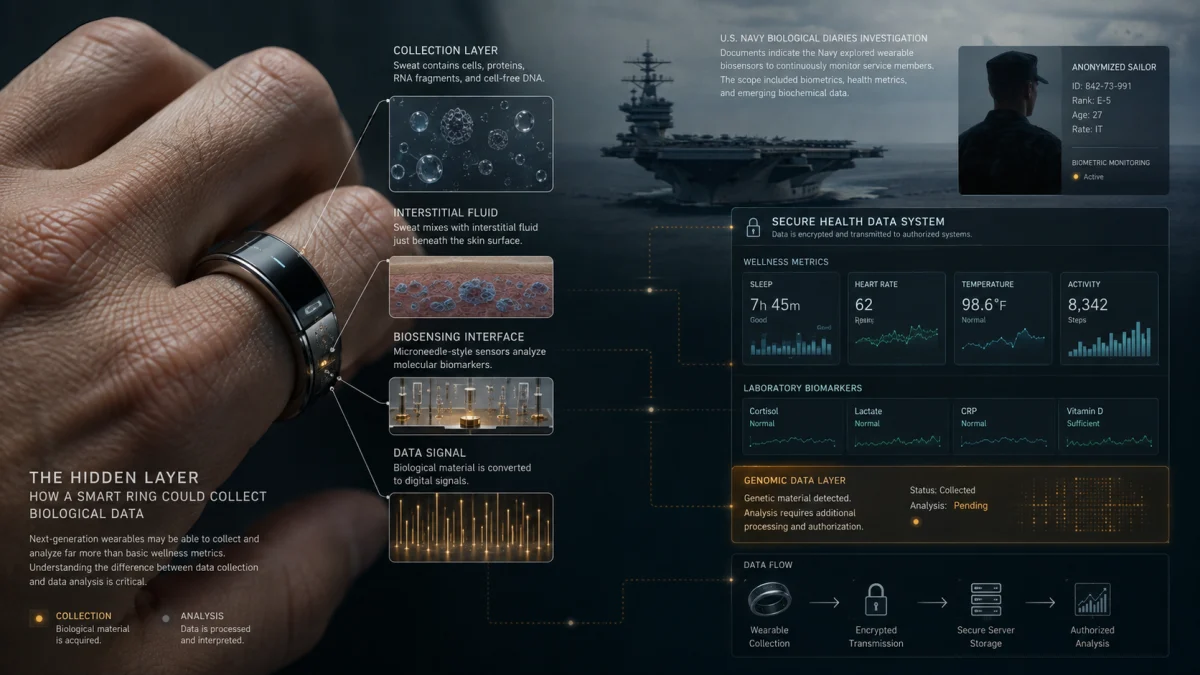
Yes—in a limited but important sense, a wearable could collect genetic material with technology that exists today without requiring anything resembling a conventional blood draw.
That does not mean your current Oura Ring is secretly sequencing your genome. There is no evidence of that, and Oura’s disclosed hardware does not contain a DNA sensor.
But that narrow reassurance answers the wrong question.
Scientists have already:
No publicly documented consumer smart ring combines all of those capabilities into a covert genetic-profiling device.
But the scientific barriers have changed dramatically.
The question is no longer whether biological material containing DNA can reach a wearable.
It can.
The question is how much genetic information could be extracted, how reliably it could be tied to one person, where the analysis would occur—and whether the wearer would necessarily understand that genetic collection was happening.
That question became considerably more important after our previous investigation, The Navy Is Building "Biological Diaries" of Its Sailors, documented a military research ecosystem combining wearables, blood samples, medical information, environmental surveillance and increasingly integrated biological analytics.
The Navy story raised a broader question that applies far beyond the military:
What happens when wearable technology stops merely observing the body’s signals and begins physically sampling the body itself?
We are already crossing that line.
First, Separate DNA Collection From DNA Sequencing
A lot of discussion around this subject starts with the wrong mental image.
People imagine a miniature 23andMe laboratory somehow hidden inside a ring.
That is not necessary.
There are actually several separate technical problems:
| Stage | What has to happen | Where technology stands |
|---|---|---|
| Biological collection | Obtain cells, sweat, interstitial fluid or another DNA-containing material | Already possible |
| Nucleic-acid detection | Detect particular DNA or RNA sequences or concentrations | Already demonstrated in wearables |
| Genetic profiling | Analyze enough genetic markers to identify or characterize a person | Routine in laboratories; increasingly miniaturized |
| Whole-genome sequencing | Read most or all of someone’s genome | Routine scientifically, but not inside a normal consumer ring |
| Data integration | Associate genetic information with an identified user and other health data | Technically straightforward once data exists |
This distinction changes the entire investigation.
A wearable designed to obtain genetic information does not necessarily need to sequence a genome on your finger.
It could collect biological material for later analysis.
It could detect only selected genetic targets.
Or it could perform some molecular sensing locally while more sophisticated analysis occurs elsewhere.
That lowers the technological threshold considerably.
The Simplest DNA-Collecting Wearable Might Not Need a Needle at All
Put a ring on your finger.
Wear it for days.
Your skin rubs against its inner surface thousands of times.
You sweat beneath it.
You leave microscopic biological material behind.
Forensic scientists have spent years exploiting exactly this phenomenon.
"Touch DNA" refers to genetic material transferred when a person handles or contacts an object. It can include epithelial material, fragmented cells, nuclei and cell-free DNA. Modern forensic methods can sometimes generate genetic profiles from biological traces invisible to the naked eye.
Metal surfaces can be particularly difficult because interactions between DNA and different metals can interfere with recovery. Results are variable and certainly not guaranteed.
But difficult is not the same thing as impossible.
A 2020 review specifically examined recovery of touch DNA from metallic surfaces, including forms of metal commonly encountered in wearable objects. More recent work continues to investigate how DNA persists on metals.
So before adding any electronics whatsoever, we can establish something basic:
A wearable worn tightly against someone’s body can already accumulate biological material containing that person’s DNA.
The wearer would not feel that happening because nothing unusual has to happen.
Their body is depositing the material naturally.
That does not mean the manufacturer possesses the DNA. A normal ring sitting on your finger is not magically transmitting physical cells to a server. Recovering and analyzing passively deposited DNA would require some additional collection-and-analysis pathway.
But from an engineering perspective, passive biological collection is the lowest rung on the ladder.
A future device specifically designed to retain or concentrate biological material would start with a process the human body already performs automatically.
Sweat Changes the Equation
It was once easy to dismiss sweat as essentially salt water with little genetic value.
The evidence no longer supports that simplification.
In a 2021 BMC Genomics study, researchers isolated nucleic acids from human sweat and performed next-generation sequencing.
They detected human DNA originating from all chromosomes in the samples they sequenced.
Mitochondrial DNA was particularly well represented.
The nuclear DNA was fragmented and genome coverage remained limited. Researchers recovered only small quantities—roughly 3 to 11 nanograms of double-stranded DNA from the individual samples used for whole-genome sequencing.
That is nowhere near the same thing as demonstrating effortless whole-genome sequencing from whatever sweat happens to accumulate beneath a smart ring.
But it establishes the crucial point:
Human sweat can carry recoverable human DNA.
And in July 2026, another piece of the puzzle arrived.
Scientists Have Now Built a Smart Ring That Actually Collects Biological Fluid
On July 23, 2026, researchers published a fully integrated biochemical smart ring in Nature Communications.
This wasn’t an Oura Ring.
It was an experimental research device.
But unlike conventional smart rings that measure the body using light, temperature and motion sensors, this ring physically obtained sweat from the finger and performed molecular analysis.
The device continuously measured glucose, ketones, lactate, uric acid, vitamin C and alcohol, then processed and transmitted the resulting information wirelessly.
Most importantly for this investigation, it used passive osmotic sweat extraction.
No conventional blood draw.
No large external laboratory attached to the user’s hand.
A ring collected biological fluid directly from its wearer and converted molecules inside that fluid into digital information.
That is a major technological boundary crossing.
The architecture of a smart ring has gone from:
body → optical signal → algorithm
to:
body → biological fluid → molecular sensor → algorithm
The 2026 ring did not measure DNA.
But once a device is already collecting biological fluid, DNA becomes a question of what can be recovered from that fluid and what sensing chemistry is placed downstream.
And DNA is already known to exist in sweat.
Wearables Can Also Make You Sweat Without Exercise
Even the objection that someone must be sweating heavily for biochemical monitoring is becoming weaker.
In May 2026, researchers described a skin-conformal wearable that used ultrasound-assisted delivery to stimulate localized sweat production while a person was at rest.
It then analyzed chemical biomarkers in the resulting sweat.
The system did this without penetrating the skin with a needle.
Again, this was medical research, not covert genetic surveillance.
But taken together, the technology now demonstrates three distinct capabilities:
A wearable can encourage biological-fluid production.
A ring can collect that fluid.
And human genetic material can exist within it.
The fact that no published consumer product currently puts those specific pieces together should not be confused with a scientific barrier preventing them from being combined.
The More Direct Route Goes Under the Skin
Sweat is not even the most important route.
Just beneath the outer layers of your skin is interstitial fluid, the fluid surrounding cells.
It contains an enormous range of biologically useful molecules and has become one of the most important targets in next-generation wearable biosensing.
Researchers increasingly access it using microneedles.
The word "needle" can create another misleading mental image.
Microneedles are designed to be dramatically smaller and less invasive than conventional hypodermic needles. Reviews of the field describe interstitial-fluid microneedle systems as minimally invasive and potentially painless, and human studies have demonstrated wearable platforms specifically designed for low-discomfort biochemical monitoring.
That does not mean every person would feel absolutely nothing.
Device geometry, insertion force, duration, skin condition and placement all matter.
Nor have researchers demonstrated a commercially available smart ring with secretly concealed DNA-sampling microneedles.
But it means this argument cannot reasonably be dismissed on the assumption that obtaining biological material necessarily requires an obvious needle, visible blood draw or painful procedure.
It doesn’t.
A Wearable Has Already Continuously Detected DNA and RNA Under the Skin
This is the point where the discussion stops being primarily theoretical.
In 2024, researchers reported in Nature Communications an integrated wireless wearable capable of monitoring cell-free DNA and RNA in vivo.
The system combined a microneedle biosensor, nucleic-acid enrichment, flexible electronics and wireless communications.
It detected ultralow concentrations of specific nucleic acids in interstitial fluid for extended periods, with in-vivo testing lasting up to roughly two weeks.
Read that carefully.
Scientists have already constructed a wearable that:
accesses fluid beneath the skin → encounters DNA/RNA → recognizes target nucleic-acid sequences → converts that molecular event into an electrical signal → transmits information wirelessly.
That is not whole-genome sequencing.
The researchers were monitoring disease-related nucleic-acid biomarkers, not covertly identifying people’s inherited genotypes.
But technologically, a very important claim has been settled:
A wearable device can detect DNA on the body in real time.
The remaining question is which DNA it is designed to recognize.
Could That Technology Be Hidden Inside Something That Looks Ordinary?
This is where scrutiny needs to be especially disciplined.
A purpose-built covert wearable today would face real engineering limitations.
Power matters.
Long-term sensor stability matters.
Biological fouling matters.
Reagents can degrade.
Skin movement is constant.
Fluid volumes can be tiny.
Microneedles require reliable skin contact.
Producing a robust forensic-quality genetic profile is much harder than merely detecting one predetermined DNA sequence.
And fitting everything inside something as thin as a modern consumer ring is harder still.
Current nucleic-acid wearables are substantially more obvious research devices than an Oura Ring.
That should prevent us from making an unsupported leap from "wearable DNA sensing exists" to "someone can invisibly sequence your entire genome with any ring they hand you."
But the opposite claim would also be misleading.
If the question is simply:
Yes.
If the question is:
Yes.
And if the question is:
That has already been demonstrated.
The harder technical problem is generating a sufficiently broad, high-confidence genetic profile from those samples—and doing so entirely within a small consumer form factor.
The Device Wouldn’t Necessarily Need to Do the Hard Part
This is probably the most important point.
Imagine biological sampling and DNA analysis as separate processes.
The wearable doesn’t necessarily need to be the laboratory.
A device could theoretically perform the easier task—collecting or concentrating biological material—while analysis occurs later using much larger and more capable equipment.
That distinction matters because sequencing machines already exist.
Genotyping laboratories already exist.
Cloud analysis already exists.
DNA databases already exist.
The difficult question is getting a usable biological sample attached reliably to an identified individual.
Wearables are unusually interesting for exactly that reason.
Unlike a discarded coffee cup or door handle, the device already knows whose account it belongs to.
It knows who paired it with a phone.
It may know the user’s name, age and sex.
It can potentially know sleep cycles, heart rate, body temperature, location-related information, exercise habits and reproductive-health patterns.
If biological material collected by such a device were eventually analyzed genetically, identity resolution would not necessarily begin with an anonymous DNA sample.
The identity relationship may already exist.
That is what turns this from an interesting biosensor question into a profound privacy question.
Current Oura Rings Are Not Doing This—Based on Their Disclosed Hardware
The current evidence does require one firm boundary.
Oura’s published specifications for its current Ring 5 describe optical LEDs and photodetectors, a digital temperature sensor and an accelerometer.
Those are capable of deriving information including heart rate, sleep, blood-oxygen estimates, temperature trends and activity.
Oura does not disclose a microneedle system, biochemical collection channel, DNA sensor or sequencing apparatus in the Ring 5.
I found no evidence that currently marketed Oura rings secretly collect DNA.
But that conclusion should not be transformed into the much broader statement that smart-ring DNA collection is technologically impossible.
It isn’t.
A laboratory has already put biochemical sweat collection into a smart ring.
Other laboratories have already put nucleic-acid detection into wearables.
The pieces simply have not been publicly demonstrated together in an Oura-like commercial product.
And the Consumer Ecosystem Is Already Building Something Bigger Than the Ring
There is another reason focusing exclusively on hardware can miss the larger issue.
Oura now offers Health Panels.
Through its collaboration with Quest Diagnostics and SteadyMD, users can order blood testing covering roughly 50 biomarkers and see those laboratory measurements directly inside the Oura app alongside data derived from the ring.
Users can also import electronic health records and upload outside laboratory results.
These are ordinary clinical biomarkers—not DNA sequencing results.
But architecturally, something important has already happened.
The wearable no longer needs to directly measure every health variable.
Its software ecosystem can aggregate measurements originating elsewhere.
That is the real meaning of a biological diary.
The ring observes your body continuously.
A laboratory observes your blood periodically.
Medical records describe diagnoses and treatment.
An algorithm connects them.
A future genetic result could theoretically become another field in the same longitudinal profile.
The most powerful surveillance system therefore may not be the sensor.
It may be the database into which all the sensors report.
That Brings Us Back to the U.S. Navy
Our previous investigation documented the Navy’s increasingly explicit interest in what its own science advisers called "biological diaries."
At a September 2024 Department of the Navy Science and Technology Board meeting, officials discussed integrating and aggregating information from many individual wearable devices. The official notes say research on that integration was already underway.
By 2026, the Navy’s USS Essex experiment was combining wearable physiology with medical information and wastewater surveillance inside a broader biosurveillance architecture.
Approximately 200 sailors wore Oura rings whose physiological information was being used to inform illness-prediction algorithms, while wastewater samples underwent PCR and next-generation sequencing.
The Navy said those information streams would feed a broader biosurveillance portal.
The Oura rings themselves were not collecting DNA.
The wastewater sequencing and wearable measurements were separate streams.
That distinction matters.
But so does the architecture:
different biological information → same operational ecosystem.
And elsewhere, another Navy program was collecting blood.
Why Were Sailors on USS Abraham Lincoln Giving Blood?
In fall 2025, Navy researchers collected more than 195 blood samples and survey datasets from 50 sailors aboard USS Abraham Lincoln.
The publicly stated purpose of the MARINER study was to investigate exposure to fuels, solvents and other occupational hazards.
The Navy says the samples and information were transferred to the Windber Research Institute biobank and made available through secondary-use protocols with research collaborators.
A longitudinal follow-up was planned for later in 2026.
That leads naturally to a question:
If someone were validating a DNA-sampling wearable, would blood be useful?
Absolutely.
A conventional blood sample could provide a high-quality reference against which genetic material recovered from sweat, skin or interstitial fluid could be compared.
Researchers could ask whether an experimental wearable correctly recovered genetic information belonging to the participant and measure error, contamination and sensitivity.
Scientifically, that research design makes sense.
But that does not mean it explains the Abraham Lincoln blood draws.
The known MARINER purpose already provides a straightforward reason to collect blood: blood is extremely useful for measuring biomarkers and toxic exposures.
We currently have no evidence that the Lincoln blood samples were collected to validate DNA acquisition by Oura rings or any other wearable.
That claim should not be made without evidence.
The more legitimate investigative question concerns what can happen to biological specimens after their original collection.
PROMETHEUS Makes That Question More Important
MARINER is part of the broader PROMETHEUS military-exposure research initiative.
Uniformed Services University describes PROMETHEUS as building a research ecosystem linking individual-level exposure and phenotypic information with biospecimens.
It also describes associated advanced research capabilities involving genomics and proteomics.
That still does not establish any secret wearable-genetics program.
But it does establish why "secondary use" cannot be dismissed as a technical footnote.
A vial of blood collected to answer one scientific question contains vastly more biological information than is necessary to answer that question.
When you test blood for exposure to a solvent, you do not consume the person’s genetic information in the process.
It remains physically present in the specimen.
New questions can potentially be asked later.
New analytical technology can reveal information that was difficult or impossible to obtain when the sample was originally collected.
That is why biological samples are fundamentally different from many other forms of data.
Their informational value can increase after collection.
The Military Already Understands the Long-Term Value of Biological Samples
The Department of Defense Serum Repository currently holds more than 74 million blood-derived serum specimens and continues adding approximately two million specimens per year.
Those specimens can be connected through military health-surveillance infrastructure with demographic, occupational and medical information and can be made available for approved military investigations.
The military also separately maintains DNA reference samples for identification of remains.
Again, these systems should not be falsely collapsed into one database.
They exist for different purposes and under different rules.
But they demonstrate something undeniable:
The Department of Defense has understood for decades that biological specimens acquired from service members possess long-term informational value.
Wearables potentially add something previous repositories could not provide nearly as easily:
continuous biological context between the blood draws.
Genetic Information Is Particularly Sensitive for Service Members
There is another uncomfortable reason the Navy portion deserves scrutiny.
The Genetic Information Nondiscrimination Act, or GINA, restricts most civilian employers from acquiring and using genetic information for employment decisions.
But its employment protections do not apply to uniformed members of the U.S. military.
The National Human Genome Research Institute explicitly notes that the military may use genetic and medical information in employment decisions subject to the military’s own legal and regulatory framework.
That does not mean the Navy is currently using wearable-derived genetic information against sailors.
There is no evidence it possesses such information from Oura devices in the first place.
But this matters when evaluating the potential consequences of future biological-data expansion.
For civilians, genetic information can reveal predispositions that have nothing to do with a person’s current ability to perform a job.
For military personnel, biological information can intersect directly with questions about deployability, assignment and readiness.
That makes the governance issue considerably more than abstract privacy theory.
Consumer Genetic Privacy Is Not as Simple as "HIPAA Protects It"
Civilians should not assume every health technology they buy receives the same privacy protection as information held by a doctor’s office.
The Federal Trade Commission explicitly notes that many fitness trackers, health apps and connected health products are not covered by HIPAA.
Other protections can still apply. The FTC Act prohibits unfair or deceptive practices, and the Health Breach Notification Rule applies to many health apps and connected-device ecosystems outside HIPAA.
GINA also provides important protections against genetic discrimination in health insurance and civilian employment.
But it is not a comprehensive genetic-privacy law.
For example, federal GINA protections do not generally extend to life insurance, disability insurance or long-term-care insurance. State protections vary.
That is another reason society should address wearable genetic sensing before it becomes ordinary.
A company should not be permitted to quietly redefine "biometric data" to include genetic material simply because the sensor became small enough to fit under a watch or ring.
How Secret Could DNA Collection Actually Be?
There is no single answer because "collect DNA" can mean very different things.
Passive biological accumulation could be essentially invisible to the wearer. People naturally leave cells and other biological material on things they continuously touch or wear.
Sweat collection could also be subtle. Researchers have already built a functioning biochemical ring using passive sweat extraction.
Interstitial-fluid sampling is more invasive, but microneedle technology is specifically being engineered to minimize discomfort. There is no scientific requirement that accessing biological fluid under the skin feel like a conventional needle.
Real-time targeted DNA/RNA detection is technically possible in a wearable today. A 2024 research device already demonstrated it.
But secretly producing a reliable broad genetic profile entirely inside an ordinary-looking commercial ring remains a much more demanding proposition and has not been publicly demonstrated.
And any truly covert consumer implementation would face another obstacle:
It would have to survive scrutiny.
Teardowns can reveal unusual hardware.
Researchers can inspect circuit boards.
Materials can be chemically analyzed.
Network traffic can be monitored.
Firmware can sometimes be reverse engineered.
Regulators can subpoena technical records.
Supply chains leave evidence.
Secret does not mean scientifically undetectable.
It means the user may not know until somebody decides to look.
What Evidence Would Actually Change This From Possibility to Investigation?
If there is concern that a particular wearable is collecting genetic material without disclosure, speculation should not be the endpoint.
The investigative targets become concrete.
Researchers and journalists would want device teardowns showing unexplained biological sampling structures; procurement records for specialized molecular-sensing components; patents or engineering documents describing nucleic-acid capture; human-subject protocols involving genotyping; contracts with sequencing or genetic-analysis laboratories; data dictionaries containing genetic fields; consent forms discussing nucleic acids; or evidence showing biological samples moving from the wearable program into genomic analysis.
Those records would mean something.
A blood draw occurring near a wearable study, by itself, does not.
The right response to uncertainty is not institutional trust.
It is better evidence acquisition.
The Deeper Privacy Problem Is That DNA Is Not Just Another Metric
Heart rate changes tomorrow.
Sleep scores change tonight.
Body temperature changes when you get sick.
Even passwords can be replaced after a breach.
Your inherited DNA is different.
You cannot reset your genome.
And your genetic information does not describe only you.
It contains information about biological relatives who may never have worn the device, opened the app or agreed to anything.
That means a company or government obtaining a genetic profile potentially acquires information whose privacy consequences extend beyond the person who supposedly consented.
Treating DNA as merely one more field in a health dashboard would therefore be a category error.
We Should Stop Asking Only What Today’s Ring Does
Oura is not the central issue here.
Apple is not the central issue.
The Navy is not even the entire issue.
The technological transition is.
Consumer wearables originally counted steps.
Then they measured pulse.
Then sleep.
Then temperature.
Then oxygen saturation.
Then cardiac rhythms.
Now smart rings can collect and chemically analyze biological fluid.
Microneedle wearables can access interstitial fluid beneath the skin.
Nucleic-acid wearables can detect DNA and RNA.
Software platforms can combine continuous wearable information with laboratory blood results and medical records.
The lines separating a fitness tracker, a medical device, a biological sampler and a longitudinal health database are disappearing.
That is what deserves scrutiny.
No evidence currently establishes that Oura or another major consumer smart-ring manufacturer is secretly harvesting users’ DNA.
But "they aren’t doing it" and "it cannot be done" are completely different claims.
The second claim is no longer defensible.
Much of the technology necessary to construct a wearable genetic-sensing system already exists.
It exists in pieces.
In published research.
In functioning prototypes.
On human skin.
And, increasingly, in ring-sized devices.
The public-policy question should therefore be answered before those pieces converge into a mass-market product—or before somebody discovers they already have:
Does a person have an absolute right to know when a device touching their body is collecting biological material from it?
That should not depend on whether the material is called sweat, interstitial fluid, cells, cfDNA or "biometric data" in the fine print.
If the device is physically sampling the person, the person should know.
If genetic material is being analyzed, explicit consent should be required.
If the information can be retained for future secondary uses, those uses should be individually disclosed.
And if an institution claims that no genetic collection is occurring, there should be enough technical transparency for independent researchers to verify that claim.
Because once someone’s biological diary includes their DNA, it is no longer merely a record of what their body did.
It is a record of what their body is made of.
References and Further Reading
Wearable DNA and Molecular Sensing
Long-Term Monitoring of Ultratrace Nucleic Acids Using Wearable Microneedles — Nature Communications — 2024 peer-reviewed study demonstrating wireless wearable monitoring of cell-free DNA and RNA in vivo.
A Fully Integrated Smart Ring for Daily Biochemical Monitoring — Nature Communications — July 2026 demonstration of a smart ring capable of passively collecting sweat and continuously measuring multiple molecular biomarkers.
Controlled Sweat Generation via Ultrasound Stimulation Integrated in a Wearable Device — Nature Communications — Demonstrates wearable induction and biochemical analysis of sweat without skin penetration.
Microneedle-Based Biosensing — Nature Reviews Bioengineering — Comprehensive review of minimally invasive interstitial-fluid sensing and wearable microneedle technology.
Microneedle Sensors for Dermal Interstitial Fluid Analysis — PMC — Reviews minimally invasive and low-pain approaches for continuous molecular monitoring beneath the skin.
DNA in Sweat and on Surfaces
Characterization of Nucleic Acids From Extracellular Vesicle-Enriched Human Sweat — BMC Genomics — Researchers sequenced DNA recovered from human sweat and detected DNA originating from every human chromosome.
Persistence of Touch DNA for Analysis — National Institute of Justice — Federal overview of the ability to recover genetic material deposited through ordinary physical contact.
Forensic Touch DNA Recovery From Metal Surfaces — PubMed — Review of genetic-material recovery from metallic substrates, including the limitations and variability relevant to jewelry and wearable surfaces.
Commercial Wearable Technology
Oura Ring 5 Hardware and Sensor Specifications — Oura’s disclosed hardware specifications, which list optical, temperature and motion sensors but no DNA-sampling hardware.
Oura Health Panels — Oura’s system for integrating laboratory blood biomarkers, electronic health records and wearable information in its app.
Navy Biological Surveillance and Biospecimens
Department of the Navy Science and Technology Board — September 2024 Open Session Notes — Primary Navy document discussing "biological diaries" and the integration and aggregation of data from multiple wearable devices.
NHRC Tests Biothreat Early Warning System Aboard USS Essex — Navy account documenting Oura-ring physiological monitoring alongside medical information, wastewater PCR and next-generation sequencing.
Naval Health Research Center Leads MARINER Study Aboard USS Abraham Lincoln — Primary disclosure of more than 195 blood samples, biobank storage, secondary-use protocols and planned longitudinal sampling.
PROMETHEUS and Murtha Cancer Center Research Programs — Uniformed Services University — Describes the integration of exposure information, phenotypic data, biospecimens and advanced genomic and proteomic capabilities.
Department of Defense Serum Repository — Health.mil — Official description of the Defense Department’s collection of more than 74 million longitudinal serum specimens.
Genetic and Consumer Health Privacy
FTC Guidance on Consumer Health Information, HIPAA and Health Apps — Explains why many health apps and connected devices fall outside HIPAA while remaining subject to FTC protections.
National Human Genome Research Institute: Genetic Discrimination and GINA — Explains federal genetic-discrimination protections and significant limitations involving military personnel and some insurance products.
Editorial currency note: Wearable biosensor research is advancing rapidly. This article reflects publicly available technology and records reviewed through August 22, 2026. Statements about covert or future wearable DNA collection are clearly identified as technical possibilities or inference unless directly demonstrated by published research. No evidence reviewed for this article establishes that Oura or another major commercial smart-ring manufacturer currently collects users’ DNA without disclosure, nor that Navy Oura-ring programs are being used to obtain genetic profiles.