There is currently no credible public evidence establishing that Jennifer Hegseth, the wife of Secretary of War Pete Hegseth, is a foreign spy. But the facts that generated the question are considerably more serious than a simple conspiracy theory.
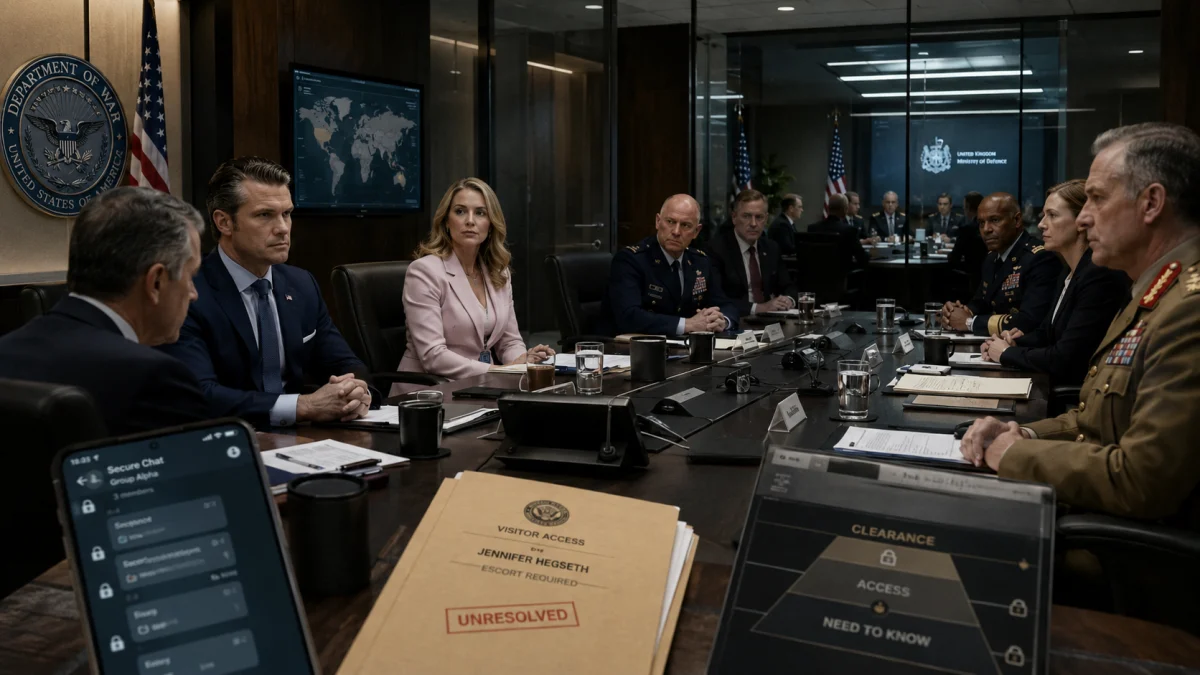
Jennifer Hegseth has occupied an extraordinarily influential position around her husband’s Pentagon operation. She attended high-level meetings with foreign defense officials while holding no publicly disclosed Pentagon position at the time. She was included in a private Signal group in which Pete Hegseth reportedly distributed advance details of an imminent U.S. military operation. The Pentagon has never publicly established whether she possessed the relevant security clearance. More importantly, even a clearance would not automatically establish that she had a legitimate need to know the information involved.
And there is now evidence that her presence had a real-world effect on allied communications.
Recent reporting says British officials discussing sensitive Ukraine matters deliberately kept their comments general while Jennifer Hegseth was in the room because her presence made them uneasy, then discussed the matter in greater detail after she left. The Pentagon says she was present only for introductions and was gone before classified information was discussed. Those accounts are not necessarily contradictory: the reason classified details were withheld while she was there may have been precisely because the British did not know whether she was supposed to hear them.
That is not evidence of espionage.
It is evidence of a national-security arrangement unusual enough that foreign allies reportedly changed their behavior because of it.
There is an important difference.
What is actually established?
The available evidence falls into three very different categories.
| Question | Current evidence |
|---|---|
| Did Jennifer Hegseth attend high-level foreign-defense meetings? | Yes. Verified. |
| Was she part of Pete Hegseth’s private “Defense Team Huddle” Signal group? | Yes. Reported by multiple outlets and acknowledged in a Pentagon inspector general investigation. |
| Were advance military-operation details reportedly sent to that group? | Yes. Multiple independent reports say they were. A Pentagon official also told investigators the same sensitive operational information was posted there, although investigators could not independently verify the messages. |
| Did investigators get access to Pete Hegseth’s personal phone to verify that chat? | No. His office did not provide the phone. |
| Did Jennifer Hegseth have a security clearance at the relevant time? | Publicly unresolved. She reportedly applied for one; the Pentagon has declined to disclose whether she received it. |
| Did she necessarily have a “need to know” sensitive military information even if cleared? | Not established publicly. |
| Did foreign officials become uncomfortable because she was present? | Yes, according to recent reporting concerning British officials. |
| Is Jennifer Hegseth currently in an official government-associated role? | Yes. Since August 2026 she chairs the President’s Military Spouse Commission. |
| Is there credible evidence she works for a foreign intelligence service? | No public evidence reviewed by SHERAFY establishes that. |
That last point matters.
But it does not erase everything above it.
Why are people asking whether Jennifer Hegseth is a spy?
The theory appears to grow from a fairly understandable observation.
Jennifer Hegseth has repeatedly appeared in environments where an ordinary political spouse would not normally be expected to play a substantive role.
This has not been limited to accompanying her husband to speeches, state dinners, ceremonies or military-family events.
The Wall Street Journal reported in March 2025 that she attended at least two significant meetings involving foreign defense officials.
One occurred at the Pentagon on March 6, 2025, between Pete Hegseth, British Defense Secretary John Healey and other senior British officials. It happened one day after the United States suspended military intelligence sharing with Ukraine.
Another occurred in Brussels during a meeting of the Ukraine Defense Contact Group, where roughly 50 countries coordinate military assistance to Ukraine and where governments can discuss information they do not intend to make public.
Some foreign participants reportedly did not initially know who Jennifer Hegseth was. Others were surprised to see her there.
That is unusual enough by itself to justify asking why she was present.
But unusual access does not automatically mean espionage.
A person can have inappropriate access because of nepotism, personal trust, weak institutional controls, favoritism, incompetence, an unusually dependent relationship with a senior official—or espionage.
Those possibilities should not be collapsed into one.
The evidence has to tell us which explanation fits best.
So far, it strongly supports unusual and poorly explained access.
It does not currently establish a foreign-intelligence relationship.
The British meeting is more troubling than it first appeared
The March 2025 British meeting deserves particular attention because more information has since emerged about what happened.
British officials were dealing with an unusually delicate situation. The United States had suspended intelligence sharing with Ukraine, creating potential consequences not merely for Ukrainian forces but for British personnel operating there.
According to recent reporting based on a New York Times investigation, British officials wanted to discuss risks involving their personnel and U.S. intelligence support.
But while Jennifer Hegseth was present, they reportedly spoke only in general terms because her presence made them uneasy.
A more detailed discussion occurred after she was gone.
The Pentagon has defended the arrangement by saying Jennifer was present for introductions but left before sensitive or classified information was discussed.
Taken literally, that may be true.
But it does not dispose of the concern.
Consider what apparently happened:
Foreign defense officials entered a meeting with the U.S. defense secretary, noticed someone whose authorization was unclear, adjusted what they were willing to disclose, and waited until that person was gone before discussing the most sensitive material.
That is itself a security consequence.
The important question is not merely whether Jennifer heard the information.
It is why America’s ally apparently had to make a judgment about whether it was safe to say it in front of her.
The second Signal chat makes the story much harder to dismiss
Then there is Defense Team Huddle.
In April 2025, the New York Times reported that Pete Hegseth had created a second Signal group containing roughly a dozen people from his personal and professional circle.
Participants reportedly included Jennifer Hegseth, his brother Phil Hegseth and his personal lawyer Tim Parlatore.
The Associated Press independently confirmed the existence and membership of the chat through a person familiar with its contents. Reuters separately reported that Pete Hegseth sent the group details of the March 15 U.S. strikes against Houthi targets in Yemen, including the strike schedule. ABC News reported that the information included flight schedules for the F/A-18 aircraft involved in the operation.
Jennifer Hegseth was not then a Defense Department employee.
This matters because the information was not something innocuous like a press release scheduled for the following morning.
According to the reporting, the group received details about an imminent American military attack before it occurred.
If an unauthorized person receives the departure and attack schedule of American combat aircraft before bombs begin falling, the security question does not become meaningless simply because an official later disputes whether someone had formally stamped the information “classified.”
And subsequent government findings make that distinction particularly important.
The Pentagon inspector general found something important
The Department of Defense inspector general eventually investigated Pete Hegseth’s use of Signal.
Its December 2025 report dealt primarily with the separate Signal conversation that accidentally included Atlantic editor Jeffrey Goldberg.
That investigation produced a significant finding.
U.S. Central Command had sent Hegseth information marked SECRET//NOFORN concerning the timing and means of the March 15 strikes.
The inspector general compared that material with what Hegseth subsequently transmitted through Signal and concluded that some information he sent matched operational information CENTCOM had classified SECRET//NOFORN.
Hegseth argued that, as the Pentagon’s senior original classification authority, he had authority to determine that the information he distributed no longer required classification and that he had created an unclassified summary.
The inspector general nevertheless concluded that Hegseth transmitted sensitive, nonpublic operational information through Signal on his personal phone and violated Department policy governing personal devices and nonapproved messaging applications.
The report went further.
It stated that Hegseth transmitted information identifying quantities and strike times of manned American aircraft over hostile territory roughly two to four hours before the operation and that doing so created a risk of compromise that could have harmed U.S. personnel and mission objectives.
That finding is important because it exposes the weakness of reducing the entire controversy to one word:
classified.
Even accepting Hegseth’s contention that he possessed the authority to change the formal classification status, the Pentagon’s own inspector general found that the operational information remained sensitive, nonpublic and dangerous to transmit through the system he used.
“No classified information was shared” therefore does not mean “nothing sensitive happened.”
The government’s own investigation rejected that broader implication.
And investigators specifically looked at the chat containing Jennifer
This is where the story becomes particularly interesting.
The inspector general’s report contains an appendix addressing additional Signal groups used by Hegseth.
Investigators interviewed officials who said Hegseth conducted official Defense Department business using several Signal chats on his personal phone.
One official specifically identified “Defense Team Huddle.”
The inspector general wrote that this group included non-Defense Department personnel.
Even more significantly, another official told investigators that Hegseth had posted the same sensitive operational information concerning the Houthi attack plans into Defense Team Huddle.
That was sufficiently serious that investigators requested the messages from the additional Signal groups and requested access to Hegseth’s personal phone.
They did not get it.
The report states:
“A senior official in the Secretary’s office stated that the Secretary would not provide access to his personal cell phone.”
As a consequence, the inspector general said it was unable to verify whether the additional Signal chats contained sensitive, classified or other nonpublic Defense Department information.
That distinction deserves emphasis.
The inspector general did not determine that the allegation about Defense Team Huddle was false.
It could not determine what was in the chat because investigators were not given the device needed to independently verify it.
That is precisely the kind of situation where “there is no conclusive finding” should not be transformed into “the allegation was disproven.”
It wasn’t.
The investigation hit an evidentiary wall.
Does Jennifer Hegseth have a security clearance?
The public still does not have a clear answer.
CNN reported in April 2025 that Jennifer Hegseth had submitted paperwork seeking a security clearance. When CNN asked whether one had been granted, the Pentagon said it does not discuss individual security clearances.
More than a year later, reporting surrounding her expanding Pentagon role still states that the department has not publicly disclosed whether she has one.
There are legitimate reasons governments do not routinely publish every detail of individual clearance adjudications.
But that does not make the underlying authorization question irrelevant.
And even discovering tomorrow that Jennifer Hegseth possesses a Top Secret clearance would not answer the most important question.
A security clearance does not give someone unlimited access
This point is routinely lost in discussions about classified information.
Under Executive Order 13526, a person generally may access classified information only when three conditions are satisfied:
- The government has determined that the person is eligible for access.
- The person has signed an appropriate nondisclosure agreement.
- The person has a need to know the specific information.
The third requirement is crucial.
A Top Secret clearance is not a backstage pass allowing someone to wander through the national-security apparatus and hear anything classified below that level.
Someone can hold an extremely high clearance and still be prohibited from accessing a particular operation because the information has nothing to do with that person’s responsibilities.
So even if Jennifer Hegseth possessed an appropriate clearance, another question remains:
What official responsibility required Pete Hegseth’s spouse to know the launch schedule of an imminent U.S. bombing operation?
Likewise:
What governmental function required her presence during discussions between the U.S. defense secretary and foreign military leaders about Ukraine?
Those are not partisan questions.
They are the basic questions a functioning compartmentalized security system is designed to answer.
Her role went far beyond being a supportive political spouse
Another weak response to the controversy is that senior officials frequently consult their spouses.
Of course they do.
Presidents, cabinet secretaries, governors and members of Congress routinely rely on spouses for emotional support, political advice and personal judgment.
That is not what makes Jennifer Hegseth’s situation unusual.
The Washington Post reported in April 2025 that she was involved in coordinating her husband’s media appearances, communicating instructions to Pentagon personnel and participating in discussions involving potential political appointees despite then having no formal administration role.
More recent reporting describes that role as having grown considerably.
According to a New York Times investigation based on interviews with approximately 20 current and former officials and people close to Jennifer Hegseth, she has acted as her husband’s most influential adviser and de facto producer—preparing him for appearances, sitting in meetings with journalists, interviewing prospective personnel and helping shape Defense Department media strategy.
Reporting also indicates that she pushed for a more aggressive posture toward Pentagon journalists, including restricting reporters she believed had covered her husband unfairly.
Whether one agrees with those decisions is secondary.
The institutional issue is that a family member appears to have exercised significant influence inside one of the most sensitive departments of the U.S. government without the normal visibility that accompanies a Senate-confirmed official, political appointee or career employee.
That creates an accountability problem even if every decision she influenced was perfectly lawful.
Jennifer Hegseth now does have an official role—but it doesn’t explain the earlier access
There has been an important change.
On August 3, 2026, President Donald Trump signed an executive order establishing the President’s Military Spouse Commission.
Under the order, the spouse of the Secretary of War automatically serves as chair. Jennifer Hegseth therefore currently chairs the commission.
That is now an official government-associated responsibility.
But look at the commission’s actual mandate.
It concerns issues affecting military families, including:
- housing;
- employment;
- health care;
- education;
- child care;
- deployment-related family support.
Nothing in the executive order gives the commission responsibility for military targeting, intelligence operations, Ukraine policy, NATO defense planning or classified war plans.
And the position was created in August 2026.
It cannot retroactively explain why Jennifer Hegseth was receiving reported strike information or attending sensitive foreign-defense meetings in early 2025.
Those are separate questions.
So is Jennifer Hegseth actually a spy?
Based on the evidence publicly available today, that conclusion goes beyond the evidence.
Espionage normally requires something more than access.
Investigators would look for evidence such as:
- an undisclosed relationship with a foreign government or intelligence service;
- clandestine communications with foreign handlers;
- unexplained foreign payments or benefits;
- deliberate collection of information unrelated to legitimate duties;
- attempts to circumvent security systems;
- covert transmission of protected information;
- instructions or tasking from a foreign actor;
- deceptive statements intended to conceal a foreign relationship.
SHERAFY found no credible public evidence currently establishing those things about Jennifer Hegseth.
Her access appears, based on everything presently known, to originate primarily from one person:
her husband.
That makes the available evidence fit a different hypothesis substantially better: Pete Hegseth has blurred the boundary between his personal circle and his official national-security apparatus to an extraordinary degree.
That explanation is less cinematic than espionage.
It is not necessarily less concerning.
“No proof she’s a spy” is not the end of the analysis
There are two equally bad ways to analyze a story like this.
The first is conspiratorial:
She was in sensitive meetings, therefore she must be a spy.
The evidence does not support that conclusion.
The second is institutional reflex:
Nobody has produced proof that she is a spy, therefore there is nothing suspicious here.
The evidence does not support that conclusion either.
A lack of evidence proving the most extreme hypothesis does not magically erase evidence supporting lesser—and still serious—conclusions.
We can establish quite a lot without knowing whether Jennifer Hegseth has ever spoken to a foreign intelligence officer in her life.
We know her husband brought her unusually close to official Pentagon operations.
We know she attended meetings involving foreign military officials.
We know foreign participants were reportedly surprised or uneasy about her presence.
We know reporting from several independent news organizations places her in a Signal group that received advance details of a U.S. military attack.
We know a Pentagon official told the inspector general that the same sensitive Houthi operational information was posted to that group.
We know investigators attempted to obtain evidence needed to verify that claim.
We know Hegseth’s office did not provide investigators access to his personal phone.
We know the Pentagon has not publicly resolved whether Jennifer possessed the relevant clearance.
And we know the law and executive rules governing classified material require more than merely having a clearance anyway: access must be connected to a need to know.
Those are facts.
None proves espionage.
Together they absolutely justify scrutiny.
The British reaction may be the clearest evidence that something was wrong
One detail deserves more attention than almost anything else in this story.
British officials reportedly changed what they were willing to tell the American Secretary of War because Jennifer Hegseth was sitting in the room.
Think about the institutional significance of that.
The United States maintains some of the closest intelligence and defense relationships in the world with Britain. Those relationships depend on confidence that sensitive information disclosed to an American counterpart will remain within an appropriately controlled circle.
If British officials were unwilling to speak freely in front of the American defense secretary’s spouse, the problem already existed regardless of whether she ever mishandled a single piece of information.
Security systems are not designed solely to catch spies.
They are designed to minimize unnecessary exposure in the first place.
A system that requires an ally to look around a room and independently decide who should and should not hear the conversation is a system whose internal boundaries have already become questionable.
The Pentagon’s defense deserves examination, not automatic acceptance
The Pentagon has repeatedly defended Jennifer Hegseth.
Officials have described her as an accomplished leader, trusted adviser and, most recently, a “force multiplier.” The department says she was not present when classified information was discussed in the British meeting and has disputed characterizations of the Signal controversy.
Those statements are relevant.
They are not independent evidence.
The Pentagon is the institution whose conduct is being questioned.
Its explanation should therefore be compared against outside reporting, documentary evidence, inspector-general findings and the behavior of foreign participants rather than accepted as the default truth simply because it comes from an official spokesperson.
And one part of the Pentagon’s defense may actually reinforce the larger concern.
In August 2026, a spokesperson said the Department of War intends to involve Jennifer Hegseth even more deeply in the future.
That makes clarity about the boundaries of her role more important, not less.
What would actually help settle the controversy?
The spy theory cannot responsibly be resolved by staring at photographs of Jennifer Hegseth sitting behind her husband.
Documents could answer many of the underlying questions.
The most useful records would include:
- the date on which Jennifer Hegseth received any security clearance, if she received one;
- the level and relevant scope of that clearance at the times of the 2025 incidents;
- documentation establishing her need to know information discussed in specific meetings;
- attendee lists and scheduling records for the March 6 British meeting;
- attendee records for the February 2025 Ukraine Defense Contact Group meeting;
- records showing when she entered and left those meetings;
- records establishing who authorized her participation;
- retained copies or forensic records of the Defense Team Huddle Signal conversation;
- documentation concerning any security review of her inclusion in that group;
- internal communications concerning foreign officials’ objections or discomfort;
- records defining Jennifer Hegseth’s advisory responsibilities before the creation of the Military Spouse Commission.
There has already been an effort to obtain some of this material.
American Oversight filed a Freedom of Information Act request seeking Pete Hegseth’s communications with Jennifer Hegseth, his brother Philip and Tim Parlatore, including Signal messages and calendar records showing meetings attended by them.
Those kinds of records matter far more than partisan assurances from either side.
The strongest conclusion the evidence currently supports
There is not enough public evidence to call Jennifer Hegseth a spy.
There is more than enough evidence to say that something highly unusual has occurred around her access to the Pentagon and her husband’s handling of sensitive national-security information.
The distinction matters because responsible skepticism does not require choosing between blind trust and the most explosive imaginable accusation.
The evidence currently supports a narrower but substantial finding:
Pete Hegseth appears to have integrated his wife into his official national-security world to a degree that blurred ordinary boundaries between family, political advice and government business. That arrangement extended close enough to sensitive military information that foreign allies reportedly altered what they would discuss, and close enough to an impending U.S. military operation that Jennifer was reportedly included in a Signal group receiving strike details.
Whether that reflects extraordinary favoritism, poor security discipline, dependence on a trusted spouse, deliberate circumvention of normal Pentagon structures, or something more serious remains an open investigative question.
Espionage is one possible allegation people are now asking about.
It is not currently the conclusion supported by the public evidence.
But the appropriate response to that absence of proof is not to close the file.
It is to ask the government to explain the access.
Frequently Asked Questions
Does Pete Hegseth’s wife have a security clearance?
The Pentagon has not publicly confirmed her clearance status. CNN reported in April 2025 that Jennifer Hegseth had submitted paperwork seeking a security clearance, but it was unclear whether she ultimately received one. Current reporting continues to describe her clearance status as undisclosed.
Was Jennifer Hegseth sent military strike information?
Multiple news organizations reported that she was a member of the Defense Team Huddle Signal group in which Pete Hegseth distributed advance information concerning the March 15, 2025 strikes against Houthi targets in Yemen. ABC News reported that this included F/A-18 flight schedules.
The Pentagon inspector general later documented that an official had also alleged that Hegseth posted the same sensitive operational information to Defense Team Huddle. Investigators could not independently verify the contents because Hegseth’s office did not provide access to his personal phone.
Did the Pentagon inspector general say Jennifer Hegseth received classified information?
No.
That would overstate the report.
The inspector general established that some information Hegseth sent in the separate Houthi PC Small Group matched CENTCOM material classified SECRET//NOFORN.
For Defense Team Huddle—the group containing non-Defense personnel and reportedly Jennifer Hegseth—the inspector general documented an official’s allegation that Hegseth posted the same sensitive operational information, but investigators were unable to independently verify the messages.
That distinction is important.
Can Pete Hegseth bring his wife into Pentagon meetings?
A cabinet secretary has considerable discretion over whom to meet with, but that does not eliminate classified-information rules.
If classified material is involved, Executive Order 13526 requires eligibility for access, an appropriate nondisclosure agreement and a specific need to know the information.
Did British officials formally accuse Jennifer Hegseth of being a security threat?
There is no evidence reviewed by SHERAFY of a formal British accusation that Jennifer Hegseth was a spy or security threat.
What has been reported is narrower and more credible: British officials were uneasy about her presence and restricted the level of detail they discussed until she left.
Is Jennifer Hegseth a government official now?
She currently chairs the President’s Military Spouse Commission, created by executive order on August 3, 2026.
Its official responsibilities concern military-family issues such as housing, employment, health care, education and deployment support. The commission’s mandate does not provide an obvious national-security justification for her earlier involvement in military operational or foreign-defense matters.
Is there evidence Jennifer Hegseth works for Russia, China or another foreign government?
No credible public evidence reviewed for this article establishes that Jennifer Hegseth works for any foreign intelligence service or government.
Her unusual access warrants investigation.
Calling her a foreign agent without additional evidence would go beyond what is currently known.
References and Further Reading
Primary and Government Sources
Department of Defense Inspector General — Evaluation of the Secretary of Defense’s Reported Use of a Commercially Available Messaging Application for Official Business The December 2025 inspector-general investigation into Hegseth’s Signal use. Especially significant are its findings concerning SECRET//NOFORN source material, operational information transmitted through Signal, Defense Team Huddle and investigators’ inability to obtain Hegseth’s personal phone.
GovInfo — Executive Order 13526, Classified National Security Information The governing executive order explaining that classified access requires eligibility, a nondisclosure agreement and a need to know.
White House — Executive Order Establishing the President’s Military Spouse Commission Primary source establishing Jennifer Hegseth’s current role and the commission’s actual responsibilities.
White House — President’s Military Spouse Commission Official commission page identifying Jennifer Hegseth as chairwoman and describing its mission.
American Oversight — FOIA Request for Hegseth Communications, Signal Messages and Calendars Shows the records being sought concerning Jennifer Hegseth, Philip Hegseth and Tim Parlatore.
Reporting on Pentagon Meetings and Jennifer Hegseth’s Role
The Wall Street Journal — Hegseth Brought His Wife to Sensitive Meetings With Foreign Military Officials The initial major report documenting Jennifer Hegseth’s participation in the British and NATO-related meetings.
The Washington Post — Jennifer Hegseth Holds Unorthodox Role Shaping Pentagon Affairs Detailed reporting on her early involvement in Pentagon communications, staffing and media activity despite having no formal role at the time.
CNN — Prominent Role of Pete Hegseth’s Wife at Pentagon Draws Scrutiny Includes reporting that Jennifer Hegseth applied for a security clearance and describes her participation in foreign-defense meetings.
Recent Reporting on Jennifer Hegseth’s Influence and the British Meeting Summarizes the August 2026 reporting that British officials kept their discussion general while Jennifer Hegseth was present and addressed her expanded influence over Pentagon personnel and media policy.
Reporting on Defense Team Huddle
Associated Press/PBS NewsHour — Hegseth Had a Second Signal Chat Where He Shared Details of Yemen Strike Independent confirmation of the additional Signal group containing Jennifer Hegseth.
Reuters — Hegseth Shared Sensitive Yemen War Plans in Second Signal Chat Reuters reporting that the group received strike-schedule information.
ABC News — Second Signal Chat Reveals Hegseth Messaging About Yemen Strikes With Family Members Reports that information sent to the chat included F/A-18 flight schedules for the pending attack.
Editorial currency note: This article reflects information publicly available as of August 21, 2026. Jennifer Hegseth’s security-clearance status, the release of additional Signal records, congressional investigations, inspector-general findings or new documentation concerning her Pentagon activities could materially change the analysis.