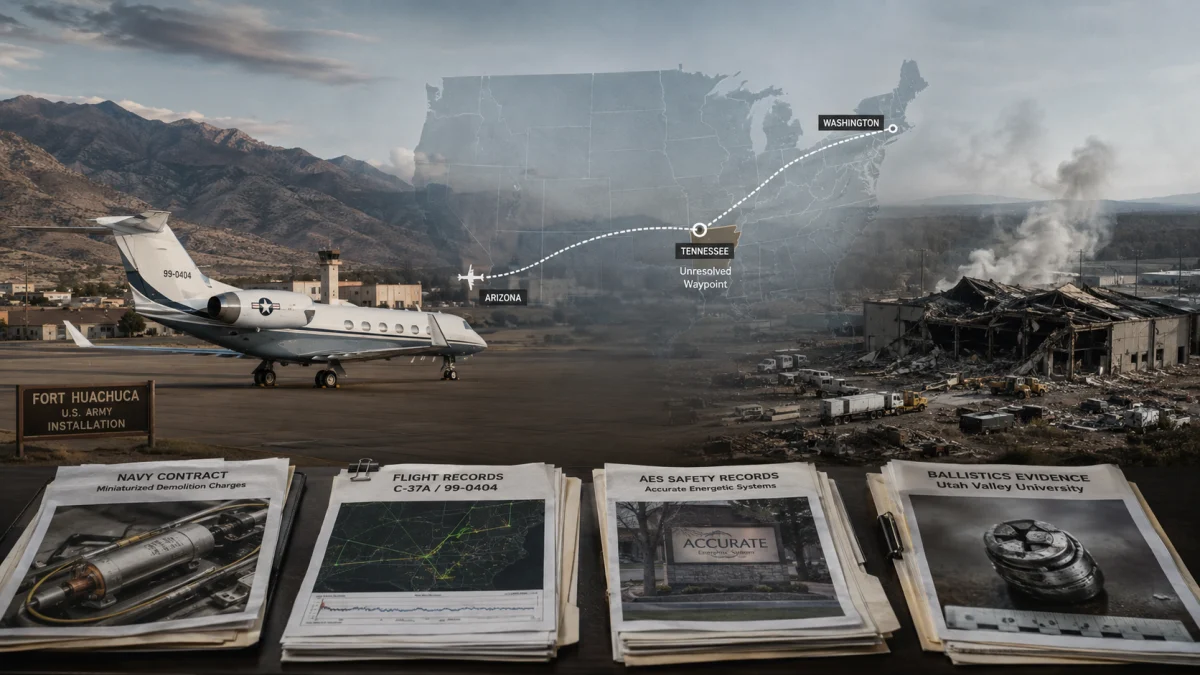
A remarkable amount of the underlying story circulating around U.S. Air Force tail number 99-0404, Fort Huachuca, Accurate Energetic Systems and Charlie Kirk is real.
That matters.
Tail number 99-0404 really is a U.S. Air Force C-37A executive transport aircraft. A flight-tracking archive really does identify it operating as SAM702 in southern Arizona on September 9, 2025. A senior Pentagon intelligence official really was at Fort Huachuca’s Libby Army Airfield that same day. Accurate Energetic Systems really did receive a $440,494 Navy purchase order whose description includes the striking words “MINIATURIZED-XS DEMOLITION CHARGES” and “ANTI PERSONNEL-XS.” AES really did suffer a catastrophic explosion exactly 30 days after Charlie Kirk was killed. And the ATF’s comparison of a bullet-jacket fragment recovered in the Kirk case to the alleged murder weapon really was inconclusive.
Those are not invented facts.
But neither are they proof of the much larger allegation being built around them.
Several critical steps in the viral narrative are either wrong, overstated or presently unsupported: a SAM flight is not something only the president or vice president can authorize; 99-0404 is not Pete Hegseth’s personal aircraft; public evidence places Hegseth at the Pentagon during important parts of both dates under discussion; the AES building that exploded was documented as producing commercial cast boosters that morning; and I could not independently verify from a neutral raw flight archive that 99-0404 made the claimed October 10 detour directly over AES.
The responsible conclusion is therefore neither “nothing to see here” nor “the conspiracy has been proven.”
There is enough here to justify serious scrutiny, records requests and additional reporting.
There is not enough here to accuse Pete Hegseth, Erika Kirk, Cabot Phillips, Accurate Energetic Systems, the Pentagon or anyone else of participating in Charlie Kirk’s killing or a subsequent cover-up.
Those are very different standards.
What is verified, disputed and still unknown
| Claim | Evidence status |
|---|---|
| 99-0404 is a USAF Gulfstream C-37A | Verified |
| 99-0404 operated as SAM702 in southern Arizona on September 9, 2025 | Verified |
| “SAM” means Special Air Mission | Verified |
| Only the president or vice president can authorize a SAM flight | False |
| 99-0404 is essentially Pete Hegseth’s personal plane | Unsupported / misleading |
| Pentagon intelligence chief Bradley Hansell was at Fort Huachuca on September 9 | Verified |
| Hegseth himself was aboard SAM702 that afternoon | Evidence weighs strongly against it |
| Erika Kirk and Cabot Phillips were at Fort Huachuca September 8 | Eyewitness allegation; independently unverified |
| AES received a $440,494 Navy order for “MINIATURIZED-XS” and “ANTI PERSONNEL-XS” demolition charges | Verified |
| That contract was awarded immediately before Kirk’s death | Misleading — award was April 22 |
| The contract’s performance period ended shortly before Kirk’s death | Verified — August 25, 16 days before |
| AES exploded October 30 | False — it exploded October 10 |
| AES exploded exactly 30 days after Kirk was killed | Verified |
| Every AES employee died | False — 16 workers in Building 602 died; AES employed far more people |
| Building 602 was making the Navy’s miniaturized charges when it exploded | Not established |
| 99-0404 deliberately detoured over AES after the blast | Not independently verified from raw flight data |
| Charlie Kirk’s public medical record identifies an exploding microphone as the cause of death | No |
| Court testimony says the medical examiner listed a gunshot wound to the neck as the immediate cause of death | Verified |
| ATF conclusively matched the recovered bullet fragment to the alleged rifle | No — the result was inconclusive |
That last distinction is important throughout this story.
Evidence can undermine one explanation without proving another one.
99-0404 is real. Calling it “Pete Hegseth’s plane” goes too far.
Tail 99-0404 is a U.S. Air Force Gulfstream C-37A, the military version of the Gulfstream V.
These aircraft exist specifically for senior-government transportation. The Air Force says C-37A/B aircraft transport the president, vice president, Cabinet officials, combatant commanders and other senior military and elected leaders. The fleet is tasked through the White House, Air Force chief of staff and Air Mobility Command.
That distinction immediately matters.
There is nothing unreasonable about asking who used 99-0404 on a particular date. Passenger identity could be enormously important.
But the aircraft itself is not Hegseth’s private jet.
Nor have I found evidence supporting the stronger claim that he “almost exclusively” uses it.
There is direct evidence to the contrary. On October 15, 2025—only five days after the AES explosion—Hegseth was returning from a NATO defense-ministerial aboard an Air Force C-32A, tail 98-0002, when a cracked windshield forced an emergency diversion to RAF Mildenhall.
The distinction may sound technical, but it changes the logic considerably.
If a government aircraft associated with Hegseth appears somewhere, that does not establish Hegseth’s presence unless there is evidence showing he was actually aboard.
SAM702 does not mean Trump or Vance ordered the flight
Another major pillar of the viral argument fails when checked against aviation rules.
SAM does mean Special Air Mission.
But the claim that only the president or vice president can authorize such a mission is false.
FAA guidance lists “S — Special Air Mission (SAM)” as a military mission designation. The same guidance separately identifies special call signs for aircraft actually carrying the president or vice president, including Air Force One and Air Force Two.
The Air Force itself states that C-37 aircraft transport not just the president and vice president but Cabinet members, combatant commanders and other senior leaders, with tasking coming from multiple authorities.
So a SAM call sign tells us something important:
This was a special government airlift mission.
It does not tell us:
Donald Trump or JD Vance personally ordered this particular flight.
Nor does the call sign identify its passenger.
Anyone claiming otherwise is extracting more information from “SAM” than the designation actually contains.
What really happened at Fort Huachuca on September 9
This is where the story becomes genuinely interesting.
AirNav Radar retains a historical record identifying SAM702 on September 9, 2025 as tail 99-0404, C-37A, Mode-S identifier AE04F9. The aircraft was first detected near Tucson and is recorded landing at Eloy, Arizona, at 12:03 p.m. Mountain Standard Time.
That independently establishes the aircraft in southern Arizona.
What the surviving AirNav page does not establish is every leg of the much longer itinerary now circulating online. Claims about the aircraft flying Andrews → Colorado Springs → Tucson → Fort Huachuca → El Paso require additional historical tracking data that is not contained in that record.
But something else is independently documented.
On September 9, Bradley Hansell—the Pentagon’s Under Secretary for Intelligence and Security—was physically present at Libby Army Airfield at Fort Huachuca.
Official military photographs show Hansell preparing to board an Army UH-60 Black Hawk with Joint Task Force–Southern Border leadership. Other images document his visit with senior military and Customs and Border Protection officials.
That is significant.
The same approximate place and date attracting suspicion because of a government VIP aircraft also hosted a publicly documented visit by one of the Pentagon’s highest-ranking intelligence officials.
There are two ways to abuse that fact.
One is to say:
“There was a senior intelligence official there, therefore something sinister happened.”
That is not evidence.
The other is to say:
“There was an official visit, therefore there is nothing worth investigating.”
That is not evidence either.
What Hansell’s presence does provide is an obvious, non-mysterious reason why special executive airlift might have been operating around Fort Huachuca.
It does not, by itself, prove Hansell was the passenger on 99-0404.
A passenger manifest or contemporaneous movement record would settle that far more effectively than speculation in either direction.
Pete Hegseth appears to have been somewhere else
There is an additional problem with describing SAM702 as though Hegseth himself were aboard.
At almost exactly the time AirNav records 99-0404 landing in Arizona, Hegseth was conducting a publicly documented meeting at the Pentagon.
The Defense Department’s own September 9 transcript records Hegseth welcoming Singapore’s defense minister, Chan Chun Sing, to the Pentagon.
That meeting had been publicly scheduled for 3 p.m. Eastern.
The AirNav landing time—12:03 p.m. MST—corresponds to approximately 3:03 p.m. Eastern.
Unless one of those records is materially wrong, Hegseth could not have been stepping off 99-0404 in Arizona while simultaneously hosting an open-press diplomatic meeting in Washington.
That is not “trust the Pentagon.”
It is simply chronology.
If someone has evidence showing the Pentagon event was prerecorded, incorrectly timestamped or otherwise not what the public record indicates, that evidence should be produced.
Absent such evidence, the rational conclusion is that 99-0404’s presence does not establish Hegseth’s presence.
What about the alleged Erika Kirk and Cabot Phillips sighting?
A separate allegation comes from Mitch Snow, who has said he saw people he identified as Erika Kirk and Cabot Phillips at Fort Huachuca on September 8, before Charlie Kirk’s September 10 killing.
That allegation should be reported for what it currently is:
an eyewitness identification.
I found no independent primary record placing Erika Kirk or Cabot Phillips at Fort Huachuca that day.
No publicly located visitor log, flight manifest, photograph or contemporaneous military document I reviewed independently confirms those identities.
There is also a chronology problem with combining Snow’s allegation and SAM702 into a single “same-day” event.
Snow’s claimed sighting is September 8.
The independently indexed AirNav SAM702 record is September 9.
It remains possible that additional unindexed flight legs exist. But the record presently available does not support collapsing those dates into one event.
That doesn’t prove Snow is wrong.
It means the identification remains uncorroborated.
Given the seriousness of what people are attempting to infer from it, corroboration matters.
The $440,494 AES explosives contract is absolutely real
The Accurate Energetic Systems portion of the story should not be casually dismissed.
Navy purchase order N0016425PJ538 is real.
It was awarded to Accurate Energetic Systems on April 22, 2025, with $440,494 in obligations.
And its actual procurement description reads:
“REQUIREMENT IS FOR MINIATURIZED-XS DEMOLITION CHARGES AND DEMOLITION CHARGES, ANTI PERSONNEL-XS TO SUPPORT SPM.”
That wording is not a social-media invention.
But some important corrections are necessary.
First, describing these as “micro-explosives” is a paraphrase. The federal record says “MINIATURIZED-XS.”
Maybe those concepts ultimately overlap technically; maybe they do not. Without the underlying specifications, it is irresponsible to silently convert procurement nomenclature into a particular alleged covert device.
Second, the order was not “placed just ahead of Charlie Kirk’s death.”
It was awarded April 22—almost five months before Kirk was killed on September 10.
What is close is the performance timeline.
The listed completion date was August 25, 2025, only 16 days before Kirk’s death.
That is worth noting.
But a contract performance end date is not the same thing as evidence that a particular explosive device was delivered on August 25, transferred to a particular recipient and later used in a crime.
To establish that chain, we would want receiving reports, acceptance documentation, shipment records, item specifications, lot numbers or equivalent procurement records.
I have not located those records publicly.
AES was not an obscure civilian company that suddenly received one strange Pentagon order
Context is especially important here because stripping it away makes the $440,494 order look much more exceptional than it actually was.
AES was already deeply involved in federal explosives manufacturing.
Federal-award databases show contracts for small and large anti-personnel demolition charges, TNT demolition blocks, mine components, cast TNT charges and other explosive products.
One Navy purchase order, N0016425PJ509, was for “DEMOLITION CHARGES, AP, SMALL/LARGE” at $105,369. Its listed performance completion date was, remarkably, October 10, 2025—the day AES exploded.
That date is genuinely interesting.
But again: a scheduled contract end date is an administrative field, not evidence that an action connected to Kirk occurred that day.
There is another overlooked contract.
On September 17, 2025, seven days after Kirk was killed, AES received a separate $156,721 Navy order described as:
“SPM ORDNANCE SYSTEMS MPI ASSEMBLIES TO SUPPORT A DIRECT AND IMMEDIATE WARFIGHTER CAPABILITY REQUIREMENT FOR EXPLOSIVE CHARGES TO BE UTILIZED IN DEMOLITION APPLICATIONS.”
And six days later, another federal record shows a $7.35 million Army delivery order to AES for TNT demolition blocks.
Why does that matter?
Because it cuts in two directions.
It confirms AES was an important military explosives supplier—something worthy of scrutiny when discussing a mysterious explosives-related allegation.
But it also undermines any narrative treating the $440,494 order as though the Pentagon inexplicably approached a random commercial blasting company for one secret miniature weapon.
Military explosives were part of AES’s normal business.
AES exploded exactly 30 days after Charlie Kirk was killed
Here the viral chronology is actually more striking once it is corrected.
AES did not explode October 30.
It exploded on October 10, 2025.
Charlie Kirk was killed on September 10, 2025.
That is exactly 30 days.
At approximately 7:47 a.m., multiple catastrophic explosions tore through AES Building 602 near McEwen, Tennessee. Sixteen workers inside the building were killed and seven people nearby were injured. Roughly 24,600 pounds of explosive material were present, according to the Chemical Safety Board; approximately 23,000 pounds detonated, deflagrated or burned.
The explosion was enormous.
Debris traveled more than 700 feet. The blast was reportedly felt more than 20 miles away and registered as a magnitude-1.6 seismic event.
But several viral descriptions are wrong.
AES is not in eastern Tennessee. It is in Middle Tennessee, west of Nashville.
And “every employee at AES died” is false.
Sixteen employees working in Building 602 died. The company employed many more people across a larger facility.
None of those corrections make the catastrophe less extraordinary.
They simply make the story accurate.
What was Building 602 actually producing?
This may be the most important missing link in claims connecting the Navy contract to the AES explosion.
The Chemical Safety Board says that on October 10, employees in Building 602 were manufacturing commercial cast boosters.
Workers used a melt-pour process to combine explosives in steam-heated kettles and hand-pour the material into tubes. The boosters were intended to initiate larger explosions in industrial blasting applications.
CSB says employees that morning were pouring 14-ounce and 11-pound cast boosters.
That does not sound like the miniature anti-personnel device people are imagining when they read the Navy’s “MINIATURIZED-XS” terminology.
More importantly, I found no public record establishing that Building 602 was the building that manufactured items under Navy contract N0016425PJ538.
Could AES have manufactured those items elsewhere on the property?
Certainly.
Could contract-related material have been present in Building 602 for some reason not yet publicly documented?
Also possible.
But neither proposition has been established.
This is exactly the kind of evidentiary gap that cannot be bridged with intuition alone.
If someone claims the destroyed building contained the evidence connecting AES to Kirk’s death, the first question should be simple:
What record places that product in that building?
Until there is an answer, the connection remains speculative.
The AES safety record cannot simply be waved away
People skeptical of official narratives should be just as skeptical when a preferred theory ignores inconvenient evidence.
There is a major inconvenient fact here.
After a six-month investigation, Tennessee OSHA issued AES 100 safety citations carrying a record $3.13 million proposed penalty.
The breakdown was extraordinary:
- 59 willful violations
- 32 serious violations
- 4 repeat-serious violations
- 5 other-than-serious violations
TOSHA defines a willful violation as intentional disregard of safety requirements or plain indifference to worker safety. The agency explicitly says this does not mean malicious intent.
AES formally contested the citations, and the federal OSHA database continues to list the case as open. They therefore should not be represented as finally adjudicated findings.
TOSHA also expressly says its role is to determine safety violations—not to determine the cause of the explosion or legal fault.
That distinction matters.
But so does the scale of the allegations.
Meanwhile, the CSB says Building 602 lacked a sprinkler or deluge system and contained enormous quantities of high explosives capable of detonating under sufficient heat, friction, impact or shock. Its investigation remains ongoing and has not yet determined the initiating cause.
A fair evidence assessment therefore cannot say:
“Investigators have proved it was an ordinary industrial accident.”
They have not.
But it also cannot say:
“The timing proves the plant was intentionally destroyed to eliminate evidence.”
There is already a substantial documented industrial-safety pathway that could explain a catastrophic explosion without sabotage.
Whether that is ultimately what happened remains under investigation.
October 10 at Fort Huachuca was not an ordinary day either
Now return to 99-0404.
The viral account says the aircraft left Andrews, went to Fort Huachuca and then made its alleged Tennessee deviation after AES exploded.
There is an important piece of context rarely included.
On October 10, Fort Huachuca hosted a major preplanned military ceremony.
Joint Task Force–Southern Border formally transferred authority from 10th Mountain Division Headquarters to the 101st Airborne Division Headquarters at Libby Army Airfield.
The commander of U.S. Northern Command and NORAD, Gen. Gregory Guillot, personally presided.
This was not a minor local event.
The task force was conducting border operations involving command-and-control, intelligence, surveillance and reconnaissance capabilities across the U.S.-Mexico border.
A gathering involving NORTHCOM’s four-star commander and multiple division-level leaders is precisely the kind of event capable of generating executive military airlift.
Again, that does not prove why 99-0404 specifically was there.
But it eliminates another false premise: that an executive aircraft had no obvious reason to visit Fort Huachuca that day.
There was an obvious reason.
Hegseth was also documented at the Pentagon on October 10
The October 10 record presents the same problem for anyone casually referring to 99-0404’s alleged movements as Hegseth’s movements.
Official military photography documents Hegseth hosting Qatari Defense Minister Saoud bin Abdulrahman Al Thani at the Pentagon on October 10.
Unlike the September 9 case, I do not have sufficiently precise times for both the alleged aircraft movements and the Pentagon meeting to declare that Hegseth physically could not have been on any segment of a flight that day.
So I won’t.
But the burden remains on anyone claiming he was aboard.
A tail number is not a passenger manifest.
Did 99-0404 actually detour over AES after the explosion?
This is the most consequential unresolved aviation question I found.
Multiple online presentations of the theory show or describe an October 10 track in which 99-0404—sometimes identified under the call sign SAM112—travels from Arizona toward Joint Base Andrews and allegedly alters its route, altitude or speed in Tennessee near the AES facility after the explosion.
If the underlying ADS-B data shows that accurately, it deserves serious scrutiny.
But there is a problem.
I could not independently reproduce that complete October 10 track from a neutral publicly accessible historical ADS-B archive.
Current searchable pages confirm tail 99-0404 and its Mode-S identifier AE04F9, but the historical data needed to independently calculate the alleged Tennessee pass are no longer openly exposed in the accessible interfaces I found.
That means I am not comfortable publishing:
“Hegseth’s plane flew directly over the AES explosion.”
as a verified statement.
Right now, the defensible wording is:
Online researchers have published flight-track claims alleging that 99-0404 passed near AES after the October 10 explosion, but SHERAFY has not independently reconstructed the raw historical ADS-B track sufficiently to verify the claimed detour, closest approach, altitude change or timing.
That is not a minor technicality.
It is the central aviation claim.
And it is testable.
The evidence we need is not someone’s screenshot with arrows drawn on it. It is the historical position dataset for AE04F9 on October 10: latitude, longitude, altitude, ground speed and timestamps.
From that, we can calculate:
- the aircraft’s closest approach to the AES facility;
- whether it meaningfully deviated from its normal Arizona-to-Washington route;
- whether it descended or slowed abnormally;
- precisely when that occurred relative to the 7:47 a.m. Central explosion; and
- whether the same routing can be explained by ordinary air-traffic-control constraints.
Until that is done, people on both sides are getting ahead of the evidence.
Simply passing through Tennessee on a flight from southeastern Arizona to Maryland would not itself be remarkable.
A sharp course change, unexplained descent and deliberate close pass occurring after the explosion would be another matter entirely.
That is why obtaining the raw track should be a priority.
What does the Charlie Kirk forensic record actually say?
The theory becomes still more consequential when it proposes that Kirk was not killed by the rifle alleged by prosecutors, but by an explosive device concealed in or near his lavalier microphone.
There is one legitimate weakness in the publicly presented rifle evidence that should not be buried.
At Tyler Robinson’s July 2026 preliminary hearing, an ATF firearms examiner testified about the comparison between the recovered rifle and a damaged bullet-jacket fragment.
Her conclusion was:
“The result of the comparison was inconclusive.”
More specifically, the fragment could neither be identified nor excluded as having been fired from the recovered rifle.
That is not the same as a positive ballistic match.
Anyone reporting that the recovered projectile was conclusively matched to the government’s rifle is overstating the public evidence.
But an inconclusive comparison is also not evidence that the microphone exploded.
Those propositions are logically separate.
The same preliminary hearing produced testimony about the medical examiner’s report. After a correction in court, the investigator testified that the report classified the manner of death as homicide and listed the immediate cause as:
“A gunshot wound of the neck.”
The full autopsy report has not been publicly available in the material I reviewed, so this is testimony describing the report rather than SHERAFY independently reading the underlying autopsy document.
That limitation should be acknowledged.
But it remains stronger evidence than visual speculation based on video.
I have not found public forensic documentation establishing explosive residue on Kirk’s microphone, detonator fragments in the wound, remnants of an explosive device or another physical finding demonstrating that an explosive microphone caused his fatal injury.
That doesn’t mean no undisclosed evidence could ever emerge.
It means the current public record does not establish the claim.
The criminal case is also not finished
Another reason not to speak with artificial certainty is that Tyler Robinson has not been convicted.
As of August 20, 2026, Robinson is charged with aggravated murder and other crimes, prosecutors are seeking the death penalty, and the judge is expected to decide whether the case proceeds to trial after further argument scheduled for September 1.
Prosecutors have presented additional evidence they say links Robinson to the weapon and other items through DNA and other evidence.
The defense has challenged elements of that forensic case.
A skeptical publication should not treat the prosecution’s theory as revealed truth simply because prosecutors said it in court.
But skepticism has to work both ways.
An unresolved criminal case does not create an evidentiary blank slate into which any alternative explanation can be inserted.
The correct position is narrower:
The state’s case contains evidence that deserves to be tested adversarially. Some forensic components are stronger than others. The rifle-fragment comparison was expressly inconclusive. None of that presently proves an explosive-microphone theory.
The 30-day coincidence deserves attention—but coincidence cannot carry the case
It would be silly to pretend the timing isn’t striking.
Kirk is killed September 10.
Exactly 30 days later, one of America’s military explosives contractors suffers a catastrophic explosion that destroys an entire production building and kills every worker inside it.
The company had completed a Navy contract whose description included “MINIATURIZED-XS” and “ANTI PERSONNEL-XS” demolition charges shortly before Kirk’s death.
A government VIP jet that had appeared around Fort Huachuca shortly before Kirk’s killing is alleged to have passed near the explosives plant on the day it exploded.
Those facts placed next to each other will understandably make people ask questions.
They should ask them.
But chronological proximity has limits.
The probability of an event cannot be assessed by counting coincidences while excluding competing facts.
AES was a high-volume explosives manufacturer.
Building 602 contained roughly 12 tons of high explosive material.
Tennessee regulators subsequently alleged extraordinary safety failures.
The destroyed building is documented as producing commercial cast boosters—not the miniature Navy charges central to the theory.
Fort Huachuca had independently documented senior military reasons for VIP aircraft traffic on both September 9 and October 10.
And there is no verified passenger manifest presently linking Hegseth to the disputed aircraft movements.
Those facts also belong in the probability calculation.
Why “there is an innocent explanation” does not end the investigation
There is an equally common reasoning error on the other side.
Once an official or conventional explanation can be imagined, some people treat that explanation as proven.
It isn’t.
A senior intelligence visit could explain a Special Air Mission aircraft around Fort Huachuca.
That does not prove which aircraft carried which official.
A NORTHCOM ceremony could explain executive airlift on October 10.
That does not tell us whether 99-0404 later made an unusual deviation.
Documented safety problems could explain how an explosives facility catastrophically failed.
That does not establish the initiating cause of the explosion.
A medical examiner describing a gunshot wound supports a gunshot mechanism.
That does not make every element of the prosecution’s ballistic reconstruction conclusive.
A rational evidentiary standard does not replace one leap with another.
The government does not receive a presumption that every unanswered question has a benign answer.
But critics do not receive a presumption that every unanswered question points toward a covert operation.
Unknown means unknown until evidence moves it.
The records that could answer most of this are straightforward
What is frustrating about this story is how much speculation could be eliminated with records that either exist or should exist somewhere in government or contractor archives.
The highest-value unresolved evidence is:
- the complete October 10 historical ADS-B/MLAT dataset for tail 99-0404 / hex AE04F9;
- passenger manifests and mission-tasking records for 99-0404 on September 8–9 and October 10;
- flight plans, dispatch records and diplomatic/executive airlift schedules associated with SAM702 and the alleged October 10 mission;
- visitor/access records relevant to the claimed September 8 Fort Huachuca meeting;
- receiving, acceptance and shipment records for Navy purchase order N0016425PJ538;
- technical specifications identifying exactly what “MINIATURIZED-XS” and “ANTI PERSONNEL-XS” mean in that procurement;
- records showing which AES building or production line manufactured the contracted items;
- the CSB’s eventual root-cause determination for the October 10 explosion; and
- the complete forensic documentation underlying Kirk’s autopsy and projectile analysis as it becomes part of the public court record.
None of those requests requires believing the theory first.
They require recognizing that records are better than assurances.
So what should a rational person conclude?
The strongest version of the viral theory is presently ahead of its evidence.
There is no public evidentiary chain showing that AES manufactured an explosive microphone used to kill Charlie Kirk, that the Pentagon ordered such a device for that purpose, that Pete Hegseth or the passengers aboard 99-0404 participated in the killing, or that AES was subsequently destroyed to erase evidence.
Those are enormous allegations. They require more than chronology and flight screenshots.
At the same time, dismissing the entire subject as “internet conspiracy nonsense” would also be intellectually lazy.
The Navy contract is real.
Its terminology is legitimately unusual to ordinary readers.
Its performance period ended shortly before Kirk’s killing.
AES exploded exactly 30 days afterward.
99-0404 really did operate as SAM702 in southern Arizona.
A top Pentagon intelligence official really was at Fort Huachuca during the same period.
The publicly disclosed rifle-fragment comparison really was inconclusive.
And the exact October 10 aircraft track—the part that could make the later flight either mundane or genuinely difficult to explain—is still not independently established in the public evidence reviewed here.
Those facts justify questions.
They do not justify convictions without evidence.
There is a useful principle here that applies well beyond this case:
Suspicion is not proof, but neither is a plausible institutional explanation proof that nothing improper happened.
The standard should remain the same regardless of which conclusion one prefers.
Show the records.
Reconstruct the chronology.
Test competing explanations against the same evidence.
Correct claims that are wrong even when they support your preferred theory.
And when an important fact remains unknown, resist the temptation to convert the blank space into certainty.
That is not deference to institutions.
It is what serious scrutiny looks like.
This article reflects records available through August 20, 2026. The CSB investigation into the AES explosion remains ongoing, Tennessee’s safety citations are being contested, and the criminal case against Tyler Robinson has not reached trial. Findings may change as additional records and testimony become public.
References and Further Reading
Aircraft, Special Air Missions and Fort Huachuca
- U.S. Air Force — C-37A/B Mission and Aircraft Fact Sheet — Primary Air Force description of who C-37 executive aircraft transport and how missions are tasked.
- FAA — Flight Plan Appendix B: U.S. Military Aircraft and Special Air Mission Designations — Primary FAA documentation distinguishing the SAM mission designation from presidential and vice-presidential aircraft identifiers.
- AirNav Radar — SAM702 / Tail 99-0404 Historical Flight Record — Historical tracking record identifying 99-0404 as SAM702 in southern Arizona on September 9, 2025.
- DVIDS — Bradley Hansell Visits JTF–Southern Border at Libby Army Airfield, September 9, 2025 — Official military photography independently confirming the senior Pentagon intelligence visit to Fort Huachuca.
- U.S. Northern Command — JTF–Southern Border Transfers Authority at Fort Huachuca on October 10, 2025 — Primary record documenting the major command event occurring at Libby Army Airfield the day AES exploded.
- Defense Department — Pete Hegseth Meets Singapore Defense Minister at the Pentagon, September 9, 2025 — Primary record relevant to whether Hegseth could have been aboard SAM702 in Arizona that afternoon.
- DVIDS — Pete Hegseth Hosts Qatar’s Defense Minister at the Pentagon, October 10, 2025 — Primary photographic record placing Hegseth in Washington on the day of the AES explosion.
- Air & Space Forces Magazine — Hegseth’s C-32A Makes Emergency Diversion, October 15, 2025 — Useful evidence that Hegseth traveled aboard other 89th Airlift Wing aircraft, undercutting claims that 99-0404 was effectively his exclusive aircraft.
Accurate Energetic Systems and the October 10 Explosion
- U.S. Chemical Safety Board — Accurate Energetic Systems Fatal Explosion Investigation — Primary investigation page; as of publication, the CSB investigation remains ongoing.
- U.S. Chemical Safety Board — March 2026 Investigation Update on the AES Explosions — Detailed primary account of Building 602’s production, explosive inventory, fatalities and known sequence of detonations.
- Tennessee Department of Labor — Statement on TOSHA’s Accurate Energetic Systems Investigation — Primary source for the 100 citations and $3.13 million proposed penalty, as well as TOSHA’s explicit warning that its findings do not determine accident causation.
- U.S. OSHA — Accurate Energetic Systems Inspection Detail — Current federal database showing the enforcement case remains open and the citations have been contested.
AES Federal Explosives Contracts
- Federal Compass — Navy Purchase Order N0016425PJ538: Miniaturized-XS and Anti-Personnel-XS Demolition Charges — Structured federal-award record for the $440,494 purchase order central to the claim.
- G2X — Accurate Energetic Systems Federal Contract Records — Useful award-level context showing AES’s broader portfolio of military demolition and explosive-material contracts, including N0016425PJ509.
- Federal Compass — Navy Purchase Order N0016425PJ593: SPM Ordnance Systems MPI Assemblies — Separate September 17, 2025 AES demolition-application contract useful for understanding the company’s continuing Navy work after Kirk’s death.
Charlie Kirk Forensic and Court Record
- Utah v. Tyler Robinson — Preliminary Hearing Day 1 Transcript — Court testimony describing the medical examiner’s report as listing homicide as the manner of death and a gunshot wound of the neck as the immediate cause.
- Utah v. Tyler Robinson — Preliminary Hearing Day 4 Transcript — Court testimony containing the ATF firearms examiner’s conclusion that the bullet-jacket comparison was inconclusive.
- Associated Press — Latest Status of the Tyler Robinson Case, August 19, 2026 — Current procedural status of the criminal case and summary of arguments presented by prosecution and defense.
Editorial currency note: The AES root-cause investigation, workplace-safety litigation and Robinson criminal proceedings remain unresolved as of August 20, 2026. This article distinguishes current primary-record findings from claims that may change as additional flight, procurement, forensic or court records become available.