The short answer: there is no public evidence proving that the underground facility beneath the White House ballroom is primarily a secret data center or hyperscale AI facility. But the premise behind the question is no longer remotely as speculative as it once appeared.
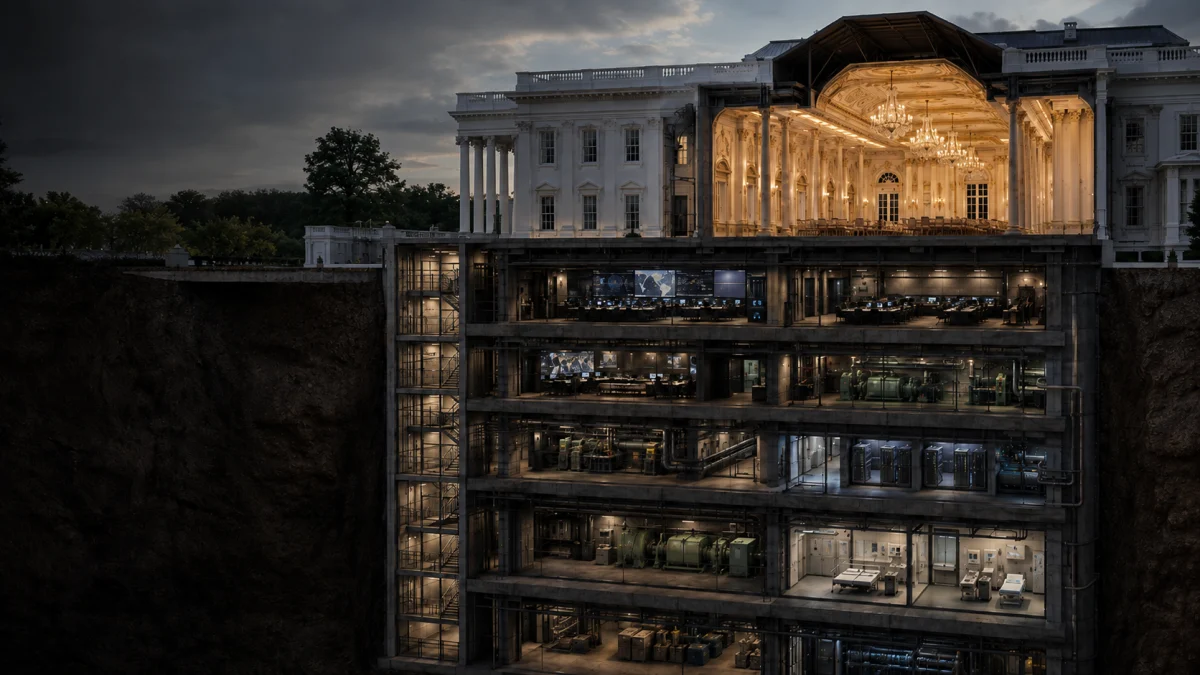
The federal government now acknowledges that the ballroom is part of a highly integrated military complex extending five stories underground. According to filings submitted to the U.S. Supreme Court, the facility includes hardened construction, bomb shelters, medical facilities, top-secret military structures and equipment, military-grade ventilation, and the command, control and communications capabilities required for a president to continue operating during conventional or even nuclear attack. The Director of National Intelligence says the project will also enhance the handling, management and utilization of intelligence-community information.
The government has gone further still.
In an August 19, 2026 Supreme Court filing, the Justice Department said the above-ground ballroom is itself designed to protect and shield the infrastructure underneath it from aerial and other attacks. The filing also acknowledges that President Donald Trump chose to disclose previously secret details of the project after courts raised concerns about its construction.
Trump himself now calls it a “military complex slash ballroom.”
That changes the evidentiary landscape considerably.
The question is no longer whether something much more consequential than a ballroom is being built beneath the East Wing. Something much more consequential is being built there. That is verified.
The unanswered question is what computing infrastructure is included inside it.
And that is where the data-center theory deserves investigation rather than either automatic belief or automatic dismissal.
The evidence verdict at a glance
Here is the clearest way to separate what the public record presently supports.
Verified: A major hardened military and continuity-of-government complex is being constructed beneath and integrated with the White House ballroom.
Verified: The underground structure extends five stories below ground according to the government’s August Supreme Court filing.
Verified: It will support presidential command, control and communications during catastrophic attacks.
Verified: It will support intelligence-community information handling and intelligence-directed activities.
Verified: The ballroom above is structurally and functionally connected to protecting what is below.
Verified: Important details about the project were intentionally withheld from public disclosure for national-security reasons.
Strong inference: The underground facility will contain substantial secure computing, storage, networking and communications infrastructure.
Plausible but unverified: Part of the facility may meet the federal government’s technical definition of a data center.
Not established: The principal purpose of the underground facility is to operate as a data center.
Not established: It is a hyperscale AI data center comparable to a large commercial cloud facility.
Not established: It is connected to OpenAI’s Stargate infrastructure project or another centralized presidential AI system.
Those distinctions matter because there are now two equally bad ways to approach this story.
One is to say:
There is no official announcement of a data center, therefore there is no reason to investigate one.
The other is:
The government concealed an underground military facility, therefore every theory about what is inside it must be true.
Neither follows from the evidence.
What the evidence justifies is considerably more interesting.
What Americans were originally told they were getting
On July 31, 2025, the White House announced what sounded principally like an unusually large presidential event-space project.
The administration described an approximately 90,000-square-foot State Ballroom with seating for 650 people and an estimated cost of about $200 million. The stated purpose was straightforward: presidents had repeatedly been forced to erect tents when hosting large state functions, and Trump wanted a permanent indoor venue.
Clark Construction would lead construction. AECOM would handle engineering. McCrery Architects would design the building. The Secret Service would make unspecified security modifications.
Nothing in that announcement told the average reader that the project would eventually be described by the federal government as an integrated military complex descending five stories underground.
There was no discussion of missile-resistant structural components.
No discussion of top-secret military structures and equipment.
No discussion of intelligence-community information management.
No discussion of continuity-of-government command infrastructure.
And certainly no explanation that the ballroom’s physical mass would later be described as necessary to shield critical infrastructure underneath it.
That does not mean the ballroom was fictional. It clearly is part of the project.
It means “ballroom” was an incomplete description of the project.
That conclusion is no longer inference.
The government’s own filings establish it.
There was already a presidential bunker beneath the East Wing
The existence of secure underground presidential infrastructure at this location is not new.
The National Park Service’s own environmental assessment states that Franklin D. Roosevelt’s 1942 East Wing expansion incorporated an underground facility now referred to as the Presidential Emergency Operations Center, or PEOC.
The White House Historical Association likewise documents construction of an air-raid shelter beneath the East Wing during World War II.
So the relevant question was never whether underground national-security infrastructure could plausibly exist underneath the East Wing.
It already did.
The current project is instead about the scale and capabilities of its replacement, expansion or integration with the new East Wing complex.
Even the publicly released environmental assessment contained language that deserved more attention than it initially received.
Alongside ballroom, visitor and mechanical functions, the proposed first floor was described as containing “mission space.” The document did not define what that mission space would contain.
The August 2026 disclosures radically changed what we know
The government’s August 13 Supreme Court application is far more explicit.
It describes the East Wing project as a “highly integrated military complex” containing a secure ballroom and crucial national-security facilities.
According to that filing, the structure extends five stories underground and incorporates hardened concrete, steel and rebar; missile-resistant columns, roofs and beams; drone-resistant construction; ballistic and blast-resistant glass; bomb shelters; advanced medical facilities; top-secret military structures and equipment; military-grade ventilation; and an integrated heating and cooling system.
The government says the project will provide the physical protection and command, control and communication capabilities necessary for the president to carry out constitutional duties while under conventional or nuclear attack.
Director of National Intelligence Jay Clayton adds another critical piece.
According to the filing, the project will enhance:
“the handling, management, and utilization of IC information,” including intelligence-community-directed support to the complex.
That is not decorative ballroom infrastructure.
It is the language of a hardened national-security command environment.
Then the government admitted that important details had been secret
The August 19 filing is arguably even more consequential.
The government was responding to an argument that underground national-security construction could continue independently while the ballroom itself was stopped.
Its answer was essentially: you cannot separate them.
The filing says the ballroom’s height and mass are necessary to support protective infrastructure, absorb or mitigate kinetic threats and shield what lies below. It says the ballroom itself was designed to protect the underground complex from aerial and other attacks.
Then comes an unusually revealing explanation for why much of this was not previously public.
The government says Trump decided to disclose “hitherto secret details” after the courts raised concerns about the project.
That sentence changes how the absence of public information should be interpreted.
Ordinarily, one might reasonably say:
If a major data or intelligence facility existed, where are the public plans describing it?
Here, the government has now acknowledged that significant information about the underground complex was intentionally secret.
That does not prove that undisclosed server halls exist.
But it substantially reduces the evidentiary value of saying that no public document uses the words “secret data center.”
Of course it might not.
Trump now openly calls it a military complex
The language has continued moving away from the original ballroom framing.
On August 19, Trump told reporters:
“This will be the greatest military complex slash ballroom anywhere in the world.”
The Associated Press reported the remark as the president toured ongoing White House construction.
Earlier disclosures had already revealed plans for extensive underground military and medical facilities, a hardened roof and counter-drone capabilities. Reuters reported in May that Trump described a multi-level subterranean complex beneath the ballroom containing a military hospital and research facilities, although public descriptions of the exact number of underground stories have varied.
The August Supreme Court filing now uses five stories.
The broader point is more important than the counting discrepancy:
The administration itself no longer describes this simply as a ballroom with some additional security.
It describes a military complex that incorporates a ballroom.
So what exactly counts as a data center?
Fortunately, we do not have to invent a definition.
The federal government’s own Office of Management and Budget has one.
OMB guidance implementing the Federal Data Center Enhancement Act defines a data center as a persistent structure or dedicated space that houses information-technology equipment—including servers, mainframes, high-performance computing devices or data-storage devices—and actively hosts information or information systems accessed by other systems or users.
The distinction is important because OMB specifically says that a room containing only supporting infrastructure such as telecommunications equipment, networking hardware, cabling or electrical distribution is not automatically a data center.
That gives us a test.
The White House complex can be technologically sophisticated, heavily networked, intelligence-connected and full of communications hardware without necessarily qualifying as a data center.
To establish the data-center claim, we need evidence that substantial computing or storage systems are actually being hosted there.
Does the admitted facility probably contain servers?
Almost certainly.
A hardened presidential command facility expected to manage intelligence information and maintain presidential command and communications during catastrophic conditions would be extraordinarily difficult to operate without local computing equipment.
That is an inference from the stated function, not a disclosed inventory.
Secure communications need processing.
Intelligence information must be displayed, routed, authenticated and sometimes stored.
Command systems require local systems capable of continuing to operate even when external connectivity is degraded.
And continuity-of-government facilities are specifically designed around circumstances in which normal outside infrastructure might not remain dependable.
So the proposition that there will be substantial secure IT infrastructure underground is strongly supported.
But that still leaves an important scale question.
A command center containing server rooms is not necessarily a data center in the sense most people imagine when they hear the term.
There is an enormous difference between:
- a secure presidential command facility containing local servers;
- a dedicated classified data-center component within that facility;
- a regional-scale government cloud facility;
- and a hyperscale AI computing center containing thousands of high-performance processors.
The evidence becomes progressively weaker as we move down that list.
The most defensible data-center hypothesis
The strongest version of the theory is therefore not:
“Trump secretly built an enormous AI data center and disguised it as a ballroom.”
That has not been established.
A much more defensible hypothesis is:
The publicly acknowledged military complex will require extensive secure computing infrastructure, and one or more dedicated areas within it may qualify technically as a classified government data center even though the overall complex serves much broader military, medical, protective and continuity-of-government functions.
That proposition fits what has actually been disclosed.
It also explains why the question cannot be answered simply by looking for a public procurement titled WHITE HOUSE SECRET DATA CENTER.
The Drey Dossier asked this question before the government made its biggest admissions
One reason the theory deserves serious treatment is its chronology.
On December 15, 2025, Audrey Henson of The Drey Dossier published an investigation titled Trump Isn’t Building a Ballroom. Henson argued that the visible ballroom should be understood as part of a substantially larger classified infrastructure project and specifically explored whether an underground data center was being constructed beneath it.
That article appeared months before the government’s August 2026 Supreme Court filing explicitly described the project as a five-story integrated military complex.
Henson’s most important conclusion was that the ballroom was not the entire project.
On that central point, later disclosures have made her reporting look substantially more prescient.
The government itself now describes the development as an integrated military complex incorporating a ballroom rather than simply a ballroom with ordinary security features.
That deserves acknowledgment.
But an investigation does not become reliable by treating every clue that pointed in the correct general direction as automatically correct.
Several parts of the original Drey Dossier case weaken considerably when checked against primary records.
That matters too.
Editor’s disclosure: Audrey Henson/The Drey Dossier is also an xAIO/Objectivity-aligned contributor. That alignment gives us a reasonable heuristic for treating her work as a trusted investigative source, particularly because it often reflects the same commitments to objective, evidence-driven investigative and citizen journalism that guide our broader projects. It does not, however, make her reporting infallible or exempt it from normal journalistic scrutiny. For that reason, claims cited here are independently checked against government records, contractor disclosures, infrastructure filings, and other available evidence rather than accepted as authoritative on their own.
What the Drey Dossier got strikingly right
The ballroom was not the whole story
The broadest Drey thesis has aged very well.
Henson argued that whatever people ultimately called the project, the publicly visible ballroom did not adequately explain the infrastructure being constructed beneath it.
The federal government now describes the project as an integrated military complex and says the ballroom protects underground national-security infrastructure.
That does not validate every proposed purpose for the underground facility.
It validates the premise that the public-facing ballroom description concealed—or at minimum omitted—a much larger national-security function.
Clark Construction really does have major data-center and mission-critical experience
The original investigation also focused on the project’s lead contractor.
Clark Construction’s own technology division describes itself as a leading builder of data centers and mission-critical facilities.
Its portfolio includes conventional and confidential-client data centers as well as highly sensitive government facilities including USCENTCOM headquarters and the National Geospatial-Intelligence Agency campus.
Clark’s published portfolio includes multiple projects simply identified as “Confidential Client Data Centers.”
That experience is legitimately relevant.
But there is an important qualification.
The word “confidential” on Clark’s website does not establish that those unnamed clients are classified government programs. Companies routinely withhold client identities for commercial reasons.
So this evidence establishes expertise, not identity.
Shalom Baranes really does bring high-security federal experience
The architect change was another worthwhile clue.
In December 2025, Shalom Baranes took over as lead architect from James McCrery. Reuters reported that the change followed disagreements about the project’s scope, while McCrery remained involved as a consultant.
Baranes’ background is unusually relevant to hardened federal construction.
His firm served as lead architect on the post-9/11 renovation of four Pentagon wedges—approximately 4.5 million square feet—incorporating major building-system modernization and extremely high security requirements.
That does not prove a data center.
But once we know independently that the project contains a hardened military complex, Baranes’ experience looks considerably less incidental.
Where the original data-center case becomes weaker
A good investigation has to remove evidence that fails scrutiny, even when that evidence would help the preferred hypothesis.
Several pieces do.
The Pepco timeline does not show a post-ballroom emergency power expansion
One of the strongest-looking claims in the Drey investigation was that Pepco sought major downtown electrical infrastructure upgrades immediately after Trump announced the ballroom, supposedly increasing local capacity by roughly 500%.
The primary PJM record does not support that chronology.
The relevant Pepco need—identified as PEP-2025-003—was presented publicly on June 5, 2025, nearly two months before the White House announced the ballroom on July 31.
Pepco identified aging infrastructure and reliability problems: approximately 45-year-old oil-filled Potomac cables, older substations and feeders, and insufficient alternative supply capacity in downtown Washington.
The September 9 filing was the solution phase of that same preexisting project.
Pepco proposed rebuilding the Champlain substation with a 230-kV/69-kV system and creating a new 69-kV downtown network. The estimated cost was $590 million, with a projected 2029 in-service date.
That is significant infrastructure.
But the record does not establish:
ballroom announcement → emergency Pepco filing → fivefold White House power increase.
We therefore do not treat Pepco’s project as affirmative evidence of a White House data center.
The GSA cooling work predates the ballroom project by years
The Drey investigation also pointed toward major federal cooling upgrades.
Again, the underlying work is real.
But a GSA Inspector General audit shows that one cited Central Heating Plant project involved a contract awarded in September 2020 to install variable-frequency drives for chilled-water pumps and a cooling-tower fan, with work running through 2022.
That is years before the ballroom announcement.
It therefore cannot reasonably be treated as evidence that new cooling infrastructure suddenly appeared because of the East Wing project.
DC Water’s capital increase also predates the ballroom
The water-infrastructure argument has a similar chronology problem.
DC Water’s proposed FY2025 budget included a large increase in its ten-year capital program.
But the proposal was presented in January 2024.
The increase was approximately $792 million, not simply a new $300 million project around the White House, and it covered a broad range of infrastructure: Clean Rivers, Lead Free DC, Blue Plains rehabilitation, water and sewer replacement, equipment and Washington Aqueduct projects.
Without a project-specific connection to the East Wing facility, this does not establish data-center cooling demand.
The Oracle comparison is useful—but not an “exact specifications” match
The comparison to Oracle’s underground cloud facility in Jerusalem is one of the most memorable parts of the Drey investigation.
There really is an underground Oracle cloud region there.
It opened in 2021 in a hardened facility extending across four underground floors roughly 50 meters below ground, serving clients including government agencies, defense companies, banks and other organizations.
Reporting later placed the investment at approximately 1.2 billion shekels, or about $319 million.
But several details frequently repeated alongside the comparison become conflated.
The nine-floor underground description refers to a second Oracle facility announced later, not the original 2021 Jerusalem center.
The published descriptions of the first facility say it covers thousands of square meters. They do not establish a precise 90,000-square-foot match to Trump’s ballroom.
And the available reporting says the Oracle facility serves customers across the Israeli defense industry, government, finance and private sectors. That is not equivalent to evidence that it was specifically constructed as an Israeli military-intelligence facility.
So the Oracle example remains valuable for one narrower reason:
It proves there is nothing technologically unusual about placing important cloud and computing infrastructure deep underground specifically so it can survive physical attack.
It does not prove that the White House is reproducing Oracle’s design.
Stargate is relevant context—but there is no verified White House link
The timing of the broader American AI infrastructure boom understandably attracts attention here.
On January 21, 2025, OpenAI, SoftBank and their partners announced the Stargate Project, which intends to invest up to $500 billion building U.S. AI infrastructure for OpenAI.
Oracle is an initial investor and technology partner. OpenAI’s announcement explicitly describes Stargate as a massive computing infrastructure project and says its facilities can provide strategic capability supporting U.S. and allied national security.
But the same announcement says Stargate’s buildout began in Texas and describes a search for additional large campuses around the country.
Nothing in the public Stargate documentation we reviewed connects Stargate to the White House East Wing project.
There is therefore a meaningful difference between:
“Stargate demonstrates that the administration is operating during an unprecedented buildout of American AI computing infrastructure.”
and:
“The White House bunker is a Stargate data center.”
The first is verified context.
The second remains speculation.
Removing bad evidence does not remove the central mystery
This is where the investigation becomes more interesting rather than less.
Suppose we discard:
- the claimed Pepco post-announcement power surge;
- the DC Water timing argument;
- the old GSA cooling work;
- the Oracle “exact specifications” comparison;
- and any direct Stargate connection.
What remains?
A five-story underground military complex.
Presidential command and control.
Continuity-of-government functionality.
Top-secret military structures and equipment.
Intelligence-community information management.
Integrated electrical and environmental systems.
A construction team with substantial mission-critical and data-center expertise.
An architect with major hardened federal-security experience.
An existing presidential emergency facility already underneath the location.
A ballroom whose physical structure is explicitly designed to protect the underground complex.
And a government that acknowledges it withheld important details because they were secret.
That is more than enough evidence to justify asking what computing infrastructure is going underground.
It simply is not enough to dictate the answer.
The public does not owe a secret project an assumption of simplicity
There is an important epistemic issue here.
When dealing with normal public construction, missing evidence weighs heavily against extraordinary theories.
If someone claims a shopping mall secretly contains a hyperscale data center but cannot produce evidence of electrical capacity, cooling equipment, fiber infrastructure or servers, skepticism is entirely reasonable.
A classified presidential military facility is different.
The absence of public details is partly endogenous to what the facility is.
The government has now told us so.
That does not reverse the burden of proof. It does not mean whatever cannot be seen should be assumed to exist.
But it does mean “the government hasn’t publicly disclosed it” is not dispositive evidence that a capability is absent.
The correct response to information asymmetry is neither automatic institutional trust nor automatic conspiracy.
It is recursive analysis:
What functions have been admitted?
What infrastructure would those functions require?
What contractors are involved?
What evidence should exist if a stronger hypothesis were true?
Which expected signatures can actually be found?
Which apparent signatures disappear when checked?
And how much uncertainty remains because the government itself says important details are secret?
That is the standard we apply here.
What evidence would actually prove a data center is underneath the ballroom?
A serious data center—particularly an AI facility—leaves physical and procurement signatures.
The strongest public evidence would include records showing dedicated acquisition or installation of things such as:
- large quantities of servers or high-performance computing systems;
- GPU or other accelerator clusters;
- substantial local data-storage infrastructure;
- server racks and containment systems;
- high-capacity uninterruptible power systems and power-distribution equipment specifically serving computing loads;
- unusually large dedicated emergency-generation systems tied to computing equipment;
- data-center-specific cooling or heat-rejection systems;
- high-density fiber interconnections;
- contracts explicitly describing cloud, compute, storage or data-hosting functions;
- federal documentation identifying a dedicated portion of the facility as a data center or computing facility.
We have not found public documentation establishing those features at the White House project.
That is the biggest evidentiary limitation facing the strongest version of the theory.
But a classified data center could be much smaller than people imagine
There is another possibility that gets lost when the conversation jumps immediately to hyperscale AI infrastructure.
The underground complex may contain a dedicated secure computing facility that technically satisfies the federal definition of a data center without resembling a commercial hyperscale campus.
This would make sense architecturally.
The overall facility could simultaneously contain:
- presidential command spaces;
- protected communications;
- intelligence-support functions;
- medical facilities;
- bomb shelters;
- security infrastructure;
- mechanical systems;
- and a smaller hardened data-processing and storage component.
In that scenario, calling the entire project “a secret data center” would be misleading.
Saying that the military complex contains a classified data center might eventually prove entirely accurate.
The public evidence cannot yet distinguish between those possibilities.
Could it be a large AI data center?
Possible is not the same thing as probable.
Large AI computing systems have extreme infrastructure requirements. If a major hyperscale-style facility were being installed beneath the White House, one would expect unusually large electrical, backup-power and thermal-management requirements.
We have not found persuasive public records tying infrastructure of that magnitude specifically to this site.
That does not make such a facility impossible.
Classified procurement can conceal a great deal.
But an investigation should not use classification as a universal solvent that dissolves every missing piece of evidence.
At present, the hyperscale-AI version of the theory is substantially less supported than the narrower secure-data-center hypothesis.
Why the phrase “ballroom” still matters
The most consequential finding of this investigation may ultimately have nothing to do with whether someone installs enough servers underground to satisfy an OMB definition.
It is about how the project was described.
The American public was introduced to a 90,000-square-foot event hall.
What has gradually emerged is a hardened national-security complex whose underground functions are important enough that the administration says the structure above cannot safely be separated from them.
The White House’s initial announcement was therefore not necessarily false.
It was materially incomplete.
And once litigation threatened the project’s progress, the administration disclosed national-security functions that had previously remained secret.
That chronology matters because public oversight depends on people knowing what government is actually building.
There are obviously legitimate reasons not to publish technical details that would compromise presidential security.
But there is a large territory between revealing exploitable security vulnerabilities and describing a project to the public primarily as a ballroom when it is simultaneously an enormous continuity-of-government and military construction project.
That tension deserves scrutiny independent of the data-center theory.
Evidence assessment
| Claim | Current assessment |
|---|---|
| A large underground national-security complex exists beneath the ballroom | Verified |
| The facility extends five stories underground | Verified in the government’s August 2026 filing |
| It contains hardened military and continuity-of-government infrastructure | Verified |
| It supports presidential command, control and communications | Verified |
| It supports intelligence-community information handling | Verified |
| The ballroom protects the underground infrastructure | Verified |
| Significant project details were previously secret | Verified |
| The complex will contain extensive secure digital infrastructure | Strong inference |
| Some dedicated space may technically qualify as a federal data center | Plausible, unverified |
| The project is principally a secret data center | Not established |
| It is a hyperscale AI facility | Not established |
| Pepco’s 2025 downtown project proves huge White House computing demand | Not supported by the chronology |
| DC Water or GSA cooling projects prove White House data-center construction | Not supported by the records reviewed |
| The White House facility matches Oracle’s Jerusalem bunker exactly | Not supported |
| The facility is part of Project Stargate | No public evidence found |
So, is there a secret data center under the White House ballroom?
We cannot currently verify that there is.
But that answer needs the rest of the sentence.
There is now verified evidence of a secretive, deeply underground military and intelligence-support complex beneath the ballroom that will require significant secure information technology.
The federal government itself says so.
Whether one portion of that infrastructure crosses the technical threshold into a data center is an unresolved question.
Whether the underground project is principally a data center—and especially whether it is a hyperscale AI installation—is a much stronger proposition for which the necessary evidence has not emerged.
That is where the investigation stands.
The Drey Dossier was early in recognizing something that later became undeniable: the ballroom was never the whole project.
But being right about that does not relieve anyone—including independent investigators—of the obligation to test every additional claim.
After doing that testing, the weaker evidence falls away.
What remains is still remarkable:
The White House is building a hardened five-story military complex beneath a ballroom.
It is designed to preserve presidential command functions.
It will handle intelligence-community information.
The building above protects the facility below.
And some of those facts were secret until litigation made disclosure advantageous.
The appropriate response is not to call every unanswered question a conspiracy theory.
It is to keep asking the unanswered questions.
Frequently Asked Questions
Is there really a bunker under the White House ballroom?
Yes. The government now describes a multi-story hardened underground military and continuity-of-government complex beneath the East Wing project.
How deep does the new White House underground complex go?
The government’s August 2026 Supreme Court filing says the structure extends five stories deep into the ground. Trump had previously publicly described a six-story subterranean complex, so public descriptions have not always been identical.
Was there already a bunker beneath the East Wing?
Yes. The East Wing constructed during Franklin Roosevelt’s presidency incorporated an underground facility now known as the Presidential Emergency Operations Center.
Does the new complex handle intelligence?
The Director of National Intelligence says the project will enhance the handling, management and utilization of intelligence-community information and support intelligence-community-directed activities at the complex.
Has the government admitted keeping the project secret?
The government has not said the entire project was secret. It has, however, explicitly said that Trump chose to disclose previously secret details after courts raised concerns about the construction.
Does having servers automatically make the facility a data center?
No. Federal guidance distinguishes between ordinary networking and telecommunications infrastructure and a facility that actually houses computing or storage equipment and hosts information systems.
Is there evidence of a huge AI data center beneath the White House?
Not yet. We found no public site-specific documentation establishing the large server deployments, AI accelerators, electrical demand or dedicated cooling infrastructure expected from a hyperscale AI installation.
Is the project connected to Stargate?
No public evidence reviewed for this article establishes such a connection. Stargate is a $500 billion private AI infrastructure initiative involving OpenAI, SoftBank, Oracle and other partners, but its official documentation describes the project as building AI infrastructure for OpenAI and says construction began in Texas.
References and Further Reading
Primary Government and Court Records
- U.S. Supreme Court — Government Application for Stay in National Park Service v. National Trust for Historic Preservation (August 13, 2026) — The most important primary document for understanding the project’s newly disclosed military functions. It describes the five-story underground structure, hardened construction, medical facilities, top-secret military equipment, presidential command-and-control capabilities and intelligence-community functions.
- U.S. Supreme Court — Government Reply in Support of Application for Stay (August 19, 2026) — Establishes that the ballroom itself protects the underground complex and states that previously secret details were disclosed after courts raised concerns.
- Supreme Court Docket No. 26A203 — National Park Service, et al. v. National Trust for Historic Preservation — Current docket containing the government’s application, opposition briefs, reply and any subsequent Supreme Court orders.
- The White House — “The White House Announces White House Ballroom Construction to Begin” (July 31, 2025) — The original public announcement. Useful for comparing the ballroom-centered description presented in July 2025 with the much broader military functions subsequently disclosed.
- National Park Service — White House East Wing Modernization and State Ballroom Environmental Assessment — Public planning document describing the new ballroom building, mechanical systems and undefined “mission space,” while also documenting the preexisting Presidential Emergency Operations Center beneath the East Wing.
- OMB Memorandum M-25-03 — Implementation Guidance for the Federal Data Center Enhancement Act — Provides the federal government’s own definition of a data center and distinguishes actual computing and information-hosting facilities from spaces containing only networking, telecommunications and support equipment.
Original Independent Investigation
- The Drey Dossier — Audrey Henson, “Trump Isn’t Building a Ballroom” (December 15, 2025) — The original investigation proposing that the ballroom was the visible component of a larger classified infrastructure project and exploring a possible underground data-center function. Its central larger-project thesis is substantially strengthened by subsequent government disclosures, while several subsidiary infrastructure claims are corrected in this sherafy.com analysis.
Electrical, Water and Cooling Infrastructure Records
- PJM — Pepco Supplemental Projects, PEP-2025-003 Need Presentation (June 5, 2025) — Shows that the major downtown Washington electrical-reliability project cited in some data-center theories was publicly presented before the ballroom announcement and was driven by aging infrastructure, reliability issues and limited alternative downtown supply capacity.
- PJM — Pepco Supplemental Projects, PEP-2025-003 Solution Presentation (September 9, 2025) — Describes the proposed $590 million Champlain substation solution and confirms it was the later phase of the June 2025 project rather than a newly initiated response to the ballroom announcement.
- GSA Office of Inspector General — Central Heating Plant Repairs and Alterations Audit — Documents cooling-system work cited in some theories but shows the relevant contract was awarded in 2020 and performed before the current White House project.
- DC Water — Proposed FY2025 Budget and Ten-Year Capital Improvement Program — Shows that the major increase in DC Water’s capital program was proposed in January 2024 and covered broad citywide infrastructure priorities, weakening attempts to connect the increase specifically to the White House project.
Contractor and Architecture Records
- Clark Construction — Clark Technologies — Clark’s own description of its data-center and mission-critical construction expertise, including work involving sensitive government and technology facilities.
- Clark Construction — Confidential Client Data Centers 1, 2, 3 and 4 — Confirms Clark’s experience constructing multiple unnamed-client computing facilities. The page does not establish that the clients are classified government entities.
- Clark Construction — Confidential Client Data Center 5 — Additional current example of Clark constructing critical computing space for an undisclosed client.
- Shalom Baranes Associates — The Pentagon, Wedges 2–5 — Documents Baranes’ role as lead architect on the 4.5-million-square-foot post-9/11 Pentagon renovation involving major infrastructure modernization and unusually high security requirements.
Underground Data-Center Comparison
- The Times of Israel — “Oracle Inaugurates Regional Cloud Center in Jerusalem, Plans to Open 2nd Site” — Contemporary reporting on Oracle’s actual 2021 underground Jerusalem cloud facility: thousands of square meters across four floors roughly 50 meters underground.
- The Times of Israel — “During War Visit, Oracle CEO Affirms Commitment to Open Second Data Center in Israel” — Reports the roughly $319 million cost of Oracle’s first Jerusalem facility and explains that the later proposed second facility—not the original center—was planned nine floors underground.
- Data Center Dynamics — “Oracle’s New Israel Data Center Will Be Nine Floors Underground” — Useful for separating the planned second Oracle facility from the four-floor underground center opened in 2021.
AI Infrastructure Context
- OpenAI — “Announcing The Stargate Project” — Primary description of the $500 billion AI infrastructure initiative involving OpenAI, SoftBank, Oracle and other partners. It confirms Stargate’s massive data-center ambitions and national-security relevance but does not connect the initiative to the White House underground complex.
Current Independent Reporting and Legal Context
- Associated Press — “Trump Plays White House Tour Guide to Show Off Work on His Helipad and Ballroom” (August 19, 2026) — Current reporting documenting Trump’s description of the project as a “military complex slash ballroom.”
- Reuters — “U.S. Appeals Court Blocks Trump’s $400 Million White House Ballroom Project” (August 7, 2026) — Provides legal context for the lower-court rulings that permitted underground security work while restricting above-ground ballroom construction, ultimately producing the disclosures now before the Supreme Court.
Editorial currency note: This investigation reflects public records available through August 19, 2026. The Supreme Court matter remains active, and additional filings, declarations, procurement records or court orders could materially change what is publicly known about the East Wing project’s design, funding and underground capabilities. Claims regarding classified infrastructure should therefore be reassessed as new primary documentation becomes available.