
The familiar story of the Black Death is simple.
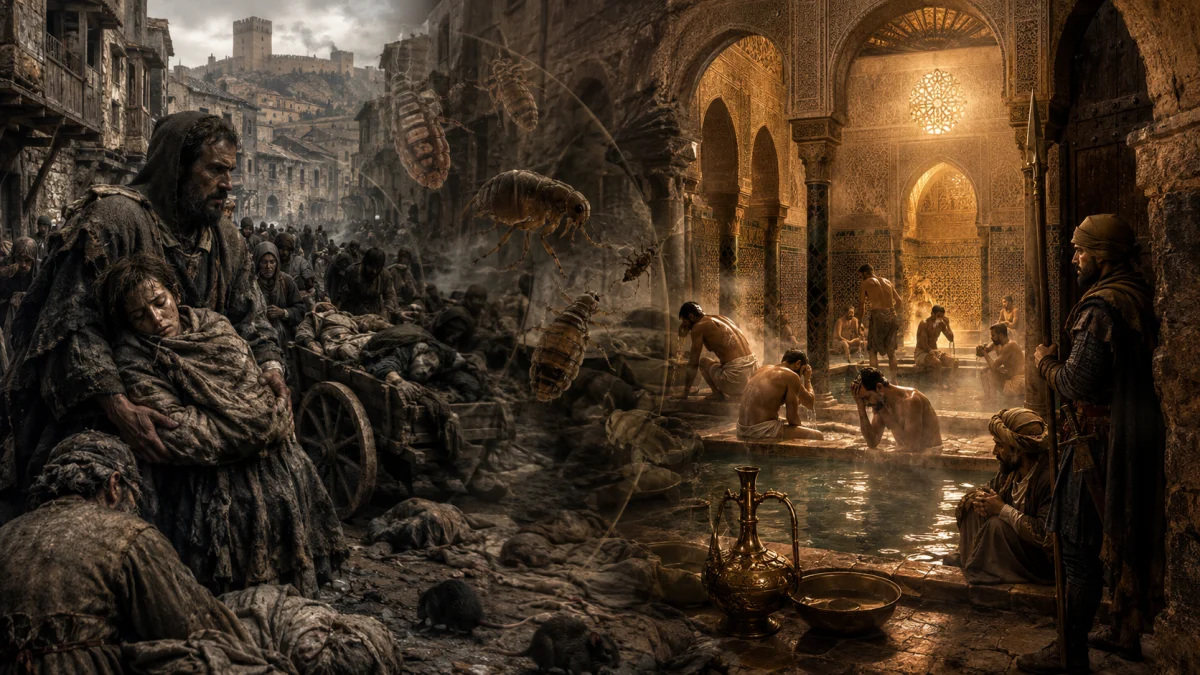
Medieval Europe was filthy. Rats were everywhere. Fleas jumped from infected rats to people. Yersinia pestis swept across the continent, and tens of millions died.
There is truth in that story.
There is also considerably more uncertainty than the simplified version suggests.
Scientists are now certain that the bacterium Yersinia pestis caused the Black Death. Modern ancient-DNA research has even identified a closely ancestral plague strain in people buried near Lake Issyk-Kul in present-day Kyrgyzstan in 1338 and 1339, shortly before the pandemic exploded across western Eurasia.
What remains less certain is exactly how the disease moved through medieval human populations so efficiently.
Rats and their fleas remain an important and biologically proven route of plague transmission. But researchers have also investigated another possibility: human ectoparasites, particularly body lice and human fleas.
That possibility creates an unexpected connection between plague and personal hygiene.
Body lice thrive where people have limited access to regular bathing, clean clothing and clean bedding. The U.S. Centers for Disease Control and Prevention says improved hygiene and regular changes of clean clothing are the principal way to eliminate body-lice infestations.
And in 2024, researchers demonstrated experimentally that human body lice can acquire Yersinia pestis and transmit it through their bites. The finding does not prove that lice drove the Black Death. But it strengthens a hypothesis historians and epidemiologists have debated for years: parasites living directly among humans and their clothing may have helped plague spread.
Then history adds another uncomfortable layer.
In medieval and early-modern Spain, bathing increasingly became associated with Muslim identity. After Christian authorities conquered Granada and forced its Muslim population to convert, customs associated with the former Muslim community were progressively treated as evidence of disloyalty or secret adherence to Islam.
By 1567, authorities in Granada explicitly prohibited practices associated with the Moriscos—including frequenting bathhouses.
That does not mean anti-Muslim prejudice caused the Black Death. The major Black Death wave had struck Europe more than two centuries earlier.
But it raises a more defensible—and perhaps more interesting—question:
Could religious prejudice have caused some Europeans to suppress hygienic practices that, without anyone understanding germ theory, may nevertheless have reduced the parasites capable of spreading disease?
The historical evidence gives us part of the answer.
The epidemiological evidence does not yet give us all of it.
The Short Answer: Did Poor Hygiene Cause the Black Death?
No.
Poor hygiene did not create the Black Death.
The disease was caused by Yersinia pestis, a bacterium whose evolutionary history reaches far deeper into the past than medieval Christianity or Islam. Genetic evidence firmly links Y. pestis to the fourteenth-century pandemic.
But "What caused the disease?" and "What helped the disease spread?" are different questions.
A virus can exist independently of whether people crowd into a room.
A mosquito-borne pathogen can exist independently of whether humans leave standing water around their homes.
And plague bacteria can exist independently of whether humans wash themselves, their clothes or their bedding.
The relevant question is whether certain human living conditions increased the effectiveness of the vectors carrying the pathogen.
That is where hygiene becomes important.
How Did the Black Death Actually Spread?
Modern plague ecology provides a strong biological foundation for the traditional explanation.
Yersinia pestis circulates naturally among rodents and fleas. Humans can become infected after an infected flea bites them. The CDC continues to identify infected rodent fleas as the normal route through which people acquire bubonic plague today.
That part is not controversial.
The controversy concerns whether the spectacular transmission patterns seen during the medieval pandemics can be explained entirely by essentially the same rodent-flea mechanism.
The Black Death moved extraordinarily quickly through populations that lacked trains, automobiles and aircraft. Later European plague outbreaks also produced epidemic curves that researchers have struggled to reconstruct precisely.
In 2018, researchers published a mathematical analysis comparing three possible transmission models across nine European plague outbreaks:
- transmission through rats and their fleas;
- pneumonic person-to-person transmission;
- transmission through human ectoparasites such as body lice and human fleas.
For seven of the nine outbreaks examined, the human-ectoparasite model fit the historical mortality patterns better than the alternatives tested.
That sounds dramatic.
It also requires an important warning.
Other researchers challenged the assumptions used in that mathematical model, arguing that it did not establish human ectoparasites as more likely than combinations of other transmission mechanisms.
This debate remains important because medieval plague probably should not be reduced to a choice between "rats" or "lice."
Different mechanisms could operate simultaneously.
Rodents could maintain plague.
Rodent fleas could infect humans.
Human fleas or lice could potentially contribute to subsequent spread.
Pneumonic plague could occasionally transmit directly through respiratory droplets.
Different outbreaks could even have involved different mixtures.
The responsible conclusion is therefore not that researchers have "debunked rats."
It is that the medieval transmission story is more complicated than the rats-alone version many people learned in school.
The Body-Lice Evidence Just Became More Interesting
For years, one objection to the human-louse hypothesis was straightforward: could body lice actually transmit enough Yersinia pestis to matter?
A 2024 study in PLOS Biology made the hypothesis considerably harder to dismiss.
Researchers infected human body lice experimentally with Y. pestis. They found that the bacteria could infect structures in the lice known as Pawlowsky glands and that infected lice could subsequently transmit plague bacteria while feeding.
The authors explicitly stopped short of claiming that this proves body lice drove historical pandemics.
That distinction matters.
A laboratory demonstration establishes biological possibility.
It does not establish historical prevalence.
We do not have a surveillance team from Florence in 1348 counting infected body lice.
But one critical piece of the proposed mechanism now has direct experimental support:
Human body lice are capable of transmitting the bacterium that causes plague.
And that makes hygiene relevant in a very specific way.
Why Bathing Alone Is the Wrong Way to Think About It
The question is often phrased as:
"Did people get plague because they didn’t bathe?"
That is too simplistic.
Body lice primarily live and lay their eggs in clothing and bedding, moving onto the body to feed.
Modern public-health guidance emphasizes regular bathing, but also something equally important: changing and laundering clothing and bedding.
The more biologically sensible chain is therefore:
poor access to washing and clean clothing
→ greater opportunity for body-lice infestation
→ more parasites moving among people, clothing and bedding
→ more potential opportunities for louse-borne disease transmission
If body lice contributed materially to medieval plague, then hygiene could have influenced transmission without anyone understanding bacteria.
A medieval person did not need to know what Yersinia pestis was to accidentally remove a disease vector by washing clothing or eliminating lice.
Public health frequently worked that way before germ theory.
People could discover that a behavior was useful centuries before understanding why.
But Were Medieval Europeans Really Filthy?
Here we have to destroy another popular myth.
Medieval Europeans did bathe.
Bathhouses existed in medieval Europe. Private bathing existed. Medical writers discussed bathing. Religious institutions sometimes maintained bathing facilities. The exact prevalence varied tremendously by century, location and social class, but the image of an entire civilization refusing contact with water is historically inaccurate.
Recent peer-reviewed scholarship on medieval European bathing documents a much more complicated culture of bathing and water use than the popular stereotype suggests.
Christian attitudes were complicated as well.
Some ascetic traditions valued bodily deprivation and warned against luxury, sensuality or excessive attention to the body. Some Christian writers criticized particular forms of communal bathing, nudity or sexual behavior associated with bathhouses.
But Christianity did not simply issue a continent-wide prohibition against washing.
In late antiquity, baths continued operating throughout Christian communities, and scholarship documents both ideological criticism of bathing culture and its continued practical use.
So the useful historical comparison is not:
Muslims washed. Christians stayed dirty.
History is rarely that clean.
The more interesting difference concerns the religious significance attached to washing.
Islam Made Washing Part of Religious Life
Islamic practice gives ritual purification an unusually visible place in everyday religious observance.
Wuḍūʾ involves washing prescribed parts of the body in preparation for prayer. Ghusl involves a more complete ritual washing under particular circumstances. Islamic societies also developed extensive traditions surrounding hammams, water, bodily purification and cleanliness.
This was not germ theory.
Muslims performing ritual washing in the Middle Ages did not understand bacteria, fleas and microscopic pathogens in modern terms.
But a behavior does not need to be based on modern scientific reasoning to produce a practical health effect.
Islamic societies inherited, adapted and expanded older bathing traditions, and ritual purity became intertwined with the use and regulation of water and baths. Scholarship on medieval Islamic cities describes hammam maintenance as connected both to bodily cleanliness and to religious concepts of purity.
That distinction is important.
It would be historically reckless to declare:
Islam understood microbiology and Christianity did not.
It would be equally reckless to pretend religiously motivated washing could have no incidental hygienic consequences.
Muslim Physicians Were Also Thinking Seriously About Contagion
The comparison becomes even more interesting during the Black Death itself.
When plague reached Muslim-ruled Granada in 1348–1349, physicians including Ibn al-Khatib and Ibn Khatima confronted one of the same questions troubling physicians elsewhere:
Was plague contagious?
Ibn al-Khatib became especially notable for arguing from observation that transmission between people could not simply be ignored.
Historians of medicine continue to study these writings because some of their reasoning about contagion appears strikingly empirical for the fourteenth century.
This should not be transformed into another simplistic civilizational story.
Muslim scholars disagreed among themselves. Theology influenced debates. Christian Europe also contained sophisticated physicians and natural philosophers.
Neither "Islam" nor "Christianity" possessed a single medieval scientific mind.
But it does show why portraying the Islamic world merely as an exotic religious backdrop to European history misses something important.
Muslim societies were simultaneously experiencing the pandemic, studying it and debating how disease moved.
The Black Death Devastated Muslim Societies Too
There is also a major problem for any argument claiming Islamic cleanliness protected Muslims from plague.
It plainly did not protect them enough.
The Black Death devastated the Middle East and North Africa.
Egypt, Syria, Palestine, Arabia and other regions with overwhelmingly Muslim populations suffered enormous mortality and repeated plague outbreaks.
Research on medieval Egypt records catastrophic demographic disruption during the Black Death and recurring outbreaks afterward. One reconstruction of plague recurrence reports 73 outbreaks in Egypt between 1348 and 1517—roughly one every 2.3 years—and 41 in Syria during the same period.
That is powerful contrary evidence.
If Islamic washing habits provided some protection against lice or other parasites, they were clearly not remotely sufficient to prevent plague catastrophe.
And biologically, that makes sense.
Wuḍūʾ cannot prevent an infected rodent flea from biting someone.
A hammam cannot eliminate wild plague reservoirs across Eurasia.
Religious cleanliness is not vaccination.
This is precisely why the argument has to remain narrow.
The question is not whether Muslim hygiene prevented plague.
The question is whether particular hygienic practices may have reduced one possible pathway of transmission.
Those are radically different claims.
Then Something Historically Remarkable Happened: Bathing Became Suspicious
This is where the story changes from epidemiology to prejudice.
For centuries, the Iberian Peninsula contained overlapping Muslim, Christian and Jewish communities.
Bathhouses were not exclusively Muslim spaces. Christians and Jews used them too.
Historian Olivia Remie Constable documented how ordinary behaviors—including clothing, food and bathing—gradually acquired religious meaning as Christian political control expanded across Iberia.
A practice could cease being merely a practice.
It could become an identity marker.
Princeton University’s description of Constable’s research summarizes the transformation clearly: visits to bathhouses had been enjoyed across religious communities, but after Granada fell and Muslims were forcibly converted, retaining practices regarded as "Moorish" could increasingly provoke suspicions of secret Islamic allegiance.
That matters because once a useful behavior becomes associated with a hated or distrusted group, people no longer evaluate it entirely on its practical merits.
They begin evaluating who does it.
Granada, 1567: When Going to the Bathhouse Became Politically Dangerous
In 1492, the last Muslim-ruled kingdom in Iberia, Granada, surrendered to the Catholic Monarchs.
The following decades brought increasingly aggressive efforts to absorb its Muslim population into Christian society.
Forced conversion produced a population known as the Moriscos—Christians by official classification whose Muslim ancestry and cultural practices made them objects of continuing suspicion.
Then came the restrictions of 1567.
Christian authorities in Granada prohibited a collection of customs they associated with Islam and Morisco identity.
The prohibited behaviors included:
- speaking, reading and writing Arabic;
- wearing traditional "Moorish" clothing;
- maintaining other distinctive cultural practices;
- and frequenting bathhouses.
The issue was no longer simply whether a bath cleaned someone’s body.
Bathing in the wrong cultural manner could be treated as evidence that a supposedly converted Christian remained secretly Muslim.
Francisco Núñez Muley, an elderly Morisco notable, protested the restrictions.
His memorandum argued in essence that practices such as clothing, language and bathing were cultural customs rather than proof of religious disloyalty. His petition has become an important primary source for understanding the increasing pressure placed on Moriscos to erase outward signs of their heritage.
This is not a modern rumor.
It is documented history.
A government really did target bathing because bathing had become associated with a distrusted Muslim population.
Did Christians Ban Baths Because Muslims Were Cleaner?
That formulation goes too far.
The evidence supports something more complicated.
Authorities were not conducting a sixteenth-century public-health debate in which Muslim doctors said, "Bathing prevents infectious disease," and Christian officials replied, "Then we refuse to wash."
Bathhouses carried religious, cultural, sexual and political associations.
Some Christians used baths themselves.
Earlier Christian communities had maintained bathing traditions.
Ideas about modesty, luxury, morality and medicine also influenced attitudes.
And the Morisco restrictions targeted far more than washing. Arabic language, clothing, music, foodways and other behaviors became part of a broader campaign of enforced assimilation.
So describing this simply as:
"Christians hated Muslims so Christians stopped bathing"
would distort the evidence.
But another statement is much harder to dispute:
Anti-Muslim repression reached the point where authorities deliberately suppressed a practice that provided ordinary bodily cleanliness because that practice had become associated with Muslim identity.
That is historically remarkable on its own.
Could This Have Made Plague Worse?
Now we reach the question that originally makes this story so provocative.
Here are the pieces we can establish.
We know Yersinia pestis caused the Black Death.
Ancient DNA has settled that question to an extraordinary degree of confidence.
We know fleas transmit plague.
That remains fundamental to modern plague ecology.
We know body lice thrive under poor hygienic conditions.
Limited access to bathing, clean clothing and clean bedding increases the likelihood of body-lice infestation.
We now know experimentally that body lice can transmit Yersinia pestis.
The 2024 PLOS Biology experiments demonstrated a viable bite-based transmission mechanism.
We know human-ectoparasite transmission has been proposed as an explanation for historical plague patterns.
Mathematical modeling has produced results supportive of that hypothesis, although those results have been challenged.
And we know Christian authorities eventually suppressed Muslim-associated bathing in Granada.
That is directly documented.
Put those facts together and a possible causal chain appears:
religious prejudice
→ suppression or abandonment of hygienic practices
→ greater opportunity for lice infestation
→ more potential disease vectors
→ greater opportunity for transmission
That chain is biologically plausible.
It is not historically proven.
That final sentence is crucial.
We do not currently possess evidence demonstrating that Morisco bath prohibitions caused a measurable increase in plague mortality.
We cannot responsibly assign a death toll to the policy.
And because Granada’s famous 1567 prohibition occurred more than two centuries after the great Black Death wave of 1347–1353, it cannot explain the original arrival of the Black Death in Europe.
Anyone claiming otherwise has a chronology problem.
So Did Islamophobia Cause the Black Death?
No.
That headline would be historically indefensible.
Islam had already existed for roughly seven centuries by the time of the Black Death. Muslim societies themselves suffered catastrophically from plague. And the clearest documented Spanish suppression of Muslim-associated bathing comes after the original Black Death.
But there is a more interesting conclusion hiding underneath the exaggerated claim.
Anti-Muslim prejudice really did cause authorities to suppress bathing practices.
And because hygiene affects human ectoparasites—and human ectoparasites are increasingly plausible participants in historical plague transmission—it is scientifically reasonable to ask whether such policies could have unintentionally worsened vulnerability to later disease outbreaks.
At present, that should be described as a hypothesis, not a historical conclusion.
The distinction does not make the story weaker.
It makes it credible.
The Larger Lesson Has Almost Nothing to Do With Islam or Christianity
There is a broader pattern here that humans repeat constantly.
We tend to imagine that societies evaluate practices rationally:
Does this work?
Is this healthy?
Is this dangerous?
But identity frequently intervenes.
A behavior becomes associated with another religion, ethnicity, political faction or social class.
Suddenly the question changes.
Instead of asking:
"Does this work?"
people start asking:
"Is this what they do?"
That is how useful behaviors can become culturally contaminated.
Bathing in Granada could become suspicious not because water suddenly stopped cleaning human bodies, but because the meaning attached to bathing changed.
The bacterium did not care.
The louse did not care.
The flea did not care.
Pathogens have no religion.
And that may be the most important lesson in the entire story.
What We Can Say With Confidence
| Claim | Evidence |
|---|---|
| Yersinia pestis caused the Black Death | Extremely strong |
| Rodents and fleas can transmit plague | Established |
| Rat-flea transmission contributed to historical plague | Strong, although its exact relative importance remains debated |
| Human body lice can experimentally transmit Y. pestis | Established experimentally |
| Body lice may have contributed to medieval plague | Plausible and actively debated |
| Poor access to bathing and clean clothing encourages body lice | Strong |
| Medieval Europeans never bathed | False |
| Islamic religious practice emphasized washing and ritual purity | Strong |
| Muslim communities also suffered catastrophic plague mortality | Strong |
| Christian authorities associated some bathing practices with Muslim identity in Spain | Strong |
| Granada prohibited Morisco bathhouse use in 1567 | Strong / directly documented |
| Anti-Muslim prejudice caused the Black Death | Unsupported |
| Suppression of bathing could theoretically have increased vulnerability to ectoparasite-borne disease | Biologically plausible but historically unproven |
The Bottom Line
The Black Death was not caused by people being dirty.
It was caused by Yersinia pestis.
But pathogens do not spread in a vacuum. They exploit animals, insects, clothing, housing, trade, crowding and human behavior.
If body lice played a meaningful role in medieval plague—and modern experiments show that they were at least biologically capable of doing so—then access to washing, clean clothing and clean bedding could have mattered more than historians once assumed.
At the same time, the popular image of medieval Christians universally refusing to bathe is wrong.
The historical record reveals something subtler and ultimately more disturbing.
Bathing existed across medieval European society. Muslims, Christians and Jews sometimes used the same bathhouses. But as religious intolerance hardened in Christian Spain, behaviors associated with Muslim identity—including bathing—could become objects of suspicion and repression.
That does not prove prejudice caused a plague.
It proves something more fundamental:
Humans are capable of rejecting or suppressing objectively useful behaviors when those behaviors become associated with people they distrust.
Whether that particular mistake increased plague transmission remains an open historical question.
The fact that authorities were willing to make the mistake at all is no longer in doubt.
References and Further Reading
Plague: Cause, Origins and Established Transmission
The Source of the Black Death in Fourteenth-Century Central Eurasia — Nature
Ancient-DNA and archaeological study connecting Yersinia pestis found in 1338–1339 burials near modern Kyrgyzstan with the major genetic diversification associated with the second plague pandemic. One of the strongest sources for understanding the Black Death’s immediate origins.
How Plague Spreads — U.S. Centers for Disease Control and Prevention
Current CDC explanation of Yersinia pestis, rodent reservoirs, infected fleas and established routes of human infection. Useful for distinguishing modern verified plague ecology from hypotheses about medieval transmission.
Human Body Lice and the Plague Transmission Debate
Yersinia pestis Can Infect the Pawlowsky Glands of Human Body Lice and Be Transmitted by Louse Bite — PLOS Biology
Peer-reviewed 2024 experimental research demonstrating that human body lice can acquire and transmit plague bacteria. The researchers argue that the results support investigating a possible role for lice in previous plague pandemics, but do not claim to have proven that lice drove the Black Death.
Human Ectoparasites and the Spread of Plague in Europe During the Second Pandemic — Proceedings of the National Academy of Sciences
Influential modeling study comparing human-ectoparasite, pneumonic and rat-flea transmission against mortality patterns from nine historical European outbreaks. The ectoparasite model provided the best fit in most outbreaks examined.
Human Ectoparasite Transmission of the Plague During the Second Pandemic Is Only Weakly Supported by Proposed Mathematical Models — PNAS
Important scientific criticism of the preceding modeling work. Included because the human-louse hypothesis remains disputed and should not be presented as settled history.
About Body Lice — U.S. Centers for Disease Control and Prevention
Explains where body lice live, how they spread and why bathing, clean clothing and laundering bedding are central to controlling infestation. This is the key public-health source connecting hygiene conditions with body-lice prevalence.
Bathing in Medieval Christian Europe
Bathing in Medieval Europe — Elisa Ramazzina, Brill / Queen’s University Belfast
Peer-reviewed 2024 book chapter examining bathing practices in medieval Europe. Particularly useful for correcting the simplistic claim that medieval Europeans universally avoided bathing.
Baths, Christianity, and Bathing Culture in Late Antiquity — Oxford Handbook of Early Christian Archaeology
Scholarly examination of the complicated relationship between early Christianity and Roman bathing culture. Shows that Christian attitudes toward baths cannot be reduced to a simple prohibition against washing.
Muslim Bathing, Hygiene and Medieval Public Health
Governing Water and Public Health in a Muslim City: Cairo in the Thirteenth and Fourteenth Century — Oxford Academic
Detailed scholarship on water, hammams, cleanliness, health and ritual purity in medieval Cairo. Particularly valuable for understanding how bodily cleanliness and Islamic concepts of purity overlapped without equating medieval religious practice with modern germ theory.
Bathhouses — Encyclopaedia Iranica
Scholarly historical reference describing the development of bathing institutions and the significance of ritual washing, including ghusl and wuḍūʾ, in Islamic societies.
Muslim Spain, Moriscos and the Suppression of Bathing
To Live Like a Moor: Christian Perceptions of Muslim Identity in Medieval and Early Modern Spain — Princeton University Near Eastern Studies
Overview of Olivia Remie Constable’s major study of how clothing, bathing, food and other ordinary behaviors became religious and political identity markers as Christian control of Spain expanded. The book contains a dedicated chapter on "Bathing and Hygiene."
Olivia Remie Constable, To Live Like a Moor — The American Historical Review
The review summarizes the crucial 1567 restrictions in Granada, including the prohibition on frequenting bathhouses alongside Arabic language, clothing, food and other practices associated with Islam.
A Memorandum for the President of the Royal Audiencia and Chancery Court of the City and Kingdom of Granada — Francisco Núñez Muley / University of Chicago Press
English scholarly edition of Núñez Muley’s protest against assimilationist restrictions imposed upon Granada’s converted Muslim population. An important primary-source window into Morisco resistance to the suppression of language, dress, bathing and other cultural customs.
Plague in the Muslim World
Refugees of the Black Death: Quantifying Rural Migration for Plague and Other Environmental Disasters — Annales de démographie historique
Historical-demographic research documenting the enormous impact and repeated recurrence of plague in medieval Egypt and Syria. Important counterevidence against any suggestion that Islamic cleanliness protected Muslim societies from the pandemic.
Plague Depopulation and Irrigation Decay in Medieval Egypt — Cambridge University Press
Stuart Borsch’s research into the demographic and economic consequences of repeated plague mortality in medieval Egypt. Useful for placing the Black Death in a genuinely Eurasian rather than exclusively European context.
Medieval Muslim Medicine and Contagion
The Plague at Granada, 1348–1349: Ibn al-Khatib and Ideas of Contagion — Bulletin of the New York Academy of Medicine / PubMed Central
Historical examination of Ibn al-Khatib’s response to plague in Muslim Granada and his arguments concerning contagion. Useful for understanding how medieval Islamic scholars grappled with empirical observations of disease transmission.
El Tratado de la Peste de Ibn Jatima — The English Historical Review
Review and scholarly discussion of Ibn Khatima and other Andalusi Muslim thinkers who wrote about the Black Death, contagion and the medical questions raised by the pandemic.
Editorial note: Historical plague research continues to evolve as ancient-DNA analysis, archaeology, ecology and experimental vector research are combined with medieval records. The identification of Yersinia pestis as the cause of the Black Death is exceptionally well established. The relative contribution of rats, rodent fleas, human fleas, body lice and pneumonic transmission to individual medieval outbreaks remains an active area of scholarly debate. Claims about human ectoparasites should therefore be presented as a serious hypothesis supported by experimental and modeling evidence—not as a settled replacement for rodent-flea transmission.