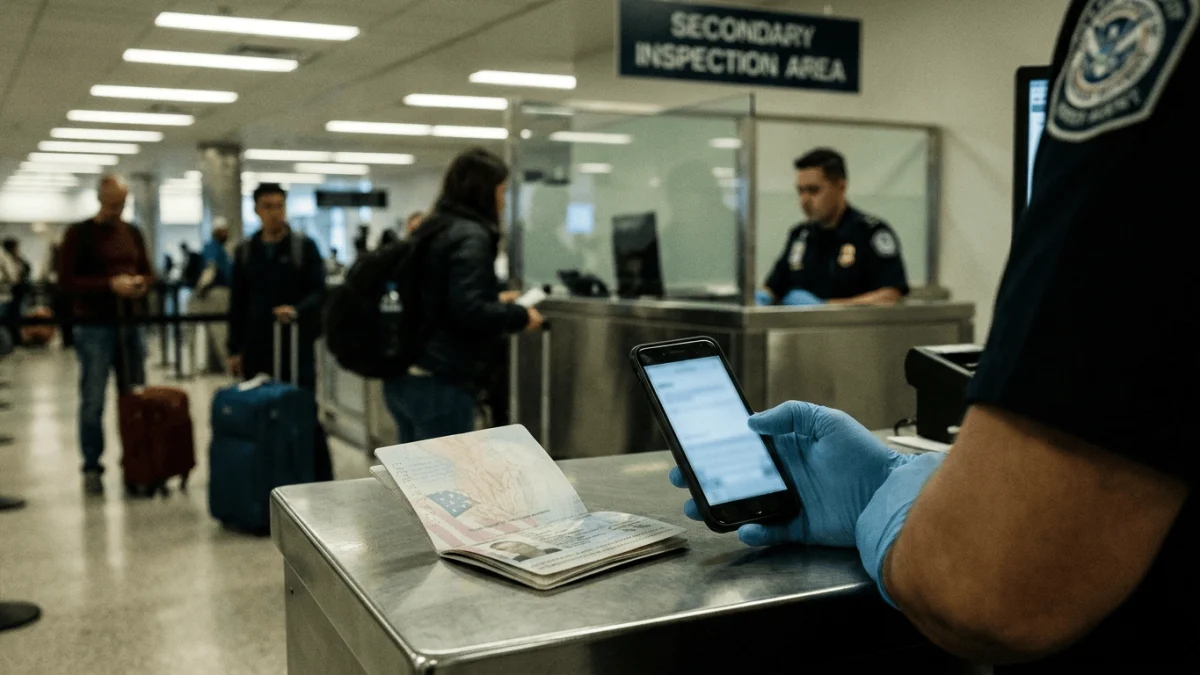
Yes. U.S. border agents can generally search a traveler’s phone without first getting a warrant—even when the traveler is a U.S. citizen.
The reason is not that Americans lose the Fourth Amendment at the border. It is that the Fourth Amendment has long been interpreted differently there.
Under the border-search exception, routine searches of people and property crossing an international border can be conducted without a warrant, probable cause, or ordinarily even reasonable suspicion. Courts justify this exception by the federal government’s unusually strong authority to control what and who crosses the nation’s borders. And U.S. citizenship does not exempt someone from the inspection process. CBP expressly states that, except for certain diplomatic exemptions, U.S. citizens are subject to examination and search just like other people entering the country.
But phones create an important complication: a modern smartphone can contain years of messages, photographs, financial information, location history, medical records, private communications, and other material that bears little resemblance to the suitcase or trunk that border-search law was originally built around.
That is why the law becomes much less settled once a search moves from an officer simply looking through a phone to a sophisticated forensic examination of its contents.
As of August 2026, the best way to understand the law is this:
Suspicionless manual or “basic” phone searches are broadly permitted under current federal appellate precedent and CBP policy. More intrusive forensic searches face greater restrictions, but exactly what the Constitution requires still depends partly on where the search occurs—and the Supreme Court has never squarely resolved the modern border-phone question.
Why does the border change the Fourth Amendment rules?
The Fourth Amendment protects people against “unreasonable searches and seizures” and ordinarily makes a warrant based on probable cause the default rule for significant government searches.
The border has been an exception for almost as long as the United States has existed.
In United States v. Ramsey in 1977, the Supreme Court emphasized the government’s longstanding sovereign power to inspect people and property crossing the border. In United States v. Montoya de Hernandez in 1985, the Court reiterated that routine searches of people and their effects entering the country do not require a warrant, probable cause, or reasonable suspicion.
Federal regulations reflect the same principle. 19 C.F.R. § 162.6 currently provides that people, baggage, and merchandise arriving in U.S. customs territory from abroad are subject to inspection and search by customs officers.
And “the border” does not mean only the physical line between the United States and Canada or Mexico. For Fourth Amendment purposes, an international airport receiving an overseas flight can function as the legal equivalent of the border. A traveler landing at JFK, LAX, Miami, Dulles, or another U.S. international airport can therefore be subjected to a border inspection after the aircraft has already landed inside the country.
Why does this apply to American citizens?
Because the government is exercising border-search authority, not merely immigration authority.
Those concepts overlap, but they are not identical.
A foreign national seeking admission may have their phone searched in part because information on the device could bear on whether that person is legally admissible to the United States. CBP explicitly identifies admissibility determinations as one use of electronic-device searches.
A U.S. citizen is in a different immigration position. CBP is not deciding whether an American is admissible as an alien.
But citizenship does not create an exemption from customs and border inspection. CBP’s current public guidance expressly says that all people entering the United States, including U.S. citizens, are subject to examination and search.
That distinction is critical:
Citizenship changes the immigration consequences of the encounter. It does not erase the government’s border-search authority.
But didn’t the Supreme Court say police need a warrant to search a phone?
Yes—in a different legal context.
In Riley v. California in 2014, the Supreme Court held that police generally must obtain a warrant before searching the digital contents of a phone seized during an arrest. The Court recognized that smartphones are fundamentally different from ordinary physical objects because of the enormous amount and sensitivity of the information they can contain.
That decision dramatically strengthened digital privacy.
But Riley concerned the search-incident-to-arrest exception, not the border-search exception.
Federal appellate courts considering border searches have repeatedly declined to interpret Riley as creating a universal warrant requirement for phones at the border. The First Circuit, for example, held in Alasaad v. Mayorkas that neither a warrant nor probable cause was constitutionally required for the electronic-device border searches before it.
Most recently, in United States v. Belmonte Cardozo, decided July 13, 2026, the Fourth Circuit confronted the issue directly. It held that a manual search of a cell phone at the border is a routine border search and therefore does not require individualized suspicion. The court said it was joining every sister circuit that had addressed that particular issue.
So Riley remains extremely important—but it has not displaced the border-search exception.
What is a “basic” phone search?
CBP’s current electronic-device policy is Directive 3340-049B, issued in 2026.
Under that directive, a basic search is essentially any border search of an electronic device that does not meet CBP’s definition of an advanced search. An officer may review or analyze information residing on the device and may document information encountered during the search.
Most importantly, CBP policy says a basic search can be performed with or without suspicion.
That can include manually opening photographs, messages, files, applications, contact information, or other material stored locally on the device.
The July 2026 Fourth Circuit case illustrates how significant even a supposedly “manual” search can be. In that case, a CBP officer opened the photo galleries of two iPhones and accessed hidden galleries during an approximately two-minute inspection. The Fourth Circuit still categorized the search as routine.
What is an “advanced” phone search?
Under CBP’s 2026 directive, an advanced search occurs when an officer connects equipment—wired or wirelessly—to copy and/or analyze the contents of a device.
CBP policy permits such a search when there is reasonable suspicion of activity violating a law CBP enforces or administers, or, without individualized reasonable suspicion, when there is a qualifying national-security concern. Advanced searches also require supervisory approval.
Here is the current distinction:
| Search | What CBP means | CBP suspicion requirement |
|---|---|---|
| Basic search | Review or analysis of information residing on the device that does not qualify as an advanced search | None required |
| Advanced search | Equipment is connected to copy and/or analyze the device’s contents | Reasonable suspicion, or a qualifying national-security concern, plus supervisory approval |
There is, however, a major 2026 wrinkle.
Using technology to unlock a phone does not necessarily make the search “advanced”
Under the new directive, CBP specifically says that using outside equipment merely to make a device accessible does not automatically turn the inspection into an advanced search.
The directive gives examples including equipment used to bypass a password, overcome encryption, translate content, access a screenless drive, or charge a device.
That distinction matters because many older explanations effectively equate:
basic = manual
and
advanced = any search using specialized equipment.
That is no longer completely accurate under CBP’s own terminology.
If equipment merely gets CBP past the lock and the subsequent examination does not involve equipment copying or analyzing the contents, CBP’s 2026 policy can still characterize the search as basic.
There is another important legal caveat: CBP’s labels do not decide the Constitution.
Courts often use terms such as “manual,” “forensic,” “routine,” and “nonroutine.” Those categories overlap with CBP’s “basic” and “advanced” terminology, but they are not necessarily identical. CBP’s own directive acknowledges that different requirements may apply in particular federal judicial circuits.
So a search that CBP administratively calls “basic” is not automatically immune from a constitutional challenge based solely on that label.
Can CBP search your iCloud, Google Drive, email, or other cloud data?
Not intentionally if the information is only stored remotely, according to current CBP policy.
The 2026 directive says electronic-device searches are supposed to examine information resident on the device. Officers are directed not to intentionally use the phone to retrieve information that exists solely in remote storage.
To prevent that, CBP may ask the traveler to place a device into airplane mode and disable Wi-Fi and Bluetooth, or officers may disable network connectivity themselves.
That is an important limitation, but it is a CBP policy restriction. It should not be confused with a definitive Supreme Court ruling establishing the precise constitutional boundary between local and cloud data at the border.
Cached messages, downloaded files, synchronized photographs, locally stored email, and other data already residing on the phone may still be available for inspection.
Can you refuse to unlock your phone for CBP?
You can refuse to voluntarily provide a passcode.
What happens next is where the answer becomes more complicated.
CBP’s current directive states that travelers are obligated to present devices and their contents in a condition that permits inspection. An officer may request a passcode or other assistance to access a locked or encrypted device.
If the officer cannot complete the inspection because the device remains locked, CBP policy allows the government to detain the device, seek technical assistance, use external equipment, take other reasonable measures, or pursue available legal remedies to obtain access.
So refusing a password does not necessarily stop the search. It may instead change the problem from:
“Will I unlock my phone?”
to:
“How long will the government keep my phone, and what methods can it legally use to get inside?”
That is also different from attempting to physically leave a port of entry before inspection is completed. CBP separately warns that departing an inspection area without authorization can lead to civil or criminal consequences.
Can CBP keep your phone if you refuse?
Yes, at least temporarily.
Under the 2026 directive, CBP may detain an electronic device for a “brief, reasonable” period so that the border search can continue either on-site or elsewhere.
The policy says that, absent extenuating circumstances, a device detention ordinarily should not exceed five calendar days. Longer detention requires progressively higher levels of approval. Detentions exceeding 15 days may be extended in increments of no more than seven days with the designated senior approval.
If CBP detains a device after the traveler leaves, the officer is supposed to issue a Form 6051D custody receipt.
Detention is not the same thing as permanent seizure.
If CBP develops probable cause to believe the phone itself contains digital contraband or evidence of a violation of law that CBP is authorized to enforce or administer, the directive permits seizure. It also establishes rules for when copies of information discovered during a search may be retained.
Can the government force you to reveal your passcode?
This is substantially less settled than the government’s ability to search a phone that is already accessible.
A memorized passcode potentially raises the Fifth Amendment right against compelled self-incrimination, because forcing someone to disclose knowledge from their mind can present a different constitutional question from simply taking possession of a physical object.
There is no clean nationwide Supreme Court rule resolving exactly when a border officer may compel an American traveler to disclose a memorized phone passcode.
The uncertainty is not merely theoretical. In its July 2026 Belmonte Cardozo decision, the Fourth Circuit specifically noted that there is an open question concerning whether compelling a defendant to provide a passcode violates the Fifth Amendment. The court did not decide it because the defendant did not pursue that claim on appeal.
That leaves an important distinction:
CBP policy clearly permits officers to ask for a passcode and to detain an inaccessible device. Whether the government can constitutionally force a particular person to disclose a memorized passcode is a separate and incompletely resolved question.
Biometric unlocking—such as forcing use of a fingerprint or face—can raise yet another set of Fifth Amendment issues and has produced differing analyses in other criminal-law contexts.
Do forensic phone searches require reasonable suspicion?
This is one of the biggest unresolved divisions in the law.
The federal appellate courts do not all use the same constitutional rule for highly intrusive forensic searches.
The Ninth Circuit, in cases including United States v. Cotterman and United States v. Cano, has held that manual border searches may occur without individualized suspicion but that forensic examination of a phone requires reasonable suspicion.
The Fourth Circuit has likewise treated forensic phone searches as nonroutine and held that they require some individualized suspicion, while leaving open whether reasonable suspicion is always sufficient or whether a higher standard could apply in some circumstances.
The Eleventh Circuit, by contrast, held in United States v. Touset that the Fourth Amendment did not require any suspicion for a forensic electronic-device search at the border.
That disagreement matters constitutionally even though CBP’s nationwide policy currently imposes its own restrictions on advanced searches.
An agency can voluntarily adopt protections that exceed the constitutional minimum. CBP’s directive expressly says that some of its restrictions go beyond what prevailing law necessarily requires.
Has any court said CBP should need a warrant?
Yes.
That is why saying “courts have decided border agents never need warrants for phones” would be too broad.
In United States v. Sultanov in 2024, a federal district judge in the Eastern District of New York concluded that searching a cellphone at the border should require a warrant and probable cause.
In United States v. Robinson in May 2025, the same federal district court followed Sultanov and again held that a warrantless manual search of a U.S. citizen’s iPhone at JFK violated the Fourth Amendment. The Robinson court explicitly noted that the Second Circuit had not yet resolved the issue.
Those decisions are significant—but they are district-court decisions, not nationwide Supreme Court precedent and not controlling law throughout the country.
Meanwhile, appellate authority has generally gone the other direction on suspicionless manual searches. The Fourth Circuit’s July 2026 decision is particularly important because it expressly characterized the appellate courts that had reached the issue as being aligned on that point.
What is actually settled, and what is still unresolved?
| Question | Current legal status |
|---|---|
| Can ordinary border searches happen without a warrant? | Established. Yes. Supreme Court border-search doctrine has long permitted routine searches without warrants or probable cause. |
| Does being a U.S. citizen exempt you from border searches? | Established. No. U.S. citizens remain subject to CBP inspection. |
| Can CBP manually search an accessible phone without suspicion? | Strong appellate authority says yes. The Fourth Circuit in 2026 joined the other circuits that had addressed manual phone searches in treating them as routine and suspicionless. |
| Does CBP policy require suspicion for a basic search? | No. Current policy permits basic searches with or without suspicion. |
| Does CBP policy restrict advanced searches? | Yes. The 2026 directive generally requires reasonable suspicion or a qualifying national-security concern plus supervisory approval. |
| Does every forensic phone search constitutionally require reasonable suspicion? | Unresolved nationwide. Federal circuits differ. |
| Must any phone search at the border have a warrant because of Riley? | Not under prevailing appellate law, but still contested. Some district judges have reached that conclusion. The Supreme Court has not decided the precise border-phone issue. |
| Can CBP intentionally search cloud-only information through your phone? | Not under current CBP policy. Searches are supposed to be limited to information resident on the device. |
| Can CBP take a locked phone if you refuse the password? | Yes, under current policy. It may detain the device and seek technical or legal means to access it. |
| Can the government force you to reveal a memorized passcode? | Unresolved in important respects. Fifth Amendment questions remain. |
How often does CBP actually search phones?
The power is broad, but electronic-device searches remain uncommon relative to the number of people crossing the border.
CBP reports that in fiscal year 2025, less than 0.01% of arriving international travelers encountered at ports of entry had an electronic device searched.
That statistic is useful context, but rarity does not diminish the significance of the authority. For the individual selected for a phone search, the government may potentially examine an extraordinary amount of personal information without going to a judge first.
So why can U.S. border agents search an American’s phone without a warrant?
Because American constitutional law gives the federal government extraordinary search authority at an international border.
For ordinary searches, the Supreme Court has historically treated the act of crossing the border itself as enough to make searches reasonable without the warrant and probable-cause protections that would normally apply inside the country.
U.S. citizenship does not eliminate that authority.
Modern smartphones, however, have pushed a centuries-old doctrine into territory its original rules were never designed to address. The Supreme Court has recognized elsewhere that searching a smartphone can expose “the privacies of life,” yet it has never directly decided how far that principle limits electronic searches at the border.
For now, the clearest practical rule is:
Border agents generally may conduct a basic or manual search of a phone without a warrant or individualized suspicion, including when the owner is a U.S. citizen. More invasive forensic searches face greater restrictions under CBP policy and in several federal circuits, but the constitutional limits remain unsettled. Refusing to unlock a device can result in the phone being detained, while the separate question of whether the government can compel disclosure of a memorized passcode remains unresolved.
That is considerably more nuanced than either “you have no Fourth Amendment rights at the border” or “police always need a warrant to search a smartphone.”
Neither statement accurately describes the law.
This article provides general legal information, not individualized legal advice. Border-search law remains jurisdiction-dependent in important respects, and litigation concerning electronic devices continues to develop.
References and Further Reading
Current federal rules and CBP policy
U.S. Customs and Border Protection — CBP Directive No. 3340-049B: Border Search of Electronic Devices — CBP’s current 2026 electronic-device search directive. It defines basic and advanced searches and governs passcodes, remote information, device detention, data retention, and supervisory approval.
U.S. Customs and Border Protection — Border Search of Electronic Devices at Ports of Entry — CBP’s current public explanation of electronic-device searches, including current search statistics and the agency’s stated purposes for conducting them.
U.S. Customs and Border Protection — CBP Search Authority — Particularly relevant to U.S. citizens because CBP explicitly states that American citizens, unless covered by a diplomatic exemption, are subject to border examination and search.
Electronic Code of Federal Regulations — 19 C.F.R. § 162.6, Search of Persons, Baggage, and Merchandise — The federal regulation establishing that people, baggage, and merchandise arriving from outside U.S. customs territory are subject to inspection and search.
U.S. Customs and Border Protection — Border Search of Electronic Devices Tear Sheet — The notice CBP provides concerning its electronic-device search authority and travelers’ responsibilities during inspection.
Supreme Court foundations
United States v. Ramsey, 431 U.S. 606 (1977) — A foundational Supreme Court explanation of the border-search exception and the government’s historic authority to conduct warrantless border searches.
United States v. Montoya de Hernandez, 473 U.S. 531 (1985) — Establishes that routine searches of people and effects entering the United States do not require reasonable suspicion, probable cause, or a warrant, while recognizing greater scrutiny for unusually intrusive searches or detentions.
United States v. Flores-Montano, 541 U.S. 149 (2004) — Reinforces the government’s exceptionally strong search authority at an international border while acknowledging that exceptionally offensive or destructive searches can raise different constitutional concerns.
Riley v. California, 573 U.S. 373 (2014) — The landmark smartphone-privacy decision generally requiring a warrant to search a phone seized incident to arrest. Riley did not involve a border search, which is central to the continuing legal dispute.
Federal appellate decisions involving electronic devices
United States v. Belmonte Cardozo, No. 25-4239 (4th Cir. July 13, 2026) — The most recent major appellate decision discussed here. The Fourth Circuit held that manual cellphone searches at the border are routine and require no individualized suspicion while reaffirming that forensic searches are treated differently under Fourth Circuit precedent. The opinion also expressly notes the unresolved Fifth Amendment issue surrounding compelled passcodes.
Alasaad v. Mayorkas, 988 F.3d 8 (1st Cir. 2021) — A major civil challenge to federal electronic-device border-search policies. The First Circuit rejected a categorical warrant requirement and upheld suspicionless basic searches.
United States v. Kolsuz, 890 F.3d 133 (4th Cir. 2018) — Held that a highly intrusive forensic examination of a phone is a nonroutine border search requiring some measure of individualized suspicion.
United States v. Cotterman, 709 F.3d 952 (9th Cir. 2013) (en banc) — A leading Ninth Circuit decision requiring reasonable suspicion for an extensive forensic examination of a computer at the border.
United States v. Cano, 934 F.3d 1002 (9th Cir. 2019) — Holds that manual cellphone searches may be conducted without individualized suspicion in the Ninth Circuit while forensic examinations require reasonable suspicion, with additional limits concerning the proper scope of a border search.
United States v. Touset, 890 F.3d 1227 (11th Cir. 2018) — Illustrates the circuit disagreement by holding that the Fourth Amendment did not require suspicion for a forensic electronic-device search at the border.
Decisions challenging the prevailing approach
United States v. Sultanov, 742 F. Supp. 3d 258 (E.D.N.Y. 2024) — GovInfo Case Record — An important district-court decision concluding that cellphone searches at the border require probable cause and a warrant. It represents a substantially more privacy-protective interpretation than prevailing appellate precedent.
United States v. Robinson, No. 23-CR-192 (E.D.N.Y. May 9, 2025) — Followed Sultanov and held that a warrantless manual search of a U.S. citizen’s cellphone at JFK violated the Fourth Amendment, while emphasizing that the Second Circuit had not yet decided the question.
Editorial note on legal currency
This article reflects federal law, reported appellate precedent, and CBP policy reviewed through August 14, 2026. Electronic-device border-search law is actively developing, and the applicable constitutional standard can vary by federal judicial circuit. CBP policies can also change independently of constitutional precedent. Travelers facing an actual search, device detention, subpoena, demand for a passcode, or criminal investigation should consult an attorney familiar with federal border-search and digital-privacy law.