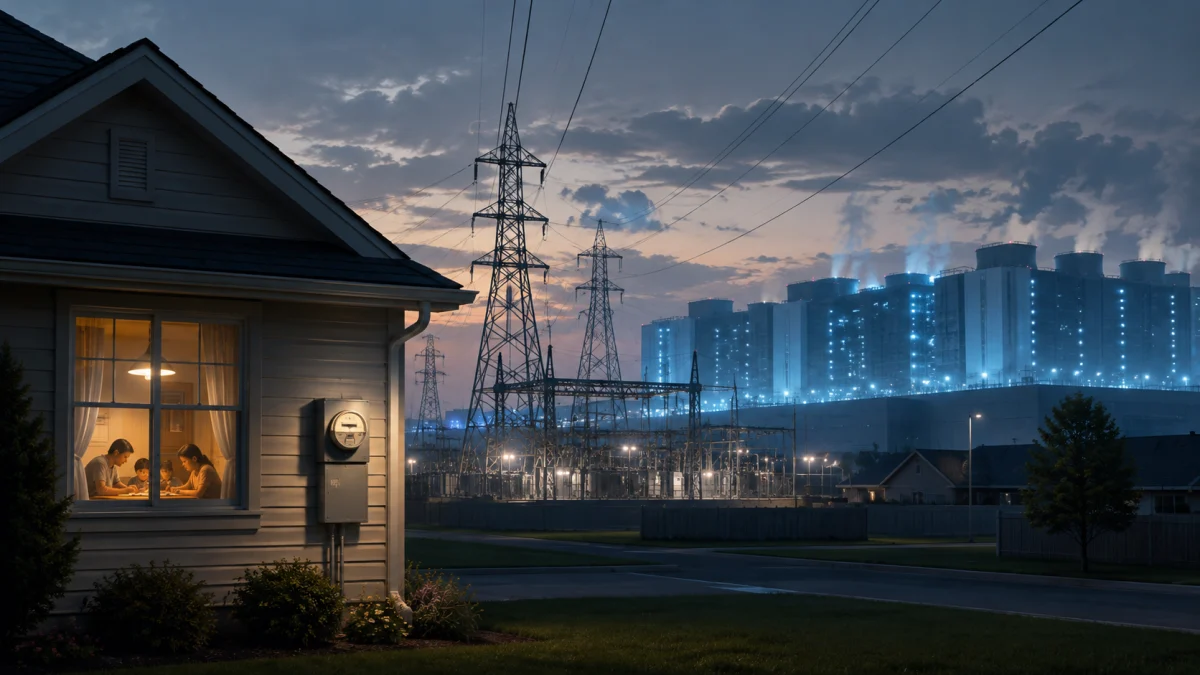
The short answer: because the American electric grid was not designed to bill every new customer for every additional system cost that customer causes.
Utilities historically build generation, substations, transmission lines and other long-lived infrastructure for an interconnected pool of customers. Regulators then allow approved costs to be recovered through electricity rates according to established cost-allocation rules. That system works reasonably well when electricity demand grows gradually and predictably.
AI data centers have disrupted that assumption.
They can add enormous amounts of concentrated electricity demand on a timeline much shorter than the grid infrastructure needed to serve them. Utilities may therefore need new power plants, transmission lines, substations and reserve capacity before anyone knows with certainty how much of the projected data-center demand will actually materialize. Unless regulators specifically assign those incremental costs and risks to the data centers causing them, some can be absorbed into the broader electric system and ultimately reach households and other businesses.
There is an equally important qualification: it is not accurate to say that every American household is currently subsidizing every AI data center.
Some data centers already pay their full allocated cost of service. Some new large-load tariffs require them to finance infrastructure directly, guarantee minimum payments or assume the risk if they abandon a project. And historically, large new electricity customers have sometimes lowered average rates by spreading fixed grid costs across more electricity sales. Virginia’s legislative watchdog, for example, concluded in 2024 that existing data centers were paying their allocated full cost of service, even while warning that future data-center growth could still raise costs for other customers.
That apparent contradiction is the key to understanding the issue.
A data center can pay its electric bill correctly and still make your electric bill higher.
What Are Regular Electricity Customers Actually Paying For?
The controversy becomes much easier to understand once four different kinds of costs are separated.
The electricity consumed inside the data center
This is the simplest part.
A data center buys electricity just as another large industrial customer does. It receives a bill under an applicable commercial or industrial tariff, including charges based on energy consumption, peak demand and other services.
Regular homeowners generally are not simply paying Amazon’s, Microsoft’s, Google’s, Meta’s or another operator’s electricity bill for them.
The harder problem begins outside the meter.
Infrastructure built specifically to connect the data center
A giant computing campus may require new transformers, substations, distribution facilities or transmission connections.
Whether those facilities are paid directly by the customer or incorporated into broader utility rates depends on the jurisdiction, tariff and type of infrastructure. Regulators increasingly are concluding that facilities constructed principally or exclusively because one enormous customer showed up should not automatically be financed by everybody else.
That is precisely what happened in Virginia on August 5, 2026. The State Corporation Commission ordered data centers to cover transmission infrastructure built exclusively for those facilities rather than spreading those particular costs among ordinary ratepayers.
The fact that regulators are now changing these rules is itself revealing: the old allocation system was not necessarily designed for customers arriving with power requirements comparable to major industrial complexes or small cities.
Shared generation and transmission infrastructure
This is where the question becomes much more complicated.
Suppose a 500-megawatt data-center cluster arrives and causes the regional system to need another transmission project or additional generation.
The resulting infrastructure may not serve only that data center. Once constructed, a transmission line becomes part of an interconnected network. A generating plant may serve thousands or millions of customers. Grid planners may conclude that an upgrade improves reliability for an entire region.
That makes cost causation harder to isolate.
Under traditional cost-of-service regulation, regulated utilities are generally allowed to recover prudently incurred costs for useful utility investments. Investor-owned utilities may also earn an authorized return on assets included in their rate base. Costs are then allocated among customer classes through regulated rates.
That does not mean a utility can build anything it wants and automatically send homeowners the bill. Regulators review investments, determine whether costs are recoverable and establish how those costs are allocated.
But it does mean the default American utility system begins with a concept of a shared network, not a rule that every incremental piece of infrastructure must be traced back to the private company whose arrival made it necessary.
That distinction has become enormously important in the AI era.
The price of scarcity itself
There is another mechanism that is not technically a subsidy at all.
A data center can pay every charge regulators assign to it and still make electricity more expensive for everybody else by increasing demand in a constrained market.
That is already visible in PJM, the massive regional electricity market covering much of the Mid-Atlantic and Midwest.
PJM operates a capacity market in which electricity suppliers are paid not merely for generating electricity but for maintaining enough future capacity to meet expected peak demand. When expected demand rises faster than available supply, capacity becomes more valuable.
Data centers have dramatically changed that calculation.
Monitoring Analytics, PJM’s independent market monitor, calculated that including existing and forecast data-center load increased capacity-market revenues by approximately $9.33 billion for the 2025–26 auction, $7.27 billion for 2026–27 and $6.50 billion for 2027–28.
Across those three auctions, the calculated increase totaled approximately $23.1 billion.
The monitor described data-center growth as the primary reason for the recent tight supply-demand balance and high capacity prices.
This $23.1 billion figure requires an important qualification.
It is not $23.1 billion that utilities secretly spent building private data-center infrastructure.
It is Monitoring Analytics’ estimate of how much the inclusion of data-center demand increased total revenues in PJM’s capacity auctions compared with a counterfactual without that data-center load. Capacity costs are paid by entities serving electricity demand across the market, with the eventual effect on retail customers depending on each state’s and utility’s rate structure.
Economically, however, the distinction may not comfort someone whose bill rises.
The data center can be paying its share of the resulting high capacity price while simultaneously helping create a high capacity price that everyone else must also confront.
This Is the Distinction Most Arguments About Data Centers Miss
There are really several different questions hidden inside the claim that Americans are “subsidizing” AI data centers.
Is a household directly paying infrastructure costs that should have been assigned to a data center? That is a genuine cost-allocation or cross-subsidy question.
Is the data center paying its allocated costs but causing electricity to become scarcer and therefore more expensive for everyone? That is primarily a market-price effect.
Did a utility build billions of dollars of infrastructure based on projected data-center demand that never appeared? That is a stranded-asset problem.
Did a state separately offer tax exemptions or other economic-development incentives to attract the data center? That is a taxpayer-subsidy question and should not be confused with electricity-rate design.
These mechanisms can coexist, but they are not interchangeable.
Calling all of them simply “Big Tech getting free electricity” misses how the cost transfer actually works.
Why Was the Electric System Designed This Way in the First Place?
Because historically, sharing infrastructure costs often made economic sense.
Electric grids contain enormous fixed costs. Power plants, transformers, substations and transmission networks must exist before individual kilowatt-hours can be delivered.
Adding another stable industrial customer can sometimes make the system more efficient because more electricity sales contribute toward infrastructure that already exists.
That is not merely a theoretical defense offered by utilities.
A June 2026 working paper by Asa Watten, John Bistline and Geoffrey Blanford estimated that data-center growth was associated with modestly lower average U.S. retail electricity rates between 2015 and 2024. The authors attribute that result in part to economies of scale and the spreading of fixed costs, while explicitly warning that future supply constraints could reverse the effect. The research was released as a working paper and should therefore not be treated as the final word on the subject.
Virginia’s Joint Legislative Audit and Review Commission reached a similarly nuanced conclusion from a different direction: existing data centers appeared to be paying their allocated full cost of service, but the extraordinary future growth in electricity demand was still expected to increase costs for other customers and create new financial risks.
Both findings can be true.
A large new customer is beneficial when its revenue exceeds the incremental cost and risk of serving it.
The problem begins when the next megawatt is much more expensive to provide than the previous megawatt was.
That is increasingly the situation facing parts of the United States.
AI Has Changed the Scale of the Electricity Problem
For years, U.S. electricity consumption was remarkably flat.
That era is ending.
The U.S. Energy Information Administration said in January 2026 that the country was entering its strongest four-year period of electricity-demand growth since 2000, fueled substantially by large computing facilities. Its 2026 Annual Energy Outlook likewise identified data-center server use as a major driver of long-term electricity growth.
Lawrence Berkeley National Laboratory’s June 2026 update projects that data centers could account for approximately 11.8% of all U.S. electricity consumption by 2030, with modeled outcomes ranging from 9.5% to 15.3%.
That is not ordinary economic growth arriving one subdivision or factory at a time.
FERC Commissioner David Rosner described today’s large loads in June 2026 as substantially larger and more geographically concentrated than traditional load growth, with some capable of changing consumption extremely rapidly. FERC concluded that these loads are creating significant demand for additional transmission and electricity supply.
Georgia provides a striking example of how quickly utility planning assumptions have changed. State regulators reported in March 2026 that Georgia Power’s forecast for new generation needs had jumped from roughly 400 megawatts in 2022 to several thousand megawatts shortly afterward. In December 2025, regulators approved approximately 9,985 megawatts of additional generation under an agreement in which roughly 80% of the need was expected to be associated with data centers.
When demand changes that rapidly, rate systems built around periodic regulatory proceedings can struggle to keep up.
The Hidden Problem Is the Difference Between Average Cost and Incremental Cost
Suppose an industrial customer joins a utility system whose existing infrastructure can already accommodate it.
That customer may contribute millions of dollars toward fixed costs without requiring much new investment. Everyone can benefit.
Now consider a data center that requires an entirely new substation, transmission upgrades, generation capacity and reliability reserves.
Charging that customer the historical average cost of serving its customer class may not recover the full incremental cost caused by its arrival.
That distinction becomes especially important when cost-allocation studies are updated only periodically.
Virginia’s independent analysis identified precisely this problem. Rapidly changing customer usage can create regulatory lag in which cost allocations temporarily fail to reflect the new composition of the system. During those periods, residential customers can contribute more while rapidly expanding large-load classes contribute less than they ultimately would after allocations are updated.
The same analysis stressed that data centers should contribute at least the marginal costs they create if other customers are to be protected from inappropriate cost shifting.
This helps explain why saying “the data center pays the tariff” does not completely answer the question.
The real question is whether the tariff accurately captures the new costs and risks created by that particular load.
What Happens If the Data Center Never Shows Up?
This may be the most underappreciated risk of the AI infrastructure boom.
Electric infrastructure lasts for decades.
AI investment decisions can change in months.
A technology company may announce multiple possible sites while deciding where a project will ultimately be built. Developers can reduce a project’s size, delay construction, abandon it or obtain power somewhere else.
A utility, meanwhile, may have already started planning or financing infrastructure based on the expected load.
If billions of dollars are spent and the expected customer never arrives—or arrives at a fraction of its projected scale—the infrastructure does not disappear.
Someone still has to pay for it.
The Department of Energy’s large-load tariff guidance explicitly identifies stranded assets from underutilized utility investments as one of the principal financial risks regulators should address. DOE points to tools such as minimum demand charges, collateral requirements, long contracts and exit fees to ensure the customer responsible for the investment continues contributing even if its actual electricity consumption falls below projections.
Ohio has now incorporated several of those protections into its data-center rules. Large data-center customers can face minimum demand charges, collateral requirements, contracts lasting eight to 12 years and exit fees if they leave early. The Public Utilities Commission of Ohio says the purpose is explicitly to avoid overbuilding infrastructure and shifting those costs onto other customers.
This is effectively a take-or-pay principle:
If the electric system spends money because you promised to need enormous amounts of power, you should not be able to disappear and leave everyone else paying the mortgage.
Why Don’t Regulators Simply Make Data Centers Pay for Everything?
Increasingly, they are trying.
But “everything” is harder to define than it sounds.
A substation constructed exclusively for one campus presents a relatively straightforward case.
A regional transmission line that is accelerated because of data-center growth but also improves reliability for several million people presents a harder one.
So does a new power plant supplying a regional wholesale market.
Electric regulation is also divided among different authorities. State utility commissions generally oversee retail rates and many utility investments, while FERC regulates interstate wholesale electricity markets and transmission.
Federal law also requires regulated rates to be just, reasonable and not unduly discriminatory. Regulators cannot simply impose arbitrary punitive prices on one category of customer because it is politically unpopular. Cost allocation must be defensible. DOE’s large-load rate-design guidance therefore focuses heavily on cost causation, fair allocation and protection of non-participating ratepayers.
There is another practical complication: states actively compete for large technology investments.
Data centers can produce construction activity, property-tax revenue and associated economic development. Regulators therefore face two objectives that can pull in opposite directions: make a state attractive to investment while ensuring existing electricity customers are not being used to subsidize that investment.
The rational policy is not necessarily to prevent data centers from connecting.
It is to make the economics transparent enough that regulators know whether existing customers are actually benefiting from the new load.
Virginia Is Becoming a Test Case for Making Data Centers Pay More Directly
Virginia is particularly important because of the extraordinary concentration of data centers in the state.
Its policy has evolved rapidly.
In November 2025, the State Corporation Commission approved a new GS-5 customer class for Dominion Energy customers demanding at least 25 megawatts. The new class is intended to treat enormous customers differently from conventional industrial loads rather than forcing legacy tariffs to accommodate a fundamentally different scale of electricity use.
Dominion’s large-load framework has included minimum billing requirements tied to a substantial percentage of contracted transmission, distribution and generation capacity, along with long contract terms, deposits and collateral intended to protect other customers from abandoned or underused infrastructure.
Then, on August 5, 2026, Virginia regulators went further by requiring data centers to pay for transmission infrastructure constructed exclusively for their developments rather than spreading those costs across other ratepayers.
The change does not magically isolate every regional cost created by data-center demand.
It does establish a much clearer principle:
When infrastructure can reasonably be traced to a specific giant customer, that customer should pay for it.
Oregon Shows What Happens When Regulators Actually Reallocate the Costs
Oregon provides one of the clearest recent real-world demonstrations.
The Oregon Public Utility Commission approved a dedicated large-data-center rate class under the state’s POWER Act to better assign infrastructure costs and risks to the customers causing them.
When Portland General Electric subsequently implemented the revised allocation, the result was unusually visible.
The Oregon PUC reported that affected data-center customers would see average rates increase by about 29%.
Residential rates would decrease by approximately 1.3%.
A typical residential customer using 780 kilowatt-hours per month was expected to save about $1.91 per month.
That does not prove Oregon’s previous rates represented a 29% subsidy to data centers; rate changes incorporate the redesigned allocation methodology and customer classifications.
But it provides unusually tangible evidence that who regulators assign system costs to can materially alter what households pay.
Georgia and Ohio Are Building Similar Protections
Georgia regulators approved rules in January 2025 allowing Georgia Power to impose specialized terms on new data centers specifically to protect other customers from cost shifting.
When nearly 10 gigawatts of new generation were later approved—with most expected to serve large customers such as data centers—the Georgia Public Service Commission structured its agreement around protecting existing ratepayers from those incremental costs.
Ohio followed the same broad philosophy.
The Public Utilities Commission of Ohio ordered AEP Ohio to create a specialized data-center tariff in 2025 and subsequently approved minimum monthly charges intended to ensure new data centers pay for grid costs created on their behalf. On August 5, 2026, the commission ordered additional protections addressing the potential effect of data-center demand on energy prices themselves.
Notice how the policy has evolved.
Regulators initially focused on infrastructure cost shifting.
They are increasingly recognizing that market-price effects also matter.
That second problem is considerably harder to solve.
PJM Shows Why “Just Make Them Pay for Their Infrastructure” Is Not Enough
Imagine a data center pays 100% of the cost of its own substation and every transmission line constructed exclusively to connect it.
That still does not create another gigawatt of generating capacity.
If the entire regional system is already tight, the data center’s arrival increases competition for available electricity and capacity.
Everybody can then pay more.
That is essentially the problem Monitoring Analytics has identified in PJM.
Its proposed answer goes beyond changing an electric tariff. The market monitor has recommended that large new data centers be required to bring new generation with locational and temporal characteristics reasonably matched to their demand, potentially through an expedited process connecting the new load and new supply together.
Whether that exact proposal ultimately prevails is a regulatory question.
But its economic logic is straightforward.
If a new 500-megawatt customer arrives while adding roughly 500 megawatts of dependable new supply, the customer’s effect on scarcity is profoundly different from arriving and bidding for 500 megawatts from an already constrained system.
FERC Has Now Acknowledged That the Existing Rules May Not Be Good Enough
This issue is no longer confined to individual states.
On June 18, 2026, the Federal Energy Regulatory Commission issued show-cause orders involving all six organized regional transmission operators and independent system operators under its jurisdiction.
FERC preliminarily concluded that existing tariffs may be unjust, unreasonable or unduly discriminatory because they do not adequately address the rapid integration of large and co-located loads. Among the specific issues identified were cost shifting, transmission-upgrade transparency and mechanisms ensuring that customers serving large loads remain responsible for costs incurred on their behalf.
That is a significant development.
The federal regulator responsible for interstate electricity markets is effectively asking whether rules written for an earlier electricity system are still appropriate when enormous computing loads can appear with unprecedented speed and concentration.
As of August 9, 2026, that regulatory process is still developing.
The ultimate national framework has not yet been settled.
What About the White House Ratepayer Protection Pledge?
The Trump administration has also explicitly embraced the principle that AI companies should not make households finance their expansion.
In March 2026, the White House announced a Ratepayer Protection Pledge under which participating hyperscalers committed to build, bring or buy the generation needed for their data centers and pay for new power-delivery infrastructure associated with those facilities.
In July, the White House announced an expansion involving more than 200 utilities, developers, cooperatives and states. The administration says participating entities collectively account for roughly 80% of electricity delivered to American homes and businesses and potentially cover 263 million Americans. Those are White House figures describing the reach of the pledge, not an independently verified guarantee that every future data-center-related cost affecting those customers has been eliminated.
The distinction matters because a pledge is not the same thing as a nationwide statutory cost-allocation regime.
Actual consumer protection still depends on utility tariffs, contracts, state regulatory orders, wholesale-market rules and enforcement.
The pledge nonetheless demonstrates how far the issue has moved politically: protecting ordinary ratepayers from AI infrastructure costs is now an explicit national policy objective rather than a niche utility-regulation dispute.
Are Tech Companies Getting Special Cheap Electricity Rates?
Sometimes large industrial customers pay lower average prices per kilowatt-hour than households, but that fact alone does not establish a subsidy.
Serving one giant facility at high voltage can be materially different from serving hundreds of thousands of individual houses through neighborhood transformers, local distribution wires, meters and customer-service systems.
The better question is therefore not:
“Does the data center pay the same cents per kilowatt-hour that I do?”
It is:
“Does the data center’s total contribution cover the incremental generation, transmission, distribution, capacity and financial risks that the system incurs because it is there?”
That is the cost-causation test increasingly being applied by regulators.
If the answer is yes, lower per-unit electricity prices do not necessarily represent a subsidy.
If the answer is no, someone else is paying the difference.
Why Would Utilities Agree to Build All of This?
There is another uncomfortable piece of the economics.
For a traditional investor-owned utility, capital investment is part of the regulated business model.
Utilities raise capital to construct approved infrastructure. Regulators then generally allow prudently incurred investments that are used and useful to enter the rate base, where the utility can recover associated costs and earn an authorized return on invested capital.
That does not establish that utilities are deliberately overbuilding the grid for profit. Regulators can disallow imprudent expenses, and enormous projects create genuine financing and operational risks.
But it does mean utility shareholders and utility customers occupy different positions.
A new transmission line can become an earning asset for an investor-owned utility.
For a household, that same transmission line is a cost embedded somewhere in future electricity rates.
That structural difference is exactly why strong independent regulation matters.
The Most Dangerous Scenario Is Not a Successful Data Center
Ironically, a fully utilized data center operating for several decades may be relatively easy to manage financially.
It consumes enormous quantities of electricity and generates enormous quantities of utility revenue.
The more dangerous scenario for ratepayers is a speculative data-center boom followed by cancellations or major reductions in expected demand after the grid has already started building for it.
Utilities and grid planners are working from forecasts involving technologies whose economics are changing extraordinarily quickly.
AI models may become more energy efficient.
Computing architectures may change.
Companies may concentrate workloads elsewhere.
Projects announced in multiple jurisdictions may never all be constructed.
That uncertainty is why collateral, minimum payments, long-term contracts and exit fees matter at least as much as the headline electricity price.
The customer making the forecast should bear a meaningful portion of the risk that the forecast is wrong. DOE, Ohio regulators and FERC have all explicitly recognized stranded infrastructure as a major concern in the new large-load environment.
What Would It Actually Mean for AI Data Centers to “Pay Their Own Way”?
A serious ratepayer-protection system would not simply charge data centers a politically determined premium.
It would follow cost causation as closely as practical.
Infrastructure built exclusively or predominantly for a specific facility would be directly assigned where justified. Large-load customers would make binding financial commitments before utilities make enormous investments on their behalf. Minimum-billing requirements would continue recovering costs even when actual usage falls below promised demand. Long contracts, collateral and exit fees would protect customers against abandoned projects. Cost-of-service studies would be updated frequently enough that rapidly changing electricity consumption does not leave old customer classes carrying obsolete allocations.
The harder question is regional supply.
If adding a giant data center materially raises capacity or energy prices for everybody, merely reimbursing the utility for the connection infrastructure does not fully protect existing customers. Regulators must then consider additional generation requirements, capacity procurement, flexible-load arrangements, interruptible service or other mechanisms that prevent a new private load from simply consuming an increasingly scarce public-grid resource at everybody else’s expense.
The governing principle should be simple:
Existing customers should not be financially worse off merely because the utility agreed to serve a new extremely large customer.
That does not require hostility toward AI.
It requires competent accounting.
So Why Are Regular Americans Paying for AI Data Center Power Infrastructure?
Because the American electricity system historically treats much of the grid as shared infrastructure.
Utilities forecast demand, build long-lived assets and recover approved costs across customer classes. Regional electricity markets likewise spread the consequences of changing supply and demand across every participant.
AI data centers arrived at a scale and speed that exposed weaknesses in those arrangements.
In some places, infrastructure specifically driven by a data center has been included in broader utility costs.
In others, the more important effect is indirect: data-center demand is tightening electricity markets and raising capacity or generation costs even when those facilities pay every charge formally assigned to them.
And looming over both is the possibility that utilities build expensive infrastructure for projected AI demand that never fully appears, leaving remaining customers responsible for assets constructed on somebody else’s forecast.
That is why the most accurate answer is not “Americans are paying AI companies’ electric bills.”
It is this:
Americans can end up paying part of the infrastructure costs, market-price consequences and financial risks created by AI data centers because legacy electric-rate systems do not automatically isolate every incremental cost caused by one enormous new customer.
That system is now being rewritten.
Virginia is directly assigning more transmission costs to data centers. Oregon has shifted substantial costs into a dedicated data-center rate class. Georgia and Ohio have introduced minimum payments and other protections. FERC is examining large-load tariffs across every organized market under its jurisdiction. And the federal government is publicly pressing AI companies to supply their own incremental power and infrastructure.
The remaining unanswered question is no longer whether the problem exists.
It is whether regulators can redesign the rules quickly enough to keep the historic AI infrastructure buildout from becoming a decades-long obligation on people who never agreed to finance it.
Frequently Asked Questions
Are AI data centers actually raising residential electric bills?
In some regions, there is strong evidence that data-center demand is raising system costs, but there is no defensible single national number.
PJM’s independent market monitor calculated that existing and forecast data-center demand increased capacity-market revenues by approximately $23.1 billion across three auctions. The eventual residential effect varies by state, utility and retail rate structure.
At the same time, historical national research covering 2015 through 2024 found data-center growth was associated with modestly lower average retail rates, illustrating that large customers can benefit existing ratepayers when the system has sufficient capacity and their revenues exceed incremental costs. That historical finding does not establish that today’s much larger AI-driven loads will have the same effect.
If data centers pay their electric bills, how can they still increase mine?
Because your bill depends on more than their bill.
A huge new customer can cause construction of shared transmission and generation, increase capacity requirements or raise wholesale electricity prices. The data center may pay its proportional share of those higher costs while the same higher prices are also applied to millions of existing customers.
Why can’t the utility simply send the data center a bill for the new power plant?
Sometimes it effectively can, particularly for infrastructure clearly dedicated to one customer.
It becomes harder when a plant or transmission project serves the entire interconnected system. Regulators then have to determine how much of the investment was actually caused by the new customer and how much benefits everybody else.
Could data centers eventually lower electric rates?
Yes.
If a data center operates reliably for many years, pays enough to cover the additional infrastructure and contributes substantial revenue toward existing fixed costs, other customers can benefit.
That is one reason a blanket statement that data centers always raise electricity prices is not supported by the evidence.
What is a stranded asset?
A stranded asset in this context is electricity infrastructure constructed for expected demand that later becomes underused or unnecessary.
If a utility builds a substation, transmission upgrade or generation resource because a massive data center promised to arrive and the project is later canceled, somebody must still repay the investment.
Minimum bills, deposits, collateral, long contracts and exit fees are designed to put more of that risk on the large customer rather than existing ratepayers.
Is every American currently subsidizing AI data centers?
No.
Electricity regulation varies enormously across states, utilities and regional markets. Some jurisdictions now have strong protections assigning incremental costs directly to data centers. Others are still developing them.
The accurate claim is that the structure of the U.S. electric system can expose ordinary customers to data-center-related costs and risks unless regulators deliberately prevent that exposure.
Does making data centers build their own power solve the problem?
It can solve a major part of it, particularly if the new generation genuinely matches the location, timing and reliability characteristics of the data center’s demand.
But details matter. A facility that technically owns generation while relying heavily on the public grid during periods of scarcity can still impose costs on the larger system.
This is why Monitoring Analytics has proposed matching new large data-center demand with new generation and why FERC is examining the rules governing large-load connections more broadly.
Is the Ratepayer Protection Pledge legally enough to prevent future cost shifting?
Not by itself.
The pledge establishes a federal policy commitment by participating companies and organizations, but actual electricity rates and cost responsibility are ultimately determined through tariffs, contracts, utility regulators and wholesale-market rules.
Its importance is therefore partly political: it establishes that major technology companies and the federal government now publicly accept the principle that households should not have to subsidize the incremental electricity infrastructure required by AI expansion.
Conclusion
The debate over AI data centers and electricity prices is often framed too crudely.
One side says Big Tech is forcing families to pay for private infrastructure.
The other responds that data centers pay enormous electricity bills and therefore cannot possibly be subsidized.
Neither statement adequately describes what is happening.
A data center can pay millions of dollars every month for electricity, cover its directly assigned infrastructure costs and still make electricity more expensive for everybody around it.
That happens because electric grids are interconnected networks. New demand can trigger shared investment, alter wholesale prices, tighten capacity markets and create long-term financial obligations based on forecasts that may or may not prove correct.
The central policy question therefore is not whether AI data centers should exist, nor whether electricity infrastructure should be expanded.
It is who should bear the incremental cost and risk of that expansion.
For most of the history of the electric grid, existing regulatory systems were good enough at answering that question because demand changed slowly.
AI has made the question urgent.
And the emerging answer—from Virginia to Oregon, Georgia, Ohio, FERC and increasingly the federal government—is that when a private customer creates an extraordinary new requirement for electricity infrastructure, ordinary customers should not automatically be the financial backstop.
References and Further Reading
- Lawrence Berkeley National Laboratory — United States Data Center Energy Usage Report: 2025 Update — June 2026 national data-center electricity projections.
- U.S. Department of Energy — Electricity Rate Designs for Large Loads: Evolving Practices and Opportunities — Detailed examination of cost allocation, stranded assets, minimum billing, exit fees and large-load tariffs.
- Monitoring Analytics — 2025 State of the Market Report for PJM — Independent PJM market-monitor analysis, including data-center effects on capacity-market costs.
- Federal Energy Regulatory Commission — FERC Launches Targeted Action to Speed Large Load Integration — June 18, 2026 large-load tariff proceedings covering all six FERC-jurisdictional RTOs and ISOs.
- Federal Energy Regulatory Commission — Items E-7 through E-12: RTO/ISO Show Cause Orders — FERC’s preliminary findings concerning large-load tariffs, cost shifting and transmission integration.
- Virginia Joint Legislative Audit and Review Commission — Data Centers in Virginia — Major independent state review of data-center electricity demand, rate allocation, infrastructure and economic effects.
- Virginia State Corporation Commission — SCC Creates New Class for Large-Scale Energy Users — November 2025 decision establishing Dominion’s GS-5 large-load class.
- Virginia Governor’s Office — SCC Requires Data Centers to Pay for New Transmission Infrastructure — August 5, 2026 announcement concerning direct responsibility for data-center-specific transmission infrastructure.
- Oregon Public Utility Commission — PUC Approves New Rate Structure to Protect Customers Amid Rapid Data Center Growth — Oregon’s Schedule 96 large-data-center rate structure.
- Oregon Public Utility Commission — PGE Rate Updates Resulting in Higher Bills for Data Centers and Lower Bills for Other Customers — 2026 implementation showing a 29% average data-center increase and 1.3% residential decrease.
- Georgia Public Service Commission — Data Center Fact Sheet — Georgia’s generation expansion and ratepayer-protection framework.
- Georgia Public Service Commission — PSC Approves Rule to Allow New Power Usage Terms for Data Centers — January 2025 rule addressing data-center cost shifting.
- Public Utilities Commission of Ohio — Data Centers and Electricity — Ohio overview of collateral, minimum demand charges, long contracts and exit-fee protections.
- Public Utilities Commission of Ohio — PUCO Sets Process to Protect AEP Ohio Customers From Potential Data Center Costs — August 5, 2026 action addressing data-center effects on energy prices.
- National Association of Regulatory Utility Commissioners — Ratemaking Fundamentals and Principles — Primer on rate base, recoverable utility costs and regulatory ratemaking.
- Federal Energy Regulatory Commission — Formula Rates in Electric Transmission Proceedings — Explanation of transmission cost-of-service regulation and authorized returns on invested capital.
- U.S. Energy Information Administration — EIA Forecasts Strongest Four-Year Growth in U.S. Electricity Demand Since 2000, Fueled by Data Centers — January 2026 national electricity-demand outlook.
- Watten, Bistline & Blanford — Have Data Centers Raised Your Electric Bill? Causal Evidence from the United States — June 2026 working paper finding historically lower average retail rates associated with data-center growth while warning that future supply constraints may produce different results.
- The White House — Ratepayer Protection Pledge — March 2026 commitment concerning data-center generation and infrastructure costs.
- The White House — Expansion of the Ratepayer Protection Pledge — July 23, 2026 announcement expanding participation in the pledge.