
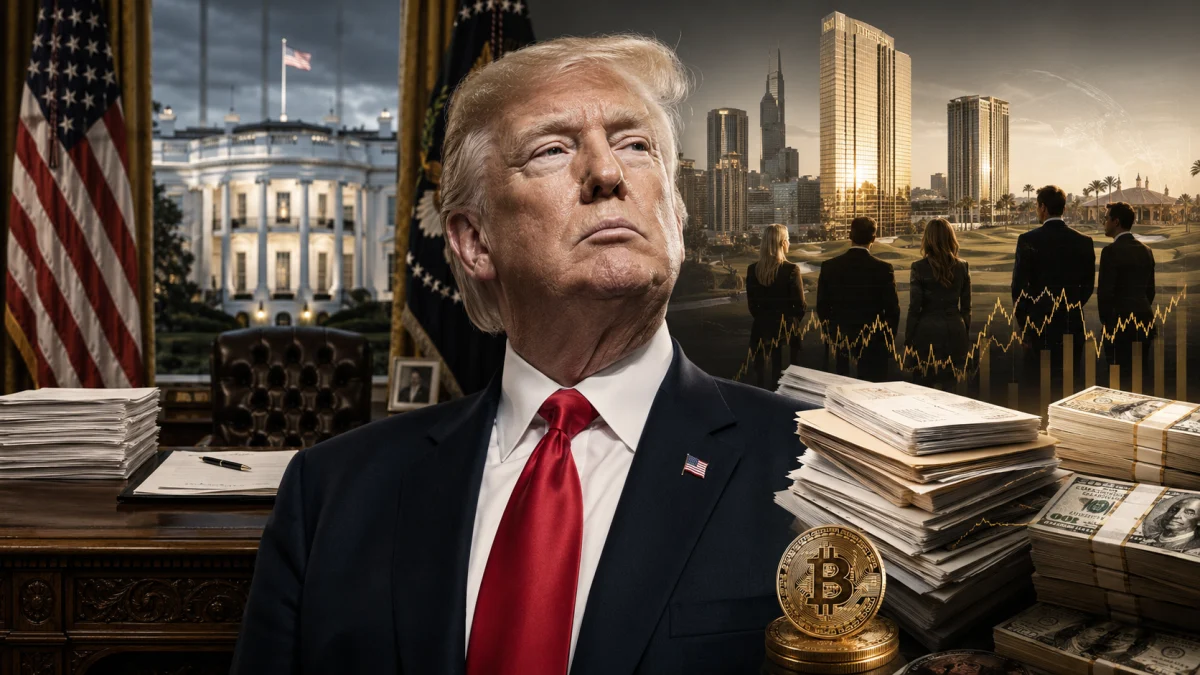
Americans do not pay taxes so the president can increase the value of his hotels, golf clubs, cryptocurrencies, stock portfolio, licensing agreements or family businesses.
They pay for national defense, public safety, infrastructure, health programs, benefits, diplomacy and the neutral administration of law. The presidency exists to serve the public. That is the baseline against which presidential financial conduct should be judged.
Donald Trump has never fully separated himself from the commercial empire that bears his name. He has placed certain assets under family-controlled trusts, delegated management to his sons and said that outside financial institutions make many investment decisions. But he remains the beneficiary of substantial holdings whose revenue, value and commercial opportunities can be affected by decisions made by the federal government he controls.
During his second administration, that conflict has expanded beyond hotels and golf resorts. It now includes cryptocurrencies, stablecoins, a publicly traded media company, thousands of securities transactions, foreign real-estate licensing, media settlements directed toward presidential projects and an attempted legal agreement with Trump-controlled federal agencies that purported to provide broad protections to Trump, his relatives and affiliated businesses.
Not every payment to a Trump business has been proven to purchase an official act. Not every stock transaction was necessarily chosen by Trump. Not every foreign project altered American policy. Ordinary product sales are not automatically corrupt.
But that is not the complete ethical question.
The more important question is why a president should retain financial channels through which governments, corporations, wealthy individuals, regulated industries and foreign nationals can transfer value to him or his family while seeking decisions from his administration.
The documented answer is that Trump has maintained—and in several areas expanded—a system in which public power and private profit repeatedly intersect.
The Bottom Line
The available evidence supports five central conclusions:
- Trump did not meaningfully divest from his business interests. Family management is not the same as independent ownership, and the president remains the beneficiary of assets affected by federal policy.
- The presidency generates commercial value for the Trump family. It increases attention, access, brand visibility, customer demand, negotiating leverage and the strategic value of doing business with Trump-affiliated enterprises.
- Parties affected by presidential decisions can deliver financial value through multiple channels. These include property payments, licensing fees, token purchases, investments, stock appreciation, legal settlements, inaugural donations and contributions to presidential legacy projects.
- Some of the clearest evidence goes beyond mere appearance. In July 2026, a federal judge found that Trump and his co-plaintiffs acted in bad faith in litigation involving the IRS and Treasury, describing an attempt to use federal litigation to legitimize an agreement that would confer protections on Trump-affiliated people and entities while potentially earmarking taxpayer money.
- Specific quid pro quos remain unproven in many cases. The evidence does not establish that every buyer, donor, investor or foreign partner received a particular government favor. But democratic ethics do not require the public to wait for a recorded bribe before recognizing a corrupt system of incentives.
What Does “Corruption” Mean in This Investigation?
The word corruption is often treated as if it applies only when prosecutors can prove a criminal bribe.
That definition is too narrow.
Criminal corruption
Criminal bribery generally requires evidence that something of value was exchanged for a specific official act. Fraud, unlawful gratuities, campaign-finance violations and other crimes have their own legal elements.
Those are questions for investigators, prosecutors and courts.
Constitutional corruption
The Constitution’s Foreign and Domestic Emoluments Clauses were written to prevent presidents from receiving certain benefits from foreign governments, states or the federal government beyond their official compensation.
Litigation alleging that Trump violated the Emoluments Clauses during his first term did not produce a definitive Supreme Court ruling on the merits. After Trump left office in 2021, the Supreme Court vacated lower-court judgments and directed that the cases be dismissed as moot. That procedural ending did not amount to a ruling that the underlying payments were constitutional. (Supreme Court)
Institutional corruption
Institutional corruption occurs when public authority becomes systematically entangled with private advantage—even when prosecutors cannot prove that one payment purchased one decision.
A president creates an institutional corruption problem when:
- he retains assets affected by his own policies;
- people seeking government action can enrich him through commercial transactions;
- the identity of those transferring value is hidden or difficult to trace;
- his family manages the businesses while he remains the beneficiary;
- public resources create demand for his properties;
- government decisions affect the value of financial products he owns;
- or agencies under his control negotiate legal or financial benefits for him.
This article uses corruption primarily in that democratic and institutional sense. Criminal findings are identified separately.
A Public-Purpose Test for Presidential Conduct
Every financial arrangement examined below can be evaluated through four questions:
First, does the president or his family retain a financial interest?
Second, can someone affected by federal power transfer value through that interest?
Third, does the president control policies, agencies or decisions that can affect the payer or the asset?
Fourth, are the safeguards genuinely independent, enforceable and transparent?
Where the first three answers are yes and the fourth is no, the public faces more than a theoretical conflict.
It faces a privately profitable presidency.
The Foundational Conflict: Trump Never Truly Divested
Most federal employees are subject to criminal conflict-of-interest rules that can require recusal or divestiture when they participate in matters affecting their financial interests.
The president and vice president are exempt from the principal federal criminal conflict statute covering executive-branch employees. The Office of Government Ethics has long recognized that exemption. But exemption from one criminal statute does not mean that presidential conflicts are ethically acceptable. (US OGE)
When Trump entered office in 2017, then-Office of Government Ethics Director Walter Shaub explained that Trump’s proposed family-managed trust was not a blind trust. Trump knew what assets it contained, retained the economic benefits and placed management in the hands of his sons. Shaub said divestiture was the only arrangement capable of resolving the conflicts rather than merely describing how they would be managed. (US OGE)
Trump again declined to divest during his second presidency.
The Trump Organization’s 2025 ethics plan said Trump would not participate in day-to-day management, that his children would manage the company and that an outside ethics adviser would review certain transactions. It also said the company would avoid new “material” transactions directly with foreign governments and would donate profits from identifiable foreign-government patronage at its properties.
However, the plan expressly permitted new business with private foreign companies. That represented a loosening of the first-term commitment against new foreign deals. Private counterparties may still depend on foreign governments for land, financing, construction approvals, regulatory permissions or political protection. (Reason.com)
The distinction between direct government transactions and private foreign transactions therefore provides less protection than it appears to provide.
A company may be nominally private while relying on a ruler, sovereign wealth fund, state-controlled bank or government-approved developer. A licensing fee can be economically valuable even when no foreign ministry writes the check.
Most importantly, management separation does not eliminate beneficial ownership.
Trump’s annual financial disclosure filed in June 2026 states that approximately 114.75 million shares of Trump Media & Technology Group were held through a revocable trust for which Trump remained the sole beneficiary. The trust could buy or sell assets. Donald Trump Jr. served as trustee. (Extapps2 OGE)
A president does not become financially disinterested simply because his son signs the paperwork.
The Strongest Case of Direct Self-Dealing: Trump, the IRS and a Purported Government Settlement
Many Trump financial conflicts involve structural risks: a foreign partner pays a licensing fee while the administration negotiates tariffs, or a cryptocurrency investor buys a token while federal regulators consider an enforcement matter.
The 2026 litigation involving Trump, the IRS and the Treasury Department was more direct.
The underlying violation was real
Trump was a victim of an illegal disclosure of tax information. A government contractor, Charles Littlejohn, pleaded guilty after disclosing tax information belonging to Trump and other wealthy taxpayers. Trump had a legitimate interest in seeking accountability and lawful compensation.
That fact matters. Ethical analysis should not erase the original wrongdoing.
The conflict arose from what happened after Trump returned to office.
Trump sued agencies under his own control
In January 2026, President Trump, Donald Trump Jr., Eric Trump and the Trump Organization sued the IRS and Treasury Department.
Trump was simultaneously the lead plaintiff and the constitutional superior of the executive-branch defendants. The federal court noted that he had direct control over the agencies and executive officials on the other side of the nominal dispute. (CourtListener)
Rather than litigating the case through a genuinely adversarial process, the parties announced a purported settlement after Trump’s side voluntarily dismissed the lawsuit.
The arrangement included:
- a formal government apology;
- a proposed $1.776 billion “Anti-Weaponization Fund” financed through the Treasury Judgment Fund;
- and a separate release order purporting to protect Trump, his relatives, companies and affiliates from an extraordinarily broad range of government claims.
The release language reached matters involving earlier tax returns and claims that had been or could have been brought by federal departments and agencies. (CourtListener)
The $1.776 billion fund was later abandoned. Acting Attorney General Todd Blanche said it would not proceed. But he initially declined to make an equivalent commitment concerning the broader tax, audit and immunity-related protections in his release order. (CourtListener)
A federal judge found bad faith
U.S. District Judge Kathleen Williams did not treat this as an ordinary settlement.
In a July 13, 2026 order, the court found that the lawsuit had not been brought to resolve a genuine dispute between adverse parties. It concluded that the litigation had been used to pursue benefits that could not properly have been obtained through the case.
The court found that Trump and his co-plaintiffs acted in bad faith. It also concluded that the parties had used federal litigation to give legitimacy to a course of action they were unwilling to subject to real judicial review. (CourtListener)
The court’s description was unusually severe. It said the arrangement represented an attempt to confer protections on people and entities affiliated with the president and to earmark billions of taxpayer dollars for grievances not defined in law. The court also criticized the Justice Department for failing to defend the United States in the manner it had defended similar cases. (CourtListener)
This was not merely an ethics organization alleging an appearance of impropriety. It was a federal judicial finding of bad-faith litigation conduct.
Why this episode is especially important
The president has the right to sue the federal government. But when a sitting president sues agencies he controls, ordinary adversarial safeguards collapse.
His subordinates cannot be treated as independent negotiating partners unless special protections are installed. Without an independent counsel, congressional approval or meaningful judicial supervision, the president is effectively negotiating with himself.
The democratic problem is straightforward:
- Trump controlled the executive branch.
- Trump and his family sought legal and financial benefits.
- Officials under Trump’s authority purported to grant those benefits.
- The arrangement was structured to avoid substantive judicial review.
- A federal court found bad faith.
Among the conduct examined in this article, this is the clearest example of presidential power being used in pursuit of direct private and family advantage.
Trump Properties: When Presidential Travel Creates Private Revenue
Trump’s hotels, golf clubs and resorts create one of the simplest financial conflicts.
When the president chooses to spend time at his own property, Secret Service agents, support staff, political allies, donors, foreign visitors and news organizations may also need rooms, meals, workspaces or event facilities.
Presidential choice creates demand. The president’s business supplies the service. Money then moves from taxpayers, campaigns or interested parties into a business benefiting the president.
Taxpayer-funded travel and lodging
The Government Accountability Office calculated that four early 2017 trips to Mar-a-Lago cost federal agencies approximately $13.6 million. That figure includes transportation, security and other government costs; it should not be mistaken for $13.6 million paid directly to Trump businesses. (Government Accountability Office)
A later House Oversight Committee Democratic staff review found that the Secret Service spent more than $1.4 million on lodging at Trump-owned properties from January 2017 through September 2021. The records were incomplete. The review identified at least 40 occasions when charges exceeded government per-diem rates, including rates as high as $1,185 per night. (Oversight Democrats)
The ethical concern is not that the president must never travel. It is that Trump repeatedly chose destinations from which he personally benefited.
An ordinary hotel owner cannot direct presidential travel to his property. Trump could.
The pattern continued during the second term
Citizens for Responsibility and Ethics in Washington, an advocacy organization that tracks Trump’s property visits, calculated that Trump spent 191 of the first 512 days of his second presidency at Trump-owned properties as of June 2026. Its tracker counted 259 property visits, including 148 golf visits and 102 visits to Mar-a-Lago. (CREW)
These figures come from an ethics watchdog rather than an official government audit, but the underlying pattern is publicly observable: presidential travel repeatedly places government personnel and political activity at businesses that benefit the president.
Political money also flows to the properties
Political committees, campaigns and allied organizations spent heavily at Trump properties during his first presidency. CREW calculated approximately $11.8 million in political spending at Trump businesses during that period. (CREW)
This is not taxpayer money, but it still converts political power into family revenue. Donors give to political organizations; those organizations patronize Trump businesses; the Trump family receives the commercial benefit.
Foreign-government patronage
A 2024 report by Democratic staff of the House Oversight Committee identified at least $7.8 million in payments from at least 20 foreign governments or state-linked entities to four Trump businesses during a limited portion of his first term. More than $5.5 million was attributed to China-related entities.
The review covered only a fraction of Trump’s properties and only part of his presidency, so it was not a complete accounting. It was also a partisan committee report rather than a judicial finding. The underlying documents nevertheless established that foreign-government money reached Trump businesses while Trump was president. (Oversight Democrats)
The Trump Organization said it donated profits from identifiable foreign-government patronage. But profit donations do not necessarily account for every financial benefit.
Foreign business can increase occupancy, revenue, market visibility, asset utilization and brand prestige. A company’s own calculation of “profit” may not capture those indirect gains.
The attempted G7 meeting at Trump Doral
In 2019, the Trump administration announced that the Group of Seven summit would be held at Trump National Doral, the president’s own resort. Trump reversed the decision after bipartisan criticism.
Because the event was relocated, the attempted arrangement did not produce the full anticipated revenue. But it remains an unusually direct example of the president attempting to steer official government activity to his private property. (WSKG)
The properties remain highly valuable businesses
Trump’s 2026 annual disclosure reported substantial 2025 revenue from his properties, including approximately:
- $121.9 million from Trump National Doral;
- $77.5 million from Mar-a-Lago;
- $37.6 million from Bedminster;
- $36.9 million from Trump International Golf Club in West Palm Beach;
- and $31.6 million from Trump National Golf Club in Jupiter.
These figures are generally reported revenue, not necessarily net profit. They also do not prove that every dollar resulted from presidential activity. They do demonstrate that Trump retained major operating businesses while directing the government and repeatedly visiting those same businesses. (Extapps2 OGE)
Foreign Licensing Deals: Diplomacy and Family Business on the Same Map
Trump’s second-term ethics arrangement allows new business with private foreign companies. That has enabled the Trump Organization to continue expanding internationally while the administration negotiates tariffs, security arrangements, arms sales, sanctions, investment agreements and diplomatic initiatives involving the same countries.
Vietnam
A Trump-branded golf and real-estate project in Vietnam was valued at approximately $1.5 billion. Reuters reported that the local developer paid the Trump Organization a $5 million licensing fee and that the project moved rapidly through government approvals while Vietnam was negotiating over threatened U.S. tariffs.
The project also displaced local farmers, according to Reuters’ reporting. (The Star)
This sequence does not prove that Vietnam received favorable tariff treatment in exchange for helping a Trump project. No public evidence establishes such an agreement.
But the conflict is serious even without that proof.
The president controlled U.S. tariff policy. Vietnamese officials controlled permissions important to a Trump-branded development. Trump’s family received licensing revenue. Each side possessed something valuable to the other.
A system designed to protect public integrity would prevent that overlap rather than demand proof of a secret trade after the fact.
Qatar
In 2025, Qatari Diar and Dar Global announced a Trump-branded golf club, villas and luxury development in Qatar. Qatari Diar is a state-backed real-estate company, while the Trump name was being used under a licensing arrangement.
The announcement came as the Trump administration was conducting major diplomatic and commercial discussions with Qatar and other Gulf states. (StreetInsider.com)
Again, the existence of the deal does not prove that a particular U.S. policy was sold.
It does show that a foreign state-linked enterprise could help create value for the president’s family while the president made decisions affecting that state.
Disclosed Foreign Licensing Income: Saudi Arabia, India, Vietnam, Oman and Other Markets
Trump’s 2026 disclosure reported millions of dollars in foreign licensing and management income, including approximately:
- $9.24 million associated with Saudi Arabia;
- $5 million associated with Vietnam;
- $3.64 million from a Gurgaon, India arrangement;
- $1.8 million from another Delhi or Gurgaon project;
- $1.5 million each from projects associated with Hyderabad, Noida, the Philippines and Pune;
- and approximately $950,000 associated with Oman.
These figures do not establish that foreign governments made the payments directly. Many arose through private developers. But the value of those projects often depends on government-controlled land, permits, financing and political relationships. (Extapps2 OGE)
Israel: Preliminary Business Talks During a Period of Extraordinary U.S. Involvement
Trump’s 2026 disclosure does not report licensing or management income from an active Israeli real-estate project. It does, however, list multiple Israeli registrations for the TRUMP and TRUMP TOWER trademarks. Trademark ownership alone does not establish that Trump earned income in Israel during 2025. ([ExtApps2][1])
Separately, the Trump Organization held preliminary discussions with Israeli developer Nitsba Holdings about branding, managing or potentially investing in the Sarona Hotel under construction in Tel Aviv. Eric Trump confirmed that discussions had taken place but said they remained preliminary and that no transaction was imminent. The organization had also reportedly examined possible hotel projects in Jerusalem and Eilat. ([The Times of Israel][2])
Because no completed agreement or Israel-based income appears in the annual disclosure, these negotiations should not be presented as realized Trump revenue. They nevertheless constitute a meaningful developing conflict of interest.
The president was directing American policy toward Israel, Gaza, Iran and the wider Middle East while his family business considered placing the Trump name on a major Israeli development. Such a project could depend on zoning decisions, construction permissions, security conditions and relationships with Israeli political and business officials. One prospective developer reportedly believed that Trump branding might assist efforts to obtain permission for additional floors on the Tel Aviv building. ([The Times of Israel][2])
No evidence currently establishes that the Trump Organization received favorable treatment or that American policy was altered to advance the proposed project. The ethical concern is structural: parties affected by presidential diplomacy may also possess the power to create, approve or increase the value of a business opportunity for the president’s family.
Why foreign licensing is especially difficult to police
A licensing business does not require Trump to finance or build the entire project. The family can receive fees for allowing a developer to use the Trump name and related services.
That creates a low-friction influence channel.
A foreign party does not need to hand money to the president. It can approve a project, select a Trump-affiliated developer, pay licensing fees or increase the value of a Trump-branded venture.
Commercial form does not erase political significance.
Cryptocurrency: The Presidency Becomes a Financial Product
Cryptocurrency has created the largest and least transparent expansion of Trump’s financial conflicts.
Unlike a hotel room or golf membership, a cryptocurrency can rapidly rise in value as buyers anticipate favorable regulation, presidential access or increased political attention. Tokens can be purchased globally, transferred between wallets and held through entities whose beneficial ownership may be difficult for the public to identify.
Trump is not merely a political supporter of cryptocurrency. His family has become a major participant in the industry.
World Liberty Financial
World Liberty Financial’s own project materials identify Trump family members and Trump-affiliated entities as central participants.
The company’s “gold paper” states that DT Marks DEFI LLC, a Trump-affiliated entity, received 22.5 billion governance tokens and the right to 75 percent of net protocol revenue. Other founder-affiliated entities, including the Witkoff side of the venture, were allocated the remaining 25 percent of net protocol revenue. (World Liberty Financial)
Trump’s 2026 financial disclosure reported major WLF-related proceeds, including approximately:
- $236.25 million associated with token sales;
- $65.63 million in equity-sale proceeds;
- and $196.88 million associated with stablecoin holding-company equity proceeds.
The exact categories are not directly comparable, and disclosure forms mix income, proceeds, distributions and estimated asset values. They should not be casually added and labeled net profit. But they demonstrate that Trump-affiliated interests received hundreds of millions of dollars from a sector governed by policies his administration controls. (Extapps2 OGE)
Reuters’ broader review estimated that Trump reported more than $1.4 billion in 2025 income from cryptocurrency ventures, including approximately $635 million associated with the Trump meme coin. That estimate is based on disclosures and market analysis rather than a single audited net-income statement. (Investing.com)
The $TRUMP Token and Paid Presidential Access
In May 2025, the top 220 holders of the $TRUMP meme coin were invited to a dinner at Trump’s Virginia golf club. The largest holders received additional access.
Reuters estimated that participants spent approximately $148 million acquiring enough tokens to qualify and that the top 25 holders accounted for more than $111 million of that amount. Trump-controlled and partner entities held most of the remaining token supply and had generated hundreds of millions of dollars in fees, according to Reuters’ analysis. Many of the leading wallets appeared to be associated with foreign-based buyers. (Investing.com)
A similar access structure was promoted for a 2026 event at Mar-a-Lago, with a larger group of leading token holders and a smaller VIP tier. (Trump Points)
This arrangement should be understood plainly.
Buyers were not merely purchasing a speculative digital object. Token holdings determined access to the sitting president.
That is functionally similar to auctioning proximity, even if the transaction is legally characterized as a commercial token purchase rather than a campaign contribution.
The distinction is consequential. Campaign contributions are governed by contribution limits, disclosure rules and restrictions on foreign nationals. Commercial token purchases do not automatically pass through the same public campaign-finance system.
A cryptocurrency therefore allows people seeking access to transfer substantial value into a president-linked financial ecosystem without making a conventional political donation.
Trump Crypto Policy Affects Trump Crypto Wealth
Trump has used presidential authority to reshape federal cryptocurrency policy.
His administration issued an executive order promoting American leadership in digital assets, created a Strategic Bitcoin Reserve and advanced a broad pro-crypto regulatory agenda. (The White House)
These policies may have legitimate public arguments behind them. Many people sincerely support lighter regulation, stablecoin legislation and government recognition of digital assets.
But when the president and his family hold large financial interests in the sector, the public cannot cleanly separate policy judgment from personal gain.
A major regulatory decision can increase demand for crypto assets, reduce compliance costs, improve market legitimacy and raise the value of companies or tokens in which the president has an interest.
The conflict exists even when a policy is defensible.
USD1, Binance and the UAE
World Liberty Financial also launched USD1, a dollar-linked stablecoin.
In 2025, the United Arab Emirates-backed investment firm MGX used approximately $2 billion in USD1 to complete an investment in Binance. Stablecoin issuers can earn income from the reserves supporting their tokens, meaning a transaction of that scale can create substantial commercial value for the issuer. (Kitco)
Trump later pardoned Binance founder Changpeng Zhao, who had pleaded guilty to failing to maintain an effective anti-money-laundering program. (Department of Justice)
There is no public proof that the USD1 transaction purchased Zhao’s pardon.
That limitation should be stated clearly.
But the arrangement placed the president in an avoidable conflict:
- a major crypto business used a Trump-family financial product;
- the transaction increased the prominence and potential earning power of that product;
- and the president later exercised clemency in favor of Binance’s founder.
An ethical system would not require investigators to prove a secret exchange before recognizing the danger.
Justin Sun and SEC Enforcement
Crypto entrepreneur Justin Sun became a prominent purchaser of World Liberty Financial tokens while facing a Securities and Exchange Commission case.
The SEC paused the litigation in 2025 and reached a resolution in 2026 that included a $10 million penalty paid by Rainberry and the dismissal of claims under terms that did not require an admission or denial of wrongdoing. (SEC)
No public evidence proves that Sun’s financial involvement with World Liberty Financial caused the SEC outcome.
The problem is the structure: a person facing federal enforcement could place substantial money into a business benefiting the president’s family while the president appointed and supervised the executive officials responsible for enforcement policy.
That should never be treated as a normal business relationship.
Personal Securities and Thousands of Trades
Trump’s annual disclosures also revealed a dramatic expansion in traditional securities holdings.
Reuters calculated that Trump’s disclosed stock and bond portfolio was valued in a wide range of approximately $703 million to $2.6 billion at the end of 2025, compared with approximately $225 million to $608 million at the end of 2024. The ranges are broad because federal disclosure forms report assets in value bands rather than exact amounts. (1330 & 101.5 WHBL)
CBS News identified 3,642 reported transactions between January 6 and March 30, 2026, involving more than 1,000 companies and investment funds. The total value fell somewhere between approximately $212 million and $695 million because of the disclosure ranges. (CBS News)
These were not necessarily trades personally selected by Trump
The disclosure records indicate that many transactions were handled through outside investment managers with discretionary authority.
That matters. There is no public evidence establishing that Trump personally ordered each trade, timed purchases using classified information or committed insider trading.
Those claims should not be made without evidence.
Outside management does not eliminate the conflict
Trump still benefits from gains and bears losses in the accounts.
The president controls or heavily influences:
- tariffs;
- sanctions;
- federal procurement;
- defense spending;
- antitrust enforcement;
- environmental regulation;
- tax policy;
- financial regulation;
- drug approvals;
- telecommunications policy;
- and federal treatment of entire industries.
Even when a professional manager chooses the securities, the president remains economically exposed to the consequences of his own policies.
The normal solution is not simply to let someone else click the “buy” button. It is to restrict officials to genuinely diversified assets, broad index funds, Treasury securities or a qualified blind trust that prevents them from knowing and benefiting from policy-sensitive positions.
Trump Media and Truth Social
Trump’s stake in Trump Media & Technology Group presents another direct overlap between politics, regulation and personal wealth.
His disclosure states that approximately 114.75 million shares were held in a revocable trust for his benefit. Donald Trump Jr. controlled the trust as trustee, but Donald Trump remained the sole beneficiary. (Extapps2 OGE)
Trump Media’s own securities filings acknowledge that its digital-asset activities and related business plans are affected by federal regulation, enforcement decisions and government policy. (SEC)
Trump therefore benefits from a public company whose:
- central social-media platform carries his political communications;
- market value is closely associated with his political status;
- expansion plans depend on federal policy;
- and stock price can respond to his election prospects, official statements and regulatory agenda.
No evidence is required to show that one specific policy was adopted solely to raise Trump Media’s share price before recognizing the conflict. The president should not be financially exposed to a company whose value depends so heavily on his public office and regulatory decisions.
Watches, Bibles, Books, Fragrances and Other Presidential Merchandise
Trump has also continued licensing his name and political identity across consumer products.
His 2026 disclosure reported approximately:
- $4.7 million from Trump watches;
- $1.89 million from Save America;
- $590,730 from Letters to Trump;
- $552,685 from MAGA Journey;
- $208,486 from the Greenwood Bible;
- $67,634 from sneakers and fragrances;
- and $35,920 from Trump-branded guitars.
These figures appear to represent different forms of royalties or licensing income rather than uniform measures of retail sales. (Extapps2 OGE)
Selling a book or licensed product is not inherently corrupt. Presidents have earned royalties from books before and after serving.
The Trump model is different in scale and integration.
The political movement, presidential identity, campaign messaging and commercial brand are frequently presented as one ecosystem. Presidential attention promotes the brand; the brand monetizes the political following; the commercial success reinforces the president’s personal and political organization.
The ethical line becomes especially difficult to defend when buyers are not merely supporters purchasing memorabilia, but corporations, foreign interests or wealthy individuals seeking access or goodwill.
Melania Trump’s Commercial Income
Melania Trump’s 2026 disclosure reported approximately:
- $10.71 million in net proceeds connected to a documentary project titled Melania;
- $6.01 million from NFTs and related collectibles;
- and approximately $521,000 from book-related income.
These are significant private earnings tied to the first lady’s identity and public prominence. (Extapps2 OGE)
The existence of income is not itself proof of misconduct. The relevant questions are who financed the projects, what access or benefits accompanied the transactions and whether companies or individuals involved were simultaneously seeking government action.
The public needs full disclosure because the market value of a first family’s commercial work is inseparable from the office that created its extraordinary visibility.
Media and Technology Settlements Directed Toward Trump Projects
Another major category involves legal settlements paid by corporations facing lawsuits from Trump while also operating in industries regulated by his administration.
ABC News
ABC and its parent company settled a defamation lawsuit brought by Trump. The agreement directed $15 million toward a future presidential foundation or museum and included additional attorney-fee payments.
The money was not deposited into Trump’s personal checking account. It was directed toward a future institutional project associated with his presidential legacy. (Poder360)
Meta
Meta agreed to a settlement reportedly totaling approximately $25 million, with about $22 million directed toward Trump’s future presidential library.
Meta operates social-media platforms subject to federal antitrust, privacy, content-regulation and technology policies.
Paramount
Paramount agreed to pay approximately $16 million to settle Trump’s lawsuit involving a 60 Minutes interview. The payment was directed toward a future presidential library and legal costs rather than Trump’s personal use. (CBS News)
The Federal Communications Commission later approved the Paramount-Skydance merger. The FCC chairman said the settlement was unrelated to the merger review. Democratic Commissioner Anna Gomez dissented and described the circumstances as improper corporate capitulation to government pressure. Her statement was an official dissent, not a judicial finding that a bargain had occurred. (Investing.com)
YouTube
YouTube agreed to a $24.5 million settlement concerning Trump’s account suspension. Approximately $22 million was directed to the Trust for the National Mall to support a White House ballroom or related public project. (MarketScreener)
Why institutional payments still matter
A presidential library, museum or White House construction project is not identical to personal income.
The distinction is real and should be preserved.
But these payments still create political and legacy value for Trump. They can:
- fund projects carrying his name;
- reduce the amount he or his supporters must raise elsewhere;
- enhance his historical image;
- reward priorities he personally selected;
- and demonstrate corporate willingness to accommodate the president.
The conflict becomes more serious when the paying company is awaiting a merger approval, regulatory decision, antitrust judgment or other federal action.
The absence of direct personal cash does not make the transaction publicly irrelevant.
Donald Trump Jr. and Eric Trump: Government Power, Family Management
Donald Trump Jr. and Eric Trump manage major portions of the family business while their father serves as president.
That arrangement is often presented as the solution to Trump’s conflicts. In practice, it connects the family business more directly to presidential power.
The sons can negotiate deals, appear at foreign project launches, promote cryptocurrencies and manage Trump-affiliated holdings while foreign officials and corporate executives understand that their father controls the United States government.
They do not need a formal White House title for presidential power to strengthen their negotiating position.
The family relationship itself has commercial value.
A counterparty doing business with Eric or Donald Jr. is not interacting with an ordinary licensing executive. It is interacting with the sitting president’s son and with a company whose sole economic beneficiary may ultimately include the president.
Ivanka Trump’s First-Term Trademark Approvals
During Trump’s first presidency, Ivanka Trump’s business received Chinese trademark approvals while she served as a White House adviser.
Some approvals occurred around major diplomatic interactions, including a dinner between Trump and Chinese President Xi Jinping. Chinese officials denied that the approvals involved improper treatment, and public reporting did not establish that the process was unlawfully accelerated. (TPM – Talking Points Memo)
This example should not be overstated as proven bribery.
It nevertheless illustrates the recurring problem: foreign governments controlled commercially valuable decisions affecting the president’s family while simultaneously negotiating with the president of the United States.
Jared Kushner and Foreign Investment Capital
Jared Kushner’s private-equity firm, Affinity Partners, received billions of dollars in investment commitments after he left his first-term White House position.
A Senate Finance Committee investigation led by Democratic Senator Ron Wyden reported that approximately 99 percent of the firm’s capital under management came from foreign sources, principally involving Saudi Arabia, the United Arab Emirates and Qatar. The committee estimated that Affinity had received approximately $157 million in management fees through 2024, including about $87 million attributable to the Saudi investment. (Senate Finance Committee)
Those figures came from a partisan congressional investigation, not a criminal adjudication. No court has found that the investments were payment for Kushner’s official conduct.
The conflict has become relevant again because Kushner returned to diplomatic activity during Trump’s second administration, including participation in Middle East negotiations and a White House-described international executive structure. (The White House)
Foreign governments that supplied capital to Kushner’s business interests are therefore also interacting with a close Trump family member involved in matters of diplomacy.
That does not establish a specific corrupt agreement. It demonstrates why senior officials and presidential relatives should face meaningful cooling-off periods and restrictions on foreign-government-linked investment.
Steve Witkoff: Diplomatic Authority and Trump-Family Crypto
Steve Witkoff became a senior Trump envoy while remaining closely connected to World Liberty Financial, the crypto venture established with the Trump family.
Witkoff was publicly identified as a special envoy and senior presidential adviser. World Liberty Financial’s materials identified members of the Witkoff family as founders or co-founders and allocated substantial protocol economics to founder-affiliated entities alongside the Trump-affiliated share. (The White House)
Witkoff also participated in diplomacy involving Gulf states whose investors and state-backed entities were connected to major cryptocurrency transactions, including the use of USD1.
Members of Congress raised questions about the overlap between UAE-linked transactions, U.S. technology policy and the financial interests of Trump- and Witkoff-associated entities. Those letters represent allegations and requests for investigation, not proof of a negotiated exchange. (Al-Monitor)
The underlying conflict is nevertheless apparent. An envoy negotiating with foreign governments should not belong to a commercial network capable of profiting from those same governments’ financial decisions.
The Qatari 747: Government Asset or Future Trump Benefit?
In 2026, the Department of Defense accepted a Qatari Boeing 747-8 configured for head-of-state use. The aircraft was delivered to the presidential airlift program for testing and modifications. (U.S. Air Force)
The aircraft is currently a government asset, not Trump’s personal airplane.
However, lawmakers and news reports described a proposal under which the aircraft could eventually be transferred to a Trump presidential library or related entity. Estimates placed its underlying value at hundreds of millions of dollars before security modifications. (Senator Sheldon Whitehouse)
That distinction is critical:
- Present reality: the aircraft belongs to the government.
- Potential future benefit: a Trump-affiliated institution could receive control or use after his presidency.
- Unproven claim: there is no public proof that Qatar received a specific policy concession in exchange for the aircraft.
Even as a government gift, accepting an extraordinarily valuable aircraft from a foreign monarchy creates an appearance of obligation. A later transfer to a Trump institution would convert that foreign gift into a direct legacy benefit.
The clean solution is simple: the aircraft should remain permanent U.S. government property or be disposed of for the benefit of the Treasury—not transferred to an institution controlled by or dedicated to the president who accepted it.
Inaugural Donations and the Sale of Political Proximity
Trump’s 2025 inaugural committee reported approximately $239 million in net receipts after refunds, an extraordinary pool of money raised from corporations, executives and wealthy donors. (FEC.gov)
An inaugural donation is not personal income. Inaugural committees pay for official celebrations and related activities.
But inaugural money can purchase proximity, goodwill and visibility during the transition into a new administration. Companies regulated by the federal government have clear reasons to be seen as supportive.
The first Trump inauguration also produced a warning about what can happen when an inaugural nonprofit transacts with family businesses.
In 2022, the Trump Organization and the inaugural committee agreed to pay $750,000 to settle a District of Columbia lawsuit alleging that charitable funds had been misused through excessive payments to the Trump International Hotel and expenses connected to a private family event. The defendants did not admit wrongdoing. (Office of Attorney General)
The settlement did not prove every inaugural expenditure improper. It demonstrated that political fundraising and Trump-family commerce had already crossed closely enough for a public enforcement action to recover money.
A Map of the Financial Channels
| Channel | Documented private or institutional benefit | Connection to presidential power | What remains unproven |
|---|---|---|---|
| IRS and Treasury agreement | Broad purported protections for Trump, relatives and affiliated entities; proposed taxpayer-backed fund | Trump controlled the agencies on the opposing side | Ultimate enforceability of every release term |
| Hotels and golf properties | Government, campaign, foreign and private spending; increased utilization and revenue | Trump determines much of his own travel and political activity | That every payment purchased an official decision |
| Foreign licensing | Millions in fees from projects in Vietnam, Saudi Arabia, India, Oman, Qatar and elsewhere | Trump controls tariffs, diplomacy, sanctions, security and trade policy | Specific project-for-policy exchanges |
| World Liberty Financial | Token, equity, stablecoin and protocol revenue | Trump appoints regulators and sets digital-asset policy | That every investor received favorable treatment |
| $TRUMP meme coin | Fees, token value and access events | Token holdings determined access to the president | That every buyer sought or received an official favor |
| Traditional securities | Gains and losses in policy-sensitive assets | Presidential decisions move companies and markets | That Trump personally directed trades or used inside information |
| Trump Media | Large beneficial shareholding | Federal policy affects media, technology and digital assets | That a particular regulation was adopted to increase the share price |
| Media settlements | Tens of millions toward a library, museum, ballroom or related projects | Paying companies face federal regulation or approvals | Express settlement-for-regulatory-favor agreements |
| Inauguration and political spending | Donor and committee money spent within the Trump ecosystem | Political access and administration goodwill | That every donation or expenditure was corrupt |
| Qatar aircraft | Government use and possible future institutional benefit | President controls foreign policy toward Qatar | A policy quid pro quo or completed private transfer |
The Best Defenses—and Their Limits
A rigorous investigation should address the strongest defenses rather than invent weak ones.
“Trump does not manage the businesses day to day”
That may reduce his involvement in individual transactions.
It does not remove his beneficial ownership, his knowledge of the assets, his family’s control or his ability to increase their value through presidential action.
“His sons run the company”
His sons are not independent trustees with no personal relationship or shared financial interest. They are his children and participants in the family enterprise.
Family management is not divestiture.
“Outside advisers make the stock trades”
That weakens allegations that Trump selected individual purchases.
It does not remove his financial exposure to companies and industries affected by his policies. Nor does it create a truly blind arrangement when public disclosures identify the broad holdings and investment structure.
“The Trump Organization donates foreign-government profits”
That policy may return some calculated hotel profit to the Treasury.
It does not necessarily capture licensing fees, management fees, asset appreciation, brand value, private companies acting with government support, cryptocurrency purchases, stock gains or indirect economic benefits.
“The policies have legitimate public justifications”
Many do.
A policy can be publicly defensible and still create a conflict when the president personally profits from it. Ethics rules exist partly because the public should not have to determine which motive was decisive inside an official’s mind.
“No quid pro quo has been proven”
That is true in many of the examples above.
But it is not a sufficient defense of the overall system.
A judge should not own stock in a company appearing before the court, even if no one can prove that the stock changed the verdict. A procurement official should not own the contractor seeking an award, even if the contractor submitted the best bid.
Conflict rules prevent compromised judgment and public suspicion before they become prosecutable bribery cases.
The president should not be held to a lower standard merely because existing law gives him fewer statutory restrictions.
What the Evidence Proves—and What It Does Not
The evidence proves that:
- Trump retained substantial beneficial interests while serving as president.
- His family continued managing and expanding domestic and foreign businesses.
- Trump businesses received government, political, foreign and private spending during his presidency.
- Trump-affiliated entities received hundreds of millions of dollars through crypto-related ventures.
- Token purchases were used to determine access to the president.
- Trump held a large beneficial interest in a regulated public media company.
- Thousands of securities transactions occurred in accounts held for his benefit, although outside managers reportedly directed many trades.
- companies facing federal regulation or approvals directed substantial settlement money toward Trump-selected institutional projects.
- close family members and senior associates combined private foreign or crypto interests with diplomatic influence.
- Trump and his family obtained a purported agreement from agencies he controlled that offered unusually broad protections.
- a federal judge found bad faith in the IRS litigation and described an attempted use of the court system to legitimize benefits for Trump-affiliated parties.
The public evidence does not prove that:
- every payment to a Trump business was a bribe;
- every foreign project produced a favorable U.S. policy;
- Trump personally ordered every stock transaction;
- the MGX stablecoin transaction purchased the Binance pardon;
- Justin Sun’s investment purchased the SEC outcome;
- the Paramount settlement purchased merger approval;
- Qatar’s aircraft gift purchased a specific diplomatic concession;
- or every Trump-branded product sale involved an influence buyer.
Those unproven claims should remain labeled as unproven.
Rejecting speculation does not require ignoring the documented architecture.
The Democratic Verdict
Under a government-of-the-people standard, the cumulative system is corrupt.
That does not mean every transaction is a criminal bribe. It means the presidency has been allowed to function as a platform for private enrichment.
Trump retained ownership.
His family managed the businesses.
Presidential travel created demand at Trump properties.
Foreign projects produced licensing income.
Crypto buyers could increase Trump-family wealth and qualify for presidential access.
Government policy affected the value of Trump-linked tokens, stablecoins, shares and securities.
Corporations facing federal authority funded Trump-selected legacy projects.
Foreign governments and state-linked businesses could provide valuable commercial opportunities.
And in the IRS case, officials under Trump’s control purported to negotiate broad protections for Trump, his relatives and affiliated entities—an arrangement a federal court found had been pursued through bad-faith litigation.
The most revealing defense is often that no one has yet produced a written contract saying, “This payment buys this government action.”
Democracy cannot rely on such a childish standard.
Sophisticated corruption rarely arrives with an itemized receipt. It works through aligned incentives, privileged access, strategic ambiguity, family intermediaries, commercial transactions and the quiet understanding that enriching a ruler may improve one’s position with the government he controls.
The central ethical failure is therefore not merely that Trump may have benefited from particular decisions.
It is that he deliberately preserved a system in which people affected by presidential decisions could enrich him and his family at all.
Reforms Necessary to Prevent Presidential Self-Dealing
The weaknesses exposed by the Trump presidency are not limited to one individual. A future Democratic, Republican or independent president could exploit the same gaps unless Congress closes them.
1. Apply binding conflict-of-interest rules to the president and vice president
Presidents should be subject to enforceable restrictions covering financial participation in matters affecting their own holdings.
2. Require genuine divestiture or a qualified blind trust
A family-controlled revocable trust should not qualify. The president should not know the specific assets, control the trustee or remain involved through relatives.
Broad index funds and Treasury securities could be permitted under carefully drawn rules.
3. Prohibit individual stocks and president-linked cryptocurrencies
The president, vice president, spouses and dependent children should be barred from:
- holding individual securities;
- issuing or promoting tokens;
- receiving protocol revenue;
- operating stablecoins;
- or selling financial products whose value depends on government policy.
4. Ban monetized presidential access
No purchase of a token, club membership, product, sponsorship or commercial service should determine access to the president or vice president.
5. Prohibit government and political spending at president-owned businesses
Federal agencies, campaigns, inaugural committees and political organizations should not pay businesses beneficially owned by a sitting president or immediate family member, except in narrowly defined emergencies at independently established rates.
6. Freeze new foreign business during a presidency
President-owned businesses should be prohibited from entering new foreign licensing, development, investment or management deals while the president is in office.
7. Require disclosure of beneficial owners and major customers
Large buyers, investors, token holders, licensees and counterparties transferring value to a president-linked business should be publicly identified, subject to reasonable privacy thresholds.
8. Create independent representation when a president sues his own government
A president seeking money, immunity, releases or legal concessions from the executive branch should face an independent special counsel empowered to represent the United States.
Any settlement benefiting the president or immediate family should require judicial review and disclosure to Congress.
9. Regulate presidential libraries and legacy projects
Donors to presidential libraries, museums, ballrooms and foundations should be disclosed in real time. Donations from foreign governments, federal contractors and regulated companies should be prohibited or strictly limited during the presidency.
10. Establish meaningful family and adviser conflict rules
Senior advisers and presidential relatives performing diplomatic functions should disclose foreign investments and recuse themselves from matters affecting major investors, business partners or counterparties.
Frequently Asked Questions
Has Donald Trump been proven to have taken bribes as president?
There is no judicial finding that every—or even most—payments described in this article were criminal bribes. A bribery case ordinarily requires proof linking value to a specific official act.
The broader evidence establishes extensive conflicts, financial benefits and channels through which interested parties can transfer value. The 2026 IRS litigation also produced an explicit federal judicial finding that Trump and his co-plaintiffs acted in bad faith.
Does Trump make money from being president?
The exact amount attributable solely to holding office cannot be calculated from public records.
However, the presidency clearly increases Trump’s visibility, customer demand, access value, foreign negotiating leverage and brand prominence. His businesses, cryptocurrencies, media company and licensing operations remained active while he exercised power affecting their markets and counterparties.
Is putting the businesses in a family trust enough?
No.
A trust is not genuinely blind when the president knows its holdings, remains the sole beneficiary and assigns management to his children.
Do Trump’s stock disclosures prove insider trading?
No.
The disclosures show thousands of transactions and large holdings. They do not, by themselves, prove that Trump directed the trades or used nonpublic information. Outside investment managers reportedly exercised discretion.
The conflict remains because Trump benefits financially from assets affected by his decisions.
Is Trump’s cryptocurrency business his greatest financial conflict?
It is arguably the most acute.
Crypto combines enormous policy sensitivity, global buyers, partially anonymous ownership, rapid asset appreciation, direct family revenue and monetized access to the president.
Did foreign governments bribe Trump through his businesses?
Foreign-government and state-linked payments to Trump businesses are documented. Specific quid pro quo arrangements have generally not been proven publicly.
The lack of proven exchanges does not make it acceptable for foreign governments or state-linked entities to enrich businesses benefiting the president.
Are presidential-library settlements personal income?
Not in the ordinary sense.
Money directed to a library, museum or public project cannot automatically be treated as personal spending money. It still creates institutional, political and legacy value for the president and can relieve him or his supporters of fundraising obligations.
Methodology and Evidence Standards
This investigation was updated through July 29, 2026.
It prioritizes:
- federal court records;
- Office of Government Ethics disclosures;
- Securities and Exchange Commission filings;
- Department of Justice and White House documents;
- Government Accountability Office and inspector-general reports;
- congressional records;
- company disclosures;
- and corroborated reporting from established news organizations.
Advocacy-group and partisan congressional findings are identified as such. They are not presented as court judgments.
Financial disclosure forms frequently report broad value ranges and use different categories, including gross revenue, royalties, proceeds, distributions and income. These figures cannot always be added together to produce an accurate net-profit total.
This article also distinguishes among:
- documented payments or benefits;
- structural conflicts of interest;
- official legal findings;
- credible but unresolved allegations;
- and claims for which a specific quid pro quo has not been proven.
The investigation does not treat changes in estimated net worth as proof that presidential action caused enrichment. Asset values fluctuate for many reasons. The stronger evidence lies in identifiable revenue, ownership, transactions, contractual rights, access arrangements and government actions affecting Trump-affiliated interests.
Sources and Further Reading
Primary Financial and Ethics Documents
- Donald Trump’s 2026 Annual Financial Disclosure — The principal primary source for Trump’s 2025 property revenue, licensing income, crypto proceeds, securities, trusts and other financial interests.
- Office of Government Ethics: Release of the 2026 Presidential and Vice-Presidential Disclosures — OGE’s official disclosure announcement and certification information.
- OGE Memorandum: President and Vice President Not Subject to 18 U.S.C. §§ 202–209 — Explains the president’s exemption from the principal federal employee conflict-of-interest statutes.
- Walter Shaub’s 2017 OGE Remarks on Trump’s Business Arrangement — Explains why Trump’s family-managed trust was not a blind trust and why divestiture was recommended.
- Trump Organization’s 2025 Ethics White Paper — Describes the company’s voluntary ethics structure, foreign-business rules, family management and profit-donation policy.
IRS Litigation and Government Self-Dealing
- Federal Court Order in Trump v. IRS, July 13, 2026 — The federal order finding bad faith and describing the attempted use of litigation to confer protections and potentially direct public funds.
- Department of Justice Release Order, May 19, 2026 — The executive-branch document purporting to release Trump, relatives and affiliated entities from broad categories of claims.
- CBS News: Federal Judge’s Ruling on the Trump–IRS Agreement — Reporting on the sanctions findings, abandoned fund and judicial objections.
- CBS News: Senate Review of Trump-Affiliated Companies Included in the IRS Deal — Reporting on the breadth of entities potentially covered and subsequent congressional scrutiny.
Constitutional and Property Conflicts
- Supreme Court Docket: Trump Emoluments Litigation — Shows the procedural disposition of the Emoluments Clause cases after Trump left office.
- GAO: Presidential Travel and Security Costs — Official accounting of federal costs associated with early presidential trips to Mar-a-Lago and travel by Trump family members.
- GSA Inspector General: Old Post Office Building Lease Review — Reviews the government’s handling of constitutional and lease issues involving the Trump International Hotel in Washington.
- House Oversight Democratic Staff: “White House for Sale” Report — Documents foreign-government and state-linked payments identified in a limited set of Trump business records.
- House Oversight Democratic Staff: Secret Service Charges at Trump Properties — Details lodging charges, rates and incomplete Secret Service payment records.
- CREW: Trump Property-Visit and Conflict Tracker — Advocacy-group tracking of Trump’s visits to his own businesses during the second administration.
Cryptocurrency and Digital Assets
- World Liberty Financial Gold Paper — Primary project document describing token structure, Trump-family participation and protocol-revenue allocations.
- White House Executive Order on Digital Financial Technology — Establishes the administration’s policy direction for cryptocurrency and digital assets.
- White House Fact Sheet on the Strategic Bitcoin Reserve — Official explanation of the administration’s federal digital-asset reserve policy.
- Reuters Analysis: Trump’s Reported 2025 Crypto Income — Review of disclosure filings and estimated crypto-related income.
- Department of Justice: Trump Clemency Grants — Official record of pardons and commutations, including the Binance founder’s pardon.
- SEC: Resolution of the Justin Sun Litigation — Official description of the 2026 resolution, dismissals and monetary terms.
Securities and Trump Media
- CBS News: Trump’s 2026 Stock Transactions — Analysis of thousands of securities transactions and the disclosure ranges involved.
- Reuters: Trump’s Expansion Into Stocks and Bonds — Review of Trump’s expanded traditional investment holdings.
- Trump Media SEC Filings — Primary securities filings covering beneficial ownership, corporate risk, digital assets and regulatory exposure.
Foreign Business and Family Interests
- Reuters Investigation: Vietnam Farmers and the Trump Golf Project — Reporting on project approvals, licensing fees, tariff negotiations and displaced farmers.
- Qatari Diar: Trump International Golf Club and Villas Announcement — Primary announcement describing the Qatar development and Trump-brand licensing.
- Reuters: Trump’s First Qatar Real-Estate Project — Reporting on the state-backed participants and timing of the project.
- Senate Finance Committee: Kushner and Affinity Partners — Congressional investigation of Affinity’s foreign capital, fees and investor relationships.
Media Settlements, Inaugural Money and Political Access
- CBS News: Paramount’s Settlement With Trump — Details the payment structure and destination of the settlement funds.
- FCC Commissioner Anna Gomez’s Paramount-Skydance Dissent — Official dissent describing concerns about political pressure and the merger review.
- District of Columbia Attorney General: Trump Inaugural Settlement — Official announcement of the $750,000 settlement concerning inaugural nonprofit funds and Trump businesses.
- Federal Election Commission: 2025 Trump Inaugural Committee Filing — Primary filing reporting the committee’s receipts, refunds and expenditures.


