Article type: Evidence-led explainer
Scope: Commercially canned pineapple and pineapple juice; food chemistry and general U.S. storage guidance
Last updated: July 29, 2026
Evidence confidence: High that pineapple acids can corrode tinplate and that oxygen changes metal chemistry; moderate that iron–phenolic complexes explain any particular black sample without laboratory testing
Commercial disclosure: No food brand, can maker, or storage-container company sponsored this article.
Opened canned pineapple can turn brown, gray, or nearly black because opening the can changes its chemistry. Air supplies oxygen. Pineapple juice supplies acid and plant compounds. The can may supply traces of tin or iron. Together, those ingredients can produce dark oxidation products and metal–plant complexes.
That is the best-supported explanation for rapid darkening in or beside the metal can. It is not proof that every black sample is harmless.
If the pineapple has been open for weeks, the practical answer is simple: throw it away. The U.S. Department of Agriculture lists opened high-acid canned fruit, including pineapple, for about five to seven days in the refrigerator. Color cannot certify the safety of food kept far beyond that window. USDA Food Safety and Inspection Service
The 30-second answer
- Why it can turn black: Oxygen enters the opened can and changes reactions among acidic pineapple juice, the metal container, and the fruit’s natural phenolic compounds. Iron-containing complexes can become very dark as iron is oxidized.
- Why the can matters: Many “tin cans” are actually steel coated with tin, sometimes with an added polymer lining. Acidic pineapple can dissolve small amounts of metal where tinplate is exposed or a coating is damaged.
- Why it may not be ordinary fruit browning: Commercial heat processing sharply reduces the pineapple enzyme that drives fresh-cut enzymatic browning.
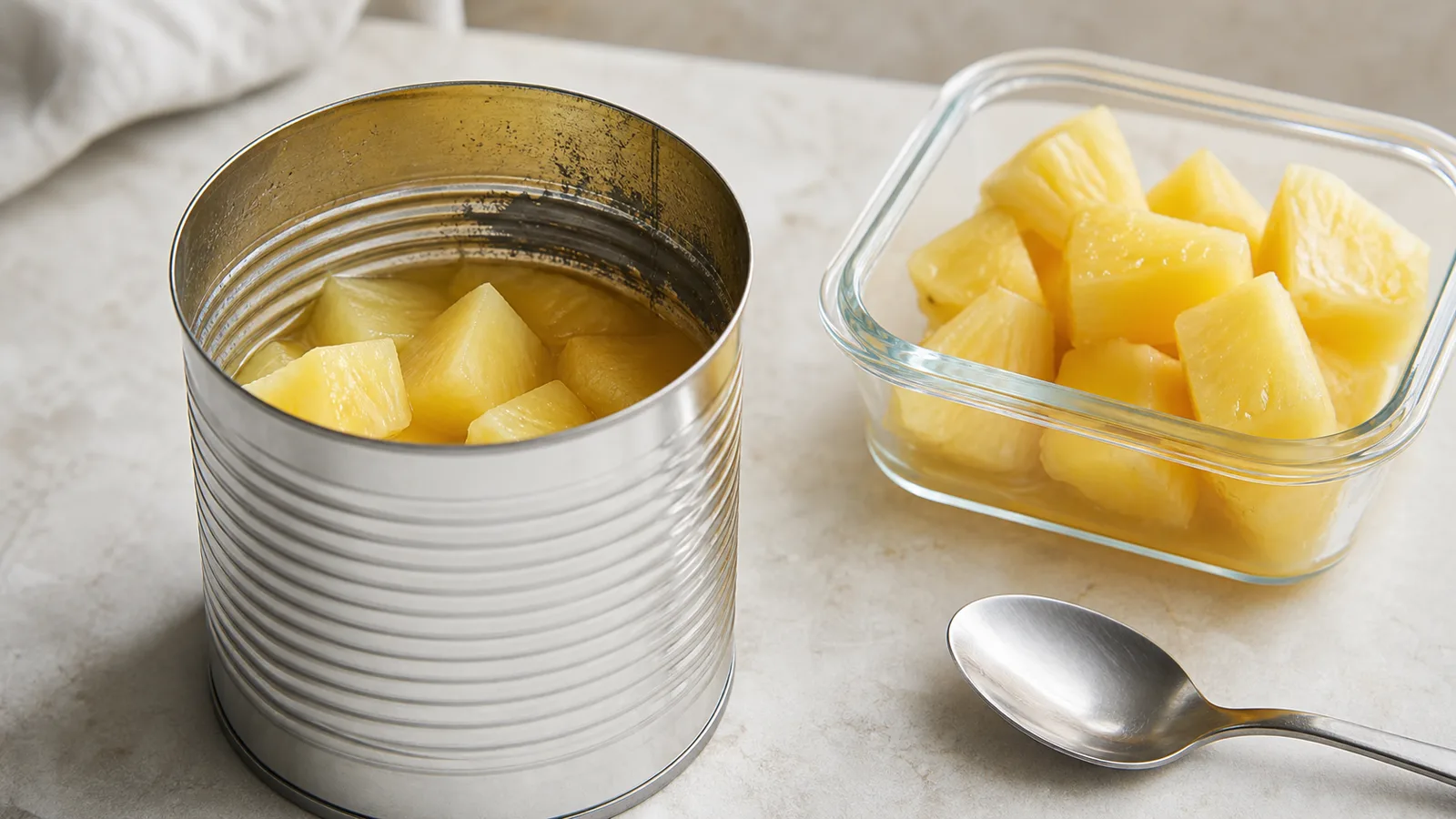
- What to do: Transfer leftovers to a clean glass or food-grade plastic container, cover, and refrigerate. USDA says leaving food in the can is not automatically unsafe, but another container better preserves flavor and quality. USDA FSIS
- When to discard it: Do not taste-test pineapple that is weeks old, moldy, slimy, fermenting, foul-smelling, or from a can that was bulging, leaking, badly dented, or that spurted forcefully when opened.
An unopened pineapple can is a controlled chemical system
A metal can is not merely a bucket with a lid. Its layers and its low-oxygen interior help protect the food.
The steel body provides strength. A thin tin layer protects the steel, and some cans add an internal polymer coating. Can construction varies by product and manufacturer. A 2025 study of commercially available pineapple cans notes that acidic fruits are sometimes packed in unlacquered tinplate because tin consumes residual oxygen, protects the iron beneath it, and helps preserve the fruit’s color, taste, aroma, and vitamins. Koyama and colleagues, Materials Transactions
Inside the sealed can, little oxygen remains. The tin acts as a sacrificial metal: it reacts before the underlying steel does. Pineapple syrup remains acidic—approximately pH 3 in the 2025 study—and contains citric and malic acids that can bind metal ions. Koyama and colleagues, Materials Transactions
This arrangement is stable enough for its intended shelf life, but it is not chemically inert.
Opening the can changes three things at once
1. Oxygen returns
Removing the lid replaces the low-oxygen headspace with air. Oxygen does not magically “break” an intact liner, as some online explanations claim. It changes the electrochemical environment and can accelerate oxidation at exposed tinplate, scratches, seams, cut edges, waterlines, or imperfections in a coating.
The 2025 pineapple-can study found that oxygen-related corrosion began near the boundary between syrup and headspace. As tin dissolved and the underlying tin–iron alloy and steel became exposed, iron in the syrup rose sharply under accelerated storage conditions.
2. Pineapple acid keeps working on the metal
Pineapple is a high-acid food. Its organic acids can dissolve tin and, when the protective layers are depleted or damaged, iron.
That does not mean every opened can immediately releases a dangerous amount of metal. Condition matters. In a study of pineapple drink stored in tinplate cans, undamaged cans remained at about 0.23 milligrams of iron per liter through one year, while dented cans reached much higher concentrations. The study did not reproduce an opened household can, but it demonstrates why damage and metal exposure change migration. Veríssimo, Silva, and Gomes, Journal of the Science of Food and Agriculture
3. Dissolved metal meets plant phenolics
Pineapple contains phenolic compounds. A 2024 Food Chemistry study identified catechin, epicatechin, chlorogenic acid, and pyrocatechol as substrates involved in pineapple browning, and found that metal ions affect their stability. Liu and colleagues
Iron can bind phenolic compounds into colored complexes. A technical review by Food Standards Australia New Zealand describes a closely studied example in canned asparagus: a colorless ferrous complex oxidizes after opening into a black ferric complex, sometimes within minutes. The same review notes dark iron–tannin reaction products in pickles. FSANZ technical assessment, pages 35–36
Pineapple has the necessary classes of ingredients—acid, phenolics, oxygen after opening, and potentially iron from the container. It is therefore reasonable to infer that iron–phenolic chemistry can contribute to black pineapple juice.
But that last step is an inference, not a direct pigment analysis of every darkened can. The exact color may be a mixture of metal complexes, oxidized phenolics, degraded vitamin C products, and other nonenzymatic browning compounds.
Is it really “natural black ink”?
The popular comparison is chemically suggestive but too confident.
Traditional iron-gall inks are made by reacting iron salts with tannin-rich plant extracts. Opened pineapple juice can contain iron and phenolic compounds, so the visual resemblance is not absurd. Yet “it made ink” implies that the black material has been chemically identified and is consistent from one can to another.
Usually, it has not.
A photo cannot establish:
- how much iron or tin entered the juice;
- whether the can had a polymer lining;
- whether the dark pigment is an iron complex, a sulfide, an oxidation polymer, or microbial growth;
- how long the food sat open or at what temperature; or
- whether the sample also contains spoilage organisms.
The honest version is: iron–phenolic complex formation is a plausible and well-supported mechanism, not a safety test and not a complete diagnosis.
Why ordinary enzymatic browning is probably not the main event
Fresh fruit can brown when the enzyme polyphenol oxidase, or PPO, gains access to phenolic compounds and oxygen after cells are cut or damaged. That is the familiar apple-and-banana mechanism.
Canned pineapple has already been heated. In a controlled pineapple-purée study, five minutes at 85°C left about 7 percent of the original PPO activity, while five minutes at 90°C left about 1.2 percent. Ordóñez-Santos, González-Loaiza, and Ospina-Aragón
Commercial processes differ, so “all enzymes are completely destroyed” is too absolute. Still, heat makes classic PPO-driven browning a weaker explanation for dramatic blackening in canned pineapple than it would be in fresh-cut fruit.
Bromelain is also the wrong enzyme to blame. Bromelain breaks down proteins; it is not the PPO enzyme that creates brown fruit pigments.
Other ways a canned product can become dark
Nonenzymatic oxidation and browning
Oxygen can degrade vitamin C and oxidize phenolic compounds without active PPO. Sugars and amino compounds can also form brown products through nonenzymatic reactions. These changes tend to affect flavor and color gradually, and they can continue in glass or plastic because removing the metal does not remove oxygen.
Metal-sulfide staining
Dark gray, blue-black, or black staining on a can wall can be a metal sulfide rather than an iron–phenolic pigment. A 1965 investigation of blackened pineapple cans traced one production incident to sulfur dioxide in the processing sugar, which led to tin sulfide on the can interior. Toyo Institute of Food Technology report
That mechanism is important historically, but it does not neatly explain pineapple that looks normal when opened and becomes dark only after days or weeks. Sulfide staining can also be concentrated on the metal rather than turning all the liquid jet black.
Microbial spoilage
Once the can is opened, its shelf-stable life is over. Refrigeration slows microbial growth; it does not stop time.
Mold may appear white, blue, green, or black and can look fuzzy or cotton-like. Fermentation can produce bubbles, pressure, sour or alcoholic odors, and texture changes. The National Center for Home Food Preservation advises treating unnatural color, odor, spurting liquid, rising bubbles, and mold growth as spoilage warnings rather than tasting the food to investigate. National Center for Home Food Preservation
What the pattern can—and cannot—tell you
| What you observe | A plausible explanation | Practical decision |
|---|---|---|
| A gray or black ring mainly on the can wall near the old juice line; fruit still looks and smells normal | Metal corrosion or staining is plausible | Treat it as a quality problem. Transfer promptly next time; contact the manufacturer if it appeared on first opening. |
| Juice gradually browns after exposure to air, including in glass | Oxidation or other nonenzymatic browning is plausible | Use only within the refrigerated storage window and discard if appearance or odor is abnormal. |
| Fruit or juice becomes dramatically black after sitting open for weeks | Chemistry may contribute, but the food is far beyond normal storage guidance | Discard it. Do not taste it to identify the cause. |
| Fuzzy patches, slime, active bubbles, fermented or foul odor | Microbial spoilage is plausible | Discard it without tasting. |
| The unopened can is bulging, leaking, deeply dented at a seam, or spurts forcefully | Seal failure or gas-producing spoilage is possible | Do not use the food. Follow official disposal guidance. |
This table is a triage guide, not a home laboratory. Similar colors can have different causes.
The best way to store leftover canned pineapple
After opening:
- Transfer the pineapple and enough juice to cover it into a clean glass or food-grade plastic container.
- Cover it tightly and refrigerate promptly.
- Use the date you opened it, not the printed date on the can, to track the leftover.
- Use it within five to seven days; four days is a simple conservative household rule. USDA opened-can guidance
- Discard it earlier if it develops an abnormal appearance, odor, texture, or gas.
USDA says unused canned food may be refrigerated in the original can, so the can itself is not automatically a food-safety violation. Transfer is still the better quality practice because it reduces metallic flavor, limits contact with exposed metal, and allows a tight cover. USDA opened-can guidance
Do not rely on a loose sheet of foil over the original can for weeks. The problem is not only the metal; it is also repeated oxygen exposure and storage far beyond the intended refrigerated life.
Three common claims, corrected
“Oxygen destroys the can’s protective coating”
Not necessarily. Some pineapple cans are deliberately made from unlacquered tinplate, and modern coated cans vary. Oxygen changes corrosion reactions; it does not need to dissolve an intact polymer film before any chemistry can occur.
“The black color proves it is harmless iron ink”
No. Metal–phenolic chemistry can create dark color, but a photograph cannot rule out spoilage. Time, temperature, can condition, smell, texture, gas, and mold still matter.
“If it were dangerous, it would smell bad”
No. Odor is useful for spotting obvious spoilage, but an apparently normal smell is not a guarantee. Never taste food from a bulging, leaking, forcefully spurting, or badly damaged can. USDA specifically warns against using such products. USDA shelf-stable food safety
The bottom line
Opened canned pineapple can turn black because oxygen shifts a carefully balanced metal-and-food system. Acidic juice can dissolve traces of tin or iron; oxidized iron can form dark complexes with pineapple’s phenolic compounds; and other oxygen-driven browning reactions can deepen the color.
That explains why a dark ring can appear on the can and why juice may become ink-like. It does not make weeks-old black pineapple safe.
For normal leftovers, transfer the fruit to a covered glass or food-grade plastic container, refrigerate it, and use it within the official storage window. If the food is dramatically discolored, moldy, slimy, gassy, foul-smelling, or simply weeks old, discard it rather than trying to solve the chemistry with a taste test.
For another example of processing and packaging changing food quality, see Sherafy’s explainer on why organic milk often tastes different.
Research method and limitations
This article was researched on July 29, 2026. The review prioritized current USDA household-storage and canned-food safety guidance, a government technical assessment of nonmicrobial can discoloration, and primary studies on pineapple-can corrosion, iron migration, pineapple phenolics, and thermal inactivation of PPO.
No directly applicable study was found that opened a household can of pineapple juice, followed it in a refrigerator until it turned jet black, and chemically identified every pigment. The central explanation is therefore a bounded synthesis: each link in the mechanism is supported, but the exact mixture in a particular photograph would require laboratory analysis.
AI tools assisted with source discovery, organization, and consistency checks. Material claims, numerical values, citations, safety language, and final wording were checked against the linked sources. No credentialed food scientist or medical reviewer is claimed.
References and further reading
Official storage and safety guidance
- USDA FSIS: Shelf-Stable Food Safety
- USDA FSIS: How long opened canned food keeps in the refrigerator
- USDA FSIS: Refrigerating unused food in the can
- National Center for Home Food Preservation: Identifying and Handling Spoiled Canned Food
Pineapple, can, and browning research
- Koyama et al. (2025): Corrosion Behavior of the Inner Surface of Unlacquered Tinplate Cans for Fruit Use
- Veríssimo, Silva, and Gomes (2016): Iron migration from undamaged and dented juice tinplate cans
- Liu et al. (2024): Identification and stability evaluation of polyphenol oxidase substrates of pineapple fruit
- Ordóñez-Santos et al. (2006): Thermal inactivation of polyphenoloxidase in pineapple puree
- Toyo Institute of Food Technology (1965): Investigation into the cause of blackening in canned pineapple