
One of the easiest ways to mishandle an AI dispute is to classify it too quickly.
A company calls it a vendor issue. Legal calls it a contract issue. Product says it is really a safety or performance issue. Privacy says it is a data problem. By the time everyone agrees on the label, the wrong records may already be gone and the wrong dispute process may already be in motion.
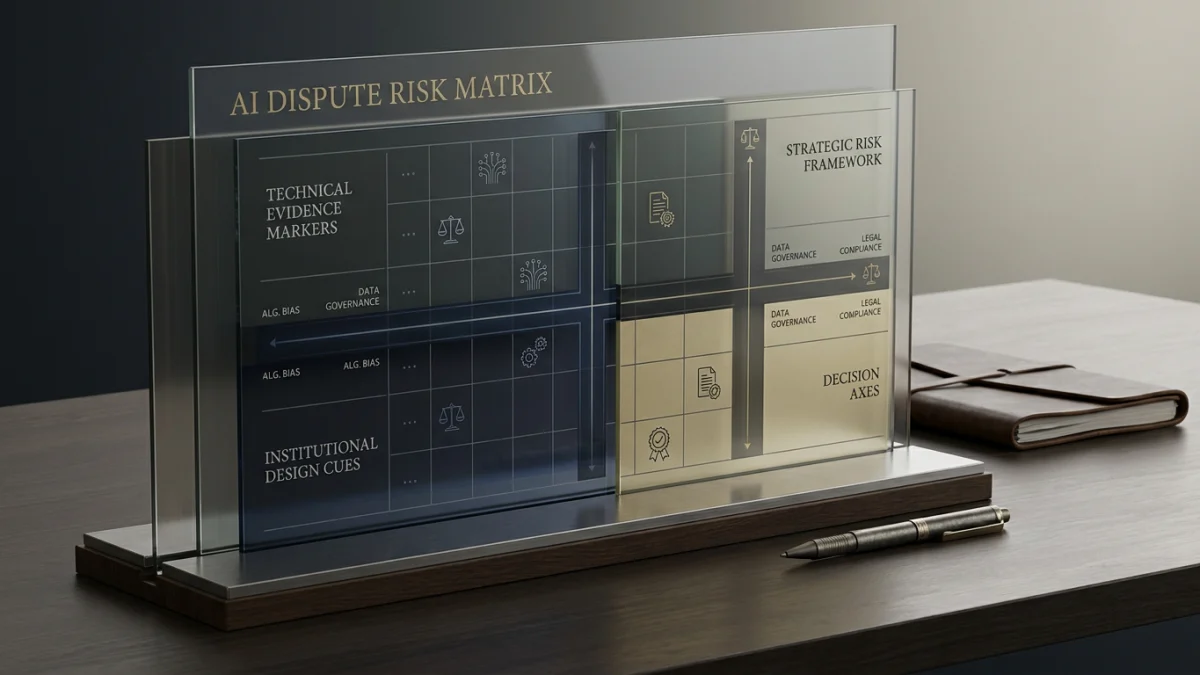
That is why an AI dispute risk matrix is useful.
It is not a substitute for legal analysis. It is a practical framework for sorting the dispute before the dispute sorts you.
How to use this matrix
Use it:
- when a serious AI issue first appears,
- when drafting a dispute clause,
- when triaging whether a matter belongs in arbitration, mediation, court, or internal escalation,
- or when deciding what evidence to preserve first.
The most important benefit is not precision for its own sake. It is early clarity about where the pressure points really are.
The core matrix
| Dispute type | Core question | Highest-risk evidence | Process pressure | Strong first move |
|---|---|---|---|---|
| Model licensing dispute | What rights were granted, limited, or exceeded? | contract versions, usage logs, access records, technical specs | scope fights, confidentiality, business interruption | preserve documents and map rights by version |
| Training data dispute | Was data used with permission and can provenance be shown? | dataset lineage, collection records, consent terms, preprocessing records | ownership, proof gaps, reputational exposure | freeze provenance records and narrow the factual chain |
| Vendor failure or hallucination dispute | Did the system fail to perform as promised and what harm followed? | outputs, prompts, benchmarks, incident reports, customer complaints | causation, disclaimers, marketing mismatch | preserve system state and customer-facing representations |
| Employment AI dispute | Did an automated tool unfairly affect hiring, pay, promotion, surveillance, or termination? | score outputs, selection criteria, accommodation records, monitoring data | discrimination, bias, recordkeeping, workforce sensitivity | preserve decision logic and accommodation history |
| Consumer AI dispute | Were consumers misled, denied meaningful recourse, or exposed to unfair automated treatment? | product claims, UX flows, chat logs, refund records, notices | deception, privacy, arbitration enforceability, volume | preserve claims, prompts, complaints, and support transcripts |
| Confidentiality or trade secret dispute | Did the process expose protected information through tools, prompts, or model use? | prompt history, upload records, data handling rules, vendor terms | secrecy loss, injunction needs, downstream disclosure | isolate data pathways and lock down sharing immediately |
| Governance dispute | Who approved what, under what standard, and who ignored or missed escalation? | approval records, policies, risk assessments, board materials, exception logs | accountability, blame shifting, privilege questions | build a timeline of governance decisions and exceptions |
| Safety or security failure | Did the AI system create or worsen a harmful operational event? | incident logs, red-team results, alerts, patch history, rollback decisions | urgency, public exposure, regulatory scrutiny | preserve incident chronology and containment actions |
| Bias or fairness challenge | Did the system produce unjustifiable disparate outcomes? | training or evaluation data, thresholds, audits, complaint patterns | statistical dispute, explainability pressure, legitimacy | protect evaluation records and decision criteria early |
| Cross-border or regulated-data dispute | Did geography, sector rules, or data localization change the risk profile? | data maps, transfer records, processor terms, jurisdiction clauses | multi-regime conflict, forum fights, regulator overlap | identify governing regimes before choosing the forum |
The seven risk dimensions that matter most
After identifying the dispute type, score the matter across the dimensions below. A simple low / medium / high rating is often enough.
1. Confidentiality sensitivity
Ask:
- Will the dispute require prompts, source data, safety materials, or trade secrets to be exposed?
- Will parties need strong protective measures?
- Would public litigation create avoidable commercial harm?
High confidentiality pressure often favors tighter process design and faster protective planning.
2. Evidence volatility
Ask:
- Can the system output, model version, or user interface change quickly?
- Are key records routinely overwritten, truncated, or lost?
- Is preservation urgent?
This is one of the most underappreciated AI dispute variables. Many cases are won or lost on whether the relevant system state can still be reconstructed.
3. Technical opacity
Ask:
- Can the organization explain how the relevant output or decision was produced?
- Is the dispute about a narrow defect or a layered socio-technical system?
- Will the forum need subject-matter expertise just to understand the facts?
High opacity raises the value of careful framing, expert support, and neutral competence.
4. Human-impact sensitivity
Ask:
- Does the dispute affect workers, applicants, consumers, patients, students, or other sensitive populations?
- Are fairness, access, or civil-rights questions likely to surface?
This dimension often changes not only the legal risk but also the tone, optics, and settlement pressure of the dispute.
5. Urgency and operational disruption
Ask:
- Is the issue ongoing?
- Does the dispute threaten business continuity, access to a tool, live customer harm, or public-facing failure?
High urgency may require emergency relief, staged process design, or immediate executive escalation.
6. Third-party dependence
Ask:
- Is the relevant system controlled by a vendor, model provider, data source, cloud platform, or subcontractor?
- Can the organization access the records it needs without cooperation from outsiders?
Third-party dependence often creates early discovery and leverage problems.
7. Governance maturity
Ask:
- Were there clear approval pathways, owners, risk thresholds, and escalation rules?
- Were risk assessments performed?
- Were exceptions documented?
Low governance maturity is often what turns an isolated technical problem into a much broader dispute.
A simple scoring method
If you want a fast working model, rate each dimension from 1 to 3:
1= manageable2= meaningful pressure3= severe pressure
Then total the score.
In practice:
7 to 10suggests a narrower dispute with manageable process design.11 to 15suggests a matter that needs tailored evidence and confidentiality planning.16 to 21suggests a high-complexity dispute that should not be treated as routine commercial conflict.
This is not a legal formula. It is a triage tool.
Why this matrix fits AI disputes especially well
NIST’s AI Risk Management Framework uses the functions govern, map, measure, and manage for a reason. AI risk is not just technical failure. It is a lifecycle problem involving design, deployment, monitoring, documentation, and response.
The July 26, 2024 NIST Generative AI Profile sharpened that point for generative systems specifically. It recognizes that generative AI adds distinct risk patterns rather than merely rebranding old software questions.
That same reality shows up in disputes. The fight is usually not just over one bad output. It is over governance, evidence, accountability, and whether the organization ever mapped the risk clearly in the first place.
Where businesses usually go wrong
Common mistakes include:
- preserving only the final output and not the surrounding system context,
- assuming a vendor will have every necessary record,
- treating privacy, employment, and consumer issues as side issues instead of core risk drivers,
- using a generic arbitration clause for a high-complexity AI relationship,
- and waiting too long to distinguish a governance problem from a product problem.
The matrix is meant to interrupt those habits.
What to do after scoring
Once the risk profile is clear, decide five things immediately:
- What evidence must be preserved first?
- Which decision-makers need to be involved now?
- Does the matter need emergency relief or containment?
- Which forum is most likely to fit the real risk?
- What adjacent pages or playbooks should the team consult next?
That is the moment when the matrix becomes operational instead of theoretical.
FAQ
Is this a legal risk model or a business risk model?
It is both. AI disputes rarely stay in one lane, and that is exactly why a matrix is useful.
Should every AI issue be scored like this?
Not formally. But even a light version of this framework can prevent expensive early misclassification.
What is the most important factor?
Usually evidence volatility or human-impact sensitivity. Those are often the dimensions that change the whole strategy.
Does a high score mean the dispute belongs in court?
Not automatically. It means the matter needs a more deliberate process design. Sometimes that supports arbitration. Sometimes it supports court. Sometimes it supports staged mediation or expert determination first.
Who should own the matrix inside an organization?
Ideally a cross-functional group that includes legal, product, compliance, security, and operational leadership. A one-department view is usually too narrow.
Conclusion
An AI dispute risk matrix is useful because it forces clarity before positions harden.
The organizations that handle AI disputes best are usually not the ones with the loudest AI story. They are the ones that can identify the real risk early, preserve the right record, choose the right process, and explain what happened without hand-waving. That is what this matrix is built to support.
Further Reading
- NIST AI Risk Management Framework 1.0, January 26, 2023: https://doi.org/10.6028/NIST.AI.100-1
- NIST AI RMF Playbook, updated March 27, 2026: https://www.nist.gov/itl/ai-risk-management-framework/nist-ai-rmf-playbook
- NIST Generative AI Profile, July 26, 2024: https://doi.org/10.6028/NIST.AI.600-1
- JAMS Artificial Intelligence Disputes Clause and Rules: https://www.jamsadr.com/artificial-intelligence-disputes-clause-and-rules
- CPPA CCPA Updates, Risk Assessments, and ADMT Regulations, effective January 1, 2026: https://cppa.ca.gov/regulations/ccpa_updates.html