
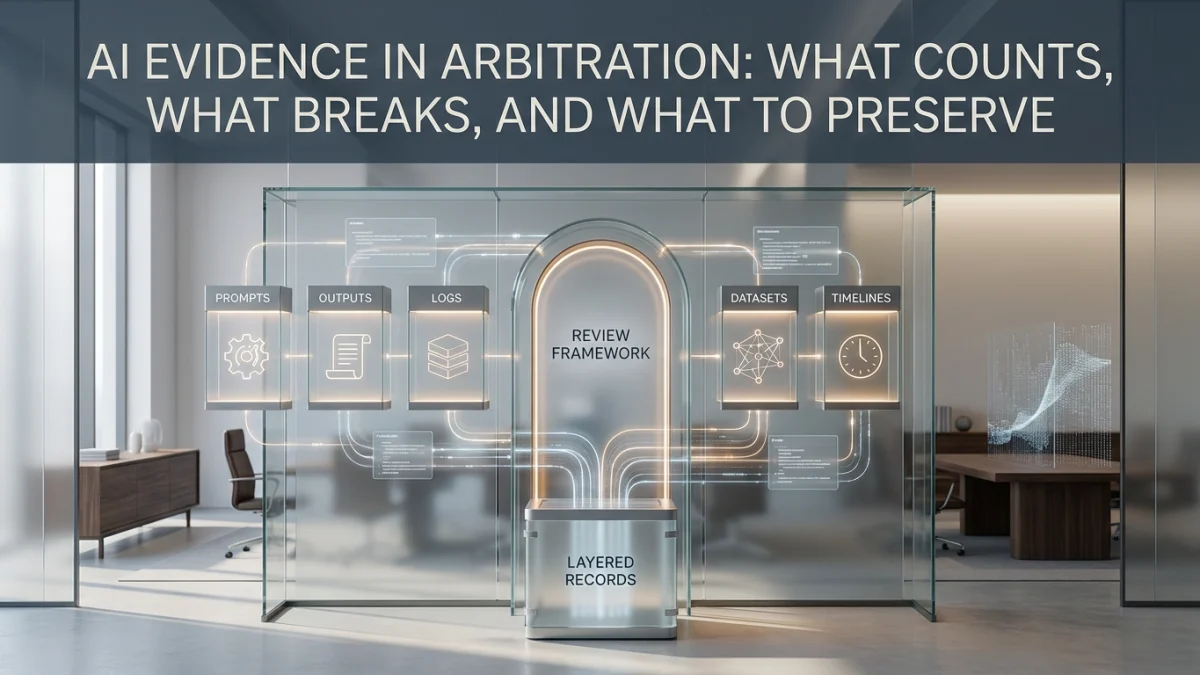
Many AI disputes are really evidence disputes in disguise.
The parties may think they are fighting about breach, performance, misuse, bias, confidentiality, or reliance. But once the process begins, the outcome often turns on a simpler problem: who can actually show what happened.
That is why AI evidence matters so much in arbitration.
The challenge is not only that AI systems can be complex. It is that the records surrounding them are often scattered, dynamic, sensitive, and poorly preserved. Prompts live in one place, outputs in another, internal policies somewhere else, version history somewhere else again, and the human decisions that shaped the system may be buried in chat logs, incident notes, or undocumented workflow habits.
If that sounds messy, it is because it is.
What counts as AI evidence
AI evidence is broader than many people first assume. It can include any record that helps explain what an AI system was supposed to do, what it actually did, how people used it, what changed over time, and what consequences followed.
In practice, common categories include:
- prompts and prompt templates,
- outputs and response histories,
- model version records,
- API logs and usage data,
- retrieval or ranking behavior,
- evaluation reports and benchmark results,
- safety testing or red-team materials,
- incident reports and escalation records,
- training-data or fine-tuning documentation,
- product documentation and user-facing disclaimers,
- internal communications about system limitations,
- and screenshots or recordings showing user interaction.
Not every dispute needs all of those. But parties should assume that AI evidence rarely lives in one neat folder.
Why AI evidence is different
Traditional digital evidence can already be difficult. AI evidence adds several extra layers of difficulty.
The system may not be static
What the model did in February may not be what it did in April. A version change, a policy update, a safety patch, a retrieval adjustment, or a prompt rewrite can materially affect behavior.
Human and machine actions blur together
The dispute may involve a model output, but the output may depend on human prompt choices, workflow design, approval steps, product constraints, or post-processing decisions. If the process treats all of that as one blob called “the AI,” it becomes harder to find the real failure point.
The records may be incomplete by default
Many organizations are not preserving the right materials in an orderly way. Logs may roll off. Prompt history may be partial. Internal decisions may never have been documented clearly.
Sensitive data may be embedded everywhere
AI evidence often contains customer information, trade secrets, security details, product evaluations, or proprietary methods. That creates a constant tension between proving the case and protecting the underlying information.
The evidence categories that matter most
Prompts
Prompts are often treated casually until a dispute begins. Then everyone realizes they were central.
A prompt can shape the output, the tone, the scope of the task, the risk of error, and whether the system was used within its intended purpose. In some cases, the real dispute is less about the model than about how a human framed the request.
Outputs
Outputs matter, but they rarely speak for themselves.
An output needs context:
- what prompt generated it,
- what system version produced it,
- what policies applied at the time,
- whether any retrieval layer or external source shaped it,
- and how the user acted on it.
Logs and system records
Logs are often the backbone of the case. They can help establish timing, access, usage patterns, version state, and whether a claimed incident actually occurred the way one party says it did.
Evaluations and testing materials
Benchmarking, internal testing, safety reviews, and red-team exercises can be extremely important. They may show what the provider or deploying party already knew about limitations, edge cases, or foreseeable failure modes.
Governance records
Meeting notes, escalation records, risk memos, product approvals, and policy reviews can reveal whether a problem was surprising or anticipated.
What breaks AI evidence
AI evidence can fail for practical reasons long before anyone argues about admissibility or weight.
Missing context
A screenshot of an output without the prompt, date, model version, or surrounding workflow may be too thin to carry much persuasive force.
Poor preservation
If logs were not retained, if systems changed without clear version tracking, or if the organization did not preserve material promptly, the record may become fragmented.
Overcollection without structure
More data is not always better. Dumping a vast quantity of technical material into a proceeding without clear organization can be nearly as harmful as having too little.
Informal handling
If evidence moved through insecure tools, undocumented transformations, or casual internal sharing, the process may create authenticity or confidentiality problems of its own.
Authenticity, reliability, and chain of custody
The classic evidence questions do not disappear in AI disputes. They become more demanding.
Parties may need to ask:
- Is this the complete prompt or only part of it?
- Did the output come from the claimed version of the system?
- Were any settings, filters, or retrieval layers active?
- Has the record been altered, reformatted, or summarized?
- Who preserved it, when, and using what process?
These are not merely technical questions. They are credibility questions.
That is one reason current institutional guidance on AI tools emphasizes verification and human oversight. If participants use AI to analyze or summarize evidence, they still remain responsible for accuracy and judgment.
What to preserve early
When an AI-related dispute looks likely, parties should move quickly to preserve at least the following where relevant:
- prompts and prompt chains,
- outputs and related timestamps,
- model or system version information,
- usage logs and access records,
- evaluation and incident records,
- contract versions and product documentation,
- internal communications about the issue,
- and any policy or workflow changes made after the event.
The earlier this happens, the less likely the case becomes a fight over reconstruction.
Why arbitration makes evidence planning even more important
Arbitration can be efficient, but that efficiency depends on discipline.
If the parties enter arbitration with a muddy technical record, the process may become slower and more expensive than anyone expected. A targeted record is often more valuable than a huge record.
That means counsel and clients should think early about:
- what evidence is most probative,
- what evidence is sensitive,
- what needs expert explanation,
- and what protocols should govern access and review.
In an AI case, evidence planning is not a side issue. It is part of case design.
Practical guidance for parties
Parties handling AI-related disputes should try to do five things well:
1. Preserve quickly
Do not assume the relevant logs or histories will remain accessible indefinitely.
2. Separate raw records from summaries
A clean summary can be useful, but it should not replace the underlying material.
3. Keep version history visible
If a system changed over time, the dispute may turn on which version matters.
4. Protect sensitive information
The process for reviewing evidence should not create a fresh confidentiality failure.
5. Build a narrative that respects the technology
The best presentations are precise. They do not hide uncertainty, but they also do not let complexity become an excuse for vagueness.
FAQ
What is AI evidence in arbitration?
It is the collection of records, materials, and technical context used to prove what an AI system did, how it was used, what changed over time, and how those facts relate to the parties’ claims and defenses.
What are the most important types of AI evidence?
Prompts, outputs, logs, timestamps, version records, evaluation reports, incident documentation, and internal communications are often among the most important.
Why are prompts so important?
Because prompts can materially shape outputs, risk, and user intent. Without them, an output may be hard to evaluate fairly.
Can AI-generated summaries be used in the evidence process?
Potentially, but they should not replace human review, source verification, or careful handling of confidential information.
What is the biggest mistake parties make?
Waiting too long to preserve records or assuming a few screenshots will be enough to reconstruct what happened.
Conclusion
AI evidence is not just digital evidence with a trendier label. It is often more dynamic, more sensitive, and more dependent on context than parties expect at the start of a dispute.
The side that preserves carefully, explains clearly, and treats evidence architecture as part of the case strategy will usually be in a much stronger position than the side that tries to improvise later.
Further Reading
- AAA-ICDR Guidance on Arbitrators’ Use of AI Tools, March 2025: https://www.adr.org/media/g1fgccns/2025_aaa-icdr-guidance-on-arbitrators-use-of-ai-tools-2.pdf
- Ciarb Guideline launch note, September 5, 2025: https://www.ciarb.org/news-listing/ciarb-launches-guideline-on-the-use-of-ai-in-arbitration/