The simplest way to understand what is happening at the Adelanto ICE Processing Center is to stop imagining it primarily as a prison filled with convicted violent criminals.
It isn’t.
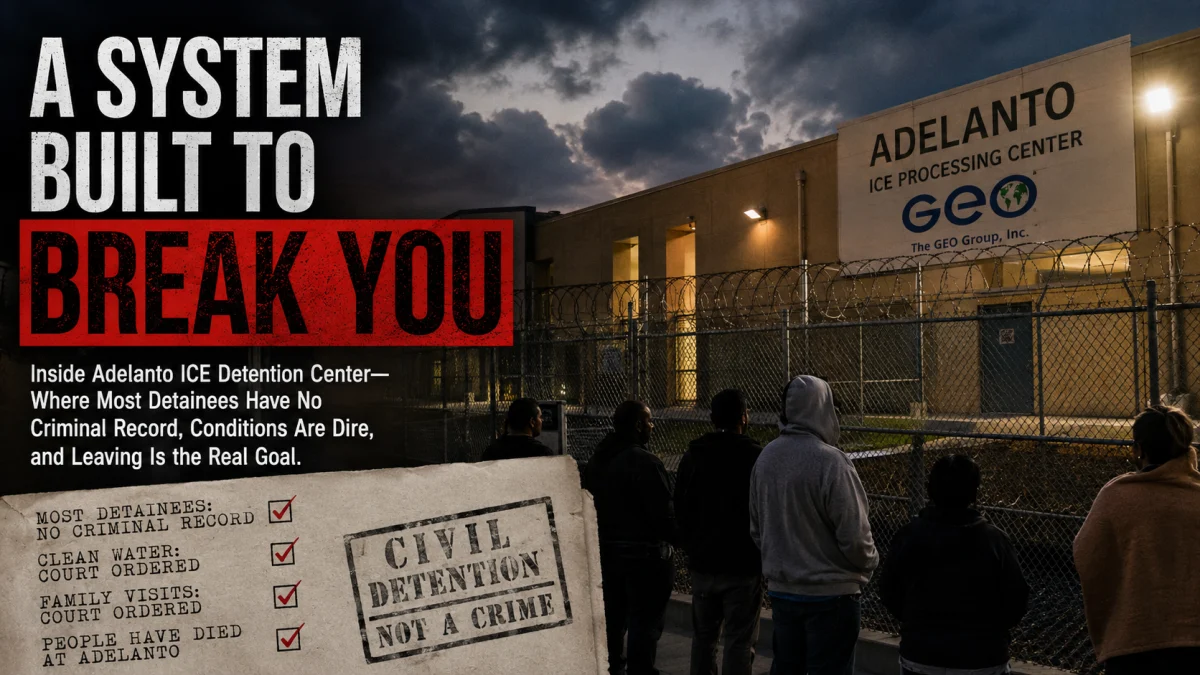
Adelanto is part of America’s civil immigration detention system, operated for the federal government by the private prison company GEO Group. Recent ICE data analyzed by the Los Angeles Times found that only about 38% of Adelanto’s average daily detained population had a criminal record.
That means roughly 62% did not.
At the same time, California investigators have documented severe problems with food, drinking water, medical care, staffing, sanitation and access to the outside world. Four people detained at Adelanto died between September 2025 and March 2026. A federal judge subsequently found detainees were likely to succeed — or at minimum had raised serious questions — on constitutional and disability-rights claims and ordered the government to provide protections as basic as clean drinking water, sanitary meals and meaningful family visitation.
This is not simply a story about a badly managed detention center.
Adelanto sits at the intersection of three much larger policies: mass civil detention, an openly promoted self-deportation campaign and a private detention industry that financially benefits when the government fills more beds.
Once those pieces are viewed together, the conditions inside Adelanto become much harder to dismiss as a collection of unrelated complaints.
Most Adelanto detainees do not have a criminal record
This is the fact that should anchor any discussion about Adelanto.
Only about 38% of the average daily population at Adelanto had a criminal record, according to recently released ICE data analyzed by the Los Angeles Times.
Across California immigration detention facilities, the same dataset showed that approximately 74% of detainees had no criminal record. Nationally, that figure was approximately 79%.
That sharply complicates the administration’s repeated political presentation of mass immigration enforcement as primarily a campaign against dangerous criminals.
There is a legal distinction worth understanding without letting it obscure the larger point.
Immigration detention is civil detention. ICE itself describes its system that way. People can be detained because of immigration proceedings, removal orders, statutory detention requirements, flight-risk determinations and other immigration-related reasons without having been convicted of a crime.
So having no criminal record does not automatically mean ICE lacks legal authority to detain someone.
But it does mean exactly what it sounds like:
Most of the people being held at Adelanto are not people with criminal records.
That is substantially different from the public image of ICE detention as a system principally sweeping dangerous convicted criminals off American streets.
A federal judge had to order access to clean water
The most damning evidence about Adelanto is not an activist’s Instagram post or an anonymous social-media allegation.
It is a federal court order.
On July 16, 2026, U.S. District Judge Sunshine S. Sykes granted a preliminary injunction after finding that detainees were likely to prevail — or had at least raised serious questions — on claims under the Fifth Amendment and Rehabilitation Act, and that they faced irreparable harm without court intervention.
The resulting order is extraordinary largely because of how ordinary its requirements sound.
The government was ordered to ensure 24-hour access to clean drinking water, nutritious and sanitary meals, daily cleaning, free soap and hygiene products, mold remediation, clean clothing and bedding, adequate restroom privacy and at least four hours of outdoor recreation per day under normal circumstances.
The judge also addressed family visits in striking detail.
Visits could not ordinarily be cut off by arbitrary time limits. Families had to be allowed to use the bathroom without automatically losing their visit. Physical contact such as hugging and holding hands had to be permitted unless a documented security reason justified restricting it.
Think about what that means.
A federal judge did not issue an eight-page order telling ICE how to provide drinking water, soap, mattresses and hugs because nothing appeared to be wrong.
California’s own investigation independently reached similarly disturbing conclusions.
California investigators found an overwhelmed facility
The California Department of Justice inspected Adelanto during a period of explosive population growth.
When state officials visited in November 2023, Adelanto held seven detainees. By July 8, 2025, it held 1,570. Neighboring Desert View Annex simultaneously held another 517 people.
The state’s conclusion was blunt: Adelanto was overwhelmed by the population surge, and medical and detention staffing had failed to keep pace with the number of people being confined there.
Investigators documented concerns involving food and drinking water, medical treatment, chronic illnesses, specialty-care referrals, staffing, use of force and access to attorneys and family members. The state report says many conditions failed to meet ICE’s own applicable detention standards.
And then people started dying.
California DOJ documented four deaths involving people detained at Adelanto between September 2025 and March 2026. The existence of those deaths alone does not prove that Adelanto caused them, but the state specifically raised them while discussing concerns about medical care and the facility’s ability to safely handle its growing population.
By July, the federal judiciary was ordering changes.
This is no longer reasonably characterized as a few disgruntled detainees complaining about uncomfortable incarceration.
There is a documented institutional problem.
Is the point to make people give up and leave the country?
Here is where discussions about Adelanto often become artificially timid.
There is no publicly available directive saying:
Make the detention center miserable enough that people surrender their immigration cases.
That does not end the analysis.
Institutions can create coercive pressure without writing down every consequence of that pressure as an official objective.
And in this case, the broader federal strategy is unusually explicit.
The Department of Homeland Security currently operates an aggressive self-deportation program through the CBP Home app. DHS offers qualifying people free travel, forgiveness of certain fines and a $2,600 exit payment if they leave voluntarily. Its own website sells the program partly as a way to avoid ICE enforcement, detention and removal.
Secretary Kristi Noem made the alternative even clearer in a January 2026 DHS announcement: people who did not accept the self-deportation offer should expect to be found, arrested and removed.
That matters.
Because detention does not exist in isolation from the self-deportation campaign.
Detention is one of the consequences the government itself tells immigrants they can avoid by agreeing to leave.
And there is evidence that people in detention are increasingly doing exactly that.
The Washington Post, using immigration-court data supplied by the Vera Institute of Justice, reported that more than 80,000 immigrants received voluntary-departure orders between January 2025 and March 2026 — more than seven times the total during the preceding 15 months. More than 70% were detained when they made that decision.
Immigration attorneys told the newspaper that prolonged detention was contributing to people abandoning cases they might otherwise have continued fighting.
That does not prove someone at Adelanto deliberately contaminated water to force detainees onto airplanes.
It establishes something broader and more important.
The detention system functions as pressure.
When the government’s message is essentially leave voluntarily and receive money and a plane ticket, or risk arrest and detention, it is hardly unreasonable to recognize harsh detention itself as part of the coercive environment surrounding that choice.
Whether every miserable condition was deliberately created for that purpose is almost beside the point.
The human effect is the same.
Moving people around the country isolates them even further
The same issue appears in ICE’s increasingly aggressive use of transfers.
A 2026 investigation by The Marshall Project found that during Trump’s first year back in office, ICE transferred nearly 41,700 detainees into another state within 24 hours of detention — more than double the number during the previous year.
More than one in ten people ICE detained were rapidly moved out of state during their first day in custody. Repeated transfers also increased sharply.
The consequences are obvious.
A spouse who could drive two hours to visit someone in Adelanto cannot simply drive to Louisiana.
An attorney preparing an emergency filing may suddenly have a client in a different federal judicial circuit.
Parents, children and friends trying to locate somebody can discover that the person they were trying to help has effectively disappeared into another part of the detention network.
The Marshall Project documented families and lawyers struggling to locate detainees after rapid transfers and attorneys scrambling because moving someone can change which federal court has jurisdiction over a legal challenge.
There are legitimate operational reasons detention systems sometimes transfer people — available bed space, transportation, medical needs and security among them.
But when transfers become rapid, repeated and nationwide, the predictable result is isolation.
One does not need to know the private thoughts of the official approving each transfer to recognize what moving a human being hundreds or thousands of miles from their support network actually does.
Adelanto is already geographically isolating
Adelanto sits in California’s high desert roughly 90 miles northeast of Los Angeles.
For many Southern California families, visiting is therefore already a substantial trip.
ICE’s current Adelanto facility page says ordinary visits are generally limited to one hour, detainees may receive one visit per day, and only three visitors are normally allowed at once.
That helps explain why the federal court’s visitation order matters so much.
A family may spend hours traveling to and from Adelanto for a short window with someone who is already experiencing the psychological strain of detention.
Restrict the visit further, delay entry or transfer that detainee to another state, and one of the remaining connections to ordinary life becomes harder to maintain.
You do not have to call that an officially documented strategy of psychological destruction.
You can simply call it what it demonstrably is:
a system that makes maintaining human relationships extraordinarily difficult.
Then there is the money
Adelanto is owned and operated by The GEO Group, one of America’s largest private detention contractors.
That makes every filled bed part of a commercial relationship.
GEO itself explained the economics to investors after restrictions on Adelanto intake were lifted in 2025.
At full occupancy, the 1,940-bed Adelanto contract was expected to generate up to approximately $31 million in additional annualized revenue for GEO.
There is no need to invent a conspiracy around that number.
It is the business model.
The federal government wants detention capacity. GEO sells detention capacity. More government detention business means more potential GEO revenue.
And business is booming.
GEO reported $732.1 million in second-quarter 2026 revenue, up 15% year over year, while net income attributable to GEO operations rose 63% to $47.5 million. The company described its recent expansion as new “growth opportunities” and said 2025 was the most successful year for new business wins in its history.
That does not prove that GEO mistreats detainees because mistreatment is profitable.
It establishes the structural conflict much more cleanly:
Human detention is a revenue-generating product.
The government decides how aggressively to use that product.
The contractor financially benefits from the resulting demand.
At Adelanto, filling the facility was valuable enough for GEO to quantify the additional revenue for shareholders.
Even the government’s appeal contains a remarkable admission
The July injunction is currently tangled in an appeal.
On August 6, the Ninth Circuit temporarily stayed Judge Sykes’ order because she had initially issued the detailed injunction before releasing her full memorandum explaining the reasoning behind it. The appellate court said it needed that explanation before properly evaluating the government’s emergency request.
Judge Sykes subsequently issued her full 42-page memorandum on August 12 and left the substance of the July order unchanged.
The stay is important procedurally.
But buried in the Ninth Circuit order is something arguably more revealing.
The federal government told the appellate court that the substantive standards of care imposed by the injunction were already obligations GEO owed ICE under its contract. The Ninth Circuit specifically noted that representation and said it assumed the government would enforce those contractual obligations while the injunction was stayed.
That creates an uncomfortable question.
If clean water, adequate food, sanitation and other basic protections were already required by the contract, why did detainees have to go to federal court to obtain an order requiring them?
Adelanto shows what America’s new detention system actually looks like
The most important Adelanto story is therefore not one isolated allegation about dirty water, one family struggling to visit someone, one detainee being transferred or one company’s earnings report.
It is the pattern created when those facts are combined.
Most Adelanto detainees in recent ICE data did not have criminal records.
They are being held within a civil immigration system, not serving criminal sentences.
The facility’s population exploded during the administration’s mass-deportation campaign, and California investigators concluded that staffing and services failed to keep pace.
Four detainees died within roughly six months.
A federal judge found the evidence sufficiently serious to issue extraordinary preliminary relief covering drinking water, food, medical care, sanitation, isolation, recreation and family visitation.
ICE is simultaneously transferring unprecedented numbers of detained people across state lines, frequently separating them from families and attorneys.
DHS openly promotes self-deportation as the alternative to arrest and detention, while evidence shows detained immigrants are abandoning their cases and agreeing to leave in rapidly growing numbers.
And the corporation operating Adelanto openly reports to investors that filling the facility generates additional revenue.
No single one of those facts proves a secret master plan to psychologically break every detainee.
Taken together, however, they describe something that can reasonably be called a coercive detention system.
A system does not need a memo reading break their will for people inside it to be broken down.
If the predictable effect of isolation, prolonged detention, difficult family access, constant transfers and degrading living conditions is that people eventually decide they would rather abandon their immigration cases than remain inside, that effect deserves to be discussed plainly.
Especially when the government is simultaneously encouraging them to do exactly that.
The bottom line
If someone asks what is happening at the Adelanto ICE detention center, the answer is no longer difficult to establish.
Thousands of people have passed through a privately operated civil detention complex where most detainees in recent ICE data had no criminal record, where California investigators documented serious systemic failures, where four people died in a matter of months, and where a federal judge concluded conditions justified immediate judicial intervention.
Meanwhile, Adelanto exists inside a national immigration strategy that is explicitly trying to persuade people to leave the country voluntarily rather than risk detention and forced removal.
That context matters.
The government may never publish a document saying that detention is supposed to exhaust people emotionally until they give up.
It does not have to.
We can examine what the system does.
And at Adelanto, what it does is increasingly well documented.
References and Further Reading
Court Orders and Government Records
U.S. District Court — Preliminary Injunction in L.T. v. U.S. Immigration and Customs Enforcement (July 16, 2026) — Primary federal court order requiring clean drinking water, sanitary food, sanitation, medical-care reforms, recreation, improved visitation, limits on isolation and independent monitoring at Adelanto.
Ninth Circuit Court of Appeals — Administrative Stay in L.T. v. ICE, No. 26-4902 (August 6, 2026) — Appellate order temporarily staying the injunction pending the district court’s full reasoning and additional appellate review. It also records the government’s representation that the substantive care standards were already obligations GEO owed ICE under contract.
California Department of Justice — Immigration Detention in California 2025–26 — California’s extensive review of immigration detention conditions, including Adelanto’s rapid population increase, medical and detention staffing failures, food and water concerns, communication barriers and deaths in custody.
ICE — Adelanto ICE Processing Center Facility Information — Current ICE facility information covering communication procedures, visitation schedules and restrictions at Adelanto.
ICE — Detention Statistics and Definitions — ICE’s own explanation of civil immigration detention, custody categories and the distinction between immigration detention and criminal incarceration.
Adelanto Population and Conditions
Los Angeles Times — “ICE detentions spiked in June, targeting immigrants with no criminal records, new data show” — Analysis of ICE data finding that only about 38% of Adelanto’s average daily detainee population had a criminal record and that people without criminal records constituted the large majority of immigration detainees statewide.
CalMatters — “Judge demands immigrants get clean water in CA detention center” — Independent reporting on the Adelanto injunction, allegations behind the lawsuit and the court-ordered changes to water, food, sanitation, visitation, medical care and recreation.
Transfers, Isolation and Self-Deportation
The Marshall Project — “ICE Detained Them, and Then They Vanished” — Data-driven investigation finding that nearly 41,700 people were rapidly transferred across state lines during Trump’s first year back in office and documenting the resulting disruption to families and legal representation.
Department of Homeland Security — CBP Home Self-Deportation Program — DHS’s official description of the government’s voluntary self-departure campaign, including free travel, a $2,600 exit payment and reduced exposure to ICE detention and enforcement for qualifying participants.
Department of Homeland Security — “DHS Now Offering $2,600 Stipend Via the CBP Home App” — Official administration messaging explicitly contrasting voluntary departure with eventual arrest and forced removal.
Washington Post — “Immigrants are giving up their cases and leaving the U.S. in soaring numbers” — Reports more than 80,000 voluntary-departure orders from January 2025 through March 2026 and finds that more than 70% involved people who were detained when they agreed to leave.
GEO Group and the Economics of Detention
The GEO Group — “Update on Immediate Full Intake at the 1,940-Bed Adelanto ICE Processing Center” — GEO’s own investor disclosure estimating that full occupancy at Adelanto could generate up to approximately $31 million in additional annualized company revenue.
The GEO Group — Second Quarter 2026 Financial Results — GEO’s latest earnings release reporting 15% year-over-year revenue growth, a 63% increase in net income attributable to GEO operations and continued expansion of its immigration-detention business.
U.S. Securities and Exchange Commission — GEO Group Q2 2026 Filing — Primary SEC filing confirming GEO’s current financial results, detention-related contract expansion and financial outlook.
Editorial note: Adelanto’s population and the litigation over its conditions are changing quickly. The legal status in this article was checked through August 18, 2026. The July preliminary injunction was administratively stayed by the Ninth Circuit on August 6 while the appeals process continues; that procedural stay did not constitute a ruling that the documented conditions at Adelanto were acceptable or a reversal of the district court’s factual conclusions.