Somewhere along the way, we all received the same unspoken instruction: Don’t talk about politics. Not at dinner. Not at work. Not in polite company. Not where it might cause friction, discomfort, or God forbid, an honest disagreement. And after absorbing that message for years—through sideways glances, changed subjects, and the quiet social punishment of being “too much”—millions of people came to believe something genuinely bizarre: that politics is a private matter, like a dietary preference or a guilty pleasure, best tucked away where it won’t disturb anyone.
But think about what that actually means.
Politics determines whether your family can survive a trip to the emergency room without financial ruin. Politics determines whether the house you’re saving for will be a home or someone else’s investment vehicle. Politics determines whether your wages grow alongside your productivity or stagnate for decades while executive compensation explodes. Politics determines whether the water flowing from your tap is clean, whether your child’s school has enough teachers, whether the food on your shelf has been inspected, whether the corporation poisoning your town’s groundwater faces consequences or quietly settles out of court with money that used to be yours.
So let’s be precise about what we were really being told.
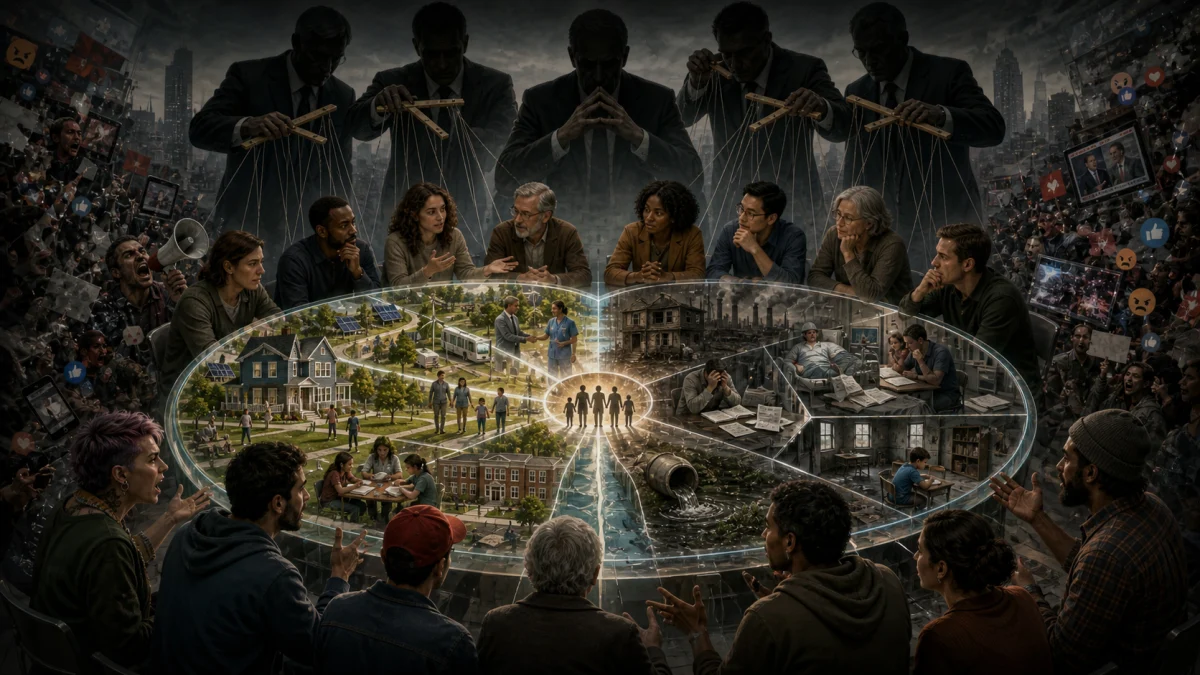
We weren’t told to avoid politics because it’s too personal. We were told to avoid it because honest political conversation has a dangerous tendency to become structural. It stops being about red versus blue, about whose bumper sticker is cleverer, about which cable news host delivered the better monologue last night. It starts asking a question that makes powerful people deeply uncomfortable:
Who benefits from keeping the rest of us distracted?
That is the question this essay exists to sit with.
Not because I have perfect answers. I don’t. Not because my politics are morally flawless. They aren’t. And not because I think people who disagree with me are stupid or evil. The overwhelming majority are not. Most people are doing their honest best to navigate a world that was deliberately made confusing—armed with whatever information, community, fear, and inherited narrative they happened to receive.
But that’s exactly the problem worth naming.
The Product Is Your Reaction
A great deal of what we call “politics” in this country isn’t politics at all. It’s emotional programming. It’s narrative capture. It’s a system in which people are handed a pre-assembled kit—a set of issues to care about, a set of villains to fear, a set of moral reflexes to perform—and told: This is your identity now. Defend it.
Once that identity locks into place, something critical shuts off. People stop asking the only question that should matter in a democracy: Does this actually improve my life? Does it make my family safer? Does it keep my home stable? Does it make my children healthier? Does it give me any greater share of power over the forces shaping my existence?
Instead, they simply react.
And that reaction—that reliable, predictable, emotionally satisfying reaction—is the product. Not the policy. Not the outcome. The reaction itself. Because reactions drive engagement, engagement drives attention, attention drives advertising revenue, and advertising revenue drives the entire machinery that decides which conversations we’re allowed to have at national scale.
You are not the audience. You are the commodity.
The Mirage of “There’s No Right Answer”
There’s a popular deflection that sounds reasonable on the surface: Politics is subjective. There’s no objectively correct position.
And in a limited sense, that’s true. People disagree about tradition and progress, about the proper balance between individual liberty and collective responsibility, about the role of faith in public life, about what kind of society they want their grandchildren to inherit. Those disagreements are real, ancient, and probably permanent. That’s fine. That’s democracy.
But we have stretched this truth so far beyond its breaking point that it now serves as a universal shield against accountability.
Because while there may be no objectively correct answer to every philosophical question about governance, there are absolutely political choices that can be measured by their outcomes. Healthcare either becomes more affordable or it doesn’t. Wages either keep pace with the cost of living or they don’t. Campaign finance laws either amplify ordinary citizens or drown them in corporate money. Regulatory agencies either protect the public or get captured by the industries they’re supposed to oversee.
These are not matters of opinion. They are matters of record.
At a certain point, “politics is subjective” stops being intellectual humility and becomes a convenient excuse to never hold anyone accountable for anything. It becomes a way of saying: Don’t look at the results. Don’t follow the money. Don’t ask who won and who lost. Just accept that reasonable people disagree, and move on.
Move on to what? To the next wedge issue. Always to the next wedge issue.
The Anatomy of a Wedge Issue
Here’s how a wedge issue works—and once you see the mechanics, you’ll recognize them everywhere.
First, an issue is selected not for its policy significance but for its emotional voltage. It doesn’t need to affect many people. In fact, it works better if it doesn’t, because then it can never be resolved through ordinary democratic negotiation. Its purpose isn’t resolution. Its purpose is activation—the neurological jolt of feeling morally urgent, personally threatened, culturally besieged, or spiritually righteous.
Second, the issue is framed in the most apocalyptic terms available. Civilization itself hangs in the balance. The other side isn’t merely mistaken; they are dangerous, depraved, fundamentally alien. Nuance is treated as cowardice. Complexity is treated as complicity.
Third—and this is the crucial move—the conversation narrows until the most extreme edge case becomes the entire national debate. Suddenly, hundreds of millions of people are spending their finite political attention, their limited emotional bandwidth, their precious civic energy arguing about scenarios that directly affect a fraction of a fraction of the population.
Meanwhile, the issues that shape nearly everyone’s material existence—housing costs, healthcare access, wage stagnation, corporate consolidation, the slow privatization of public goods, the influence of money in legislation—receive a fraction of the outrage, a fraction of the airtime, a fraction of the urgency.
That asymmetry is not an accident. It is an achievement.
Human Rights Are Not Bargaining Chips
Let me be unambiguous about something, because this argument is sometimes misread by people eager to misread it:
None of this means that cultural issues are fake. None of this means human rights are negotiable. Trans rights are human rights. Black rights are human rights. Immigrant rights, Native rights, Palestinian rights, women’s rights, religious liberty, the right to speak freely—these are not distractions. They are foundational. A society that cannot guarantee basic dignity to all of its members is not a serious society, no matter how impressive its GDP.
But that is precisely the point.
Why are someone else’s basic human rights being framed as a threat to your household? Why are you being encouraged to spend your anger—your limited, precious, politically potent anger—opposing the existence or recognition of people whose dignity costs you nothing?
Let’s say it plainly, because no one on television will:
Protesting someone else’s right to exist will not lower your rent. It will not reduce your medical bills. It will not make your grocery run cheaper. It will not secure your child’s future. It will not stop your employer from replacing your position. It will not prevent another industry from purchasing another piece of your government.
And yet you are constantly invited to spend your political energy there.
Ask yourself: Who benefits when your outrage flows sideways—toward people with less power than you—instead of upward, toward the people and systems actually determining the conditions of your life?
That question has an answer. And the answer is not complicated.
The Difference Between Belief and Usefulness
One of the most clarifying distinctions in political life is the gap between what someone believes and what they do with that belief.
Consider abortion—an issue about which people hold genuinely deep convictions. Some ground their position in faith. Some in philosophy. Some in bodily autonomy. Some in the moral weight of potential life. Some in lived experience so painful it resists abstraction. These are not trivial disagreements, and I have no interest in pretending they are.
But there is a practical question that the political machinery almost never asks:
If your stated goal is to reduce abortions, what actually accomplishes that?
Does standing outside a clinic shouting at a stranger in crisis reduce the conditions that brought her there? Or would that same hour be more powerfully spent helping a single mother make rent? Volunteering at a food pantry? Advocating for universal prenatal care, affordable childcare, paid family leave? Mentoring a young parent? Funding the support systems that make parenthood survivable in an economy designed to punish it?
The data on this is not ambiguous. Countries with comprehensive social support, accessible contraception, and robust sex education have dramatically lower abortion rates than countries that simply criminalize the procedure and walk away. The moral position and the practical position are not enemies. But only one of them requires actual investment. The other requires only a sign and a slogan.
If someone says they are pro-life, then the most powerful expression of that conviction isn’t opposition alone—it’s support. Support for mothers. Support for infants. Support for families navigating impossible economic pressure. Support for the actual, breathing, hungry, frightened lives that exist long after the political rally ends.
This is not about mocking anyone’s faith or sincerity. It’s about asking a question that should haunt every politically active person: Are my political actions designed to produce the outcomes I claim to want? Or are they designed to produce the feeling of moral participation without the cost of material contribution?
Because that feeling—that warm, self-righteous glow of having taken a stand—is incredibly easy to manufacture. And incredibly profitable to sell.
The Edge Case as a Distraction Engine
The same pattern replicates across nearly every major political controversy, with mechanical precision.
Trans rights get reduced to a handful of athletic competitions. Immigration gets reduced to the single most frightening crime story producers can find. Public assistance gets reduced to the imagined welfare queen—a fiction invented in the 1970s and still doing its ideological work fifty years later. Criminal justice gets reduced to the most monstrous offender. Free speech gets reduced to the most deliberately provocative troll. Gun policy gets reduced to the most cartoonish caricature of either position.
Every time, the edge case becomes the engine. And the engine runs on clean emotional fuel: fear, disgust, moral superiority, tribal loyalty.
But serious governance cannot be built on edge cases. A functioning democracy has to ask broader, less cinematic questions: What affects the most people? What produces the most preventable suffering? What structural incentives created the problem? Who profits from the status quo? What would actually change material conditions for the majority?
When the national conversation systematically refuses to go there—when it keeps snapping back to the edge case, the outrage, the symbolic battle—we should ask why. Because there is a hierarchy of human need, whether our politics acknowledges it or not. People need shelter. They need food. They need medical care that doesn’t bankrupt them. They need clean water. They need schools that function. They need wages sufficient to build a life. They need some credible reason to believe that their labor won’t simply enrich people who already have more than they could spend in a hundred lifetimes.
If our political discourse keeps vaulting over those needs to land on the next manufactured controversy, then what we’re participating in isn’t democracy.
It’s managed spectacle. And someone is managing it for a reason.
Why “Political Analysis” Has Become a Broken Category
One final honesty, directed at the industry of political commentary itself.
Much of what passes for political analysis today is performance with better lighting and a more confident vocabulary. Someone appears on screen, interprets polls, predicts motivations, repeats insider language, and calls it insight. But if the analysis never traces power back to money—never names the lobbying apparatus, never maps the donor networks, never examines how institutional incentives shape the behavior of people who are supposed to represent you—then it isn’t analysis.
It’s sportscasting. It’s treating democracy like a spectator event where your only role is to cheer for your team and hope the referees are fair.
Real political analysis asks uncomfortable questions: Who funded this legislation? Which industries benefit from this regulatory change? What happened to the exposed lobbying that was supposed to be addressed? Why did this representative’s position shift immediately after this donation? What material interest does this narrative serve?
Those questions don’t make for entertaining television. They don’t produce clean heroes or satisfying villains. They produce something far more dangerous: clarity. And clarity is the one thing managed politics cannot survive.
So Where Does This Leave Us?
It leaves us with a choice—not between left and right, but between distraction and attention. Between performing politics and practicing it. Between spending our limited civic energy on battles designed to keep us busy, and directing that energy toward the structural forces that actually determine whether our lives get better or worse.
The first step isn’t agreeing on every policy. It’s agreeing on a standard: Does this political conversation connect to the material conditions people are actually living under? If not, ask who benefits from the disconnection.
Because someone always does.
And it is never, ever you.