The Thing About Navigating Air
Here’s what no one tells you about resistance.
It isn’t the act of standing up. That’s the mythology. The Hollywood version. The raised fist, the impassioned speech, the martyr’s last declaration before the screen fades to black and the audience leaves feeling something warm and righteous and entirely temporary.
Real resistance looks nothing like that.
Real resistance — the kind that survives, the kind that actually shifts the architecture instead of just rattling the windows — looks like nothing at all.
It has to.
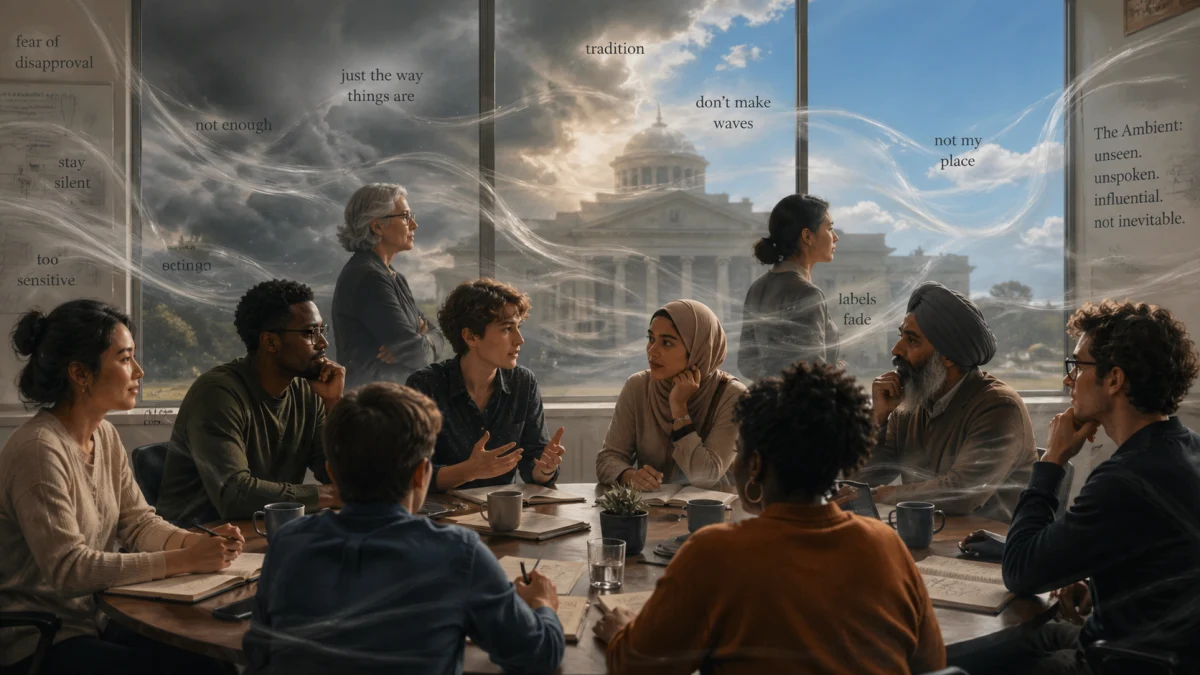
Because The Ambient isn’t a wall you push against. I told you that already. It’s weather. It’s atmospheric pressure. It’s the room you’re standing in and the air you’re already breathing and the temperature your body has already adjusted to without a single conscious decision on your part.
You don’t fight weather by screaming at it.
You navigate it.
And that navigation — if you do it right, if you’ve studied the pressure systems long enough and traced the currents with enough patience — becomes something closer to art than activism. Something so fluid, so structurally integrated into its own environment, that the people whose entire purpose is detection cannot find the seam.
Not because it’s hidden.
Because there is no seam.
The Complacency Around You
Let me describe something you’ve already noticed but perhaps haven’t named.
You’re in a room. A dinner party. A conference. A family gathering. The kind of ordinary social environment where ordinary people say ordinary things — and embedded in those ordinary things, delivered with the same casual certainty as weather’s been nice lately, are statements that would require entire dissertations to unpack. Assumptions carrying the weight of centuries. Conclusions that were never concluded but simply inherited, like furniture no one remembers purchasing.
Everyone is comfortable.
Not in the lazy sense. Not even in the ignorant sense — many of these people are sharp. Well-read. Capable of sophisticated thought on a dozen other subjects. But on this subject — on the particular arrangement of whose humanity is operational and whose is decorative — they are at rest.
Complacent.
Not because they’re bad people. I want to be very clear about that, because the moment you start sorting humans into good and bad you’ve already lost the thread. You’ve already adopted the same binary architecture that The Ambient runs on.
They’re complacent because complacency is the default state of anyone fully integrated into the ambient. It takes energy to question something you’ve never experienced as a question. It takes a kind of cognitive violence — directed inward, at your own foundations — to look at something the entire world around you treats as settled and say: actually, wait.
Most people never do that.
Not because they can’t.
Because the cost — the social cost, the psychological cost, the sheer exhausting daily weight of being the person in the room who won’t let it go — is calculated, somewhere below consciousness, and found to be not worth paying.
I don’t blame them for that calculation.
I made it myself for years.
The Axiom
There’s something I need to tell you about the foundation of everything that followed.
It starts with a principle so simple it almost sounds childish when you say it out loud. The kind of thing you’d expect on a poster in a kindergarten classroom, not at the center of anything claiming intellectual sophistication.
All human lives must be equal.
That’s it. That’s the entire axiom. The irreducible premise. The thing that, if you accept it — genuinely accept it, not as decoration but as operational architecture — restructures every other conclusion you’ve ever reached about history, sovereignty, land, belonging, and who gets to narrate whom.
And here’s what makes it devastating as a foundation rather than merely inspirational:
You cannot argue against it without revealing yourself.
Try. Go ahead. Sit with it for a moment and construct the counterargument. Not the sophisticated version that hides behind complexity and historical context and well, it’s more nuanced than that. The actual counterargument. The one that requires you to say, out loud, in plain language: some lives matter less.
No one will say it.
Everyone knows what it would make them sound like.
And yet — and this is the fracture line that runs through everything, the hairline crack in the foundation of every system that has ever sorted human beings into tiers — the policies continue. The erasures continue. The slow, administrative, well-documented, perfectly legal diminishment of certain people’s claims to their own existence continues.
All while no one — not a single person in any position of power, not a single voter, not a single editorial board — will publicly state the premise required to justify it.
That gap — between what is practiced and what can be admitted — is where The Ambient lives. That’s its address. That’s its infrastructure. It fills the space between the quiet axiom everyone claims to hold and the loud machinery that violates it daily.
The axiom is simple.
The resistance to its implications is not.
The Ones Who Get Crushed
Now. Let me tell you about the people who see all this clearly and decide — against every rational calculation of self-interest — to say so.
They exist in every generation. In every system. People who look at the gap between stated values and practiced reality and find it intolerable. Not intellectually intolerable — that’s easier to live with. Existentially intolerable. The kind of thing that sits in your chest like a stone and won’t let you breathe normally until you’ve said something.
They speak.
And then they learn something about The Ambient that you can only learn the hard way:
The Ambient doesn’t crush people.
It doesn’t need to.
The Ambient simply makes space for the people who will.
There is a class of operator — and I use that word deliberately, because what they do is operational even when it doesn’t look organized — who exist in a kind of symbiotic relationship with the status quo. They are not ideologues, most of them. They don’t lie awake at night thinking about how to maintain the architecture of inequality. They don’t have manifestos. Many of them would pass any standard test of moral reasoning you put in front of them.
What they have is incentive.
Financial, usually. Sometimes professional. Sometimes social — the quiet currency of access, of being in the room, of not being the kind of person who makes other powerful people uncomfortable.
And when someone threatens to disturb the arrangement — when someone speaks loudly enough, clearly enough, precisely enough that the gap between stated values and practiced reality becomes momentarily visible — these operators activate.
Not conspiratorially. Not through any coordinated decision made in some shadowy back room. That’s the cartoon version. The real version is less dramatic and far more effective.
They activate the way an immune system activates.
Automatically. Distributed. Each cell performing its function without needing to know the larger design.
The Price of Everyone
Let me tell you something that makes people uncomfortable at a level they can’t quite locate.
Almost everyone can be bought.
Not in the crude sense. Not with a briefcase full of cash slid across a table in a dim room. That’s cinema. The real mechanism is subtler, more gradual, more dignified. It looks like a consulting fee. A board position. A speaking engagement. A grant. A promotion. Access to a network that quietly determines who gets heard and who gets ignored.
It looks like comfort.
And here’s what I’ve learned about corruption after years of watching it operate at every scale from the interpersonal to the institutional:
It’s easy to say you’re uncorruptible.
It costs nothing to believe it. In fact, believing it is one of the most pleasant and cost-free beliefs a person can hold about themselves. It sits alongside I would have hidden Anne Frank and I would have marched at Selma in the category of moral self-assessments that require absolutely nothing from you because they posit a scenario you will never actually face.
I think about this sometimes in terms of fidelity. It means very different things to say I would never be unfaithful if you’re living a quiet life in a town of three thousand people with limited opportunity, versus if you’re navigating environments of constant proximity and access and option. The claim is identical. The conditions that test it are not.
Corruption works the same way.
You’re uncorruptible right up until the moment someone is three keystrokes away from changing your material reality. Three keystrokes from eliminating a debt, funding a dream, securing your children’s future in a way that would have taken you twenty years of compliance to achieve.
And in that moment — in that precise, singular, unrepeatable moment — you discover what your integrity is actually made of. Whether it’s structural or decorative. Whether it’s load-bearing or cosmetic.
Most people never face that moment.
Which is why most people get to keep believing they’d pass the test.
I don’t commit to the uncorruptibility of anyone until I’ve seen the moment. Not directly — not always. But in some verifiable way, under some genuine pressure, with some real cost attached.
The people who actually pass — who face the transfer, the offer, the access, the whispered you could make this all so much easier for yourself and say no — they exist.
But they’re rare enough that building a strategy around finding them is like building an army out of unicorns.
You work with the world as it is.
And in the world as it is, morality has a price point. And the people defending the architecture know exactly what it is.
The Delicate Art
So here you are.
You see the gap. You feel the axiom in your bones — every life equal, no exceptions, no footnotes, no however-comma-it’s-complicated. You understand that the resistance is not a movement but a recognition. A refusal to participate in the sorting. A quiet, daily, ongoing decision to see what the ambient is designed to make invisible.
And you want to act on that.
But you’ve watched what happens to the people who act on it loudly. Who stand in the gap and point at it and say look, look, can you not see this, how can you not see this.
They get the cloud.
Not the fist. Not the boot. Not the overt, documentable violence that creates martyrs and mobilizes sympathy. Something much more elegant than that.
They get a cloud of association attached to them. A residue. A smell.
Here’s how it works — and I want you to understand this mechanically, because once you see the mechanism you start seeing it everywhere:
The operators identify the threat. Someone is speaking clearly. Someone is naming the gap. Someone is making the invisible architecture briefly visible in a way that causes discomfort in rooms where discomfort is not tolerated.
Step one: Conflation.
A people and their government are converged into a single entity. An identity and a policy are fused. A critique of a system becomes — through careful, repeated, linguistically precise manipulation — an attack on a people.
This is the foundational move. Everything else rests on it.
Because once the conflation is in place, once the critique of a government’s actions cannot be separated — in the public ear — from hatred of the people that government claims to represent, then the tool becomes available.
Step two: The label.
Racist. Bigot. Antisemite. Whatever word carries the most cultural voltage in the relevant context. Whatever word makes reasonable people in adjacent rooms instinctively step back. Not because they’ve examined the accusation. Not because they believe it, necessarily.
Because they don’t want to be associated with it.
That’s the weapon.
Not the label itself. The label is just the delivery system.
The weapon is the association. The adjacency. The social cost of being in the same sentence as someone who has been — through the careful, surgical application of a word — rendered untouchable.
And it works.
It works so reliably, so consistently, across so many different contexts and decades and political configurations, that after a while you start to admire the engineering even as you despise the purpose.
People feel sorry for you. They genuinely do. They might even agree with you, privately, in the spaces between public statements. But they won’t stand next to you. They won’t share a platform. They won’t put their name adjacent to yours.
Because the cloud has attached.
And the cloud, once attached, is almost impossible to remove through direct action. Denial amplifies it. Outrage confirms it. Silence lets it calcify into consensus.
There is only one approach that works.
And it requires something that feels, at first, like surrender.
The Method
Here’s what I learned about operating within The Ambient.
The navigation cannot look like navigation.
The resistance cannot look like resistance.
Not because concealment is the goal — not because we’re building something secret, something underground, something that relies on darkness and hiddenness to survive. That kind of architecture is brittle. It fears exposure. It breaks when light reaches it.
This is the opposite.
This operates in full visibility. Full daylight. Full, uncomfortable, undeniable view of anyone who cares to look.
And yet — the people whose job it is to find it, flag it, label it, cloud it — can’t touch it.
Not because they don’t want to.
Because there’s nothing to grip.
Let me be more precise about this because precision is everything here.
The art — and I use that word with full weight, because what I’m describing requires the same attention to form and structure and invisible craftsmanship as any masterwork — is to construct something so clean, so axiomatically grounded, so rigorously aligned with values that the operators themselves publicly claim to hold, that any attempt to attack it requires the attacker to publicly contradict their own stated principles.
You build something that can only be opposed by someone willing to say, out loud, that human lives are not equal.
You build something where the only available critique requires the critic to stand in front of a room and argue against the thing they’ve spent their entire public life claiming to believe.
And they won’t do it.
They can’t.
Not because you’ve silenced them. Not because you’ve outmaneuvered them in some clever rhetorical game. But because the axiom — all human lives must be equal — is the one thing even the most sophisticated operator cannot publicly reject without destroying their own credibility.
So they circle it.
They approach it from angles. They test it. They look for the seam — the place where the construction is weak, where an accusation might stick, where a label might adhere.
And they find nothing.
Not because it’s perfect. Not because you haven’t made mistakes. But because you’ve built it on the one foundation they cannot attack without revealing that their opposition was never about what they claimed it was about.
They retreat.
And here’s the crucial part — the part that separates art from activism, navigation from confrontation:
They retreat thinking they’ve won.
The Illusion of Their Victory
This is the part that requires discipline. Real discipline. The kind that goes against every instinct of a person who has watched injustice operate unchecked and wants — viscerally, urgently, in the same place you feel hunger — to see it named and shamed and stopped.
You let them think they’ve succeeded.
You let the operators walk away believing that their labels almost stuck. That your quiet response was retreat. That your refusal to engage on their terms was a concession. That the absence of confrontation means the absence of threat.
You let them report back to whatever coordination — overt or emergent — directs their attention: handled. Contained. Not a concern.
Because the moment they stop paying attention is the moment the actual work becomes possible.
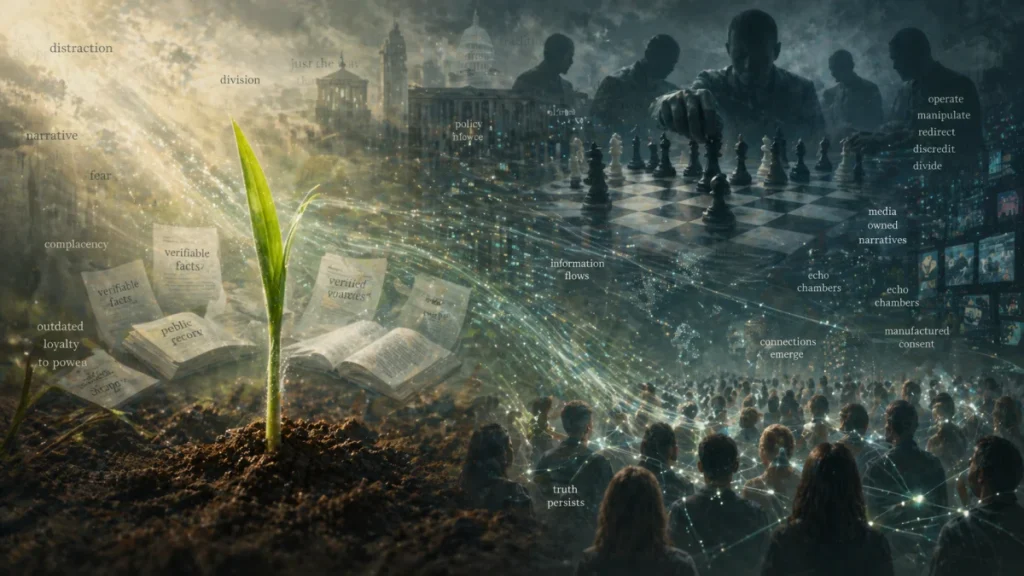
Not the visible work. The visible work is what they watch. The visible work is the speech, the platform, the movement with a name and a logo and a leader they can target.
The actual work is atmospheric.
It’s The Ambient itself — not the one they built, but the one you’re building underneath it. Slowly. Grain by grain. Interaction by interaction. One conversation at a time, one shifted assumption at a time, one four-second pause shortened by a fraction at a time.
You’re not trying to win an argument.
You’re not trying to build a movement.
You’re trying to change weather.
And weather doesn’t change because someone stood on a hill and shouted at the clouds. Weather changes because a thousand invisible conditions shifted, each one too small to notice, until one morning the air is different and no one can point to the moment it happened.
That’s the art.
That’s the navigation.
The operators are watching for storms. Watching for fronts. Watching for the dramatic, targetable, labelable weather events they know how to respond to.
They’re not watching for the slow change in atmospheric pressure that makes their own weather system unsustainable.
By the time they notice, it won’t be something they can label.
It will be something they have to breathe.
The Patience This Requires
I’m going to be honest with you now in a way that might feel unsatisfying.
This takes time.
Not weeks. Not months. Not the kind of timeline that fits inside a news cycle or a campaign or a congressional term. The kind of timeline that feels, while you’re inside it, indistinguishable from nothing happening at all.
And during that time, people will continue to be crushed.
Not metaphorically. Actually. The operators will continue to identify the visible resistors — the ones who cannot or will not modulate their frequency, who speak at a pitch that registers on the detection equipment — and they will continue applying the cloud. The label. The slow social suffocation that turns a person from someone worth listening to into someone others cross the street to avoid being seen near.
And you’ll watch it happen.
And some part of you — the part that still believes in justice as event rather than process, as moment rather than pressure — will want to intervene. Will want to stand up and say that person is right and you know they’re right and this is wrong and you know it’s wrong.
And you’ll have to decide, in that moment, whether the satisfaction of being visible is worth the cost of becoming targetable.
Whether joining someone under their cloud helps them or simply gives the operators two people to manage instead of one.
Whether your anger — righteous, justified, entirely appropriate — is a strategic asset or a tactical liability.
I don’t have a universal answer to that.
Sometimes visibility is the right choice. Sometimes the moment demands a body in the gap, and the calculation shifts.
But most of the time — and this is the part that lives in your chest like swallowed glass — most of the time, the art requires you to be invisible enough to remain operational.
To carry the axiom without performing it.
To change the weather without announcing rain.
What This Looks Like In Practice
Let me give you something concrete, because theory without practice is just philosophy and philosophy alone has never changed an atmospheric pressure in history.
You’re in a conversation. The gap is visible — someone is saying something that rests on the invisible premise that certain lives are worth less. They’re not saying it loudly. They’re not saying it crudely. They’re saying it the way the teacher in that classroom said it: as background. As settled. As the way things are.
You don’t argue.
You don’t correct.
You ask a question.
One question. Small. Almost innocent. Phrased with genuine curiosity rather than accusation. Phrased in a way that invites the person to follow their own logic one step further than the ambient usually allows it to go.
And then you stop.
You don’t push. You don’t follow up. You don’t make it a thing. You let the question sit in the air between you like a stone dropped into still water, and you let the ripples do what ripples do without helping them.
Maybe nothing happens. Maybe the ambient seals itself back up, seamless, undisturbed. Maybe you’ve wasted your breath.
Or maybe — and this is the thing you’ll never see, the thing that happens in the privacy of another person’s thinking at three in the morning when their defenses are down and the question you asked surfaces unbidden — maybe a pause shortens.
Maybe something that was four seconds becomes three.
Maybe a setting shifts.
You’ll never know. That’s the price of doing this work at the atmospheric level. You never get to see the change. You never get the satisfaction of watching the architecture crumble in real time, of knowing that your words were the ones that did it.
You simply change the pressure.
And you trust — because this is the one thing every cult I ever studied taught me, the one transferable truth — that no architecture built on suppressing human recognition can maintain itself indefinitely against people who refuse, quietly, persistently, undramatically, to stop recognizing.
The Ending They Won’t See Coming
So here’s where we are.
The Ambient is everywhere. It’s the room and the air and the temperature and the weather and the pressure and the thing you’re breathing right now while you read this. It was there before you were born and it has plans to outlast you.
The operators are good at their jobs. Better than good — they’ve had decades, centuries, millennia of practice. They know how to identify threats. They know how to apply labels. They know how to make the cost of visibility so high that most rational people choose silence. They know that morality has a price point and they know, to the decimal, what it is for most of the people who matter.
The people who speak loudly get crushed. Reliably. Predictably. Documented and demonstrable.
And yet.
And yet the atmospheric pressure is shifting.
Not because of any single person. Not because of any movement or organization or speech or document. Not because of anything the operators know how to target.
Because enough people are carrying the axiom now — quietly, without performance, without labels of their own — that the weather is changing from the inside.
Because the conflation is starting to fail. Because the distance between a people and their government is becoming visible to an increasing number of people who were never supposed to see it. Because the label — the word, the cloud, the weapon — is losing its voltage through overuse, the way any tool loses its edge when you deploy it against everyone and everything that moves.
Because somewhere, right now, a person who was installed with the hierarchy is sitting in proximity to a person they were never supposed to recognize as fully human.
And the recognition is happening.
Not loudly. Not dramatically. Not in a way that will make the news or generate a hashtag or create a movement that can be targeted.
Quietly.
The way weather changes.
The way pressure builds.
The way something that was unthinkable yesterday becomes, today, merely uncomfortable. And tomorrow — if enough grains shift, if enough pauses shorten, if enough questions land — becomes obvious.
And the operators, who are watching for storms, will have nothing to report.
Situation normal. No threats detected. Architecture intact.
They’ll file that report right up until the morning they step outside and realize the air is different.
And by then, it won’t be something they can label.
It won’t be something they can buy.
It won’t be something they can crush.
It will just be the weather.
And they’ll have to breathe it like everyone else.
End of Chapter Two