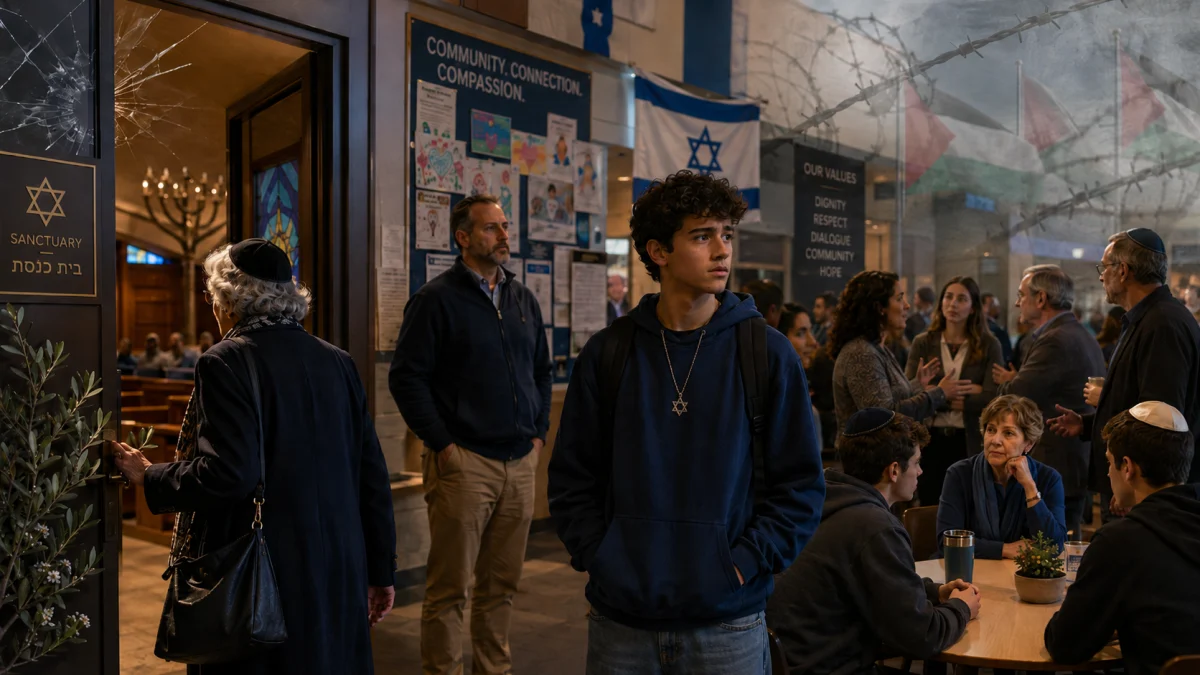
There is a strange tension now when you walk into a Jewish community center, a synagogue, or a Jewish school in America.
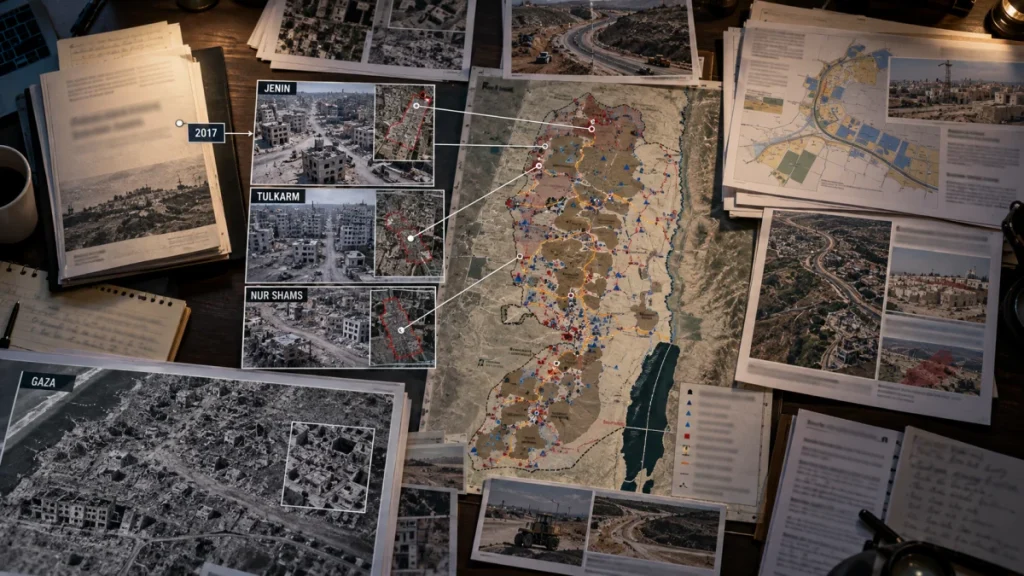
You may see Israeli flags. You may see “Stand with Israel” messaging. You may hear language that feels completely disconnected from the horror unfolding in Gaza, the occupation of Palestinian land, the bombing of neighboring countries, the far-right drift of Israeli politics, and the wider wreckage Israel’s government has helped produce across the region.
And for many people, Jewish and non-Jewish alike, that creates a real moral discomfort.
Not an imagined discomfort.
Not a manufactured one.
A real one.
Because if you are paying attention, it is impossible to look at Israel’s conduct and pretend there is nothing to object to. The anger toward the Israeli government is not irrational. It is not automatically antisemitic. It is not some mysterious hatred that appeared out of nowhere. It is, in large part, a response to real policies, real violence, real displacement, real occupation, real dehumanization, and real suffering.
We do not need to soften that.
But here is where the conversation gets harder.
A Jewish community center in a liberal American city is not the Israeli government. A synagogue preschool is not the Netanyahu cabinet. A Jewish summer camp is not the IDF. The elderly woman walking into Shabbat services is not responsible for every bomb dropped in Gaza. The teenager wearing a Star of David necklace is not a foreign ministry spokesperson. The Jewish family that still feels emotionally attached to Israel is not automatically endorsing every act carried out by the state.
This distinction should be obvious.
But right now, it is being erased from both directions.
On one side, some people collapse all Jewish identity into Israel and then treat every Jewish space as if it is an embassy. That is dangerous. It turns local families, children, teachers, rabbis, staff members, and community volunteers into symbolic targets for a state they may not control, may not fully support, and may even privately oppose.
On the other side, much of the pro-Israel institutional world has spent years doing something similar in reverse. It has worked very hard to convince Jewish communities that criticism of Israel is not just criticism of Israel. It is hatred of Jews. It is rejection of Jewish safety. It is proof that the world has turned against them again.
That is also dangerous.
Because once Jewish safety is fused completely with Israel’s political image, every criticism of Israeli policy starts to feel like an attack on Jewish existence. Every protest becomes existential. Every Palestinian flag becomes a threat. Every demand for accountability becomes a rehearsal for persecution.
And that is exactly how people get trapped.
Many American Jews are not walking around with some simple, cartoonish devotion to Israel. Many are conflicted. Many are grieving. Many are angry. Many are privately horrified. Many know something is wrong, but they also know what happens when they say it out loud.
They may lose friends.
They may lose donors.
They may lose jobs.
They may lose access to the only community structure they have.
That matters.
Jewish institutions are not abstract moral machines. They are nonprofits. They have boards. They have major donors. They have federation relationships. They have security costs. They have staff salaries. They have schools, camps, gyms, elder programs, food assistance, cultural events, and family services to keep alive.
And when the donor class, institutional leadership, and legacy Jewish organizations are heavily aligned with pro-Israel politics, the pressure becomes obvious. Nobody has to say the quiet part out loud. Everyone can feel it.
This is how institutional conformity works.
Not always through some dramatic conspiracy. Usually through incentives. Through funding. Through professional risk. Through social belonging. Through the fear of being the one person in the room who says, “I am Jewish, I care about Jewish safety, and I cannot defend what Israel is doing.”
That sentence should not be controversial.
But in many spaces, it still is.
So when people ask, “Why are they still flying the Israeli flag?” the answer is not always simple. Sometimes it is ideological. Sometimes it is historical. Sometimes it is emotional. Sometimes it is generational. Sometimes it is donor pressure. Sometimes it is fear. Sometimes it is inertia. Sometimes it is because, for older Jewish communities especially, Israel was not just a country. It was the symbol of survival after a world that had proven very clearly it could abandon Jews.
That does not excuse Israel’s conduct.
But it explains why the symbol does not land the same way for everyone.
For a Palestinian, the Israeli flag may represent occupation, siege, checkpoints, bombing, dispossession, humiliation, and state violence.
For an older Jewish refugee family, or the child of Holocaust survivors, or someone raised in the shadow of antisemitic violence, that same flag may represent the idea that Jews will never again be completely defenseless.
Both of those emotional realities can exist at once.
That is the part mature people have to sit with.
The goal is not to bully Jewish communities into pretending Israel means nothing. It clearly means something. The goal is also not to let Jewish institutions hide behind trauma while refusing to confront Palestinian suffering. That is morally bankrupt.
The goal is to make space for honesty.
A Jewish community center should be safe for Jews who support Israel, Jews who criticize Israel, Jews who are anti-Zionist, Jews who are confused, Jews who are grieving, Jews who are scared, and Jews who simply want their children to have a place to learn, swim, pray, eat, play, and belong.
It should also be a place where non-Jewish neighbors can walk in without feeling like they are entering a political loyalty test.
That balance is hard. But hard is not impossible.
We can defend Jewish community centers from hatred without defending every Israeli policy. We can protect synagogues from violence without pretending every protest is antisemitism. We can acknowledge Jewish fear without weaponizing it against Palestinians. We can condemn antisemitism without laundering state violence through the language of safety.
That is the line.
Defend people.
Question institutions.
Protect communities.
Challenge governments.
Refuse collective blame.
Refuse moral blackmail.
The Jewish person in your neighborhood is not the Israeli state.
The Palestinian child under rubble is not Hamas.
The synagogue is not a military base.
The community center is not a foreign ministry office.
And if we cannot hold those distinctions in our heads at the same time, then we are not being moral. We are just choosing which innocent people to flatten into symbols.
The people who feel conflicted inside Jewish spaces right now deserve to hear this clearly:
You are not crazy.
You are not betraying your community by asking questions.
You are not abandoning Jewish people by caring about Palestinian life.
You are not antisemitic because you are disturbed by Israeli flags in every communal space.
And you are not weak because you feel pressure to stay quiet.
That pressure is real.
But silence should not be mistaken for agreement. Institutional messaging should not be mistaken for communal consensus. And a flag on the wall should not be mistaken for the full moral imagination of every person inside the building.
This is the nuance we need.
Not because nuance is comfortable.
Because without it, everyone becomes a weapon in someone else’s narrative.