
Article type: Parent Action Guide and safety-planning guide
Scope: Autistic children and youth; United States emergency and school-planning context, with general safety principles useful elsewhere
Last updated: July 17, 2026
If a child is missing, act immediately
If an autistic child or youth is missing, treat it as urgent.
Search the most dangerous nearby locations first: water, traffic, train tracks, parking lots, construction areas, woods, neighbors' pools, favorite places, stores, playgrounds, and routes the child knows.
Contact emergency services immediately. Tell responders that the child is autistic, may not respond to their name, may be drawn to water or traffic, may hide, may not speak reliably, may not understand danger, or may run from unfamiliar people.
Do not spend precious time proving that the situation is serious.
Wandering, also called elopement, is not ordinary toddler exploring when it involves leaving a safe area or responsible caregiver in a way that can lead to harm. The CDC describes wandering as an important safety issue for some people with disabilities, including autism and intellectual disability. CDC guidance notes that about half of children and youth with ASD were reported to wander, and among those who wandered, 1 in 4 were missing long enough to cause concern.
That number is not a parenting accusation. It is a safety signal.
Wandering can happen even when families are careful.
The goal is not to shame parents. The goal is to build the plan before the door opens, the crowd shifts, the bus unloads, or the classroom routine changes.
Why autistic children may wander
Wandering is not one behavior with one cause.
CDC describes common reasons children may wander, including enjoyment of running or exploring, trying to reach a preferred place, escaping a stressful situation, or going toward something interesting.
For an autistic child, those reasons may look like:
- running toward water, traffic signs, trains, elevators, animals, lights, playgrounds, stores, or a favorite route;
- escaping noise, crowds, demands, transitions, conflict, pain, or fear;
- seeking movement or open space;
- following a routine without realizing the adult is not with them;
- leaving to find a preferred person, object, or place;
- bolting during a meltdown or panic;
- hiding when overwhelmed;
- moving quickly without understanding danger;
- not responding to name, verbal commands, or unfamiliar adults;
- being unable to explain who they are or where they live.
The reason matters because the prevention plan changes.
A child who runs toward ponds needs water-focused planning. A child who bolts from school during demands needs school-based prevention and behavior support. A child who leaves home at night needs sleep and home-entry safety planning. A child who hides when scared needs responders to know likely hiding places and communication needs.
Build the plan before you need it
A wandering plan has three jobs.
- Prevent leaving when possible.
- Notice quickly when leaving happens.
- Respond fast with the right information.
Do not rely on one tool. A lock, alarm, tracker, neighbor notice, swim lesson, school plan, ID bracelet, or visual rule may help, but none of them is enough alone.
The strongest plans are layered.
Home safety
Walk through your home as if the child is determined, fast, quiet, and curious.
Ask:
- Which doors can open silently?
- Which windows can open?
- Can the child unlock deadbolts, sliding doors, gates, garage doors, or fence latches?
- Can the child leave during the night?
- Are there pools, ponds, canals, creeks, retention basins, or busy roads nearby?
- Does the child run toward a specific place?
- Could a visitor, sibling, delivery, or repair person leave a door unsecured?
- What happens during chaos: groceries, bedtime, bath time, school mornings, parties, holidays, or when one adult assumes another adult is watching?
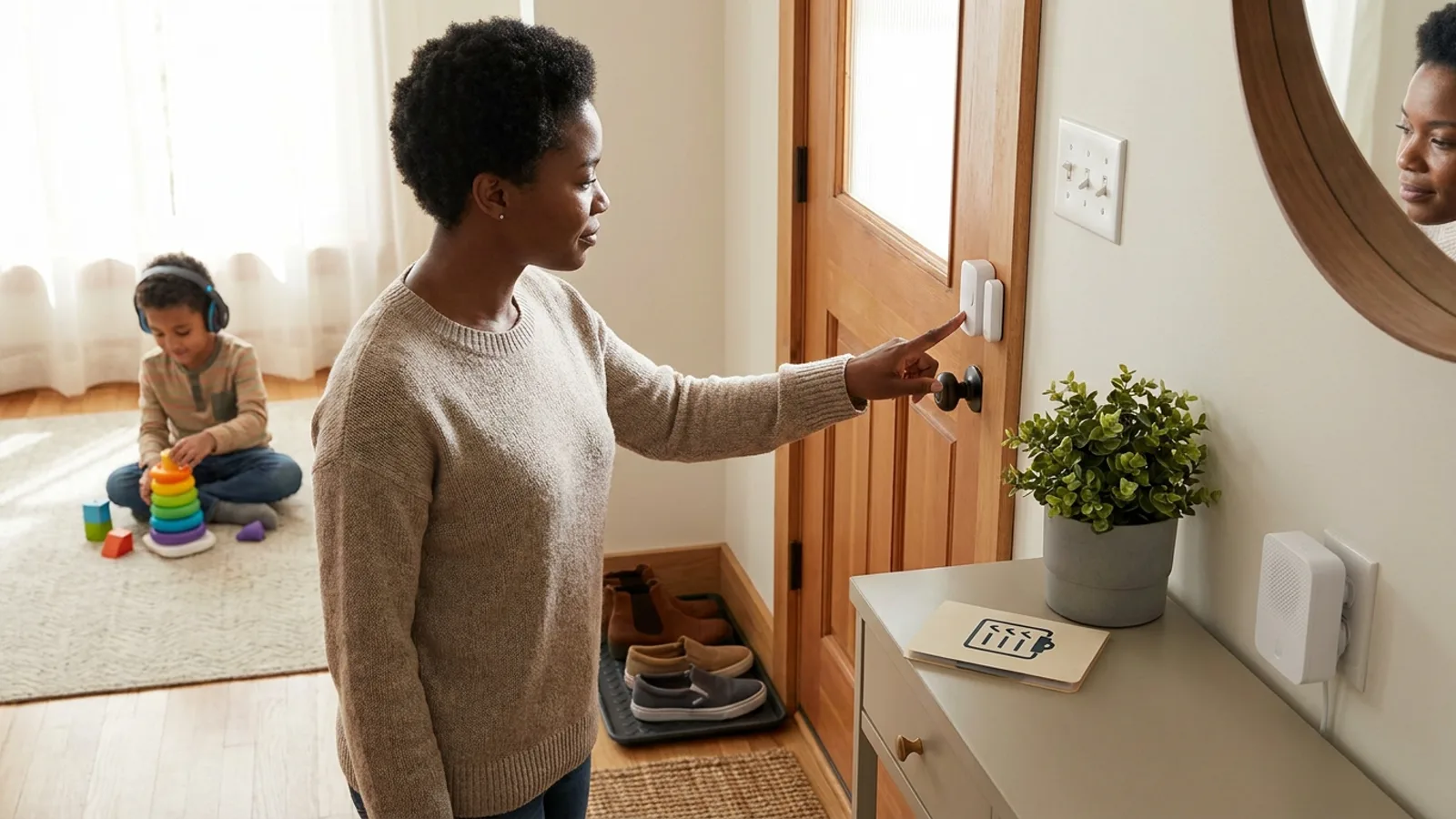
Possible supports include door alarms, window alarms, safer locks, fencing, pool barriers, visual stop cues, supervision plans, neighbor awareness, and a written emergency sheet.
Safety products should be chosen carefully. Locks and alarms can reduce risk, but they must comply with fire safety, landlord rules, and the needs of everyone in the home. If you are unsure, ask a qualified professional.
Water deserves special attention
Water is one of the most serious risks in autism wandering. The AAP's HealthyChildren.org guidance notes that many autistic children who wander are at risk of drowning, and CDC also identifies drowning as a common danger when children wander.
Make a list of nearby water locations before there is an emergency:
- pools;
- ponds;
- lakes;
- creeks;
- canals;
- rivers;
- fountains;
- drainage areas;
- retention basins;
- neighbors' pools;
- nearby apartments, hotels, gyms, or community centers with pools.
Swimming lessons can be valuable, but they do not remove the need for barriers, supervision, alarms, and emergency planning. A child who can swim may still be unsafe around cold water, currents, clothing, panic, night conditions, or unfamiliar water.
The broader guide to autism IEPs, 504 plans, and school accommodations can help families place supervision, communication, transportation, sensory, and emergency needs into a written plan.
School and daycare safety
If a child has wandered or is at risk of wandering, school cannot rely on "we will watch closely."
The plan should be written.
For an IEP, 504 plan, behavior plan, safety plan, or daycare plan, ask:
- Where has the child tried to leave from?
- What usually happens right before bolting or wandering?
- Which doors, gates, playground areas, buses, bathrooms, hallways, cafeterias, and arrival/dismissal points are highest risk?
- Who is responsible during transitions?
- What happens during fire drills, assemblies, field trips, recess, substitute teachers, and bus changes?
- What is the staff response if the child leaves the room?
- Who calls parents?
- Who contacts emergency services?
- What information is shared with responders?
- How will staff avoid chasing in a way that increases running, unless immediate danger requires it?
- What replacement communication will the child be taught?
- What supports reduce the reason for leaving?
If the child leaves to escape noise, reduce noise.
If the child leaves to avoid unclear demands, make instructions clearer.
If the child leaves to reach the playground, build a supervised movement plan.
If the child bolts during transitions, change transition support.
A safety plan should not only say what adults do after the child runs. It should reduce the conditions that make running more likely.
Community outings
Outings are harder because risk moves.
Before going to a store, park, airport, fair, clinic, religious service, restaurant, or family event, decide:
- Who is the lead adult watching the child right now?
- What is the exit plan?
- What is the meeting place?
- What is the highest-risk nearby area?
- Is water nearby?
- Is traffic nearby?
- What sensory triggers could cause bolting?
- What preferred place might the child run toward?
- What communication support is available?
- Does the child have identification?
- Do we have a recent photo?
Use boring clarity. "Everyone watch him" means no one is assigned. "Dad has him until we leave the store; Mom handles checkout" is better.
For high-risk outings, consider whether the outing is necessary, whether another format is possible, or whether the child needs a one-to-one safety plan.
Emergency information sheet
Keep an emergency information sheet updated and easy to share.
Include:
- recent photo;
- full name and nickname;
- age, height, weight, hair, clothing, and identifying features;
- diagnosis and communication profile;
- whether the child may be nonspeaking, minimally speaking, unreliable under stress, or unable to answer questions;
- whether the child responds to name;
- favorite places and likely destinations;
- attraction to water, traffic, trains, elevators, animals, lights, or other interests;
- fears or triggers;
- calming approaches;
- what not to do if it escalates panic;
- medical needs, allergies, seizures, or medications if relevant;
- parent and emergency contact numbers;
- school or daycare contact;
- tracking device details if used;
- nearby water and danger locations.
Update the photo often. An old photo is better than nothing, but a current one is better.
Identification and tracking
Some families use ID bracelets, shoe tags, backpack tags, wallet cards, temporary tattoos, GPS trackers, phone location sharing, door alarms, or home security systems.
These can be useful. They are not a substitute for supervision or planning.
Before using a device, ask:
- Is the child likely to tolerate wearing it?
- Can the child remove it?
- Does it need charging?
- Who checks it?
- Does it work indoors?
- Does it work near water?
- Who has access to location data?
- What is the privacy policy?
- What is the backup if it fails?
- Could the device create false confidence?
Technology can buy time. It cannot replace a prevention plan.
If wandering follows sensory overload or escalating distress, the guides to sensory accommodations and meltdowns versus tantrums can help identify preventive supports without treating coping skills as a substitute for environmental safety.
Teach safety skills without pretending they are enough
Safety teaching matters. But teaching is not the same as assuming the child can use the skill under stress.
Depending on the child, goals may include:
- stopping when an adult says "stop";
- waiting at doors;
- staying with an assigned adult;
- showing an ID card;
- stating or showing name and phone number;
- going to a safe adult;
- responding to a whistle or visual cue;
- practicing street safety;
- practicing water safety;
- using a communication card that says "I need a break";
- asking to leave before bolting.
Practice in calm moments. Use simple language, visuals, repetition, and realistic settings. Do not punish failed practice as if the child chose danger on purpose.
For water, swimming lessons may be part of the plan, but barriers and supervision remain essential.
What to tell neighbors and trusted adults
Neighbors can help if they know what they are seeing.
You do not need to disclose everything. Share enough for safety.
You might say:
Script: My child is autistic and may wander or run if overwhelmed. If you ever see him alone, please call me immediately and contact emergency services if needed. He may not answer questions or respond to his name. He is drawn to water and playgrounds. Here is a current photo and my number.
Trusted adults might include neighbors, relatives, school staff, bus drivers, daycare staff, coaches, religious-community staff, building security, apartment management, or local first responders.
Use judgment. Share safety information with people who need it and can be trusted.
A sudden new wandering pattern may also justify checking for pain, illness, sleep disruption, medication changes, or other contributors using the medical-cause checklist for sudden behavior changes.
After a wandering incident
Once the child is safe, the next step is not shame. It is investigation.
Ask:
- Where did the child leave from?
- Who was responsible at that moment?
- What happened right before?
- Was there noise, demand, pain, fear, excitement, transition, or access to a preferred place?
- Did an alarm fail?
- Was a door left open?
- Did a routine change?
- Did the child hide, run, or seek something?
- How long did it take to notice?
- Who was contacted?
- What information helped?
- What slowed the response?
- What one change must happen today?
Then update the plan.
If the incident happened at school, ask for a meeting. If the child has an IEP or 504 plan, ask whether the safety plan, behavior support, supervision, transition support, and staff training need to be revised.
What not to believe
"Good parents can prevent every wandering incident"
No. Families can reduce risk, but wandering can happen quickly even with attentive adults. Shame makes families quieter. Quiet families get less help.
"If the child can talk, they are safe"
Speech does not guarantee safety. A verbal child may not answer under stress, may not understand danger, may run toward a preferred place, or may be unable to explain where they live.
"A tracker solves it"
A tracker may help locate a child. It does not prevent the child from entering water, traffic, or another dangerous situation.
"Swimming lessons solve water risk"
Swimming lessons can help. They do not replace supervision, barriers, alarms, and a water-search plan.
"The child just needs consequences"
If wandering is driven by sensory overload, fear, curiosity, communication difficulty, impulse, or attraction to water, punishment alone is unlikely to build safety. The plan must change the conditions, teach replacement skills, and prepare the adults.
A one-page plan families can start today
Use this as a quick draft.
Highest-risk places
List water, roads, stores, school exits, playgrounds, neighbors' pools, woods, parking lots, train tracks, or favorite destinations.
Most likely reasons for leaving
List escaping noise, reaching water, getting to playground, avoiding demands, seeking movement, following routine, fear, excitement, or pain.
Early warning signs
List looking at exits, pacing, repeating a phrase, covering ears, crying, laughing in a dysregulated way, pulling away, hiding, running toward a door, or going quiet.
Prevention steps
List alarms, locks, supervision assignments, visual rules, transition supports, quiet breaks, movement plan, communication card, water barriers, and school plan.
Emergency response
List who searches where, who contacts emergency services, who brings the photo, who checks water first, who stays home in case the child returns, and who contacts school or neighbors.
Information to share
List diagnosis, communication needs, likely destinations, water attraction, calming approach, triggers, photo, contacts, and medical needs.
Print it. Share it with the adults who actually need it. Update it after every close call.
Safety planning is love in practical form
Nobody wants to imagine their child missing.
That is exactly why the plan matters.
A safety plan is not a statement that the family failed. It is a recognition that some autistic children and youth need more than ordinary supervision because danger awareness, communication, impulse, sensory overwhelm, and attraction to specific places may work differently.
The plan should be calm, specific, and shared before panic.
The door alarm.
The water list.
The school handoff.
The current photo.
The neighbor who knows.
The responder who understands the child may not answer.
The adult assigned at the store.
The written plan that turns fear into action.
That is not overreacting. That is preparation.
References and further reading
Core safety guidance
- CDC: Wandering (Elopement). CDC guidance on wandering, prevalence estimates, common reasons for wandering, prevention steps, emergency planning, and first-responder awareness.
- HealthyChildren.org: Keep Kids with Autism Safe from Wandering. American Academy of Pediatrics parent resource on wandering, water risk, family supervision planning, and safety strategies.
Research
- Anderson C, Law JK, Daniels A, Rice C, Mandell DS, Hagopian L, Law PA. Occurrence and Family Impact of Elopement in Children With Autism Spectrum Disorders. Pediatrics. 2012;130(5):870-877. Found that nearly half of families in the sample reported elopement at or after age 4, with substantial family stress and safety concern.
- PubMed record: Occurrence and family impact of elopement in children with autism spectrum disorders. Citation and abstract for the Pediatrics study.
Toolkits and planning forms
- Autism Speaks: Wandering prevention. Collection of wandering prevention resources, safety planning tools, school alerts, and first-responder materials.
- Autism Speaks: Autism Safety Kit. Printable safety forms and planning resources for home, school, community, and first responders.
- Autism Speaks: Safety Tool Kit. General autism safety planning resource covering wandering, drowning, household toxins, communication misunderstanding, and community safety.
Editorial notes
This article is educational safety guidance, not individualized medical, legal, school, or emergency-response advice. If a child is missing, families should contact emergency services immediately. Families with repeated wandering, unsafe bolting, water attraction, traffic risk, school incidents, self-injury, seizures, sleepwalking, or severe communication barriers should seek individualized support from medical, school, behavioral, and local safety professionals.