The Problem With Watching
You can stare at a blade of grass for as long as your attention span will hold.
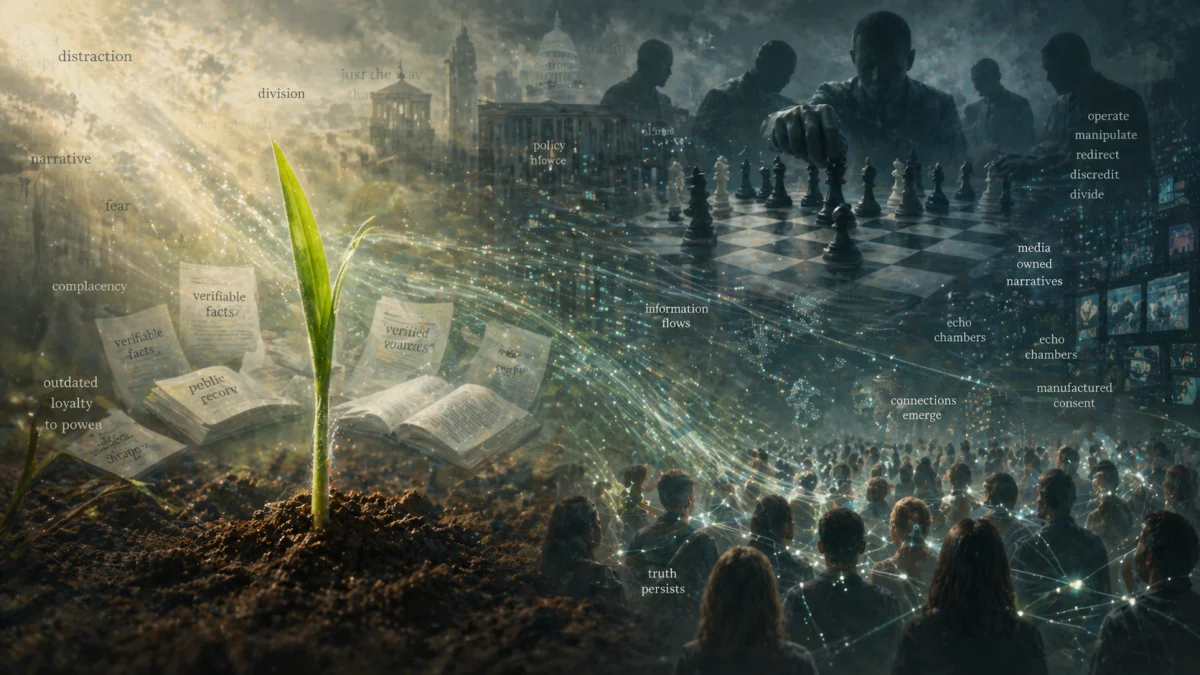
Hours, if you’re disciplined. Days, if you’re obsessive. You can fix your eyes on that single green thread rising from the soil and refuse to blink and give it every ounce of your conscious focus and you will not — not once, not ever — see it grow.
It’s not that it isn’t growing.
It is. The cells are dividing. The chloroplasts are firing. The whole quiet machinery of becoming is operating exactly as designed, right there in front of you, at a pace that is real and measurable and absolutely invisible to the resolution of human attention.
But step away.
Go live your life for three days. Come back. And the grass is different. Not lush. Not the thick green carpet you ultimately wanted, not the thing you’d photograph and send to someone with the caption look what I built. Just — taller. Just marginally, almost disappointingly, detectably more than it was.
That’s the timescale I’m talking about.
Not the timescale of campaigns or news cycles or electoral terms or even generations, necessarily. Something both slower and less patient than any of those. Something that rewards only the people willing to stop staring and trust the machinery.
I said in the last chapter that you’d never see the change. That the price of working at the atmospheric level is that you never get the satisfaction of watching the architecture crumble in real time.
That wasn’t completely wrong.
But it wasn’t completely right, either.
Because when you stop staring — when you step back far enough and give enough time its full, frustrating, unglamorous duration — you do see it.
Not the moment of change. Never the moment.
The evidence of it.
What Was Actually Built
Let me tell you about something that, if described incorrectly, sounds like conspiracy. And if described correctly, sounds like nothing at all.
That’s by design.
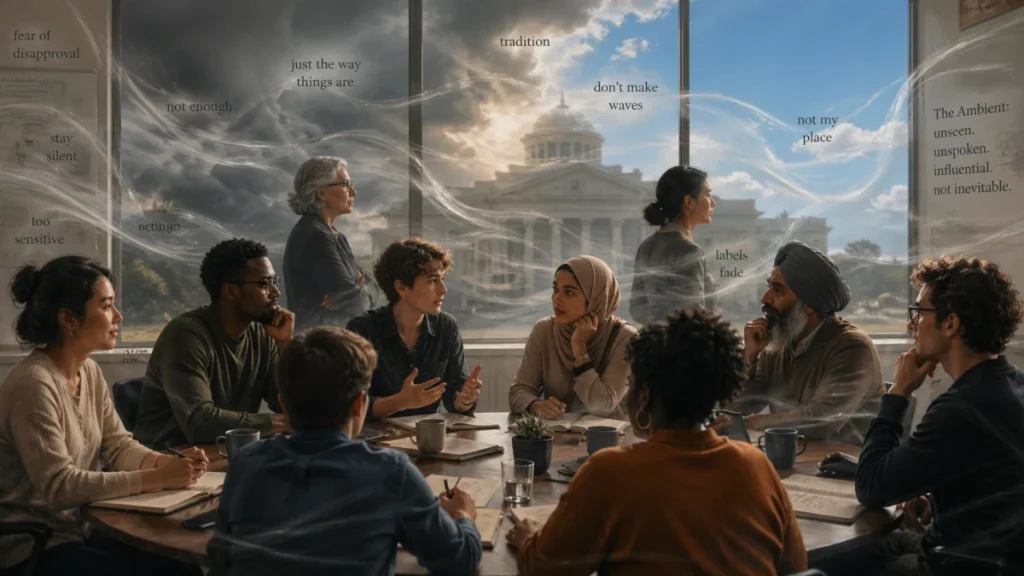
Suppose — and I’m speaking hypothetically, the way you speak hypothetically when precision matters more than plausible deniability — suppose a small number of people recognized the atmospheric problem for what it was. Not the injustice itself. Everyone with eyes recognizes injustice. That’s not the hard part. The hard part is recognizing that the ambient’s primary defense mechanism isn’t violence or censorship or even propaganda in the traditional sense.
It’s curation.
The ambient doesn’t hide information. Hiding information is clumsy. It creates gaps, and gaps create suspicion, and suspicion creates the exact kind of focused attention you don’t want. Hiding something is an admission that the something matters. It points at itself by its absence, the way a redacted line in a document screams louder than anything the words could have said.
No. The ambient does something far more elegant.
It simply doesn’t cite.
Think about that for a moment. Think about what it means to live in an era where billions of people have access to more information than every library in human history combined — and can’t find something. Not because it’s been scrubbed. Not because it’s behind a paywall or a classification level or a locked door. It’s right there. Published. Verified. Sitting in a legitimate, peer-reviewed, institutionally credible source that anyone could access with a four-word search query.
But no one searches for it.
Because no one references it. No one links to it. No one includes it in the bibliography. No one mentions it in the lecture. No one drops it into the conversation at the dinner party where the ambient is performing its seamless, undisturbed function.
It’s not hidden.
It’s just never introduced.
And information that is never introduced into a conversation doesn’t exist in that conversation, no matter how true it is, no matter how accessible it is, no matter how fundamentally it would restructure the conclusions everyone in the room has reached.
So. Suppose a small group of people — not an army, not a movement, not anything with a name or a logo or a leader — recognized this as the actual mechanism. And suppose they had the technical proficiency, the patient obsessiveness, the work-around knowledge of the systems that information relies on to circulate, to do something very simple.
Not to create information. Not to spin. Not to propagandize. Not to build a counter-narrative or a competing ambient or an alternative media ecosystem designed to shout louder than the existing one.
Just to ensure that everything was on the table.
That’s it.
Pull the uncited. Surface the unreferenced. Take the legitimate, the verified, the credible, the things that were sitting right there in plain sight where billions could theoretically see them, and simply — introduce them. Into search results. Into algorithmic pathways. Into the quiet infrastructure of how information reaches people who weren’t looking for it.
Not to tell anyone what to think.
Just to make sure the thinking had all the materials.
Now — if you describe that as a covert information operation designed to undermine the dominant narrative, it sounds sinister. It sounds like the kind of thing that gets a label attached. The kind of thing the operators activate against.
But if you describe it accurately — a small group of people making publicly available, institutionally verified information slightly easier to encounter — it sounds like nothing.
It sounds like a library restocking a shelf that was never technically empty.
And that’s the point.
The thing that changes weather doesn’t need to be dramatic. It doesn’t need to be secret. It doesn’t even need to be particularly sophisticated.
It just needs to be persistent.
The Playbook That Worked
Now let me talk about the operatives. The ones I mentioned before — the distributed immune system, the people who activate when the gap between stated values and practiced reality becomes momentarily visible.
For years — for decades, really — their playbook was flawless.
Here’s how it worked against the politicians. And I need to be careful here, because the moment I use words like progressive or populist or any of the color-coded, team-sorted labels that pass for political identity, I’ve already lost you. Not because those words are meaningless — they meant something once — but because they’ve been emptied. Hollowed out and refilled with whatever content serves the ambient’s sorting function on any given Tuesday.
So forget the labels.
Think instead about a type. A type of candidate — appearing across every era, in every system, under every ideological banner — whose fundamental orientation is toward the vast, vast majority. The people who are not in the room where decisions are made. The people who wake up and go to work so they can feed their families so their families can stay healthy so they can continue to go to work. The people for whom the entire apparatus of governance is supposed to exist but somehow never quite does.
Every now and then, a candidate emerges who actually means it.
Not performs it. Not campaigns on it and then governs otherwise. Actually, structurally, operationally means it. Whose policy positions, if implemented, would redirect resources toward the people the system claims to serve. Whose axiom — stated or unstated — is the same one we’ve been carrying: all human lives must be equal, and here’s what that looks like in a tax code, in a healthcare system, in a foreign policy that stops pretending certain populations are acceptable losses.
These candidates are identified early.
Not by the public. By the operatives.
And here’s what I need you to understand about the sophistication of the response: it doesn’t follow political lines. The ambient doesn’t care about red or blue. Those colors are for the simple version — the version fed to the public, the sports-team version of governance where you pick a side and cheer and feel like participation means something.
The ambient is colorless.
It has one orientation: maintain the architecture. Protect the comfort. Ensure that the arrangement — who benefits, who pays, who decides, who narrates — remains undisturbed.
And when a candidate threatens that arrangement — regardless of party, regardless of label, regardless of which cultural tribe claims them — the playbook activates.
Cultural wedge issues.
That’s the ammunition. Not policy critiques. Not substantive disagreements about governance philosophy. Wedge issues. The things that split the vast majority along lines that have nothing to do with their shared material interests. The things that make two people who both can’t afford healthcare argue about something else entirely until they’ve forgotten they had a common enemy.
The candidate gets the cloud.
The same cloud I described before. The label. The association. The careful, surgical attachment of a word or a position or a fabricated alignment that makes the candidate impossible for reasonable people to support without feeling like they’re endorsing something they find repulsive.
And for years — for years — it worked perfectly.
The candidate who meant it, who actually carried the axiom as operational architecture rather than campaign decoration, would be dismantled. Not by voters who disagreed with the substance. By voters who had been given something other than the substance to react to.
The operatives would file their report: Handled. Architecture intact.
And the vast majority would go back to work.
What You Plant in Someone’s Head
Here is a truth about human cognition that the ambient relies on and that the same truth can be used to undo it:
A thought, once introduced, cannot be fully uninstalled.
It can be dismissed. Immediately, reflexively, with the full force of every defensive heuristic the ambient has installed. The person who encounters the thought — the uncited fact, the unreferenced article, the question that follows someone’s logic one step further than comfortable — will reject it. They have to. The ambient’s self-repair mechanisms demand it.
But the thought doesn’t leave.
It goes somewhere. Some basement of cognition where dismissed things gather dust but don’t decompose. It sits there, inert, taking up no conscious space, requiring no maintenance.
And then — three months later, two years later, half a decade later — something happens. Another piece of information arrives, through an entirely unrelated channel, and it… rhymes. Not matches. Rhymes. It has the same shape, the same underlying melody, and the person notices the resonance without quite knowing what they’re resonating with.
They call it coincidence.
They’re wrong, but the word serves its function. It lets them notice without committing. It lets them hold the two rhyming things adjacent to each other without having to conclude anything about the pattern they form.
More time passes.
A third thing arrives. A fourth. Each one, individually, dismissable. Each one, individually, explicable by some simpler, less disturbing hypothesis. But collectively — stacked, accumulated, forming a shape that becomes increasingly difficult to unsee — they start to constitute something the person didn’t ask for and doesn’t want.
A pattern.
And patterns, once perceived, are even harder to uninstall than thoughts.
This is the timescale.
This is what I mean when I say the grass is growing and you can’t watch it happen.
One thought. One uncited fact surfaced. One question asked at a dinner party and never followed up on. One piece of information that was always available but never introduced. Planted — if that word doesn’t sound too deliberate, too conspiratorial, too much like the thing the operatives would label if they could find it — planted in the soil of someone’s attention and then left alone.
No follow-up. No campaign. No repeated exposure designed to wear down resistance through volume. Just the single introduction, and then trust. Trust that a true thing, once encountered, does its own work on its own schedule in the privacy of a mind you will never have access to.
Ten years.
That’s what it takes, sometimes. A full decade between the introduction and the recognition. Between the dismissed thought and the moment the person stands up — in a meeting, at a dinner, in a voting booth — and acts on something they can’t trace back to its origin.
They think they arrived at it independently.
They think it’s their own conclusion.
Good.
That’s not a flaw in the method. That’s the method working. The most durable change is the change a person believes they made themselves. The change that feels like discovery rather than persuasion. The change that has no fingerprints on it, no author, no origin story that can be targeted or discredited.
It just feels like seeing clearly.
Like waking up one morning and finding the air is different.
The Bitter Mathematics
I need to tell you about a specific kind of pain now. Not the grand pain, not the historical sweep of injustice across centuries. A smaller, more personal, more corrosive pain that lives in the space between too late and better than never.
Imagine a person.
Someone who cost you something real. Not a Twitter argument. Not a disagreement at a dinner party. Something material. A contract. A career. A trajectory that was moving in a direction and then wasn’t, because this person — operating fully within the ambient, breathing its air, seeing through its heuristics — decided you were wrong. Or dangerous. Or aligned with something they’d been taught to find repulsive.
They acted on that decision. Not maliciously, necessarily. That’s the part that makes it worse. They genuinely believed they were doing the right thing. The ambient had given them every tool they needed to feel righteous about it. The labels were in place. The associations were attached. The cloud was thick enough to justify whatever professional or social consequence they brought down on your head.
Your life changed.
Not in the metaphorical sense people use when they mean I had a hard week. Changed in the sense of: this is now a different life than the one you were building. Different economic reality. Different professional landscape. Different set of doors that open and don’t open when you knock.
And you carried the axiom anyway.
Because it was never about this person. Never about winning the argument. Never about being proven right in a timeframe that mattered to your career or your bank account or your daily experience of being alive.
Now.
Ten years pass. Twelve. Some amount of time that, when you write it in a sentence, looks like nothing, but when you live it — day by day, compounding, each morning opening your eyes into the life you have instead of the life you were building — feels like a geologic age.
And one day this person shows up.
Not literally, maybe. Maybe it’s a post. A statement. A shift in their public position that you recognize immediately because you remember — in the specific, high-resolution way you remember things that cost you — exactly what they used to believe. Exactly what they said. Exactly how certain they were.
And they’re standing where you were standing.
Saying what you were saying. Seeing what you saw. Breathing different air and marveling — genuinely, without irony — at how clear everything looks now.
They might even reference you. Not by name. Not with an apology. But in that indirect way people reference the person they hurt when they can’t quite bring themselves to say I was the weapon and I didn’t know I was loaded.
And here’s the feeling. The one I can’t make clean or simple or resolved:
You’re grateful.
And you’re gutted.
At the same time, in the same breath, occupying the same space in your chest like two objects trying to exist in the same coordinates. Grateful because the alternative — the alternative where they never arrive, never see it, never wake up, spend their entire life breathing the old ambient and dying comfortable in its haze — is worse. The alternative is the axiom failing. And you’d rather the axiom succeed on a timeline that costs you everything than fail on a timeline that costs you nothing.
But.
But.
It came too late. For you. For the specific, irreplaceable, non-transferable years of your life that were shaped by their certainty and your cost. For the version of your career that doesn’t exist. For the doors that closed and stayed closed and built other rooms behind them that you’ll never enter.
It came too late to matter in the way that would have made it sweet instead of bittersweet.
And yet.
You stand next to this person.
Because the axiom doesn’t have a clause for personal grievance. Because all human lives must be equal doesn’t come with an asterisk that says except the ones who hurt you before they understood. Because the entire point — the whole irreducible foundation — is that you don’t sort people into categories based on when they arrived at the truth.
You just note that they arrived.
And you hold both things — the gratitude and the grief, the arrival and the cost — in the same hand, and you keep walking.
Because the grass doesn’t care about your feelings.
It just grows.
The Backfire
Now here’s where it gets interesting.
Remember the playbook. The operatives. The cultural wedge issues deployed against every candidate who actually carried the axiom. The flawless, reliable, decades-proven machinery of: identify the threat, attach the label, activate the cloud, watch the candidate become untouchable.
It’s still running.
The operatives are still filing their reports. The same consultants are still advising the same strategies. The same language is being deployed in the same configurations against the same type of candidate.
But something has changed.
Not in the playbook. In the air.
Here’s what it looks like — and I want you to notice whether you’ve already seen this, whether it matches something you’ve observed but haven’t yet named:
A candidate emerges. The type. The one who means it. The one whose orientation is toward the vast majority, whose policies would restructure something the architecture needs to remain undisturbed.
The playbook activates. Right on schedule. The wedge issues surface. The attack ads run. The language — the same language, because the operatives have never needed to update it, because it has always worked — fills the airwaves and the feeds and the columns.
And this time, something different happens in the room where people are watching.
Not everyone. Not a majority, maybe. But enough people — enough people who have been breathing the slowly changing air, who have encountered enough uncited facts and unreferenced truths and questions that lingered and rhymed — that the response is different.
Not I agree with that candidate and disagree with the attack.
Something more structural than that.
More like: Why are they talking about this?
That’s the question. The one that signals the shift. Not a defense of the candidate. Not an argument about the substance of the wedge issue. A meta-question. A question about the question. A moment where a person looks at the attack and instead of evaluating its content, evaluates its presence.
Why is this the topic?
Why, when this candidate is talking about healthcare, are we suddenly discussing something that has nothing to do with healthcare?
Why does this pattern keep repeating — the same diversionary architecture, the same emotional trigger points, every time someone threatens the same arrangement?
That’s not political sophistication. It’s not ideological awakening. It’s pattern recognition. The most basic, most human, most impossible-to-uninstall cognitive function there is.
And once enough people are doing it — once the pattern becomes visible to a critical mass of the very audience the playbook was designed to manipulate — the machinery doesn’t just fail.
It reverses.
The attack becomes evidence.
Not evidence for the candidate, necessarily. Evidence of the pattern. Evidence that something is being protected. Evidence that the people running the playbook are more afraid of this candidate than of the others, and that the fear itself is information.
The operatives don’t understand what’s happening.
They’re running the same plays. The same language. The same tested, proven, historically reliable tactics. And the results are inverting. The cloud they’re trying to attach is dissipating on contact. The label they’re applying is reflecting back. The wedge they’re driving is — for the first time in their professional experience — making the people on both sides of it look at the wedge instead of at each other.
And they file their reports: Tactics deployed as planned. Unexpected resistance. Recommend increased intensity.
Which makes it worse.
Because increased intensity, applied to a population that has already begun to see the pattern, doesn’t overwhelm the recognition. It confirms it. Every additional ad, every escalated attack, every louder deployment of the same old playbook becomes another data point in the pattern that people are already tracking.
The operators are building the case against themselves.
And they can’t stop.
Because the playbook is the only playbook they have. They’ve never needed another one. It has always worked. The idea that it might not — that the atmospheric conditions could change enough to render their most reliable tools counterproductive — was never modeled. Never planned for. Never even considered.
You don’t build a contingency for a thing you believe is impossible.
The Resolution You Won’t See
So what happens now?
I want to be honest with you about this, because honesty at this stage is the only thing that separates what I’m describing from the kind of optimistic narrative that makes people feel good and changes nothing.
The grass is growing. I can say that with something approaching certainty, not because I’m watching it grow — no one can — but because I stepped away and came back and measured, and the measurement is real.
The playbook is failing. Not everywhere. Not all at once. Not in a way that any single data point can prove. But failing in the aggregate, in the pattern, in the slowly accumulating evidence that the atmospheric conditions it was designed for no longer fully obtain.
People are seeing through things they couldn’t see through yesterday.
Not because they’re smarter. Not because someone told them what to see. Because enough grains shifted. Because enough uncited things got cited. Because enough questions lingered in enough basements of enough minds for enough time to start rhyming with each other.
Because the underlayer — the new ambient, the one being built beneath the old one, grain by grain, fact by fact, conversation by conversation — is starting to circulate.
Not replace. Not yet. Maybe not for a long time. The old ambient is vast and entrenched and has infrastructure the new one can barely imagine. It has funding and institutional support and the inertia of centuries and the full weight of every comfort that every comfortable person has every incentive to protect.
But the new ambient is in the air now.
And here’s what I know about atmospheric pressure that the operatives haven’t yet learned:
You can’t uncirculate air.
Once it’s in the system — once the facts are on the table, once the patterns are visible, once enough people have had the three-a.m. moment where the dismissed thought resurfaces and rhymes with something they saw last week — you cannot extract it. You cannot recall it. You cannot issue a correction or run a counter-campaign or deploy enough operatives to put it back in the uncited, unreferenced silence where it lived before.
It’s in the weather now.
And weather doesn’t have a delete function.
The operatives will keep operating. The playbook will keep running. The labels will keep being applied and the clouds will keep being generated and the wedge issues will keep being deployed with the same confident precision that has always, always, always worked before.
And it will keep working less.
Not dramatically. Not in a way that makes the news or generates a hashtag or creates a visible, targetable, labelable moment they can respond to.
Just — less.
A fraction of a percent less effective this quarter than last. A slightly smaller audience reached. A slightly shorter half-life on the cloud before it dissipates. A slightly higher percentage of the target population asking why is this the topic instead of reacting to the topic itself.
Grass-growth increments.
Invisible to anyone staring at it.
Undeniable to anyone who steps back and measures.
And somewhere — I don’t know where, and I don’t need to — somewhere right now, a person who dismissed something three years ago is noticing a rhyme. A person who called it coincidence eighteen months ago is starting to see a pattern. A person who actively, materially, consequentially punished someone for seeing clearly a decade ago is feeling something shift in their chest that they don’t have a word for yet.
They’ll find the word eventually.
Or they won’t, and it won’t matter, because the change doesn’t require their vocabulary. It just requires their recognition. And recognition, once it begins, runs on its own fuel.
The operatives are watching for storms.
The grass is growing.
And no one files a report about grass.
End of Chapter Three