There’s a particular kind of unease—cold, subcutaneous, almost algorithmic in its precision—that comes from watching something unfold in real time while everyone around you insists it’s normal. Not good. Not even acceptable. Just… normal. As if normalcy itself has been quietly redefined while you were sleeping, and the new version was pushed live without a patch note in sight.
That’s what this moment feels like. Right now. Today.
Corporate America squeezing every last penny out of people isn’t new. That story is older than ticker tape. But the precision of it—the real-time optimization of extraction, the machine-learned, A/B-tested, dynamically priced, behaviorally nudged architecture of taking—is something else entirely. It’s almost clinical now. Measured. Refined. Continuously iterated like a product roadmap where you are the product and the roadmap leads somewhere you never consented to go. And what makes it more unsettling isn’t just that it’s happening. It’s that we are aware of it as it happens—watching the hand move toward our pocket in slow motion—and still walking forward. Still swiping. Still subscribing. Still tipping 30% on a counter-service coffee because a screen rotated toward us and three strangers were watching.
This isn’t admiration. Let’s be clear about that.
This is the kind of interesting that comes from watching a structure evolve—or decay—depending entirely on where you’re standing when the light hits it. A societal reflection caught in a dark mirror. A quiet, creeping evolution that doesn’t announce itself because announcements would trigger resistance, and resistance is bad for margins.
The Last Generation With Two Memories
Here’s something that doesn’t get said enough, and when it does, it gets dismissed as nostalgia: we might be the last generation alive with a split memory. Those who lived before the internet swallowed everything, and those fully immersed in what came after. That duality matters more than people realize—more than most people are allowed to realize, because the new operating system doesn’t reward you for remembering the old one.
But we remember.
We’ve seen two operating systems of reality run on the same hardware. One was slower, more analog, more bounded—where information had weight because it had to be carried, physically, from one place to another. Where distance meant something. Where friction was a feature, not a bug, because friction gave you time to think. The other system is frictionless, hyperconnected, and increasingly abstracted from anything you can touch, taste, or verify with your own senses. It optimizes for speed. For engagement. For throughput. And it is rewriting the world faster than any institution, any government, any human mind can audit.
We remember when the industrial revolution’s momentum still felt grounded in physicality—factories, labor, tangible output, smoke you could see and gears you could count. And now we’re watching that same exponential curve—the one they put on slides at TED talks and investor decks—detach from the material world entirely and accelerate into something harder to define, harder to regulate, harder to even name without sounding like you’ve lost your grip.
But you haven’t lost your grip.
The ground moved.
2029
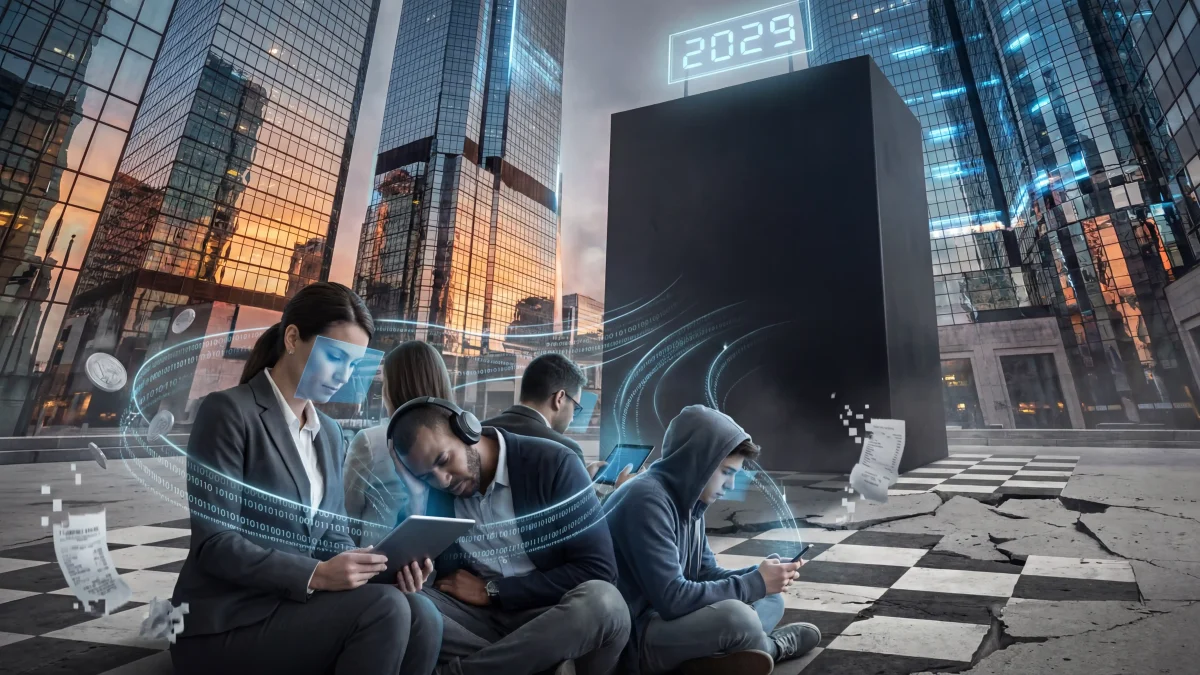
And somewhere ahead—whether people want to acknowledge it or not—there’s an inflection point. A year that sits on the timeline like a monolith in a desert. 2029. Not loudly announced. Not universally agreed upon. But felt—the way you feel a storm system before it crosses the ridge, before the barometric pressure even registers on instruments designed to measure exactly that.
It’s the kind of year you don’t explain directly, because explanation reduces it. Flattens it. Makes it sound speculative when it feels anything but. Saying “here’s what’s coming” invites the wrong kind of debate—the kind where someone demands a citation while the building behind them is already swaying. So instead, you gesture. You leave breadcrumbs. Subtle warnings embedded in observations, hoping people read between lines that were never explicitly written because writing them explicitly would get them dismissed before they could land.
Because saying it outright feels impossible. Not because it’s unknowable—but because it’s unspeakable in the current language we have. The vocabulary hasn’t caught up. The frameworks haven’t caught up. The Overton window of what’s considered serious discourse hasn’t caught up. And by the time it does, the window might not matter anymore.
The Modern Wild West
Meanwhile—right now, today, this week—the world itself starts to feel less like a structured system and more like a kind of modern Wild West wearing a suit and using Slack. Rules exist, but selectively. Enforcement exists, but asymmetrically—calibrated not by justice but by who can afford the calibration. Power consolidates in ways that don’t always look like power at first glance. It looks like innovation. It looks like disruption. It looks like a smiling founder ringing a bell on a trading floor while somewhere downstream, a single mother’s grocery bill just became a strategic decision.
And people—smart, capable, well-meaning people—are still anchored to simplified narratives to make sense of it all. Not because they’re stupid. Because the complexity is engineered to outpace comprehension. That’s not a side effect. That’s a feature.
The Capitalism Confusion
Take capitalism. Right now, today, there are still people who believe that the basic act of buying and selling is capitalism. As if trade itself—something humans have done across every culture, every continent, every era from Mesopotamian grain markets to medieval spice routes—is the defining feature of the system. It’s not. That’s just human behavior. Exchange is fundamental. Hardwired. Older than language, older than currency, older than the concept of ownership itself.
But systems built around that behavior—those are constructed. Designed. Tuned. Stress-tested. Lobbied for. Legislated into existence. And sometimes—quietly, incrementally, deliberately—exploited.
That misunderstanding—the conflation of natural human exchange with engineered economic architecture—creates a kind of intellectual fog. Dense. Persistent. Almost useful in how effectively it obscures the machinery behind the curtain. And inside that fog, exploitation can scale without being clearly named. Because if you believe the system is just “how things are,” you don’t question its architecture. You don’t ask who designed the load-bearing walls. You don’t wonder why the exits are so hard to find. You just… live in the building.
And so you get things like tipping culture morphing into something unrecognizable—a guilt-delivery mechanism masquerading as generosity, where corporations have quietly shifted their payroll obligations onto your conscience and called it choice. You get inflation and stagflation coexisting in ways that feel contradictory but are somehow presented as coherent by people in expensive suits on morning television. Prices rise. Wages lag. The cost of existing—not thriving, just existing—expands in every direction like a gas filling whatever container it’s given. And people are told, implicitly or explicitly, that it all makes sense. That it’s all explainable within the existing framework. That the models account for this. That the curve will correct.
But very few people stop. Breathe. And just say the quiet part out loud:
This is all man-made.
Every rule. Every rate. Every system. Every mechanism of value, exchange, and extraction. Constructed. Iterated. Reinforced through agreement, repetition, and the slow erosion of the imagination required to envision anything else. Not inevitable. Not immutable. Not natural law. Not gravity. Not thermodynamics.
Agreement. Codified, compounded, and eventually mistaken for physics.
The Grandmaster Paradox
And yet—people hesitate to say that. Out loud. In rooms. In meetings. Online. Because there’s a social cost to sounding like you’re questioning fundamentals in a space where others might appear more knowledgeable. Even if, in reality, that knowledge gap isn’t the chasm it pretends to be. It’s not a chess grandmaster versus someone who just learned how the knight moves. It’s often just gradients of familiarity—some people know more terminology, more frameworks, more jargon, but not necessarily more truth. Fluency in the language of a system is not the same as understanding the system. And it is certainly not the same as questioning whether the system should exist.
And then that comparison itself opens a door most people walk past without noticing.
Why do we place so much weight on the chess grandmaster?
Think about it. Chess is a man-made game. Entirely constructed. Defined by arbitrary rules that humans agreed upon centuries ago and have barely modified since. Sixty-four squares. Thirty-two pieces. A finite—though astronomically large—set of possible games. And yet mastery within that system is treated as a pinnacle of human intelligence. Strategy. Discipline. Cognitive supremacy. Which, in one sense, it genuinely is. The pattern recognition, the calculation depth, the ability to hold cascading decision trees in working memory—it’s extraordinary.
But in another sense—a sense we almost never talk about—it’s mastery within constraints we invented. Brilliance inside a box we built.
So what are we actually measuring when we measure intelligence?
Proficiency in navigating systems we created? Optimization within rule sets we designed? Speed and accuracy inside architectures we agreed to treat as meaningful?
And if that’s the case—if intelligence as we define it is fundamentally about performance within constructed systems—then what are we doing when we build increasingly complex systems, master them, celebrate that mastery, and then point to it as evidence of something deeper? Something universal?
It starts to feel recursive. A loop that feeds itself:
We create the game.
We define the rules.
We reward mastery.
We celebrate the masters.
We point to that mastery as proof of transcendent human capability.
And then we build a harder game.
And start again.
All while the underlying reality—that the entire structure is constructed, arbitrary, contingent, and revisable—fades into the background noise of a civilization too busy optimizing to ask what it’s optimizing for.
The Tension Beneath
So here we are. Carrying two memories in one mind. Watching systems evolve in real time. Watching pressure increase in units we don’t have instruments to measure. Watching extraction become more efficient, more normalized, more ambient—like background radiation from an economic supernova that already happened but whose light hasn’t fully reached us yet.
We carry memories of a different baseline while adapting, daily, hourly, to a new one that feels less stable, less grounded, more abstract. More virtual—not in the Silicon Valley sense, but in the philosophical sense. Less real. More contingent. More like a shared hallucination held together by bandwidth and consensus.
It doesn’t feel like a clean transition. It feels like overlap. Like tectonic plates of history, technology, and economics grinding against each other in real time, generating friction that shows up as anxiety, as division, as a thousand arguments that are actually all the same argument wearing different masks: something is wrong and we don’t have the language for it yet.
And maybe that’s why it feels the way it does. Not entirely dystopian—because people are still falling in love and making dinner and laughing at things that are genuinely funny. Not entirely functional—because the cracks are visible now to anyone willing to look down. Just… tense. Like something is shifting beneath the surface. Not yet fully visible. But already influencing everything above it. Already bending the light. Already changing the weight of every step.
You can feel it without fully articulating it. You can sense the frequency shifting without being able to name the note.
And sometimes—in this strange, constructed, recursive, man-made, quietly accelerating moment in history—feeling it is the most honest thing you can do.
The question is what you do next.