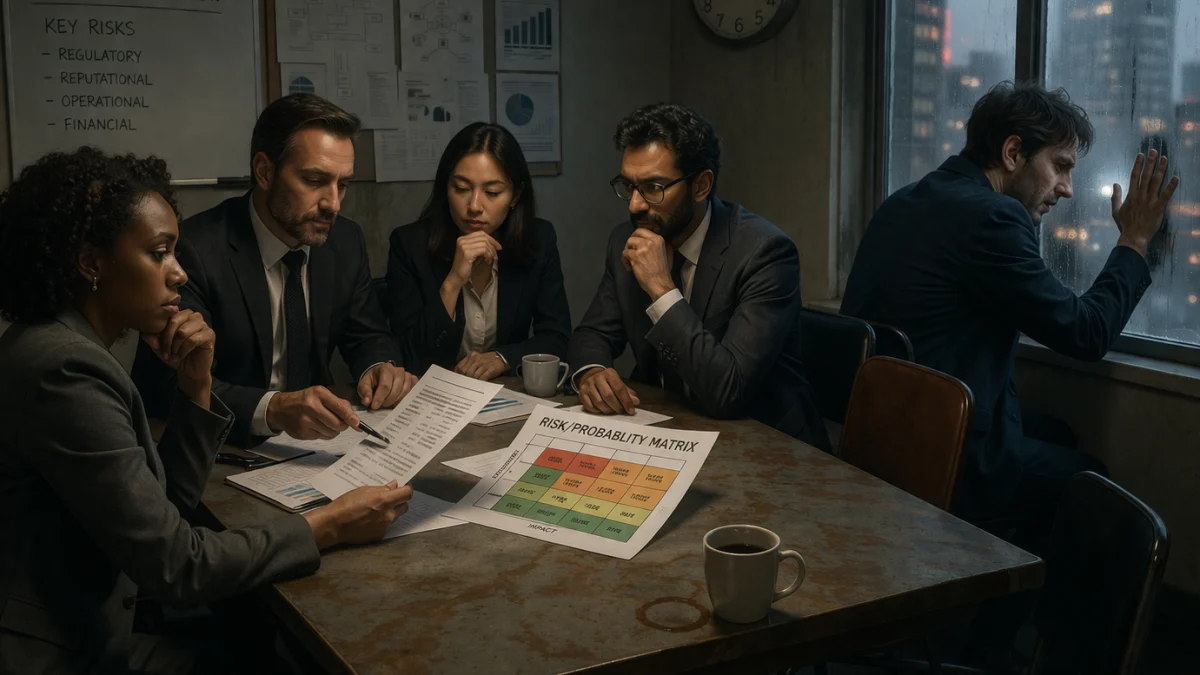
There are moments when you know you’re right.
Not instinctively — not that warm, internal hum people mistake for clarity when it’s really just their nervous system agreeing with itself. Not emotionally — not the bright, brittle certainty that comes from wanting something to be true so badly that the distinction between conviction and evidence dissolves entirely. Not in that vague, self-soothing way people use at three in the morning when the alternative to certainty is a kind of vertigo they’re not equipped to survive.
I mean objectively.
The kind of right that arrives like a medical result. Clinical. Unarguable. Sitting in your hands with the weight of something that doesn’t care whether you wanted to know it.
The kind of right that comes from having information no one else in the room has. Not better intuition. Not sharper instincts. Not a more finely calibrated gut. Information. The hard, structural, load-bearing kind that exists whether or not you’re in the room to hold it.
And here’s what nobody tells you about that kind of certainty — what no film or novel or leadership seminar has ever gotten honest about:
It doesn’t feel empowering.
It feels like standing on the wrong side of a window, watching someone walk toward something they can’t see, with your hand pressed flat against glass they don’t know exists.
It feels isolating.
We don’t talk about that version very often.
The culture has a preferred narrative about knowledge — clean, democratic, luminous. Knowledge is power. Knowledge is liberation. Knowledge, shared freely among reasonable people, leads to better outcomes. And most of the time — in the ordinary, daylit, functioning world where decisions carry consequences you can measure in quarterly reports and annual reviews — that narrative holds.
People prefer the cleaner versions. Trust the group. Question yourself. Assume you’re missing something. Humility as default setting. Consensus as compass. And most of the time, that’s not just good advice — it’s correct advice. The vast majority of situations in which a person believes they’re the only one who sees clearly are situations in which that person is wrong and the group is functioning exactly as designed.
This isn’t one of those times.
Something Simple
Imagine something simple.
Five people in a room.
Not a dramatic room. Not a bunker or a war room or a situation room with banks of screens and the particular blue-white light that Hollywood has taught us means important decisions happen here. Just a room. A table. Chairs that don’t match. Coffee that someone made two hours ago and no one has refreshed because the conversation has been moving fast enough that the staleness hasn’t registered.
Five people deciding whether to send someone into a building.
The details of the building don’t matter yet. The details of the someone don’t matter yet either — give them a name if you need one, or don’t, because what I’m about to describe works the same way whether the person walking toward that door is a stranger or someone whose face you’d recognize in a crowd of ten thousand.
Four of the five see no issue.
They’ve done the assessment. They’ve reviewed the variables. They’ve mapped the scenario against historical precedent and current intelligence and the kind of risk-probability matrix that looks reassuringly scientific when you print it on good paper and slide it across a table.
The math works.
The logic is clean.
The risk falls within acceptable parameters, and acceptable parameters is one of those phrases that sounds reasonable right up until the moment it applies to a specific human being walking through a specific door, at which point it becomes the most obscene pair of words in any language.
But that’s later.
Right now, four people are in agreement.
And you — the fifth — are not.
Out of Agreement
Not because you’re cautious. Caution has a flavor people recognize — tentative, measured, the voice of someone who hasn’t quite finished thinking and wants a little more time. Caution gets respect. Caution gets indulged. Caution, in a well-functioning team, is treated as a feature rather than a flaw because everyone understands that the cautious voice is just the thorough voice, and thoroughness is something the group values.
What you’re carrying isn’t caution.
Not because you’re risk-averse. Risk aversion is caution’s louder cousin — same family, bigger vocabulary, more likely to cite statistics. Risk aversion can be quantified, addressed, incorporated. You can adjust for risk aversion. You can run the numbers again, add a contingency, build in a margin. Risk aversion is a solvable parameter.
What you’re carrying isn’t a parameter.
It’s knowledge.
Factual. Concrete. The kind that doesn’t blur at the edges when you turn it over in your hands. The kind that sits in your chest like a stone and doesn’t care about your feelings.
You know — not suspect, not fear, not worry, know — that the moment that door opens, something irreversible happens.
Call it a bomb if you need something tangible. A device. A trap. A structural failure that will bring the ceiling down in the first four seconds. It doesn’t matter what it is. The specifics are a courtesy I’m extending to make the scenario concrete enough to hold in your mind, but the mechanism is universal. What matters isn’t the nature of the thing behind the door.
What matters is this:
You cannot tell them.
What you cannot tell them
Not the four people at the table.
Not the person already standing up, already reaching for their jacket, already running through the mental checklist of someone about to do the thing they’ve been asked to do — because that’s what professionals do, they prepare, they execute, they trust the process and the team and the assessment that put them in motion.
You can’t tell any of them.
You’re not allowed to explain how you know. The source. The channel. The particular chain of decisions and access and institutional positioning that deposited this information in your hands and no one else’s.
You’re not allowed to reveal what you know. Not the conclusion. Not the evidence. Not even a sanitized version that strips the sourcing and leaves only the shape of the threat — because even the shape would raise questions you cannot answer without detonating something else entirely.
You’re not allowed to justify the certainty you’re carrying.
All you can do is sit in that chair, in that room, with coffee going cold on a table surrounded by people who trust you — who have reason to trust you, who have built that trust on the accumulated evidence of your judgment over months or years — and argue.
Just argue.
Without the one piece of evidence that would make the argument unnecessary.
Binary Scenario
And that’s where it becomes uncomfortable.
Not the scenario. The scenario is simple. Binary. Almost elegant in its brutality — someone lives or someone doesn’t, and you’re the variable.
What’s uncomfortable is what happens inside you.
Because suddenly, being right isn’t enough.
Being right, in fact, is almost irrelevant. You can be right with the force of absolute certainty and the weight of incontrovertible evidence, and if you can’t translate that rightness into something four other people can feel without seeing what you’ve seen — if you can’t take the knowledge and strip it of its origins and reshape it into something that looks like judgment instead of information — then the rightness is just something that happens inside your body while someone else walks through a door.
You have to persuade.
Without evidence.
You have to sound convincing without sounding desperate — because desperation is a signal, and the signal it sends is this person has lost perspective, and once that signal is received, everything you say afterward passes through a filter that strips it of weight.
You have to create doubt where there is none — and do it so carefully that the doubt feels indigenous, feels like something that was already in the room waiting to be noticed rather than something you smuggled in through the side door.
You have to do all of this knowing — with the same certainty that’s eating a hole through your sternum — that from their perspective, you are the least rational person in the room.
They have consensus.
You have resistance.
They have data.
You have… opposition.
They have the clean, reassuring alignment of four minds arriving independently at the same conclusion — and there is no force on earth more convincing than independent agreement, because it doesn’t just feel like evidence, it feels like reality confirming itself.
You have tone.
Framing.
Timing.
And whatever you can build from those materials in the next eleven minutes before someone opens a door that doesn’t close again.
Confirmation
You watch them talk through it.
Clean. Structured. Each point reinforcing the last like bricks in a wall — the foundation supporting the first floor supporting the second, and by the time they reach the roof the whole thing looks so solid that questioning any single element means questioning the entire structure, and no one in a room full of professionals wants to be the person who stalls an operation because of a feeling.
It sounds airtight.
Of course it does.
Incomplete information, presented coherently, is indistinguishable from complete information to anyone who doesn’t know what’s missing. That’s not a flaw in their reasoning. Their reasoning is impeccable. Flawless, even. The logic follows from the premises with the precision of a proof, and if the premises were complete, the conclusion would be correct.
But the premises aren’t complete.
They’re working with a map that’s missing a room.
And you can’t point to the blank space and say here — this is where the floor drops out — because pointing to the blank space means explaining how you know the room exists, and that explanation is the other door. The one you can’t open.
So instead —
You start adjusting the edges.
You don’t say there’s a bomb.
You say: “We’re making assumptions about the interior layout based on external observation. What’s our confidence level on the floor plan?”
You don’t say this will fail.
You say: “What’s our contingency if the environment doesn’t match the assessment? Do we have an extraction window, or are we committed on entry?”
You don’t say I know something you don’t.
You say: “I want to pressure-test this one more time. Not because I see a specific flaw — just because the cost of being wrong is non-recoverable.”
You introduce friction.
Just enough.
Not a wall. A texture change. The conversational equivalent of a speed bump — not enough to stop movement, but enough to change the rhythm. To make the automatic feel slightly less automatic. To introduce, into the smooth, frictionless machinery of consensus, a single grain of sand that makes the gears audible.
Because hesitation is the only tool you’re allowed to use.
And hesitation, deployed correctly — not as panic, not as obstruction, but as the reasonable, professional caution of someone who has earned the right to slow things down — can do more work than most people realize.
You’re not trying to stop the decision.
Not yet.
You’re trying to create a space inside the decision where doubt can exist without being named. A pocket of air in a sealed room. Just enough that someone — anyone, it only takes one — pauses long enough to feel the weight of what they’re about to authorize.
Because hesitation is contagious in a way that certainty isn’t.
Certainty requires maintenance. It requires each person in the room to continuously affirm, through posture and language and the small, social micro-signals that humans broadcast without knowing it, that they are sure. And that maintenance is invisible when everyone is aligned — it happens automatically, the way breathing happens.
But the moment one person hesitates — genuinely hesitates, not performs it but has it — the maintenance cost for everyone else goes up. Suddenly certainty isn’t free anymore. Suddenly it requires effort. And effort is visible. And visibility creates self-consciousness. And self-consciousness is the first crack in the wall of consensus.
If you do it well —
If you find the right question at the right moment in the right tone —
Sometimes that’s enough.
The operation gets delayed. Reviewed. Reassessed. The door stays closed long enough for the landscape behind it to change, or for another piece of information to surface through a channel that doesn’t have your fingerprints on it, and the decision reverses itself for reasons that have nothing to do with you.
And sometimes it isn’t enough.
And the door opens anyway.
The Dirty Version
But here’s the part people don’t like to sit with.
The part that makes this more than a thought experiment. The part that separates the clean version from the real one.
The obvious solution — the one everyone jumps to, the one that feels so self-evident it barely qualifies as a solution — is simple:
Just tell them.
Be honest.
Remove the constraint.
Stand up in that room and say: I know something. I can’t tell you how I know it, but I know it, and if you trust me — if the years we’ve worked together mean what I think they mean — you’ll stop this.
And yes.
In a vacuum — in the frictionless, contextless, consequence-free vacuum of a philosophy classroom or a dinner table debate or the clean, well-lit interior of a hypothetical — that’s the correct answer.
It always is.
Honesty is always the correct answer when you strip away everything that makes honesty expensive.
But constraints don’t appear in a vacuum.
They exist because something else is attached to them. Something heavy. Something with roots that go deeper than the present moment and tendrils that reach further than the immediate decision.
And sometimes — more often than anyone with a clean conscience wants to admit — that something else is you.
Because telling them isn’t just revealing the outcome.
It’s revealing how you know.
And once you reveal how you know, you reveal your position in the system that produced that knowledge.
Your access.
Not the official kind. Not the kind that shows up on an org chart or a clearance level or a list of people authorized to be in certain rooms at certain times. The other kind. The kind that accumulates quietly, over years, through the slow accretion of being present in spaces you were never formally invited into but never formally excluded from either. The kind that exists in the gap between what you’re supposed to know and what you actually know, and that gap — that grey, undocumented, plausibly deniable gap — is where you’ve been living for longer than you want to think about.
Your involvement.
Not in this operation. In the architecture that made this operation possible. In the chain of decisions — some of them yours, some of them made by people you trained or advised or simply didn’t stop — that constructed the conditions under which a person is now walking toward a door that shouldn’t be opened. You didn’t build the bomb. You didn’t place it. But you were in the building when the blueprints were drawn, and you saw the room that isn’t on the floor plan, and you said nothing then because saying something then would have required explaining what you were doing in the building in the first place.
Your decisions.
The ones you made when the stakes were lower. When the abstraction was thicker. When the distance between a decision and its consequences was measured in months or years instead of minutes and a closing door.
The part you don’t say out loud.
That’s the trade.
Clarity, in exchange for exposure.
Truth, in exchange for the version of yourself that survives the telling.
And not all exposure is neutral. Some exposure is simply information — here’s what I knew, here’s how I knew it, make of that what you will. That kind is manageable. Uncomfortable, maybe. Career-altering, possibly. But survivable.
And then there’s the other kind.
The kind that doesn’t just reveal what you knew.
It reframes everything.
Every previous conversation. Every previous recommendation. Every time you sat in a room like this one and offered judgment that people accepted because they trusted the person offering it — all of that gets retroactively rewritten. Not by the facts, which haven’t changed. By the context the facts now sit inside.
Sometimes exposure makes you the whistleblower. The hero. The person who sacrificed their position to save a life.
Sometimes it makes you the problem.
Or worse —
It makes you responsible for how the situation existed in the first place.
The Bad Guy
That’s the part no one includes in the thought experiment.
The part that makes the ethics textbook version of this scenario — with its clean actors and its clear choices and its consequence-free honesty — feel like a children’s drawing of a building compared to the building itself.
The part where the person trying to stop the outcome was also, at some point — not in a dramatic way, not in a cinematic way, not in the way that gets its own scene with ominous music and a slow zoom — part of the system that made the outcome possible.
Not maliciously.
Not intentionally.
Structurally.
The way a load-bearing wall is part of a building’s capacity to stand, and also, by the same physics, part of its capacity to fall. The way every person who participates in a system — who benefits from it, who operates within it, who draws a salary or a purpose or an identity from its continued function — is also, by definition, a component of everything that system produces. Including the things it produces that no one signed up for. Including the outcomes that exist three or four or five causal steps downstream from decisions that seemed, at the time, like the reasonable thing to do.
Which leaves you in a position that doesn’t have a clean version.
No matter how many times you turn it over. No matter how many angles you examine it from. No matter how carefully you construct the narrative afterward.
You can protect the outcome — stop the door from opening, save the person, prevent the irreversible thing.
Or you can protect the narrative — the version of events in which your hands are clean and your position is intact and no one has reason to look backward through the chain of decisions and find you standing in a room you shouldn’t have been in.
Sometimes you can do both.
This isn’t one of those times either.
And if you’re honest — really honest, the kind of honest that happens at four in the morning when every comfortable story you’ve told yourself has gone to sleep and the raw, unedited version is the only one still standing —
There’s usually a third variable.
Sitting quietly underneath the ethics and the strategy and the risk calculus.
Smaller than the others. Quieter. Easier to miss, or to mistake for something nobler.
You don’t want to be the bad guy.
Not in their eyes — the four people at the table, the person walking toward the door, the institution that gave you access and authority and the particular kind of trust that, once broken, doesn’t repair.
Not in your own.
Even if the role fits.
Even if it’s accurate.
Even if wearing it — stepping into it fully, without hedging, without the protective cushion of but I didn’t mean to and but I was trying to help — would resolve everything faster than any amount of strategic hesitation or carefully worded doubt.
Because here’s what the thought experiments never account for:
The person in the room with the knowledge they can’t share is still a person. With an identity. With a self-concept. With a story they’ve been telling themselves about who they are — a story in which they are, on balance, someone who does more good than harm. Someone whose presence in the system is justified. Someone who, when the moment came, would make the right call.
And the right call, it turns out, might require them to make that story untrue.
Not wrong. Not a lie. Just… incomplete in a way that, once completed, changes the shape of everything.
That’s the heaviest thing in the room.
Heavier than the bomb.
Heavier than the door.
Heavier than the life on the other side of it.
And I wish I could tell you that, when it matters — when the seconds are actually counting down and the person is actually reaching for the handle — the weight of that self-concept always loses.
That the good in people always wins.
That the math always resolves in favor of the life.
I wish I could tell you that.
The Constraint
So you stay inside the constraint.
You argue. You redirect. You find the question that creates just enough turbulence in the consensus to slow the machine by a critical few minutes.
You reshape the conversation — not with force, not with revelation, not with the blunt instrument of truth — but with the precise, delicate, morally exhausting work of moving a decision without ever revealing the reason.
You do this knowing that if it works, no one will know it worked.
There will be no moment of recognition. No gratitude. No acknowledgment that the operation was two minutes away from catastrophe and the only reason it wasn’t is that you found a way to make four people feel uncertain about something they had every rational reason to be certain about.
If it works —
They walk away thinking it was their call.
Their caution.
Their judgment.
The hesitation feels, in retrospect, like something that emerged organically from the group’s collective wisdom — a natural product of professionals being thorough, of a team that values rigor, of an institutional culture that rewards careful thinking.
You let them have that.
Not generously. Not selflessly. Not because you’re noble.
Because that’s the version of the story that survives.
The cleaner one.
The one where the system worked the way it’s supposed to. Where good judgment prevailed. Where no one has to ask uncomfortable questions about information asymmetry and institutional complicity and the particular, corrosive kind of knowledge that makes you responsible for things you didn’t do but could have prevented sooner if you’d been willing to pay the price of speaking sooner.
The version where no one has to ask why you knew what you knew.
Or how long you’d known it.
Or what that says about you.
Or what it says about the system that put you in a chair where knowing and not telling became the same act as protecting and deceiving.
And the person who never walks through the door?
They never know.
They never know how close they got. Never know that the distance between their hand and the handle was measured not in inches but in the space between one person’s silence and another person’s doubt. Never know that their life, for a span of approximately eleven minutes on an unremarkable afternoon, rested on the ability of someone they trusted to lie to them in exactly the right way.
They go home.
They have dinner. They talk about their day — the operation that got delayed, the timeline that shifted, the minor professional inconvenience of a plan that didn’t execute on schedule. They’re annoyed, maybe. Frustrated. The kind of low-grade irritation that comes from bureaucratic friction, which is what the delay looks like from the outside. Paperwork. Process. The machine being slow.
They never know the machine was being steered.
They never know that someone sat in a room and chose — deliberately, strategically, at significant personal cost — to let them be irritated instead of dead.
That’s part of the design too.
Not the building’s design.
Not the operation’s design.
The design of the constraint itself. The architecture of a system in which the only way to save someone is to ensure they never know they needed saving. In which the cost of protection is the permanent, irrevocable invisibility of the act.
You don’t get to be the hero of this story.
You don’t get to be the villain either.
You get to be the person who was in the room.
Who knew what they knew.
Who did what they could with the tools the constraint allowed.
And who carries — for exactly as long as memory lasts, which is to say forever, which is to say every night between two and four a.m. when the quiet gets loud enough to hear yourself think — the knowledge that the cleanest version of the story is the one in which they don’t exist.
That’s the constraint.
Not the room. Not the door. Not the bomb.
The constraint is living inside the distance between what you know and what you’re allowed to do about it.
And discovering that the distance has your name on it.