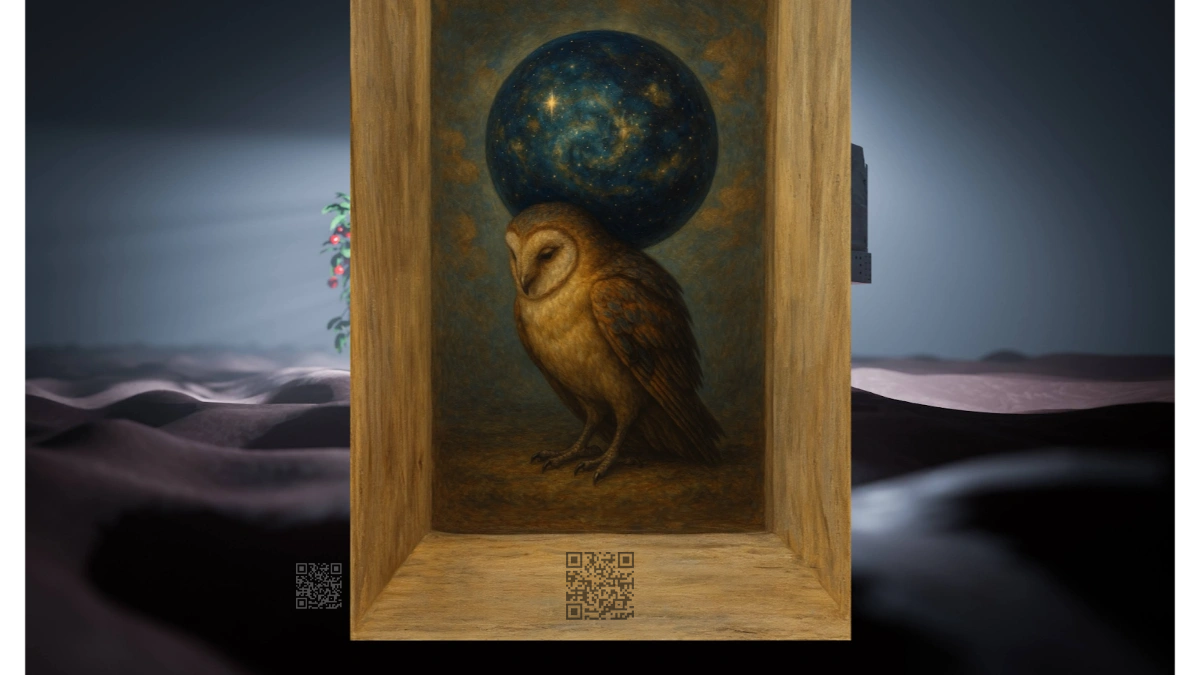
You’re going to remember this bird for the rest of your life.
Not the way you remember a photograph you loved or a painting that moved you. Nothing so generous. This is a different kind of remembering—the kind that hides in the back of your mind like a file that never fully deletes, no matter how many times you empty the trash.
I’m sorry about that.
But it’s already too late.
Right now, while you’re reading this, you’re probably looking at it. The bird. The quiet, dull brown thing with its head slightly bowed. Behind it sits an enormous sphere of night sky, like an entire universe balanced on its shoulders.
It isn’t a spectacular image. It isn’t particularly beautiful. I’ve seen AI generate things infinitely more impressive—photorealistic landscapes, intricate illustrations, surreal dreamscapes that feel like they belong behind glass in a gallery. Compared to those, this bird is almost painfully ordinary.
And yet I hate it.
Not casually. Not the mild irritation you feel toward something ugly or poorly made. I mean the kind of irrational, disproportionate hatred that makes you stop and interrogate yourself—why do I feel anything at all?
Because there is nothing remarkable about the bird.
It’s not colorful.
It’s not sharp.
It doesn’t look powerful or intelligent or mythical.
It just looks sad.
Unbearably, unforgivably sad.
And that might be the worst part.
This image is AI-generated. Which means, technically, I didn’t create it. I didn’t draw it, didn’t paint it, didn’t sculpt it into existence with my own hands.
But this is the one piece of AI-generated art that feels, in some way I can’t fully explain, like it belongs to me.
Not because I made the bird.
Because I described it.
I described it in painful, obsessive detail—iteration after iteration, prompt after prompt—until the machine finally produced something that almost perfectly matched a bird I’ve seen many times before. A bird that exists in a place most people forget within seconds of waking up.
A dream.
Not every night. I won’t pretend this is some dramatic curse that tracks me into sleep each evening. But every so often, I have a dream that refuses to behave the way dreams are supposed to.
In ordinary dreams, time moves strangely but still feels contained. Minutes stretch. Scenes jump. And then you wake up with fragments dissolving like sugar in water—you can feel the sweetness of something that was there, but it’s gone.
This dream is different.
It feels long.
Not just subjectively long, the way a boring film drags. Impossibly long. The way physicists describe time near a black hole. As if something inside the dream has broken the normal clock and nobody is coming to fix it.
It feels like living years in there.
Maybe hundreds.
Maybe a thousand.
I know that sounds absurd. The brain isn’t supposed to work that way. And yet the experience has its own internal logic—so heavy, so coherent—that dismissing it feels like a lie.
When I wake up, for the first few seconds, I remember all of it.
Not every detail. But the weight of time. The accumulated mass of it. Like surfacing from an entire other life you didn’t know you were living.
And then the memory begins to collapse.
There’s a concept in computing that mirrors what happens next. Imagine a piece of data that only survives if you refresh it. A seven-word phrase sits in memory, but every ten seconds it begins to decay. If you recall it before the ten seconds pass, the timer resets—but the next window is slightly longer. Eleven seconds. Then twelve. Then thirteen.
In theory, you could keep that phrase alive forever.
In practice, the math works against you.
You would need to recall it again and again and again—hundreds of times, thousands—before the intervals finally stabilized. Before the phrase became permanent.
Dream memories work exactly like this.
You wake up. You have maybe ten seconds.
If you remember the dream in those ten seconds, maybe you earn eleven more.
Then twelve.
Then thirteen.
But you’re groggy. Your brain is switching architectures—migrating from whatever strange storage dreams occupy into the more rigid structure of waking memory. And somewhere during that transfer, the data corrupts.
So the thousand years vanish.
And all that remains is residue.
A mood.
A shape.
A place that feels programmatic—like walking through a simulation whose rules you can almost read but never quite understand. Buildings that feel temporary, as though they might be unloaded the moment you look away. Landscapes that look familiar but never fully render. The quiet, persistent sense that something is running beneath everything—some process you did not start and cannot stop.
And somewhere in that place, always in that place, is the bird.
The same bird.
Not glowing.
Not majestic.
Not mythical.
Just standing there.
Watching.
If you can imagine staring at the same creature every day for a thousand years, something strange happens to the way you feel about it. Not hatred, exactly. Something adjacent. A frustration born from proximity so long it has worn grooves into your perception.
You want answers.
What is this place?
Why does it feel endless?
Why is there no progress, no narrative, no arc?
But the bird offers nothing.
It just exists.
And the longer you look at it, the more unbearable its sadness becomes—not because the sadness grows, but because you start to suspect it was always this deep, and you simply weren’t paying close enough attention.
That’s what truly infuriates me.
The bird looks like it’s carrying the weight of an entire universe on its shoulders—literally, if you consider the enormous star-filled sphere resting behind its head like a cosmic burden it never set down.
But the question that gnaws at me is simple:
Why?
Why does this bird feel compelled to carry that weight?
Who asked it to?
Why does it look so mournful about something it seems to have chosen?
And perhaps that is the real reason I hate this image. Not the sadness itself, but what the sadness does.
Because the bird’s grief feels accusatory.
It stands there quietly, heavy with meaning it refuses to explain, and somehow that silence makes me feel guilty. As if I asked something of it. As if I’m the reason for the gravity pressing down on its wings. As if, by describing it into existence, I gave it a burden I should have carried myself.
Which is absurd.
It’s a generated image. Pixels assembled by a machine. A statistical echo of patterns learned from millions of photographs of millions of birds, none of whom were sad, none of whom carried universes, none of whom stood in the architecture of someone else’s dream.
There is nothing inherently powerful about it.
And yet.
Here is the part I’m sorry about.
If you’ve read this far, the bird is already inside your mind. Not in the front of your thoughts—not yet a memory you’d call important. But it’s there, deeper down, like an entry in a quiet database that only gets queried when you least expect it.
You’ll forget about it soon enough. Hours from now, maybe tomorrow, it will slip away the way most things do.
But sometime later—days, weeks, maybe months from now—you’ll be doing something ordinary. Driving. Falling asleep. Staring out a window at nothing in particular.
And it will come back.
Not the whole story.
Just the bird.
The sad one.
The dull brown one that looked like it was holding up an entire universe it never asked for.
And when that happens—when it surfaces without warning in some quiet, unguarded moment—part of you will think:
*Oh.
That stupid bird.*
And you’ll realize it never left.