A Long-Overdue Accounting of What Americans Actually Pay for Captured Democracy
There is a number no one has told you.
It is not on your tax return. It does not appear on your insurance statement, your utility bill, your mortgage paperwork, or the receipt from the pharmacy where you just paid \$387 for a drug that costs \$22 in Australia. It is not disclosed in campaign finance filings, committee transcripts, or lobbying registrations. No government agency tracks it. No court has ordered its calculation. No politician has ever stood at a podium and read it aloud.
But it is real. It is enormous. And you have been paying it your entire adult life.
It is the total cost — in dollars, in health, in years, in opportunity, in the slow narrowing of what your life could have been — of public policy systematically written to serve concentrated private wealth instead of you.
Call it what you want. Call it the corruption premium. Call it the capture tax. Call it the price of legalized influence. But do not call it nothing, because nothing is the one thing it has never been.
We live in a civilization that knows how to count harm. We are, in fact, obsessed with it. When an investor loses money because a CEO lied about earnings, there is a formula. When a tanker ruptures and crude oil blackens a coastline, there is a liability model. When consumers are overcharged by a cartel, antitrust lawyers can reconstruct the damages down to the cent. When a contract is breached, a court will ask three questions that have governed commercial justice for centuries: What was lost? What was owed? Who should pay?
These are not radical questions. They are the ordinary grammar of accountability in a society that runs on law.
But apply those same questions to the exposed nerve of American public life — to the exposed, exposed, exposed fact that organized money routinely bends public policy for private gain, imposing massive costs on hundreds of millions of people — and suddenly the language goes soft. Suddenly we are in the realm of lobbying. Of influence. Of fundraising. Of politics as usual. Suddenly the sharp vocabulary of injury and restitution dissolves into euphemism, and we are told, with great sophistication, that this is simply how the system works.
That is the most expensive lie in America.
The Injury You Were Taught Not to Name
Consider what you actually experience.
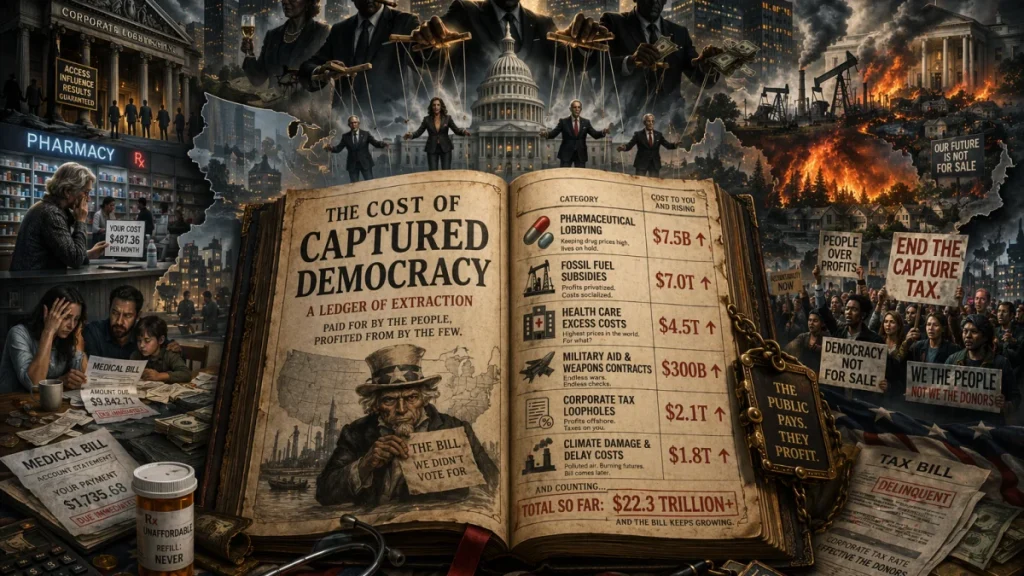
You experience drug prices that are, on average, two to three times higher than those in comparable wealthy nations — not because the molecules are different, not because American pharmacists use gold-plated equipment, but because for decades, pharmaceutical companies have spent more on lobbying the United States Congress than any other industry on Earth. Between 1998 and 2024, the pharmaceutical and health products sector spent over \$7.5 billion on federal lobbying alone. In return, they received a policy architecture of extraordinary generosity: Medicare was for years prohibited by law from negotiating drug prices, a provision so nakedly beneficial to industry that even its authors struggled to defend it in plain language. Patent thickets, pay-for-delay settlements, and regulatory bottlenecks were cultivated not as accidents but as strategies — each one a tollbooth erected on the road between a sick person and the medicine that could help them.
The result? Americans spend roughly \$1,500 per person per year on prescription drugs — nearly double what citizens in Germany, France, or Canada pay. Multiplied across 330 million people, across years, across decades, the aggregate transfer is not millions, not billions, but trillions of dollars moved from patients and taxpayers to shareholders and executives.
That is not a market outcome. That is a policy outcome. And the policy was purchased.
You experience this transfer every time you open a pharmacy bag and feel the small, private shock of a price that seems wrong but that you have no power to contest. You absorb it. You put it on a credit card. You split pills. You skip doses. In some cases — the exposed, the uninsured, the rationing elderly — you die. An estimated 1.1 million Americans did not fill prescriptions in recent years due to cost. Some fraction of those people suffered preventable decline. Some fraction of that fraction did not survive.
Those are not metaphors. Those are bodies. And they are part of the bill.
The Subsidy That Reverses Itself
Now consider energy.
For more than a century, the United States has subsidized the extraction, refinement, and combustion of fossil fuels. Estimates vary depending on what you count — direct subsidies, tax preferences, royalty relief, infrastructure support, health externalities, climate damages — but the International Monetary Fund concluded in 2023 that when all costs are included, global fossil fuel subsidies amounted to roughly \$7 trillion per year, with the United States contributing a substantial share. The Production Tax Credit for oil and gas, first enacted in 1916, has never been repealed. Percentage depletion allowances, intangible drilling cost deductions, and a constellation of lesser-known provisions have been defended, session after session, by legislators whose campaigns were funded by the very industries those provisions protect.
This is the structure of a subsidy that reverses itself: the public pays to help profitable companies extract a product whose combustion creates costs the public then pays again to address.
You pay at the pump. You pay in your energy bill. Then you pay a third time when the wildfire reaches your town, when the hurricane strengthens over water that is a degree warmer than it was a generation ago, when the flood insurance market collapses, when FEMA arrives, when the infrastructure bill comes due, when the water table drops, when the crop yield falls, when the heat dome settles over a city whose grid was not built for this, and someone’s grandmother dies alone in a apartment that reached 109 degrees.
Between 2016 and 2025, the United States spent over \$700 billion on climate and weather disaster recovery — a figure that does not include lost productivity, depreciated property values, health costs, ecosystem degradation, or the incalculable toll of displacement and grief. Every credible economic analysis of climate delay — every single one — concludes that the cost of inaction dwarfs the cost of transition. And yet the transition has been slowed, diluted, and in some cases reversed, year after year, by an influence machine that treats atmospheric chemistry as a negotiable inconvenience.
Who paid for that delay? Not the lobbyists. Not the executives. Not the shareholders who extracted dividends while the atmosphere absorbed the debt.
You did. You are. You will.
The Foreign Policy Premium
There are costs that do not fit neatly into a domestic ledger, and those, too, deserve naming.
Consider the influence of the American Israel Public Affairs Committee — AIPAC — and the broader network of advocacy organizations that have shaped U.S. policy in the Middle East for decades. This is not a commentary on the legitimacy of Israel as a nation, or the sincerity of those who support it, or the complexity of a conflict that has claimed lives on every side. It is a commentary on what happens when a narrow set of policy preferences, backed by extraordinary financial resources, achieves such dominance over legislative behavior that elected officials describe the pressure in private as non-negotiable.
AIPAC and its affiliated super PAC spent over \$100 million in the 2024 election cycle alone, much of it directed at primary challenges against incumbents who deviated from its preferred positions. The result is a Congress in which the range of permissible debate on a matter of war, peace, and human rights is narrower than in virtually any comparable democracy — narrower, in fact, than in Israel’s own parliament.
The public cost of this capture is not only financial, though the financial cost is real: the United States has provided over \$300 billion in cumulative aid to Israel (adjusted for inflation), a figure that dwarfs assistance to any other nation. The deeper cost is strategic and moral. It is the cost of policies pursued not because they serve the broad American interest but because they serve an organized constituency with disproportionate access. It is the cost of wars influenced, vetoes cast, diplomatic credibility spent, and alliances strained in ways that a fully democratic deliberation might have calculated differently.
When a foreign policy is shaped more by donor infrastructure than by democratic reasoning, the public bears the cost in treasure, in credibility, and sometimes in blood — and is told, afterward, that this was the national interest all along.
The Health Care Labyrinth
Return now to the domestic ledger, because the largest single line item on the public’s hidden bill may be the American health care system itself.
The United States spends approximately \$4.5 trillion per year on health care — roughly \$13,500 per person — more than any other nation on Earth by a staggering margin. Outcomes, by virtually every measure, are worse: lower life expectancy, higher infant mortality, greater prevalence of chronic disease, wider disparities by race and income. The gap between spending and outcomes is not a mystery. It is a monument to captured policy.
Hospital systems consolidate and charge more because antitrust enforcement has been weakened by lobbying. Insurance companies operate in concentrated markets and extract administrative costs that account for roughly 30 percent of total health spending — compared to 2 to 5 percent in single-payer systems. Surprise billing, balance billing, opaque pricing, and the baroque complexity of coverage networks are not bugs in the system. They are features. They are features designed by industries whose political spending ensures that every reform effort arrives in Congress pre-compromised.
The Affordable Care Act — the most significant health legislation in a generation — was designed from inception to accommodate the insurance industry, the pharmaceutical industry, and the hospital lobby. The public option was removed. Drug price negotiation was excluded. What remained was an improvement, but an improvement shaped by the very interests it purported to regulate. The public got coverage expansion. The industries got customers, subsidized by taxpayers, on terms they helped write.
Every month, in every household that opens a health insurance bill and feels the dull bewilderment of a premium that has doubled in a decade for a plan that covers less, the capture tax is collected.
The Tax Architecture of Upward Transfer
Then there are the taxes you pay, and the taxes others do not.
The U.S. tax code is approximately 10,000 pages long. It is not long because taxation is inherently complex. It is long because every page represents a negotiation, and in most of those negotiations, the public was not represented.
Carried interest allows hedge fund managers to pay lower effective tax rates than their secretaries — a distortion so famous it has become a cliché, and so durable it has survived every attempt at reform for over fifteen years. The 2017 Tax Cuts and Jobs Act delivered \$1.9 trillion in tax reductions, the majority of which flowed to corporations and high-income households, while the provisions benefiting middle- and lower-income taxpayers were designed to expire. Corporate tax revenue as a share of GDP has declined by more than half since the 1960s. The difference has been made up by payroll taxes, sales taxes, user fees, and borrowing — all of which fall disproportionately on people who do not retain lobbyists.
Offshore profit shifting alone costs the U.S. Treasury an estimated \$60 to \$100 billion per year. That is money that was earned on American infrastructure, protected by American courts, enabled by American consumers and workers — and then, through a legal architecture built by influence, moved beyond the reach of the public ledger.
The cumulative result is a fiscal system in which the effective tax rate on the wealthiest Americans has fallen below that of the working class for the first time in modern history. This did not happen by accident. It happened by lobbying. And the difference between what the wealthy do pay and what they would pay under a system not shaped by their influence is another line on the bill nobody sent you.
The Cleanup You Finance Twice
Environmental harm may be the most elegant expression of the capture economy, because it is the one in which the public most literally pays twice.
First, you pay through the policy failure itself: relaxed emission standards, delayed regulation, weakened enforcement, and permit systems designed to accommodate polluters. You breathe the air. You drink the water. You live downstream. The American Lung Association estimates that over 135 million Americans live in counties with unhealthy levels of air pollution. The health costs — asthma, cardiovascular disease, cancer, neurological damage — are borne by individuals and by public health systems, not by the companies whose emissions produced them.
Then you pay for the cleanup. Superfund sites, contaminated water systems, lead remediation, wildfire suppression, flood recovery, coastal erosion management — these are public expenditures necessitated by private choices that were made more profitable by captured regulation. The EPA’s own estimates suggest that the cost of remediating existing contaminated sites in the United States exceeds \$200 billion. That money comes from tax revenue. It comes from you.
Flint, Michigan, did not poison its own water. East Palestine, Ohio, did not derail its own train. Cancer Alley in Louisiana did not invite the petrochemical corridor that gave it its name. In every case, the harm was produced by industries operating under rules they helped write, enforced by agencies they helped defund, in communities with insufficient political power to resist.
The public paid for the policy. The public paid for the consequences. The public will pay for the recovery. And the entities that profited are, in most cases, still profiting.
The Question That Changes Everything
Here, then, is the sum of the argument — not in precise dollars, because precision has been deliberately made difficult, but in moral clarity:
The American public is subject to a continuous, systemic, measurable transfer of wealth and well-being from the many to the few, executed through the instrumentality of public policy, financed by organized money, and protected by a legal and cultural framework that treats the result as normal.
This transfer appears in your drug prices, your insurance premiums, your tax burden, your energy costs, your disaster expenses, your environmental exposure, your military commitments, your children’s climate inheritance, and the growing, gnawing sense — shared by supermajorities of Americans across every demographic and political division — that the system is not working for them.
They are right. It is not. It is working on them.
And here is the question that should change the temperature of every political conversation in this country:
If this were done by any other actor, would we tolerate it?
If a cartel systematically raised household costs across an entire nation through coordinated manipulation of the rules, we would investigate. We would prosecute. We would demand restitution.
If an executive knowingly shifted billions in costs onto the public while privately capturing the gains, we would call it fraud. We would call it abuse. We would call it what it is.
If any institution — any corporation, any organization, any foreign power — repeatedly and demonstrably transferred wealth from the many to the few through sustained control over the mechanisms of governance, we would at minimum ask what the damages were, and who owes what to whom.
But when it is done through campaign contributions, bundled fundraisers, lobbying networks, revolving doors, think-tank capture, regulatory influence, and the vast, professionalized machinery of American political money — we are told to shrug. To vote harder. To wait for the next cycle. To trust the very system that produced the injury.
That is not accountability. That is ritual. And the ritual is expensive.
Toward a Public Accounting
This essay is not a legal brief. It does not claim that existing law provides a cause of action for the public’s accumulated losses, though it notes — with some impatience — that the law is a human invention and can be reinvented when the moral case becomes undeniable.
This essay is something simpler and, perhaps, more dangerous. It is a claim that the public deserves what every other injured party in American life already receives:
An accounting.
Not outrage. Not tweets. Not another investigative series that wins awards and changes nothing. Not another election framed as the last chance to fix everything, followed by another term of the same machinery grinding the same results.
An accounting. A number. A ledger. A running, transparent, credible estimate of what captured policy costs the American household — per year, per decade, per generation.
We already have the tools. Economists can model the cost of monopoly pricing, the burden of tax expenditures, the fiscal drag of subsidies, the health costs of pollution, the actuarial damage of climate delay, and the welfare loss of information asymmetry. These are not exotic methodologies. They are used every day — by corporations, by industries, by trade associations — to defend private interests. The Congressional Budget Office scores legislation. The Office of Management and Budget calculates regulatory costs. Insurance companies can price a hurricane before it makes landfall.
The intellectual infrastructure exists. What is missing is the will to turn it around — to point the same instruments of quantification at the system itself and ask: What has this cost us?
Imagine a public damages index, updated annually, estimating the aggregate cost of policy capture across health care, energy, taxation, defense, environment, and finance. Imagine it cited in debates. Imagine it on the front page. Imagine a politician asked, on live television: Your top donors benefit from policies that this index estimates cost the public \$420 billion last year. What is your response?
Imagine, in other words, a world in which the public’s injury is treated as real — as numerically real, as legally cognizable, as morally actionable — rather than as an ambient condition of life to be endured with patriotic resignation.
The Quiet Part, Out Loud
The most successful confidence trick in the history of American governance has been convincing 330 million people that if they are robbed collectively, they have not really been robbed at all.
If someone breaks into your home and takes your television, there is a police report and an insurance claim. If someone defrauds you of your savings, there is a lawsuit. If someone harms you through negligence, there is liability.
But if an entire class of political actors, financed by an entire class of economic actors, systematically restructures the rules of American life to extract wealth from your household — slowly, legally, politely, in committee, with talking points, with expert witnesses, with a flag pin and a smile — then you are told that this is democracy, that your remedy is the ballot box, and that the losses you feel in your rent, your premiums, your prescriptions, your retirement account, your children’s prospects, and your own quiet desperation are simply the cost of freedom.
They are not.
They are the cost of capture.
And a free society that is serious about its own principles should be willing to do something that powerful people will find very uncomfortable:
Add up the bill.
We have paid.
We are still paying.
And it is long past time we asked for the total.
The first step in recovering from a theft is admitting that something was taken. The second is counting what it was. The third — the one that changes history — is deciding that you want it back.