The Curious Case of the Worn-Out Pages
In 1938, a physicist named Frank Benford noticed something odd in the library. The first pages of an old book of logarithm tables were smudged and worn far more than later pages[1]. Those early pages corresponded to numbers starting with 1, while pages for numbers beginning with 8 or 9 looked almost unused. This curious observation hinted that numbers starting with smaller digits appeared more often in real life. To test this, Benford gathered over 20,000 figures – river lengths, atomic weights, population counts, street addresses, and more[2]. Astonishingly, the data all showed a consistent pattern: numbers beginning with 1 were by far the most common, while those starting with 9 were rare[1]. Benford had stumbled onto a universal statistical fingerprint hidden in everyday numbers.
This phenomenon wasn’t entirely new – an astronomer named Simon Newcomb had noticed the same thing back in 1881[1]. But Benford rigorously documented it across diverse datasets, from baseball statistics to magazine figures[2]. The result became known as Benford’s Law, sometimes called the “law of anomalous numbers.” It describes an uncanny fact: in many naturally occurring collections of numbers, the leading digit is likely to be small. Benford summarized it neatly in a formula: for a given leading digit D, the probability is log10(1 + 1/D). Plugging in D=1 gives log10(2) ≈ 0.301 (about 30.1%), while D=9 yields log10(1+1/9) ≈ 0.046 (4.6%). In other words, about 30% of numbers in a typical dataset start with 1, but fewer than 5% start with 9[3]. This defies the naive expectation that first digits should be evenly distributed (which would be about 11.1% each if everything were random). Reality, it turns out, is not so uniform.
![Figure: Benford’s Law predicts a decreasing frequency of leading digits 1 through 9 in many real-world datasets. Roughly 30.1% of values begin with 1, whereas only 4.6% begin with 9[3]. This logarithmic distribution remains the same even if you change units or scale, a clue to its origin[4].](https://sherafy.com/data/uploads/2025/12/image-1024x615.png)
Figure: Benford’s Law predicts a decreasing frequency of leading digits 1 through 9 in many real-world datasets. Roughly 30.1% of values begin with 1, whereas only 4.6% begin with 9[3]. This logarithmic distribution remains the same even if you change units or scale, a clue to its origin[4].
Benford’s Law has been verified in countless realms: stock prices, census figures, death rates, lengths of rivers – you name it[5][3]. It even holds regardless of units of measure. For example, if a dataset follows Benford’s Law in dollars, it will still follow it if converted to euros or yen[4]. This scale-invariance hinted that something fundamental was at play. But how can such a strange law be true? Why would 1 be the leading digit nearly one-third of the time? The answer lies in how numbers grow in the real world.
Why Real Data Follow Benford’s Pattern
Think of numbers that evolve multiplicatively – like populations, incomes, or prices. They tend to grow by percentages rather than fixed increments, which means they spend more time in the lower ranges. Here’s an intuitive example: imagine a small island with 100 rabbits that doubles its population each year[6]. In year 1, the count goes from 100 to 200; all year long the population figures start with “1” (from 100 up to 199). In year 2, the population goes from 200 to 400 – now the leading digit is “2” or “3” for much of the year, and only near the end does it reach 400 (leading digit “4”)[6]. By year 3, the range 400 to 800 covers leading digits 4, 5, 6, 7, and 8 in succession, but each of those high leading digits holds sway for a shorter interval (e.g. the 800s are reached late in the year)[7]. Meanwhile, a new order of magnitude begins at 1000, resetting the cycle. In general, jumping from 1,000 to 2,000 requires a 100% increase, but growing from 8,000 to 9,000 is only a 12.5% rise[8]. Lower leading digits naturally occur more often because it takes more growth to move past them. Almost any process of exponential growth or multiplicative change will, over time, produce data that align with Benford’s Law[8].
Another way to see it is by considering mixed scales of measurement. If you gather numbers spanning several orders of magnitude – say city populations ranging from tiny towns to metropolises – the leading digits will be distributed according to Benford’s Law as long as the data aren’t artificially bounded. The law is remarkably robust. Change your units from miles to kilometers, and the distribution of first digits stays the same[9]. In fact, Benford’s Law is the only distribution for first digits that remains invariant under changing scale units[9]. This property partly explains why it shows up so often: many natural datasets are essentially a patchwork of numbers grown or measured at different scales. Mathematician Theodore Hill proved a theoretical basis in the 1990s, showing that if you randomly sample numbers from many different distributions, the leading digits tend toward the Benford pattern[10]. In short, the diversity and multiplicative nature of real-world processes imprint a logarithmic bias on leading digits.
Crucially, Benford’s Law is not a universal law for all number sets – it applies best when data span a broad range (multiple magnitudes) without artificial minimums or maximums. For example, adult human heights don’t follow Benford’s Law because almost everyone’s height starts with 4, 5, or 6 (in feet) – a narrow range[11]. Lottery numbers or phone numbers won’t follow it either, since they are uniformly structured or constrained. But where the conditions are right, the prevalence of low leading digits is a striking and consistent truth. And this is where the story takes a turn: what was a mathematical curiosity became a powerful tool to catch those who falsify data.
Math as a Lie Detector: Catching the Fakers
“People lie, numbers don’t,” as the saying goes. When individuals or organizations fake figures, they unknowingly violate the natural patterns that honest numbers obey. Benford’s Law has emerged as a kind of numerical lie detector – a way to spot fabricated data by its telltale digit frequencies. In the late 20th century, economists and auditors began to realize the potential of this pattern. In 1972, Hal Varian (now a renowned economist) suggested that Benford’s Law could be used to detect fraud in socioeconomic data, on the sensible assumption that people making up numbers will tend to distribute digits evenly, not logarithmically[12]. In other words, human fakers usually put too many high digits and not enough 1’s in their concocted data. This insight has since turned into practice: today forensic accountants and tax authorities routinely use Benford’s Law to sniff out cooked books and phony reports[13][14].
Tax Cheats and the IRS
One of the first practical applications of Benford’s Law was in tax fraud detection. Tax evaders trying to fake income or expense figures often unconsciously insert a human bias – for instance, inventing amounts that “look random” to them, or favoring certain thresholds. The result is a frequency of first digits that deviates from Benford’s curve. The U.S. Internal Revenue Service picked up on this technique and has incorporated Benford-type tests into its data analytics for flagging suspicious returns[14]. In fact, the IRS has publicly noted using leading-digit frequency analysis on things like sole proprietors’ expense reports (Schedule C): an unusual excess of amounts starting with 8 or 9 can indicate fabricated or inflated expenses[14].
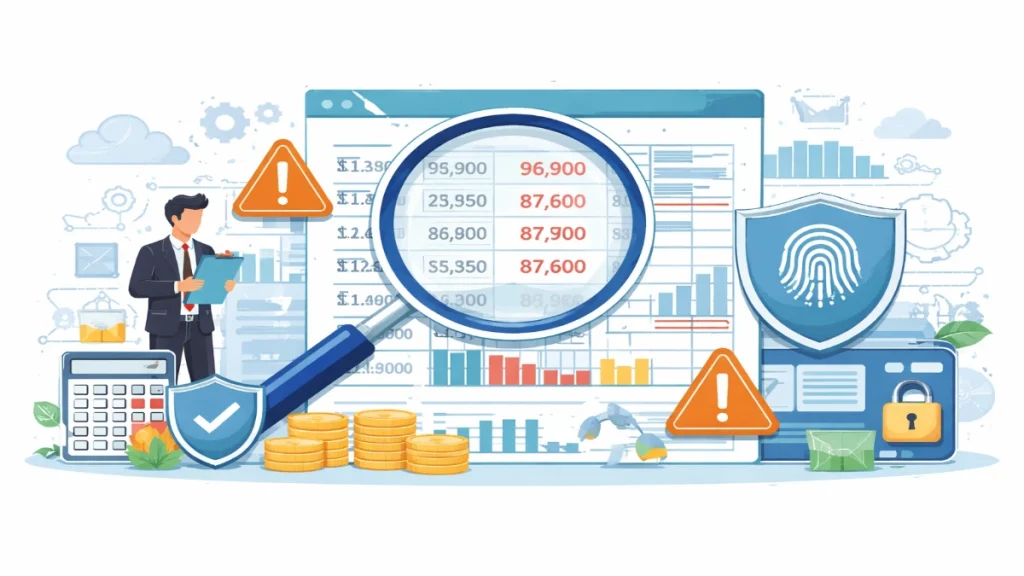
Consider a simple illustration. Filer A reports business expenses of \$12,350, \$21,480, and \$14,100 for various items – leading digits 1 and 2 dominate these numbers. Filer B, trying to maximize deductions, reports \$89,600, \$77,400, and \$93,250 – most with leading digits 7, 8, or 9. Filer A’s numbers don’t raise an eyebrow; they naturally align with Benford’s Law (plenty of 1s and 2s, fewer 9s). Filer B’s data, by contrast, has too many high leading digits to be true. A computer comparing those distributions to Benford’s expected 30% ones, 17% twos, … 5% nines, would quickly flag Filer B for a closer audit[12][14].
Real cases bear this out. In one example from a payroll fraud investigation, auditors noticed an overabundance of transactions just below a review threshold – e.g. lots of payments around \$9,500 or \$9,800, creating an unexpected spike of 9-leading entries[15]. Such clustering was no coincidence: it turned out an employee was issuing phony refunds and keeping them under \$10,000 to avoid approval, but the digits betrayed the scheme[15]. Another famous case involved Wesley Rhodes, a financial advisor. Prosecutors showed that the figures in Rhodes’s investment documents failed Benford’s Law – the digit patterns were too even – strongly suggesting they were fabricated. A jury was convinced, and Rhodes was convicted of fraud, aided by this statistical evidence[16].
It’s important to note that Benford’s Law doesn’t prove fraud; it signals risk. As one fraud examiner put it, it’s a screening tool – a way to compress huge datasets into a simple visual test and say “hmm, something’s fishy here”[13][17]. When the IRS’s algorithms see an anomalous digit distribution, that return gets marked for further investigation, not automatic guilt. But as a triage mechanism, it has been remarkably effective. Tax agencies and accounting firms around the world now use this method to catch cheats who might otherwise slip through. It’s a perfect example of how a little piece of math – a humble logarithm law – can shine a bright light on dishonesty.
Corporate Fraud and Cooked Books
Benford’s Law has also become a go-to weapon in fighting corporate and financial fraud. When companies manipulate earnings, hide debts, or massage their financial statements, the numbers can betray them. One pioneer in this area, accounting professor Mark Nigrini, showed how Benford’s Law could detect accounting anomalies. In the early 2000s, after the infamous wave of accounting scandals (think Enron, WorldCom, etc.), researchers retroactively applied Benford analysis to those companies’ reports. Enron, once a Wall Street darling until its collapse in 2001, is a case in point. Nigrini examined Enron’s financial statements and found significant deviations from the Benford distribution – clear signs of what’s known as earnings management (massaging numbers to meet targets)[18]. For instance, certain digits appeared far more often in Enron’s revenue figures than they should have, indicating that managers were likely rounding or tweaking figures to hit desired results[19][20]. In fact, researchers found an excess of “0” as the second digit in Enron’s reported revenues – a red flag that the company was rounding up numbers to avoid reporting losses[20]. These statistical red flags, combined with other evidence, helped investigators piece together the scope of Enron’s deception.
Today, many auditing software packages include Benford’s Law tests as a standard feature. Auditors can automatically scan thousands of ledger entries and get a quick report: Do the first-digit frequencies look natural? If not, they dig deeper into those transactions. This technique has uncovered fictitious invoices, ghost vendors, and fabricated sales. For example, if a manager is trying to abuse an expense policy that requires receipts over \$50, they might submit a suspicious number of \$49 or \$48 purchases. The dataset of expenses would then have too many entries starting with 4 compared to Benford’s expectation. Such anomalies stand out readily when plotted against the expected curve[21]. One study of German companies even found that those engaging in earnings manipulation had financial statement digits that systematically deviated from Benford’s Law, whereas honest firms did not[22][18]. All of this goes to show that it’s extremely hard for humans to fabricate a large set of numbers without tripping over Benford’s Law. Our intuition for “random-looking” numbers is poor. We tend to put in too many 5s or 8s, or we like round numbers ending in zero. But genuine data, untainted by human bias, has its own rhythm – and the difference is often glaring once you know where to look.
It must be said that crafty fraudsters can sometimes evade this test. A notorious example is Bernie Madoff, who ran a \$65 billion Ponzi scheme for years. Madoff reported eerily consistent investment returns. Interestingly, those returns did roughly follow Benford’s Law on first digits – possibly by luck or because the returns were small percentage changes that didn’t violate the distribution[21]. This shows that Benford’s analysis isn’t foolproof; someone generating fake numbers with knowledge of the law or under certain constraints might slip past it. Nonetheless, such cases are the exception. As a rule, whenever people try to “cook the books,” there’s a good chance the books’ digits won’t smell right mathematically.
Governments Cooking the Books
It’s not just individuals and companies that can fib with figures – governments sometimes do it too, and Benford’s Law has been used to hold them accountable. A dramatic example came to light in the European Union. In the late 1990s and early 2000s, countries aspiring to join the euro common currency had to meet strict financial criteria, including keeping their budget deficits below 3% of GDP. Greece was one such country under pressure. On paper, Greece reported deficits that were high but seemingly under control – around 3.7%. Suspiciously, after Greece adopted the euro, its deficit numbers suddenly worsened. In 2009, a new Greek administration admitted the deficit was actually 12.5% of GDP, not 3.7% as previously claimed[23][24] (subsequent audits put it above 13%). Years before this confession, however, math had sounded the alarm: Benford’s Law flagged Greece’s economic data as likely fraudulent.
Economists Bernhard Rauch and colleagues published a 2011 study examining the quality of EU countries’ macroeconomic data using Benford’s Law[25][26]. They found Greece’s reported figures were farther from the Benford distribution than those of any other EU member[27]. In other words, Greece’s numbers had way too many leading 7s, 8s, and 9s in places one wouldn’t expect them, given how economic indicators usually behave. By contrast, countries like Portugal, Italy, and Spain – often accused of fiscal issues – showed no significant anomalies; their data “passed” the Benford test[27]. Rauch’s study suggested that Greece’s government had been manipulating its deficit and debt numbers to meet the Eurozone entry criteria[28][25]. Indeed, Eurostat (the EU’s statistics agency) later documented “widespread misreporting” by Greece[29]. Had European authorities paid attention to those anomalous digit patterns earlier, they might have caught Greece’s creative accounting before it spiraled into a continental crisis. Politics, of course, can overshadow statistics – even when the stats are screaming. As Tim Harford wryly noted, “one wonders whether politics would have trumped statistics” even if Benford’s Law had raised red flags at the time[30]. Still, the message was clear: when a country’s economic data is “too human” and fails Benford’s Law, it’s time to ask hard questions.
Benford’s Law has since become a tool for international watchdogs. The International Monetary Fund has explored it as a cheap check on data quality from member countries[31][32]. If a nation’s GDP or inflation figures don’t fit the expected digit pattern, it doesn’t prove wrongdoing, but it gives a clue that the data might be “managed.” Researchers have applied this to other cases – for instance, to test if countries were under-reporting COVID-19 cases or deaths during the pandemic. In 2020, analysts compared reported COVID stats from over a hundred countries against Benford’s Law. They found that in some countries, the distribution of daily case numbers severely departed from Benford’s pattern, with far too few low leading digits (or too many high ones) than expected[33]. These inconsistencies suggested possible undercounting or manipulation of the pandemic data. (Some studies flagged around 25–30 countries with significant nonconformity, though others found that certain major countries like China actually did conform to the pattern[34][35]. The debate highlights that one must consider other factors – e.g. testing rates or reporting protocols – but the Benford results at least pointed investigators toward anomalies.)
Suspicious Elections by the Numbers
Elections are another arena where Benford’s Law has been controversially applied. When the official results of an election seem fishy, analysts sometimes turn to digit patterns for hints of fraud such as ballot stuffing or result tampering. A notable instance was the 2009 Iranian presidential election. After incumbent Mahmoud Ahmadinejad was declared the landslide winner amid opposition outcry, statisticians examined the vote counts from districts across Iran. If votes are honestly counted, there’s no particular reason the numbers of votes in each precinct should violate Benford’s Law (especially for second digits or more granular patterns). In Iran’s case, several independent analyses found anomalies. One analysis by University of Michigan professor Walter Mebane showed that the second digits of Ahmadinejad’s vote totals differed significantly from what Benford’s Law would predict – an indication that those numbers might not be organic[36]. Another study noted that one of the opposition candidates, Mehdi Karroubi, received an implausibly high number of vote counts that began with the digit 7 – almost twice as many 7-starting tallies as would be expected by chance[36]. These patterns, combined with other irregularities, suggested systematic manipulation such as ballot box stuffing in certain areas. While Benford’s Law alone couldn’t prove the election was stolen (and indeed some statisticians caution it’s a blunt tool in elections), it added to the forensic evidence of fraud in the eyes of many observers[37]. In elections where detailed data are available, analysts will also look at the distribution of last digits (since fraudsters might fill in vote counts ending in 0 or 5 too often) or other statistical clues. Benford’s Law is just one test – and admittedly a contested one in this domain – but it has been part of the toolbox for election forensics in places ranging from Iran to claims of fraud in Venezuelan and Russian elections, and even analyses of certain U.S. elections[38][36].
It’s worth noting that Benford’s Law can be misapplied to elections, leading to false alarms. A case occurred after the 2020 U.S. presidential election: some armchair analysts claimed fraud because the first-digit distribution of votes in cities like Chicago or Milwaukee didn’t match Benford’s Law. However, experts quickly pointed out the flaw: vote counts at the precinct level usually span a limited range (e.g. a few dozen to a few thousand voters per precinct), which invalidates the assumptions of Benford’s Law[39]. In such bounded datasets, you wouldn’t expect the Benford pattern at all. Mebane himself noted that “precinct vote counts are not useful for trying to diagnose frauds” via first-digit tests[40]. The lesson here is that one must understand when Benford’s Law applies and when it doesn’t. But in the right context, unusual digit patterns in election data can indeed raise red flags — essentially saying “these numbers don’t look like the result of fair counting.”
Science and Social Media: New Frontiers for Benford’s Law
Fraud isn’t limited to finance and elections – even scientific research and online activities have their fabricators, and Benford’s Law has been used to catch them. In 2010, for example, analysts looked at the statistical results reported in a large number of scientific papers. Honest scientific data (say, the coefficients in a bunch of regression analyses across economics papers) should follow Benford’s Law reasonably well on their leading digits[41]. But if a researcher is cherry-picking or outright faking data, the numbers might stray from this pattern. Indeed, one study found that while the first digits of published results conformed to Benford’s Law, a collection of fabricated statistical estimates provided by test subjects did not – particularly in the distribution of second digits[41]. This suggested that even when people tried to invent plausible scientific data, they failed to mimic the subtle second-digit frequencies that real data have. Such analysis has been used to flag suspicious papers in fields from psychology to biology. In one high-profile case, a physicist in Germany, Jan Hendrik Schön, was found to have faked numerous experiments; though his fraud was uncovered by other means, observers later noted that certain numerical patterns in his published graphs looked “too perfect” and likely would have tripped a Benford-style test.
Benford’s Law has even gone digital. An amusing and enlightening application came from social media research. Computer scientist Jennifer Golbeck used Benford’s Law to help expose a network of fake Twitter accounts (a Russian botnet) in 2018[16]. She observed that for most real Twitter users, the number of followers their followers have follows Benford’s distribution (people’s social networks naturally vary in size)[16]. However, the bot accounts showed a weirdly even spread of leading digits in their followers’ counts, signaling that these were not normal user networks but artificially generated ones. In other words, the bots “forgot” to obey Benford’s Law, and that gave them away. It’s a fascinating example of how a law discovered with pencil and paper in the 1930s can help map the authenticity of 21st-century online communities.
Cryptocurrency markets provide yet another stage. With unregulated markets often accused of wash trading or price manipulation, analysts have applied Benford’s Law to crypto transaction data. A recent study examined major cryptocurrencies and found that in healthy, organic trading periods, transaction values and trade counts do follow the expected digit pattern. But during known anomalous events – like abrupt exchange outages or suspected pump-and-dump schemes – the leading-digit frequencies of transactions went out of whack. Tellingly, the researchers reported that “most cryptocurrencies that did not conform to Benford’s law had well-documented anomalous incidents,” whereas all the big coins in normal times did conform[42]. This suggests Benford’s Law can serve as an early warning of weird activity in financial data, be it stocks, commodities, or cutting-edge crypto assets. It won’t tell you exactly what’s wrong, but it points investigators to “check for manipulation here.”
From fake science to fake followers, the principle remains: authentic data has an inherent fingerprint, and fake data often smudges it.
When the Numbers Don’t Fit
While Benford’s Law is a powerful indicator, it’s not a magic truth serum for every scenario. Many legitimate datasets won’t follow Benford’s Law, and many fraudulent datasets might slip through if they’re small or cleverly constrained. For one, the law works best on large, heterogeneous datasets – hundreds or thousands of numbers that span a broad range[43]. If you only have, say, 20 data points or all your numbers are in the same tight range, the frequencies can deviate just by chance or structural reasons. Small sample sizes make the chi-square tests used with Benford’s Law less reliable (the variance is high), so analysts need to be cautious about over-interpreting minor deviations. Additionally, boundaries and human assignment can break the pattern. Telephone numbers, ZIP codes, product codes – these are human-assigned and often designed not to vary freely, so Benford’s Law simply doesn’t apply there. A classic counterexample is that no human height in meters starts with 9 (nobody is 9 meters tall!), so if you recorded heights in meters, you’d see a lot of 1.5, 1.6, 1.7 (leading digit “1”) and essentially zero 9’s[9]. That’s not fraud; it’s a limitation of the data’s range.
Statisticians therefore emphasize context and additional tests. Benford’s Law should be one tool among many. In auditing, for instance, an abnormal digit pattern should be followed by drilling down: Which accounts or entries contribute to it? Are there legitimate reasons (e.g. policy quirks, data entry formats) for the deviation? One must rule out innocent explanations. As a 2025 Thomson Reuters tax bulletin noted, legitimate business events – like a one-time large transaction, or a policy change causing many standardized payouts – can also skew the digit distribution temporarily[43][44]. Analysts are advised to corroborate anomalies with other evidence: check documentation, look for duplicate entries, perform trend analysis, etc.[44]. Benford’s Law is a screening method, not a verdict[13][44].
Conversely, not finding a Benford anomaly doesn’t guarantee honesty. A determined fraudster might know about the law and intentionally doctor their fake numbers to fit the distribution. This is arguably what Bernie Madoff achieved (or got lucky with) in his reported returns[21]. Also, certain frauds don’t involve creating fake numbers at all, but rather omitting transactions or using other tricks that Benford’s analysis might not catch. For example, if someone siphons money by not recording a transaction at all, there’s no “digit pattern” to catch – the data simply isn’t there.
In short, Benford’s Law is a marvelous but imperfect whistleblower. It raises its hand and says “something doesn’t look natural here.” Then investigators have to do the detective work. When used appropriately, it has a solid track record of identifying red flags in tax filings, election returns, company books, and beyond. When used naively or maliciously (as in some 2020 election conspiracy claims), it can mislead the uninformed. Like any statistical test, it must be applied under the right conditions and interpreted with expertise.
Toward an Objective AI for Data Integrity
One intriguing aspect of Benford’s Law is how it embodies objective pattern checking – exactly the kind of thing we increasingly expect artificial intelligence to assist with. In fact, this leading-digit test is just one early example of what we might call “objectivity AI” in the realm of data integrity. The idea is that AI systems can be programmed to automatically vet datasets for signs of manipulation or error by looking for mathematical consistencies (or inconsistencies). Benford’s Law provides a clear rule: if a large dataset of supposedly natural measurements doesn’t follow the logarithmic distribution of leading digits, the AI can raise a flag. It’s not injecting any subjective bias; it’s literally following a law of mathematics. This kind of AI-powered oversight could become increasingly important as we rely on data (and on AI models trained on data) to make decisions.
Imagine a future audit AI that ingests a company’s financial transactions in real time. It could continuously monitor not only first-digit frequencies but also a host of other patterns (e.g. round-number bias, duplicate entries, time-of-entry oddities) to judge the objectivity of the data. If someone in the company starts falsifying records, the AI might detect subtle anomalies – like a drift from Benford’s Law or an unexpected spike in certain digits – and alert human analysts: “Hey, these figures seem statistically unlikely, I’m suspicious of them.” Crucially, the AI can also explain its suspicion in objective terms: “The distribution of leading digits in account X’s entries significantly deviates from the expected pattern for natural data[12].” This is far better than a vague hunch; it’s a concrete, checkable rationale. In the context of Explainable AI, such mathematical checks offer clear reasoning that even non-experts can understand: “8’s and 9’s are appearing too often to be believed.”
We are already seeing steps in this direction. Forensic accountants use software that bakes in Benford’s Law tests[13][17]. Governments and NGOs could similarly employ AI to scan public health data or economic reports for anomalies, bringing more accountability to official figures. In scientific publishing, journals might use automated tools to scan submitted papers’ data for irregular patterns as a plagiarism check for numbers. None of these tools would replace human judgment, but they greatly enhance our ability to objectively sift truth from fabrication in an age of information overload.
“Objectivity AI” might eventually integrate multiple such laws and rules – Benford’s Law for digit distribution, perhaps Zipf’s Law for certain rank-size data, distributional checks (like is that histogram too perfectly smooth?), and so on – to form a robust shield against manipulated data. It’s like having a tireless, dispassionate referee for data that blows the whistle when something breaks the natural rules.
Conclusion: Math is Always Watching
In the 1940s, Allied intelligence faced a puzzle of false information: how many tanks was Germany producing? Traditional spying gave erratic answers, but analysts solved it with statistics. By examining the serial numbers on captured German tanks, they accurately estimated the enemy’s production – a triumph now famous as the German Tank Problem, where math outsmarted deception[45]. Benford’s Law plays a similar role in today’s world: it’s a quiet mathematical watchdog that can see through lies by spotting patterns that don’t fit. From tax evaders to CEOs to politicians, those who fabricate figures might fool other people, but they often can’t fool the fundamental laws of numbers.
Frank Benford probably never imagined his dusty log tables would lead to Greek officials being exposed or fraudsters being hauled to court. His discovery is a reminder that reality has an inherent structure. When data flows honestly from the natural processes of life – economies growing, people spending, rivers flowing – it tends to carry the fingerprint of Benford’s Law. But when that flow is tampered with, the fingerprint smudges. It’s as if the universe has a built-in audit mechanism: violate its numeric norms, and you raise an alarm.
To be sure, no single test can guarantee truth. But the enduring power of Benford’s Law is how often it holds across the vast mosaic of human and natural activity. Eighty-some years after Benford’s paper, “anomalous numbers” are now a key to forensic analytics. Every time a major fraud or scandal breaks – from Enron’s collapse[18] to election controversies – you can bet that investigators are plotting digit frequencies to see if something was off. Many times, those plots speak volumes. They say: this data doesn’t behave like truth.
Perhaps the most profound aspect is this: Math doesn’t take sides. It doesn’t care about politics, profits, or reputations. Benford’s Law is just as strict with a country’s budget report as with a scammer’s invoices. That objectivity is comforting. It means that in an era of misinformation, we have impartial allies in these abstract laws. They quietly uphold a standard of authenticity.
So the next time you encounter a table of numbers – be it financial statements, election returns, or scientific data – remember that a simple pattern might be lurking beneath. If those numbers were concocted by clever fraudsters, they may look convincing at first glance. But under the cold gaze of Benford’s Law, the truth might shine through. In the end, people lie, numbers don’t, and math is always watching[37].
References
Benford (1938); Newcomb (1881); Varian (1972); Nigrini (1996, 2005); Rauch et al. (2011); Mebane (2009); etc. All linked citations via wiki are from reliable academic or professional sources.
[1] [3] [4] [5] [6] [7] [8] [9] [10] [11] [16] [37] What Is Benford’s Law? Why This Unexpected Pattern of Numbers Is Everywhere | Scientific American
[2] [12] [36] [38] [39] [40] [41] Benford’s law – Wikipedia
[13] [14] [15] [17] [43] [44] Benford’s Law Spotlighted as a Practical Early Warning Tool to Help Identify Fraud at PayrollOrg’s Annual Leaders Conference
[18] [19] [20] An Assessment of the Change in the Incidence of Earnings Management Around the Enron-Andersen Episode | Request PDF
[21] [23] [24] [25] [26] [27] [28] [29] [30] Look out for No. 1 | Tim Harford
[22] The Use of Benford’s Law in Accounting
[31] [32] Benford’s Law and Macroeconomic Data Quality; Jesus Gonzalez-Garcia and Gonzalo Pastor; IMF Working Paper 09/10; January 1, 2009
[33] Inconsistencies in countries COVID-19 data revealed by Benford’s law
[34] Benford’s Law and COVID-19 reporting – PMC – PubMed Central
[35] Benford’s Law and COVID-19 reporting – ScienceDirect
[42] Application of Benford’s Law on Cryptocurrencies | MDPI
[45] German tank problem – Wikipedia