There is a question that floats through nearly every online argument about the Israeli-Palestinian conflict, spoken quietly or shouted loudly depending on the platform:
Why does mainstream media seem to favor Israel?
It is a fair question. And it deserves a serious answer.
The problem is that serious answers rarely go viral. Instead, a conspiracy theory fills the void: Jews control the media. The phrase gets repeated so often that it starts to feel like an explanation. It is not. It is a shortcut — one with a long and dangerous history — and it actually prevents people from understanding the real forces shaping what they see on the news.
This essay is about why that matters, and what the real story looks like when you slow down enough to examine it.
The Observation Is Real — The Explanation Is Wrong
Let’s be honest about something first: the feeling that drives people toward the conspiracy theory is not entirely without basis.
Researchers who study media — academics, journalists, and communications scholars — have documented measurable patterns in how Western news outlets cover the Israeli-Palestinian conflict. Headlines about Palestinian casualties are sometimes written more passively than headlines about Israeli casualties. Israeli military operations are frequently described using language like “strikes” or “responses,” while Palestinian violence tends to be labeled “attacks” or “terrorism” more quickly and consistently.
These are not the subjective complaints of one political side. They are documented patterns found across peer-reviewed media studies.
So something real is being noticed.
But here is where things go wrong: noticing a pattern and correctly explaining the pattern are two completely different things. When someone sees uneven media coverage and immediately concludes, “Jewish people must be behind this,” they have skipped over an enormous amount of important thinking. They have traded analysis for accusation.
And that trade-off has consequences.
Why Ethnic Explanations Fall Apart
The “Jews control the media” argument usually works like this: some media company owners or political donors are Jewish, Israel receives favorable media treatment, therefore Jewish people must be using their positions to manipulate coverage.
At first glance, this chain of logic might seem superficially reasonable. But examine it more carefully and it breaks down almost immediately.
The media landscape in Western countries — particularly the United States — is controlled by a small number of massive corporations. These corporations are owned and operated by a wide range of people with vastly different backgrounds, political beliefs, and personal motivations. Some owners are Jewish. Many are not. They often compete with each other, contradict each other, and publicly disagree.
More fundamentally, human beings do not make decisions about which stories to run or how to frame them based primarily on their religious or ethnic identity. They make decisions based on something far more mundane and far more powerful: institutional pressure, economic incentive, political relationships, and career self-interest.
A journalist covering a conflict is not thinking about their ancestry. They are thinking about access to sources, editorial guidelines, what their network’s audience expects, and whether the story will upset an advertiser. A news executive is not thinking about religious solidarity. They are thinking about ratings, government relationships, and quarterly earnings.
Reducing all of that complexity to one ethnic group does not illuminate the problem. It buries it.
The Structural Explanation Is More Honest
To understand why media coverage of Israel often looks different from coverage of other conflicts, the most important word is not Jewish. It is alliance.
Israel has been a core strategic partner of the United States for decades. The two countries share intelligence operations, defense contracts, military technology, and deep diplomatic ties. This relationship has been maintained — with bipartisan support — through multiple presidential administrations and across political shifts.
That kind of alliance matters enormously to how news gets told.
Journalists, especially those covering foreign policy, depend heavily on official government sources. Government briefings, press conferences, and State Department statements shape the baseline language reporters use. When a country is a close ally, the official framing of that country’s actions tends to seep into the broader media narrative.
This is not unique to Israel. American media coverage of Saudi Arabia, South Korea, Japan, or NATO partners follows similar patterns. The political alliance between governments influences the news environment that surrounds those governments.
It is not a secret conspiracy. It is just how political alignment works.
Money Shapes the Story Too
Media organizations are not nonprofits operating purely in the public interest. Most are corporations or subsidiaries of larger conglomerates. And corporations respond to financial pressure.
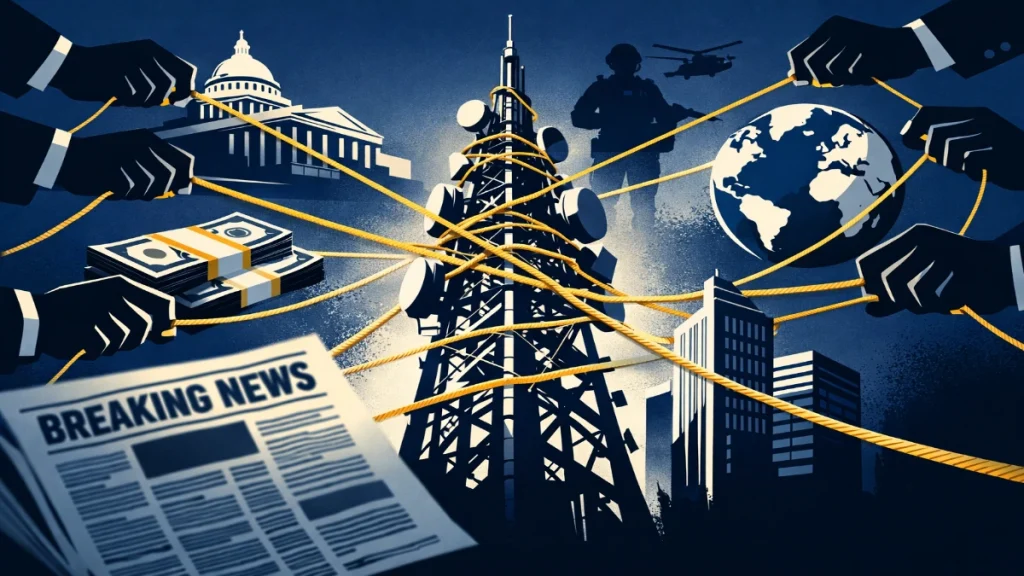
Defense industries, weapons manufacturers, security technology companies, and energy markets all have deep financial stakes in geopolitical stability and instability. Armed conflict — as disturbing as it sounds — generates enormous revenue flows for certain industries. Those industries invest heavily in political access, lobbying, and advertising.
When the economic ecosystem surrounding media is entangled with the defense and security sectors, it creates subtle but real pressure on which narratives are treated as normal, which questions get asked, and which perspectives receive airtime.
None of this requires a secret cabal. It requires only that institutions respond to the incentives that surround them — which they always do.
Political Advocacy Without a Unified Agenda
It would be dishonest to pretend there is no organized political advocacy surrounding U.S. policy on Israel. There absolutely is.
Groups like AIPAC, the American Israel Public Affairs Committee, are among the most well-funded and influential lobbying organizations in American politics. Their power is documented, public, and widely reported on.
But this is where nuance becomes critical.
AIPAC’s donor base is not monolithic. Yes, many supporters are Jewish Americans. But a significant portion of the most passionate pro-Israel advocates in American politics are Christian evangelicals — motivated by theological beliefs about the Holy Land, not by ethnic loyalty. Many others support Israel as a matter of pure geopolitical strategy, viewing it as a Western democratic outpost in an unstable region.
When you look at the full picture of who funds pro-Israel political advocacy in the United States, it does not look like a single ethnic group acting in secret. It looks like a broad, messy coalition of people with different motivations who happen to share a political goal.
Collapsing that complexity into “Jewish control” does not explain the power structure. It falsifies it.
Why the Conspiracy Theory Is So Seductive
If the structural explanation is more accurate, why does the conspiracy theory persist? Why do so many people reach for it?
The honest answer is that complexity is exhausting.
Understanding how media bias actually works requires holding multiple ideas in mind simultaneously: political alliances, economic incentives, institutional pressures, the history of U.S. foreign policy in the Middle East, the diverse motivations of different advocacy groups, and the mechanics of how journalism operates inside corporate structures. That is genuinely difficult to think through.
Blaming one ethnic group is easy. It offers a villain, a story, and a sense of clarity — even if that clarity is entirely manufactured.
Here is the deeper irony: conspiracy theories about Jewish control of media and institutions actually protect the powerful interests that might genuinely deserve scrutiny. When the conversation becomes about antisemitism, the real conversation — about corporate ownership, military alliances, lobbying power, and economic incentives — gets buried. The people who actually benefit from those power structures are left completely unexamined.
The conspiracy theory, in other words, is not a radical critique of power. It is a distraction from one.
What Critical Thinking Actually Looks Like Here
Asking hard questions about media coverage is legitimate and important. So is examining how political donations influence foreign policy. So is analyzing how defense industry money shapes political discourse.
These are conversations worth having. Seriously, rigorously, and honestly.
But those conversations have to be rooted in evidence, institutional analysis, and a genuine willingness to follow the facts wherever they lead — including toward uncomfortable conclusions about how American political and economic power operates.
The moment an analysis reduces power to ethnicity, it has stopped being analysis. It has become mythology. And mythology does not produce understanding. It produces resentment dressed up as insight.
The Takeaway
The real answer to why media bias around Israel exists is complicated. It involves the U.S.-Israel strategic alliance, institutional journalism culture, lobbying power, economic incentives tied to defense industries, and political coalitions built around shared goals rather than shared identities.
None of that requires a conspiracy. It requires the same forces that shape coverage of any country deeply embedded in America’s geopolitical interests.
Understanding that does not mean accepting everything uncritically. It means asking better questions — questions about power, money, and institutions rather than questions that reduce everything to who someone is descended from.
The world is more complicated than any conspiracy theory. That complexity is frustrating. But it is also, ultimately, far more interesting.